Planning a holiday should be exciting, but travelling with a significant allergy can raise an important question:
Will my allergy affect my travel insurance, and could I be asked to provide medical evidence?
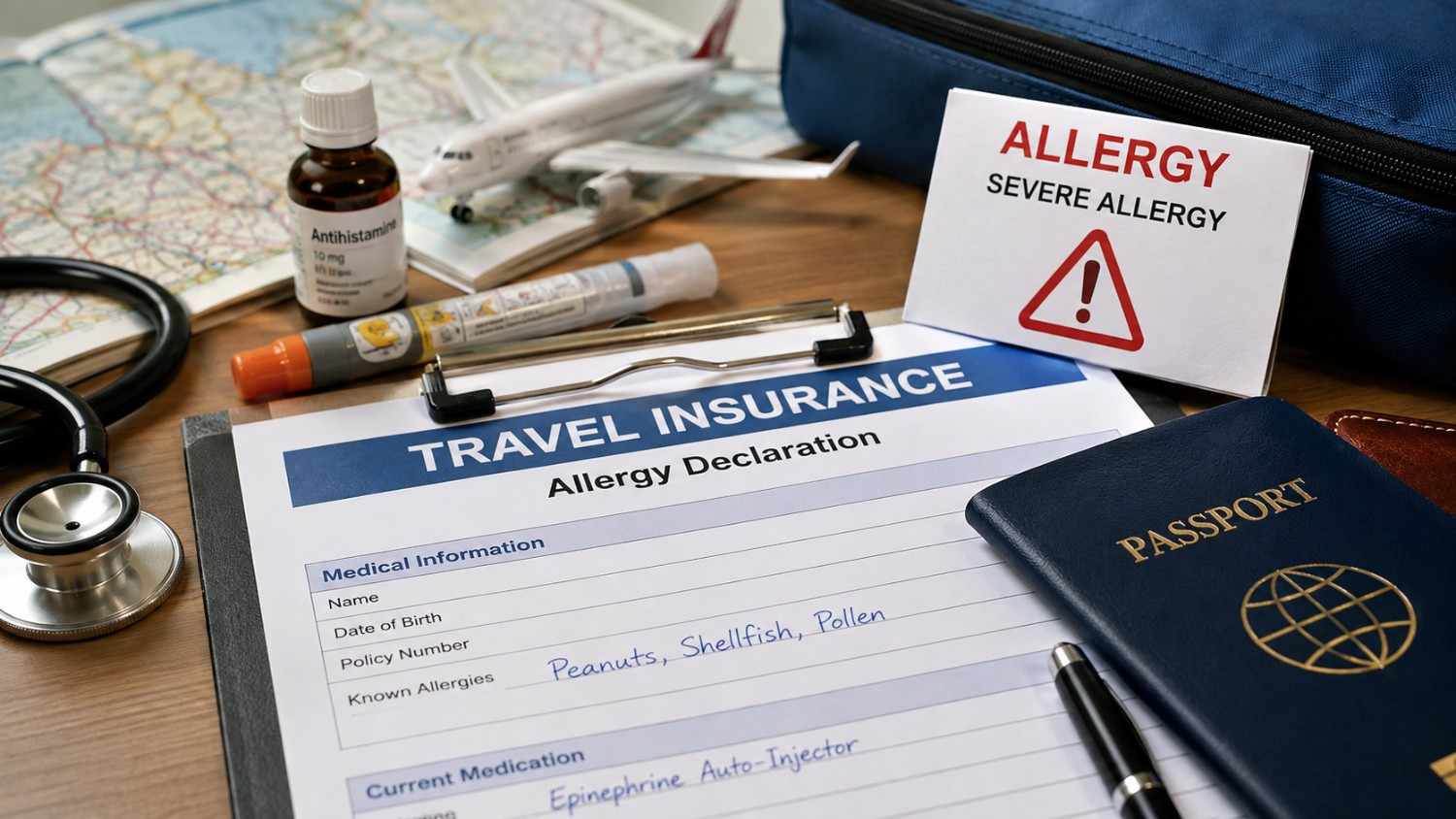
The answer depends on the type of allergy you have, your medical history, the treatment you use and the requirements of the particular insurer.
For some travellers, declaring an allergy may simply be part of the insurer’s medical screening questions. Others may be asked for additional information about previous reactions, medication, treatment or a diagnosis. In more complicated cases, an insurer may want further medical information before deciding what cover it can provide.
Importantly, there is no single medical document that every person with an allergy needs to obtain before buying travel insurance. Insurance companies have their own questions, definitions, underwriting criteria and documentation requirements.
Important: This article provides general information about travel insurance and allergies. Insurance requirements vary between providers and policies. Always check the terms of your policy and answer your insurer’s medical questions accurately.
Can You Get Travel Insurance If You Have an Allergy?
In many cases, having an allergy does not automatically prevent you from obtaining travel insurance.
The important issue is whether the allergy is considered a relevant pre-existing medical condition under the insurer’s rules.
MoneyHelper explains that insurers generally require travellers to declare existing health conditions when obtaining travel insurance. What counts as a pre-existing condition can vary between insurers, and some providers may ask about medical conditions treated or discussed with a doctor within a particular period.
This means you should not make your own assumption that an allergy is “too minor to mention”.
For example, there can be a significant difference between:
- A mild seasonal allergy
- A food allergy requiring strict avoidance
- A medication allergy
- An allergy that has previously caused an emergency
- A severe allergic reaction requiring hospital treatment
- An allergy for which you carry an adrenaline auto-injector
Your insurer may ask different questions depending on your circumstances.
Why Does an Allergy Matter to Travel Insurance?
Travel insurance is based on assessing potential risks.
If a traveller has a medical condition that could potentially require treatment while abroad, the insurer needs enough information to determine whether and how that risk can be covered.
The Association of British Insurers explains that pre-existing medical conditions can affect the likelihood and potential cost of needing medical treatment overseas, which is why insurers take them into account when deciding whether to provide cover and at what price.
An allergy may therefore be relevant because of the possibility of:
- An allergic reaction during the trip
- Emergency medical treatment
- Hospitalisation
- Medication requirements
- Cancellation because of a medical problem
- Changes to travel plans following a serious reaction
That does not mean that everyone with an allergy will pay more for insurance.
The outcome depends on the individual circumstances and the insurer’s assessment.
What Information Might a Travel Insurer Ask About Your Allergy?
When completing a medical screening questionnaire, you may be asked questions about your condition and medical history.
The exact questions vary, but potentially relevant information could include:
The type of allergy
You may need to explain what triggers your allergic reaction.
For example:
- Food
- Medication
- Insect stings
- Pollen
- Animals
- Latex
- Other substances
The severity of previous reactions
An insurer may want to know whether you have experienced symptoms such as:
- Skin reactions
- Swelling
- Breathing difficulties
- Dizziness
- Fainting
- Other serious symptoms
Previous medical treatment
You may be asked whether you have:
- Seen a GP
- Visited an allergy specialist
- Required emergency treatment
- Been admitted to hospital
- Received prescribed medication
Current treatment
You may need to disclose medication or other treatment that you currently use to manage your allergy.
Whether your condition is stable
An insurer may be interested in whether the allergy is well controlled or whether you have experienced recent reactions.
The key principle is simple:
Answer the questions the insurer actually asks, accurately and completely.
The ABI specifically advises travellers to declare pre-existing medical conditions and to speak to their insurer or broker if they are uncertain about what needs to be disclosed.
What Medical Evidence Could You Be Asked to Provide?
There is no universal list that applies to every insurer.
However, depending on your circumstances, an insurer could potentially ask for supporting medical information.
This might include:
1. A GP letter
A GP letter may be relevant if an insurer needs confirmation about your medical history, diagnosis, treatment or current condition.
It could potentially help explain information such as:
- The nature of the allergy
- Previous reactions
- Current treatment
- Whether the condition is stable
- Relevant medical history
However, do not assume that you need a GP letter simply because you have an allergy.
If the insurer has not requested one, you may not need to obtain one.
2. Medical records or clinical information
In some circumstances, an insurer may require additional medical information to assess a pre-existing condition.
The insurer should tell you what information it needs and why.
The important thing is not to provide random medical documents unnecessarily. Instead, find out exactly what the insurer requires.
3. Prescription information
If you take prescribed medication for your allergy, details about your medication may be relevant.
For example, you might need to provide information about:
- The medication name
- Dosage
- How frequently it is used
- Whether it is taken regularly or only during reactions
You should also make sure that you have enough medication for your trip and understand any requirements relating to carrying medicines overseas.
4. Evidence of previous treatment
If you have previously required emergency treatment for an allergic reaction, an insurer may ask questions about what happened.
Depending on the circumstances, medical evidence could help establish:
- When the reaction occurred
- How severe it was
- What treatment was required
- Whether hospital care was necessary
- Whether there have been subsequent reactions
Again, the specific requirement depends on the insurer.
If your travel insurer has asked you to provide medical evidence, the first step is to check exactly what information or documentation they require.
If supporting medical documentation is appropriate for your circumstances, you can get a doctor’s note for travel insurance online after discussing your situation with a healthcare professional. This gives you an opportunity to explain your medical history, treatment and documentation requirements and find out what evidence may be suitable for your insurer.
Do You Need a Doctor’s Note for Travel Insurance?
Not automatically.
This is one of the most important points for travellers with allergies.
A doctor’s note is not a universal requirement for obtaining travel insurance simply because you have an allergy.
Some insurers may be able to assess your situation using their standard medical screening process. Others may ask for additional information if your medical history is more complicated.
For example, further documentation may become relevant if:
- You have experienced a serious allergic reaction
- You have recently required emergency treatment
- Your condition has changed
- You are undergoing investigation
- You have significant medication requirements
- The insurer specifically requests medical evidence
For travellers who need supporting medical documentation for a genuine health-related purpose, DoctorsNotes.co.uk provides medical documentation services that may be relevant depending on the circumstances and documentation required.
The document should always accurately reflect your genuine medical situation.
What If Your Allergy Is Severe?
A severe allergy deserves additional planning before travelling.
For example, some people who are at risk of a serious allergic reaction may carry an adrenaline auto-injector or other emergency medication.
If this applies to you, consider discussing your travel plans with your healthcare professional before departure.
You may need to think about:
- How much medication to take
- How medication should be stored
- Whether you need documentation for carrying medication
- What happens if medication is lost
- Whether your destination has specific requirements
- How you will access medical care abroad
Your travel insurer should also be given the information it requests about your medical condition.
Does Carrying an EpiPen Affect Travel Insurance?
Carrying an adrenaline auto-injector does not automatically mean that you cannot obtain travel insurance.
However, the fact that you have been prescribed emergency allergy medication may be relevant to your medical history.
If the insurer asks about medication, diagnoses or previous allergic reactions, answer accurately.
You should also plan how you will carry your medication while travelling.
For air travel, it is sensible to check the airline’s current rules and any destination-specific requirements before departure.
If you are carrying medication in your hand luggage, having appropriate supporting documentation can sometimes make travel easier, particularly when medication or medical equipment needs to be explained at security.
Your healthcare professional or pharmacist can advise you about your individual medication requirements.
What Happens If You Do Not Declare Your Allergy?
This is an important issue.
It may be tempting to leave out an allergy because you believe it is mild or unlikely to cause problems during your holiday.
However, you should not hide a medical condition from your insurer when the application requires you to disclose it.
MoneyHelper warns that failing to provide accurate information about your medical history can result in a claim being rejected.
The ABI similarly recommends declaring pre-existing medical conditions fully and honestly so that the insurer can assess the appropriate level of cover.
Imagine that you experience a serious allergic reaction abroad and need emergency treatment.
If the insurer later discovers that you failed to disclose relevant medical information during the application, you could potentially face difficulties with your claim.
The safest approach is therefore:
If the insurer asks about it, disclose it accurately.
If you are unsure whether something needs to be declared, ask the insurer rather than guessing.
Could an Allergy Increase the Cost of Travel Insurance?
It can, but there is no automatic rule that every allergy results in a higher premium.
Insurance pricing depends on the individual risk assessment.
Factors may include:
- The type of medical condition
- Previous reactions
- Treatment requirements
- The destination
- Length of the trip
- Age
- Other medical conditions
- The level of cover
- The insurer’s underwriting criteria
The ABI notes that insurers consider pre-existing conditions when deciding whether to offer cover and what price to charge.
This is why comparing policies can be worthwhile.
Do not choose a policy purely because it is the cheapest.
The important question is whether the policy provides the protection you actually need.
What If a Standard Insurer Will Not Cover You?
Do not automatically assume that you cannot travel.
If one insurer cannot provide suitable cover, you can investigate other providers.
MoneyHelper maintains a directory of specialist travel insurance providers for people with medical conditions and explains that specialist insurers may be useful where mainstream providers cannot offer appropriate cover.
The ABI also recommends shopping around and considering specialist providers or insurance brokers where appropriate.
You may also find that changing the type of policy or trip affects the available options.
For example, a single-trip policy may work differently from an annual multi-trip policy.
The destination can matter too, because medical treatment costs vary significantly between countries.
Does the Destination Matter If You Have an Allergy?
Yes.
Where you are travelling can influence the cost and requirements of travel insurance.
A trip to a country where private medical treatment is particularly expensive can involve different insurance considerations from a short European holiday.
The ABI notes that destinations such as the USA or Mexico can affect the price of cover because medical costs may be higher.
You should therefore provide the correct destination and trip details when obtaining a quote.
Do not assume that a policy covering one destination will automatically provide identical terms for another.
What About Food Allergies When Travelling Abroad?
Food allergies can introduce additional practical considerations.
If you have a serious food allergy, you may need to think about:
- Communicating your allergy in another language
- Checking food ingredients
- Restaurant procedures
- Emergency medication
- Access to medical care
- Travel companions knowing what to do during a reaction
From an insurance perspective, your food allergy should be disclosed according to the insurer’s medical screening requirements.
If the insurer asks about previous reactions or treatment, provide accurate information.
Medical documentation may become useful if the insurer requests confirmation of your condition or treatment history.
What Medical Documents Should You Take on Holiday?
The documents you need depend on your individual circumstances.
If you have a significant allergy, consider discussing your travel plans with your healthcare professional before departure.
Depending on your situation, useful information may include:
- A list of prescribed medicines
- Prescription details
- Information about your allergy
- Emergency treatment instructions
- Relevant medical contact information
- Travel insurance policy details
- Emergency insurer contact numbers
- Any documentation specifically requested by your insurer
If you carry emergency medication, make sure you understand how it should be stored and transported.
It is also sensible to keep important information accessible rather than placing everything in checked luggage.
Can a Doctor’s Note Prove That You Have an Allergy?
A medical document can potentially provide information about a diagnosed condition, treatment or medical history, but what constitutes acceptable evidence is determined by the organisation requesting it.
An insurance company may have its own requirements for supporting medical evidence.
For example, it may ask for information directly from your GP or another healthcare professional rather than accepting a generic document.
Therefore, if an insurer says that it needs medical evidence, ask:
“What specific information or document do you require?”
That question can prevent you from obtaining documentation that does not meet the insurer’s requirements.
What If Your Allergy Affects Your Ability to Travel?
A serious allergic condition can sometimes affect travel plans.
For example, you may have recently experienced a severe reaction, be undergoing medical investigation or have another health issue that makes travelling difficult.
If you have been advised by a healthcare professional that you are not fit to travel, you should follow that medical advice.
The ABI notes that travel insurance may not provide cover where a person has been medically advised that they are unfit to travel or that travelling would be unsafe.
This is another reason to understand your policy before travelling.
If you become unwell before your trip, contact your insurer and healthcare professional as appropriate rather than assuming your existing policy will automatically cover cancellation.
Does GHIC Replace Travel Insurance?
No.
If you are travelling in eligible European countries, a valid Global Health Insurance Card (GHIC) may provide access to certain state healthcare arrangements.
However, it is not a replacement for travel insurance.
The ABI explains that neither a GHIC nor an EHIC provides the same protection as travel insurance, including cover for medical repatriation and cancellation.
If you have an allergy or another medical condition, having appropriate travel insurance can therefore be particularly important.
A Pre-Travel Checklist for Travellers With Allergies
Before leaving the UK, consider working through this checklist.
Insurance
- Have I declared my relevant medical conditions?
- Have I answered the insurer’s questions accurately?
- Does my policy cover my declared condition?
- Do I understand any exclusions?
- Do I know the emergency contact number?
Medication
- Do I have enough medication?
- Do I know how it should be stored?
- Do I have the necessary prescription information?
- Have I checked the airline and destination requirements?
Medical information
- Do I know what to do if I experience a reaction?
- Does my travel companion know about my allergy?
- Have I discussed travel with my healthcare professional if necessary?
- Do I have any medical documentation specifically requested by my insurer?
Destination
- Have I checked the healthcare arrangements where I am travelling?
- Do I know where to obtain emergency medical assistance?
- Have I checked relevant travel advice?
Planning these details before departure can make it easier to respond if something unexpected happens.
Frequently Asked Questions
Do I need to tell travel insurance about an allergy?
If your insurer’s medical screening questions require you to disclose the allergy or related medical history, you should do so accurately. Insurers have different definitions and time periods, so check the questions and policy wording carefully.
Can I get travel insurance with a food allergy?
Often, yes. Having a food allergy does not automatically prevent you from obtaining travel insurance. However, you may need to declare it and answer questions about your medical history and previous reactions.
Will I need a GP letter for travel insurance?
Not necessarily. Some insurers may not require additional documentation, while others may request medical information depending on your circumstances. Always ask the insurer what evidence it specifically requires.
Can an allergy make travel insurance more expensive?
It can, depending on the insurer’s assessment of your medical circumstances and the trip. However, having an allergy does not automatically mean that you will pay more.
What if my insurer asks for medical evidence?
Ask exactly what information it needs. The insurer may specify the type of document, the healthcare professional who needs to provide it or the particular medical information that must be confirmed.
Can I travel with an EpiPen?
Many travellers who require adrenaline auto-injectors travel with them, but you should check current airline and destination requirements before departure and carry appropriate medical information where necessary.
What happens if I do not declare my allergy?
If the insurer required you to disclose the condition and you failed to do so, you could face problems if you later make a claim connected with that condition. MoneyHelper advises travellers to provide accurate medical information when purchasing travel insurance.
Is a GHIC enough if I have an allergy?
No. A GHIC is not a substitute for travel insurance. It does not provide the full range of protection offered by travel insurance, including medical repatriation.
Final Thoughts
Having an allergy should not automatically mean putting your holiday plans on hold.
For many travellers, the most important step is simply understanding what their travel insurer needs to know.
Declare relevant medical conditions honestly, answer the medical screening questions carefully and check the policy’s exclusions before travelling. If your allergy is significant or has previously required emergency treatment, make sure you understand how it could affect your cover.
Medical evidence may sometimes be requested, particularly where an insurer needs more information about a diagnosis, previous reaction or treatment. But there is no universal requirement for every traveller with an allergy to obtain a doctor’s note.
If documentation is requested, find out exactly what the insurer needs before obtaining it.
And if you need medical documentation for a genuine health-related reason, make sure it accurately reflects your medical circumstances and comes from an appropriate medical source.
Ultimately, good preparation is about more than packing your suitcase.
Know your allergy. Know your medication. Know your insurance. And know what your policy actually covers before you leave home.

Dr. Anuj provides convenient online medical consultations for patients across the UK, making it easier to speak with a doctor without the need for an in-person visit.
Through secure online consultations, Dr. Anuj can assess your symptoms, discuss your concerns, and provide appropriate medical guidance. Where medically appropriate and legally permitted, a doctor’s note or medical documentation may also be provided following the consultation.