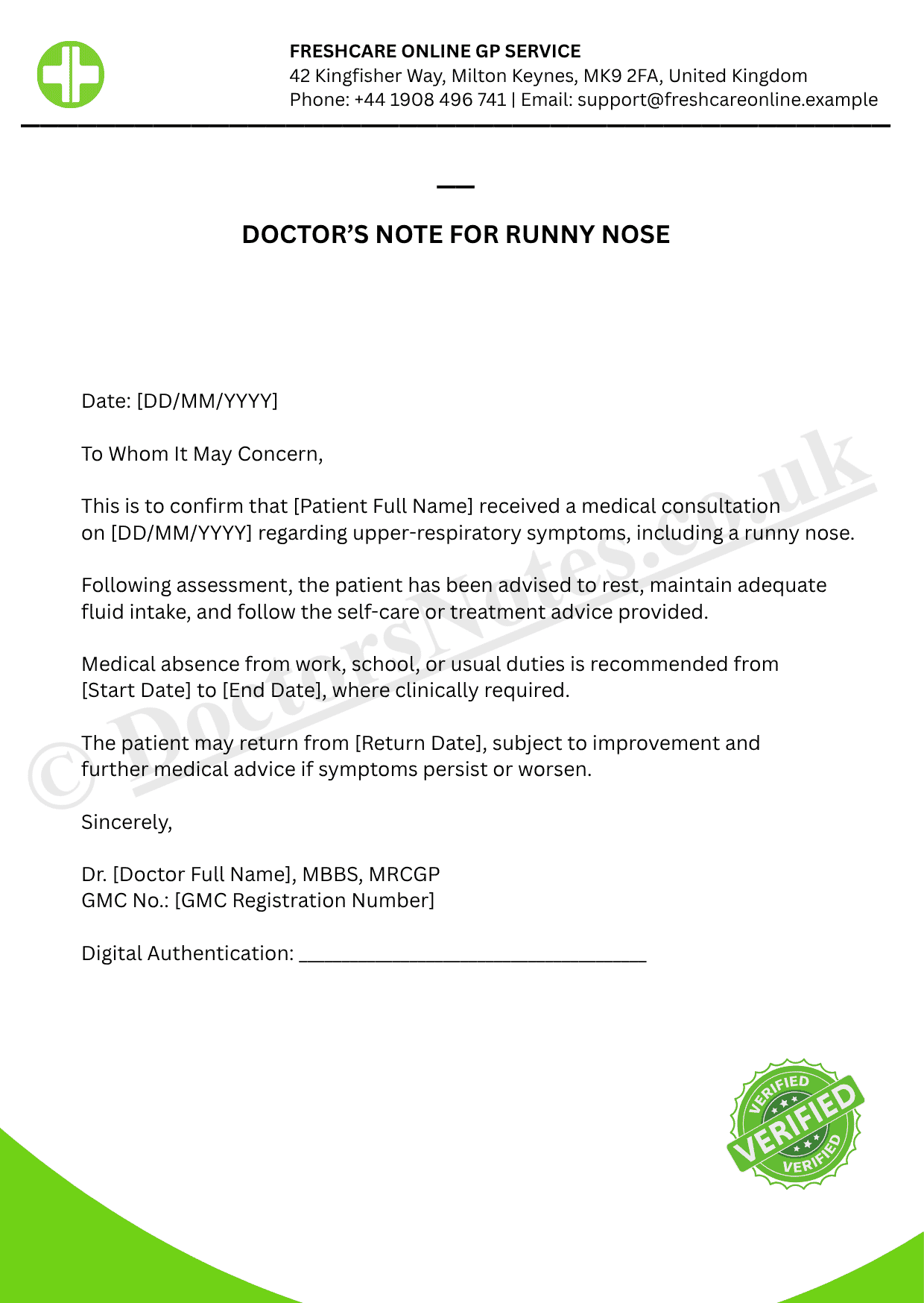


A runny nose can seem minor, but it can become difficult to manage during a full working day. Frequent sneezing, nasal discharge, congestion, headaches, tiredness, or other symptoms may affect your normal duties. If your symptoms are affecting your ability to work, a doctor’s note for runny nose may be considered after an appropriate healthcare assessment.
Runny Nose and Work
| Question | Answer |
|---|---|
| Can a runny nose affect work? | Yes, especially when symptoms are frequent or occur with other illness. |
| Is a runny nose always a cold? | No. Allergies, rhinitis and other conditions can also cause it. |
| Can you get a doctor’s note for a runny nose? | Medical documentation depends on your individual assessment. |
| Can you work with a runny nose? | It depends on your symptoms and the demands of your job. |
| Can an online assessment help? | It may be suitable when your symptoms can be assessed remotely. |
| Do you always need a fit note? | No. Employees can generally self-certify for the first 7 calendar days of sickness. |
What Is a Runny Nose?
A runny nose happens when excess fluid or mucus comes from the nose.
It can occur on its own or alongside other symptoms.
Common accompanying symptoms include:
- Sneezing.
- Blocked nose.
- Sore throat.
- Cough.
- Headache.
- Tiredness.
- Feeling generally unwell.
- Reduced sense of smell.
A common cold often causes a runny or blocked nose and usually improves within 1 to 2 weeks.
What Can Cause a Runny Nose?
A runny nose has several possible causes.
| Possible cause | Other symptoms or features |
|---|---|
| Common cold | Sneezing, sore throat, cough |
| Flu | Fever, aches and stronger fatigue |
| Allergic rhinitis | Sneezing, itchy eyes and nose |
| Non-allergic rhinitis | Nasal symptoms triggered by irritants or environmental factors |
| Sinus problems | Facial pressure, blocked nose or reduced smell |
| Environmental irritation | Symptoms after exposure to smoke, dust or strong smells |
| Other infections | Runny nose alongside other respiratory symptoms |
The cause cannot always be identified from a runny nose alone.
Can You Get a Doctor’s Note for a Runny Nose Through Telehealth?
Yes, you may be able to get a doctor’s note for a runny nose through telehealth. A healthcare provider can assess your symptoms, including congestion, sneezing, coughing, or fever, during an online consultation.
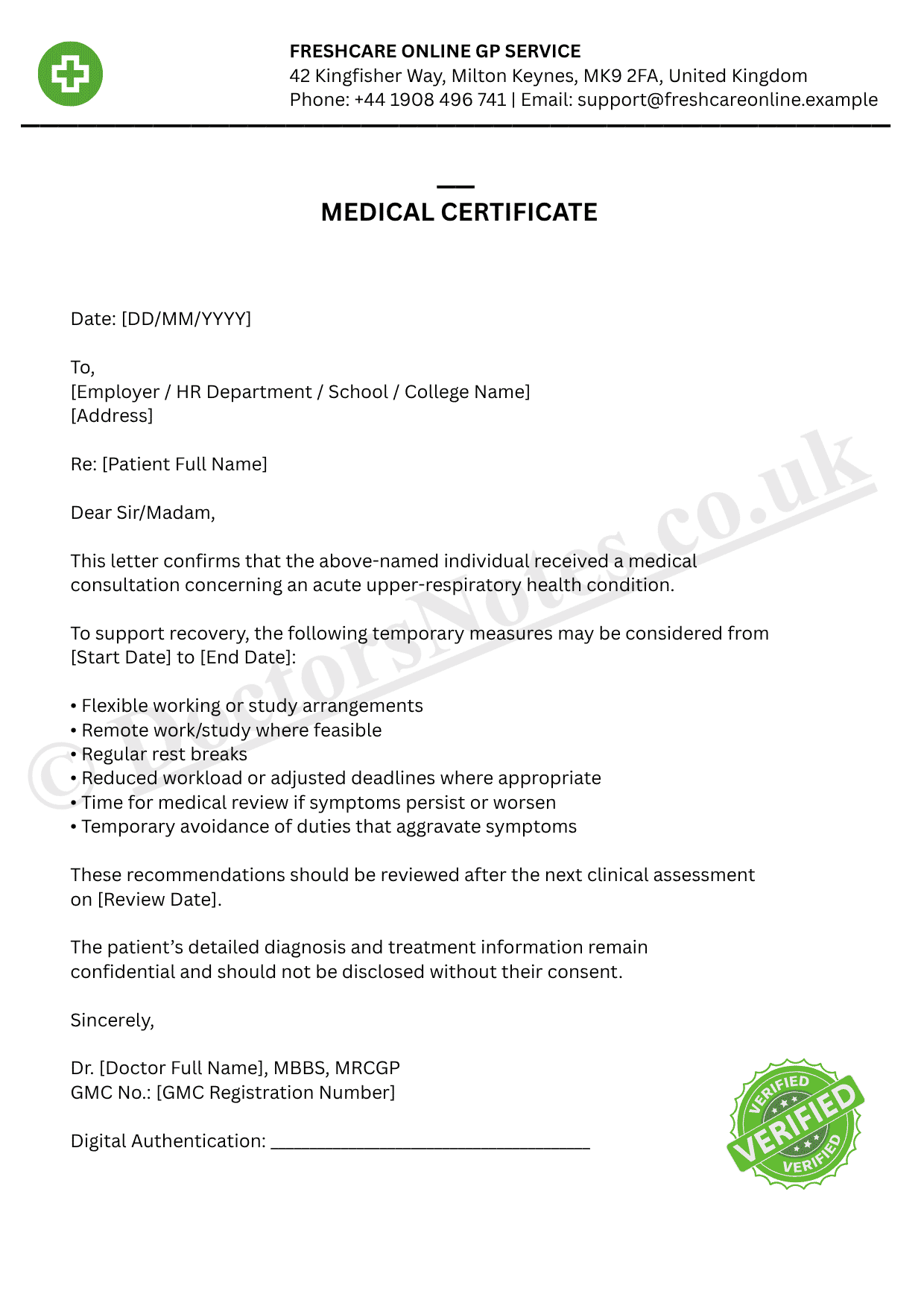
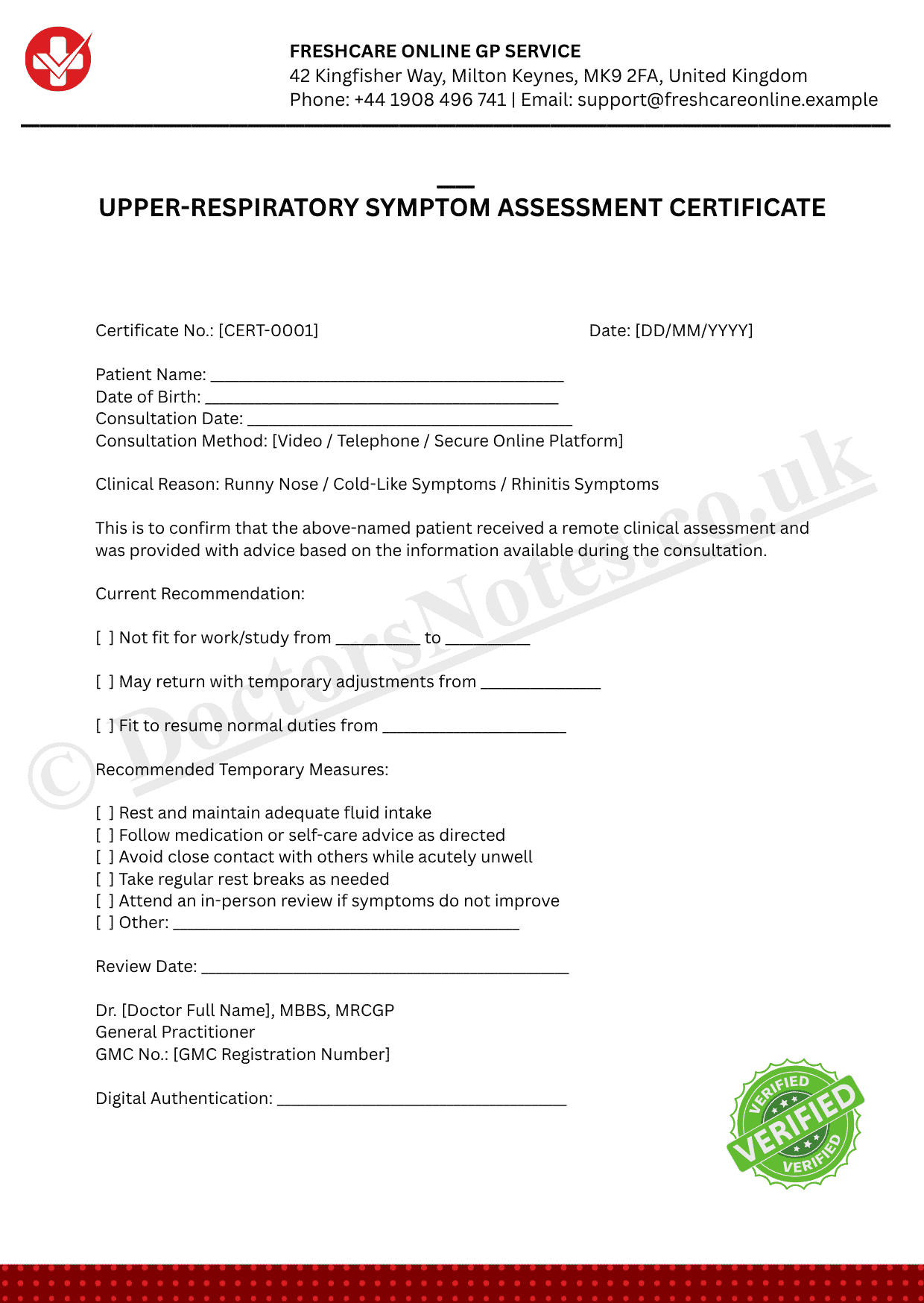
If medically appropriate, the doctor may recommend time off work or school, rest, or temporary work adjustments. The note can document the recommended absence period and any necessary restrictions.
Whether a note can be issued depends on the provider’s assessment and your workplace or school requirements. Seek medical advice if symptoms persist or worsen, and get urgent care for difficulty breathing.
Can a Runny Nose Stop You Working?
Not usually by itself.
However, the overall illness may affect your ability to work.
You may struggle when you have:
- Constant nasal discharge.
- Repeated sneezing.
- Severe congestion.
- Headaches.
- Fever.
- Significant fatigue.
- A persistent cough.
- Poor sleep.
- Difficulty concentrating.
The effect also depends on your job.
Someone working from home may manage symptoms more easily than someone working with customers, patients, children, or food.
Doctor’s Note for Runny Nose for Work
If your symptoms are affecting your work, describe the practical problem rather than simply saying that you have a runny nose.
For example:
“I have frequent sneezing and nasal discharge, along with fatigue, and I am struggling to complete my normal duties.”
The healthcare professional can then consider how your health affects your fitness for work.
A fit note is based on the impact of your health on what you can do at work.
Can You Work With a Runny Nose?
Sometimes.
A mild runny nose does not necessarily prevent normal activities.
However, staying at work may become difficult if you also feel significantly unwell.
Consider the full picture:
- Are you able to concentrate?
- Can you complete your normal duties?
- Do you have a fever?
- Are you extremely tired?
- Are you coughing or sneezing frequently?
- Do you need regular medication?
- Does your workplace involve close contact with others?
- Can you safely perform your normal tasks?
Your symptoms and working environment both matter.
Runny Nose and Customer-Facing Work
A runny nose can be especially inconvenient when your role involves regular contact with other people.
This includes:
- Retail staff.
- Receptionists.
- Hospitality workers.
- Teachers.
- Care workers.
- Healthcare workers.
- Call-centre employees.
- Personal service workers.
Frequent sneezing, coughing, or feeling unwell can make normal customer interaction harder.
If you have an infectious illness, you should also follow relevant workplace and public-health advice.
Runny Nose and Food-Handling Work
Food-handling roles can involve additional workplace hygiene requirements.
If your runny nose occurs with vomiting, diarrhoea, fever, or another suspected infectious illness, follow your employer’s sickness and hygiene procedures.
Do not assume that a doctor’s note determines whether you are permitted to handle food. Workplace rules and public-health requirements may also apply.
Runny Nose and Working From Home
Working from home may be easier when your symptoms are mild but uncomfortable.
For example, you may be able to:
- Rest between tasks.
- Keep tissues nearby.
- Adjust your environment.
- Take suitable breaks.
- Avoid commuting.
- Reduce close contact with colleagues.
However, working from home does not mean you must work when you are too unwell to do so.
Your ability to work should still be considered based on your health.
Can Allergies Cause a Runny Nose?
Yes.
Allergic rhinitis can cause symptoms such as:
- Sneezing.
- Runny nose.
- Blocked nose.
- Itchy nose.
- Itchy or watery eyes.
Allergy-related symptoms can also affect concentration and sleep.
If your symptoms keep returning, explain the pattern during your assessment.
Runny Nose From a Cold
A common cold usually develops gradually.
You may notice:
- Sneezing.
- Runny or blocked nose.
- Sore throat.
- Cough.
- Feeling tired or unwell.
Most people begin to feel better within 1 to 2 weeks.
If symptoms are unusually severe, persistent, or worsening, seek appropriate medical advice.
Runny Nose With Flu-Like Symptoms
A runny nose can occur with respiratory infections.
However, flu tends to cause more severe illness than a typical cold.
You may also experience:
- High temperature.
- Muscle aches.
- Strong fatigue.
- Headache.
- Cough.
- Feeling too unwell for normal activities.
If you feel significantly unwell, consider medical advice rather than focusing only on obtaining workplace documentation.
Can You Get an Online Doctor’s Note for a Runny Nose?
An online assessment may be suitable when your symptoms can be assessed remotely.
During the consultation, you may need to explain:
- How long you have had symptoms.
- Whether they are getting better or worse.
- Whether you have a fever.
- Whether you have a cough or sore throat.
- Whether you have breathing problems.
- Whether you have allergies.
- How your symptoms affect your work.
The healthcare professional decides whether remote assessment is appropriate.
How Does an Online Runny Nose Assessment Work?
1. Describe your symptoms
Explain what you are experiencing and when it started.
2. Explain the pattern
Mention whether symptoms are constant, intermittent, seasonal, or linked to a particular environment.
3. Mention additional symptoms
Tell the healthcare professional about fever, cough, sore throat, headaches, fatigue, or other symptoms.
4. Explain your work
Describe the tasks you normally perform and anything you can no longer manage comfortably.
5. Discuss your fitness for work
The healthcare professional can assess how the illness affects your ability to work.
6. Discuss documentation
If clinically appropriate, they can consider whether a fit note or other medical evidence is suitable.
What Should You Tell the Healthcare Professional?
Use this checklist before your consultation.
Symptom checklist
☐ When the runny nose started
☐ Whether it is getting better or worse
☐ Whether the discharge is continuous
☐ Sneezing frequency
☐ Nasal blockage
☐ Sore throat
☐ Cough
☐ Headache
☐ Fever
☐ Fatigue
☐ Allergy symptoms
☐ Breathing symptoms
☐ Recent exposure to someone who was ill
☐ Current medication
☐ Previous similar episodes
Work checklist
☐ Your normal working hours
☐ Main duties
☐ Customer or patient contact
☐ Food-handling responsibilities
☐ Outdoor work
☐ Physical tasks
☐ Driving requirements
☐ Screen-based work
☐ Whether working from home is possible
Does a Runny Nose Mean You Need a Sick Note?
Not automatically.
In the UK, employees can generally self-certify sickness for the first 7 calendar days. A fit note may be required when sickness lasts longer than 7 days.
Your employer may also have its own sickness-reporting process.
Therefore, check your workplace policy before arranging medical documentation for a short absence.
Sick Note vs Fit Note for a Runny Nose
“Sick note” is a common everyday term.
The formal UK document is a fit note, also known as a Statement of Fitness for Work.
A healthcare professional may assess you as:
- Fit for work
- May be fit for work
- Not fit for work
The assessment considers your ability to perform work rather than simply confirming that you have symptoms.
Could a Fit Note Recommend Work Adjustments?
Yes.
If you are assessed as may be fit for work, possible adaptations can include:
- Altered hours.
- Amended duties.
- A phased return.
- Workplace adaptations.
- Working from home where appropriate.
These recommendations help you and your employer discuss practical options. They are not automatically binding.
For a runny nose, the relevant adjustment depends on the wider illness and the work involved.
Who Can Issue a Fit Note?
Eligible healthcare professionals include:
- Doctors.
- Nurses.
- Occupational therapists.
- Pharmacists.
- Physiotherapists.
The professional must carry out an appropriate assessment before issuing a fit note.
How Long Can a Runny Nose Fit Note Last?
There is no standard duration for every case.
The period depends on your health and clinical assessment.
During the first six months of a condition, a fit note can normally cover a maximum of three months at a time.
A review may be appropriate if your symptoms continue.
Can a Runny Nose Doctor’s Note Be Backdated?
It may be possible in certain circumstances.
A healthcare professional can consider whether your condition affected your fitness for work during an earlier period.
However, backdating is a clinical decision. It should never be assumed or guaranteed.
When Should You Seek Medical Advice?
A simple runny nose often improves without medical treatment.
However, seek medical advice if:
- Symptoms are unusually severe.
- Symptoms keep getting worse.
- You remain significantly unwell.
- Symptoms last longer than expected.
- You develop breathing difficulties.
- You develop chest pain.
- You have another concerning symptom.
- You have an underlying health condition that makes respiratory illness more concerning.
Urgent symptoms should take priority over obtaining a doctor’s note.
Runny Nose and Breathing Problems
A runny nose is different from difficulty breathing.
If you develop significant breathlessness, severe breathing difficulty, or chest pain, seek urgent medical attention rather than relying on an online documentation service.
What If Your Employer Wants Medical Evidence?
Ask what type of evidence your employer accepts.
A fit note is one form of medical evidence. Employers may have specific procedures for reporting sickness and requesting documentation.
If a fit note states that you may be fit for work, you and your employer can discuss possible changes that could help you remain at work or return to work.
Can a Runny Nose Affect Concentration?
It can, particularly when it occurs alongside:
- Poor sleep.
- Headaches.
- Fatigue.
- Frequent sneezing.
- Nasal congestion.
- A wider infection.
If concentration is affected, explain how this changes your normal work performance.
Why Choose an Online Assessment for Runny Nose?
An online assessment can be convenient when your symptoms are suitable for remote care.
You can explain:
- Your symptoms.
- Your work environment.
- Your daily limitations.
- Your sickness absence.
- Any documentation requirements.
If the healthcare professional believes you need an examination or further investigation, they may recommend in-person care instead.
Can a Doctor’s Note for Runny Nose Be Guaranteed?
No.
A healthcare professional needs to assess your circumstances before deciding whether medical documentation is appropriate.
The outcome should reflect your actual health and fitness for work.
Prepare for Your Runny Nose Assessment
Before starting your consultation, keep these details ready:
Symptoms:
When they started, how severe they are, and whether they are changing.
Other symptoms:
Fever, cough, sore throat, headache, fatigue, congestion, or breathing problems.
Possible cause:
Cold, allergies, environmental irritation, or another suspected cause.
Work:
Your duties, working environment, contact with others, and any tasks affected.
Documentation:
What your employer has requested and how long you have been absent.
FAQs
Can you get a doctor’s note for a runny nose?
You may receive medical documentation if a healthcare professional assesses that your symptoms affect your fitness for work.
Can I get a doctor’s note for runny nose for work?
Yes, this can be considered when your symptoms have a meaningful effect on your ability to perform your job.
Can you get an online doctor’s note for a runny nose?
An online assessment may be suitable for some cases. The healthcare professional decides whether remote assessment is appropriate.
Can a runny nose make you too ill to work?
A runny nose alone may not prevent work, but the underlying illness and other symptoms can affect your ability to work.
Is a runny nose always caused by a cold?
No. Allergies, rhinitis, environmental irritation, and other conditions can cause a runny nose.
Can allergies cause a runny nose?
Yes. Allergic rhinitis commonly causes sneezing and a runny or blocked nose.
How long does a cold-related runny nose last?
A common cold usually improves within about 1 to 2 weeks.
Do I need a sick note for a runny nose?
Not necessarily. For sickness lasting 7 calendar days or less, employees can generally self-certify.
What is the difference between a sick note and a fit note?
“Sick note” is a common term. The formal UK document is a fit note, which assesses fitness for work.
Can a fit note recommend working from home?
Working from home can be considered as a workplace adaptation where appropriate.
Can a fit note recommend reduced hours?
Yes. Altered hours can be considered when a healthcare professional believes they may help you remain in or return to work.
Can a runny nose fit note be backdated?
It may be possible following a healthcare professional’s assessment, but backdating is not guaranteed.
Who can issue a fit note for a runny nose?
Doctors, nurses, occupational therapists, pharmacists, and physiotherapists can certify fit notes when appropriate.
Can a runny nose doctor’s note be guaranteed?
No. Medical documentation depends on the outcome of an appropriate healthcare assessment.
What if my runny nose comes with breathing problems?
Breathing difficulties require medical attention. Do not delay urgent care while seeking workplace documentation.
Can I work from home with a runny nose?
You may be able to if your symptoms are mild enough and your role allows it. Your overall health should still guide whether you work.
What should I tell the healthcare professional?
Explain when your symptoms started, other symptoms you have, possible triggers, and how the illness affects your normal work.
Get Medical Documentation for Runny Nose
A runny nose can be a small symptom of a short-term illness or part of a wider health problem. What matters for work is how the overall illness affects your ability to perform your normal duties.
If your symptoms are interfering with work and you need medical documentation, an online assessment can give you an opportunity to discuss your situation with a healthcare professional.
Explain your symptoms, work requirements, and documentation needs during your assessment.


Reviews
There are no reviews yet.