

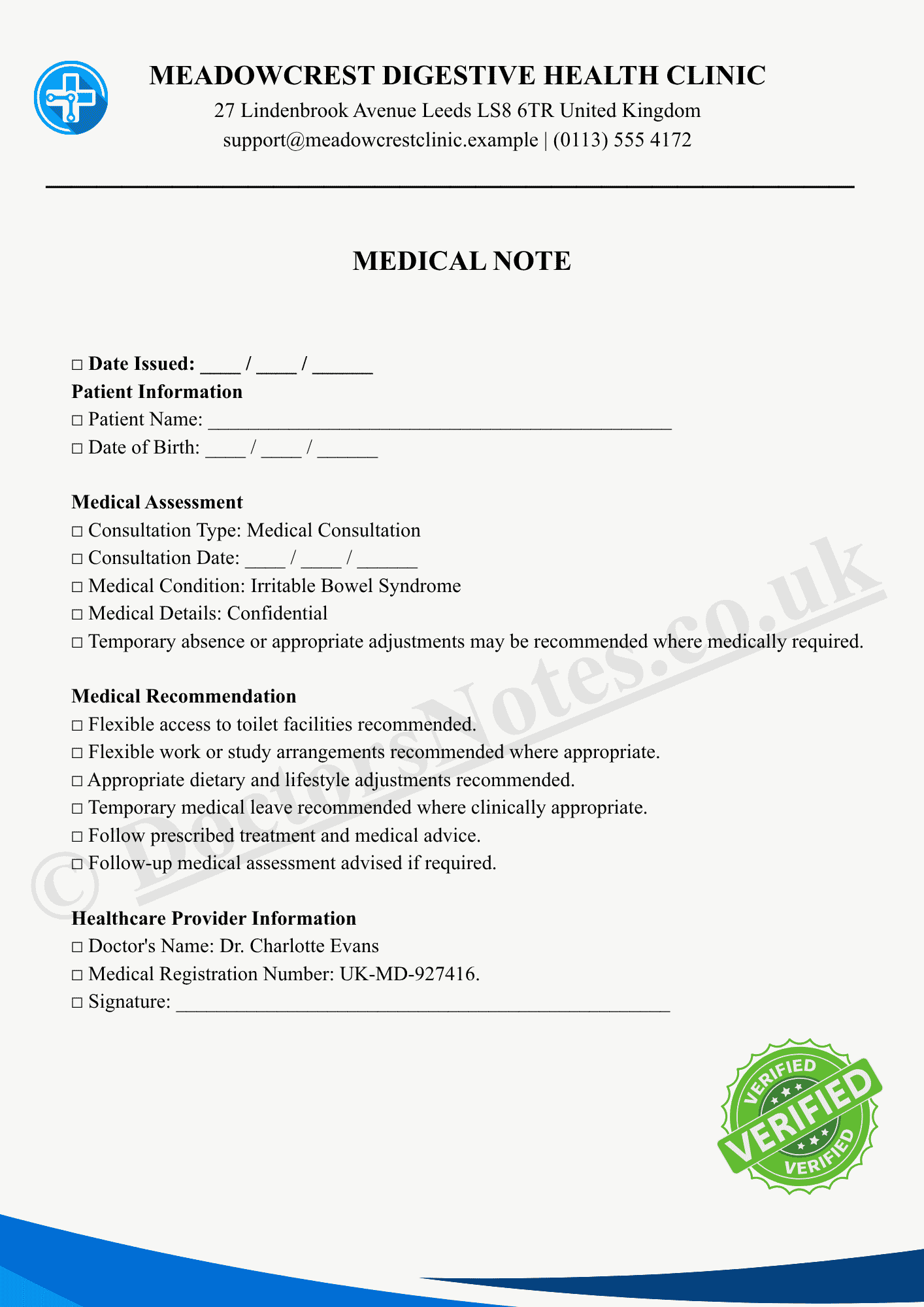
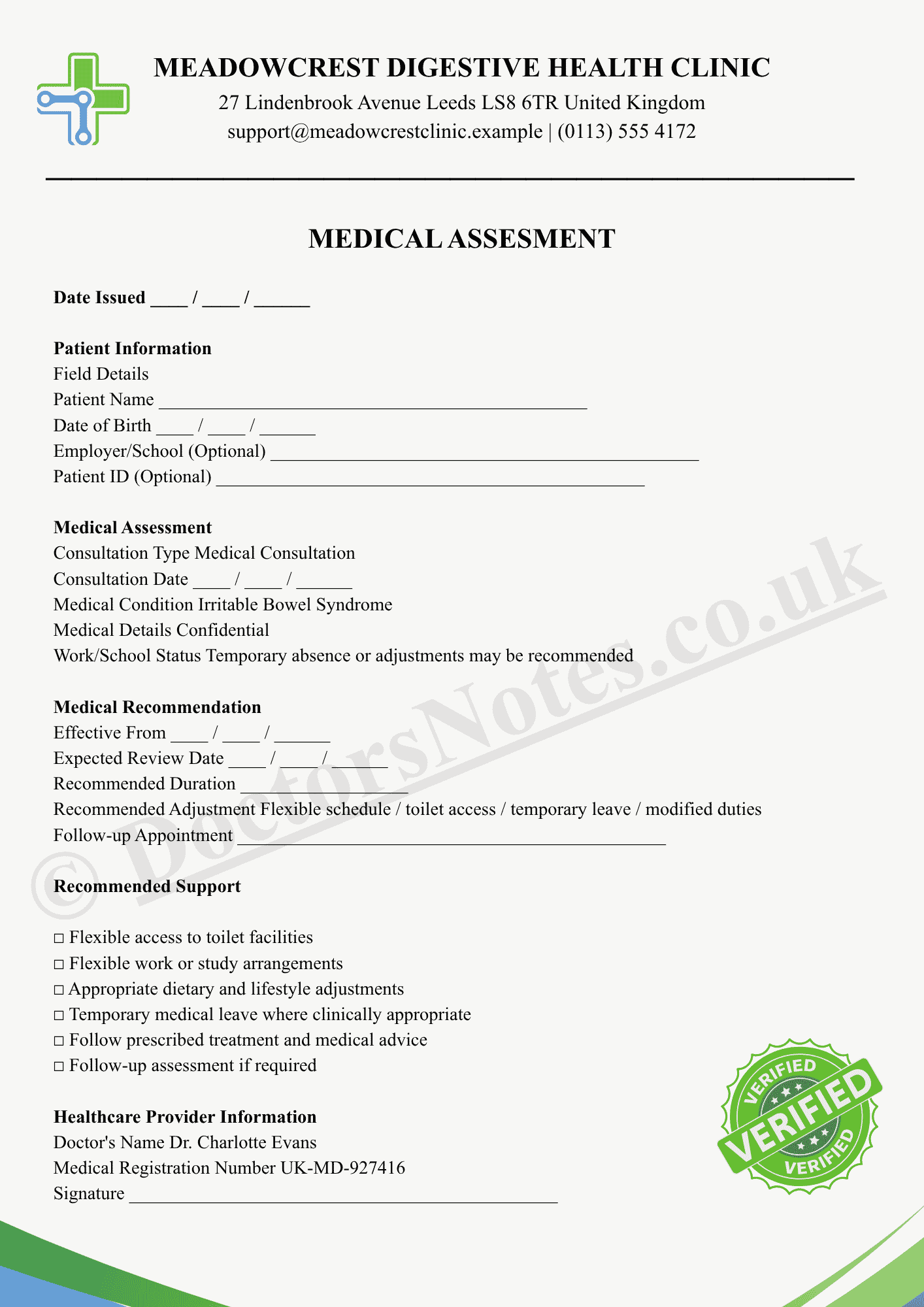
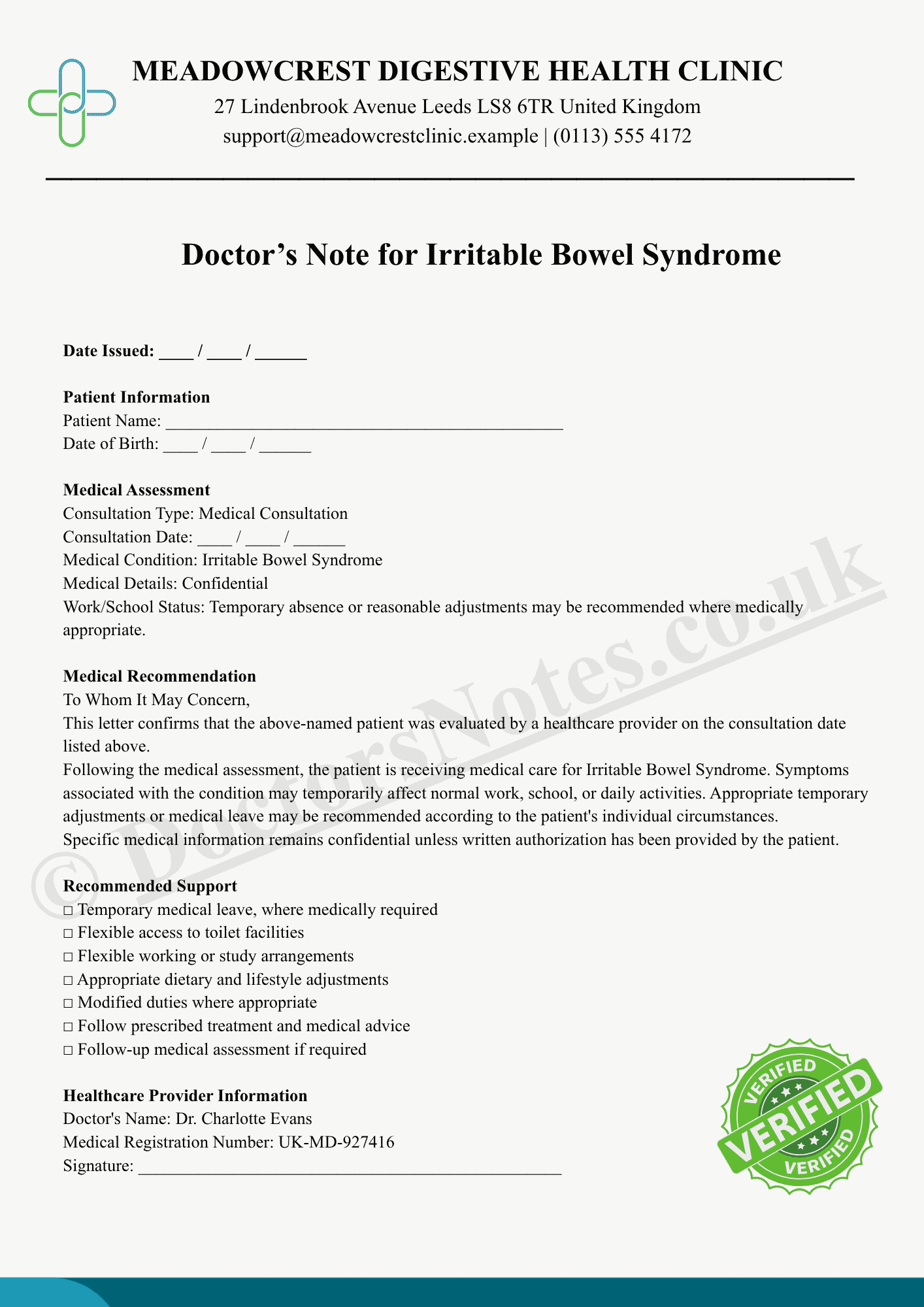


A doctor’s note for irritable bowel syndrome may be needed when IBS symptoms interfere with your ability to work, attend classes, travel, or manage your normal responsibilities. Abdominal pain, bowel urgency, diarrhoea, constipation and bloating can be unpredictable, particularly during an IBS flare-up.
If you are experiencing a medically recognised IBS problem and need documentation relating to your absence or fitness for work, an online healthcare assessment can provide a convenient way to discuss your circumstances where remote assessment is appropriate.
Discuss your IBS symptoms and documentation requirements with a healthcare professional online.
IBS and Work: Why Medical Documentation May Become Necessary
Irritable bowel syndrome does not affect everyone in the same way.
For some people, symptoms are manageable during an ordinary working day. For others, a flare-up can make commuting, remaining at a workstation, attending meetings or working without immediate toilet access extremely difficult.
A request for medical documentation may arise when:
- IBS symptoms have caused an absence.
- A flare-up is preventing normal duties.
- Frequent bowel movements are disrupting work.
- Abdominal pain is making concentration difficult.
- Your role involves long journeys or limited toilet access.
- You need temporary changes to your duties.
- Your employer requests evidence for an extended absence.
- You need information relating to your fitness for work.
The important consideration is how IBS is affecting your particular circumstances, rather than simply whether you have an IBS diagnosis.
Irritable Bowel Syndrome: A Concise Definition
Irritable bowel syndrome (IBS) is a long-term digestive condition associated with symptoms such as abdominal pain and changes in bowel habits.
IBS can involve different patterns, including:
| IBS pattern | Common bowel changes |
|---|---|
| IBS with diarrhoea | Loose or frequent stools |
| IBS with constipation | Difficult or infrequent bowel movements |
| Mixed IBS | Diarrhoea and constipation occurring at different times |
Bloating, abdominal discomfort and urgency can also occur.
Symptoms often fluctuate. A person may therefore have periods when IBS has little effect on daily life followed by episodes that significantly disrupt their routine.
When IBS Symptoms Become a Work Problem
The practical impact of IBS can be greater than the symptoms themselves.
Imagine having an important meeting while experiencing sudden bowel urgency. Or having to drive for two hours without knowing whether a toilet will be available.
Situations that may become difficult include:
- Long commutes
- Public transport journeys
- Customer-facing shifts
- Classroom teaching
- Extended meetings
- Driving
- Outdoor work
- Factory or warehouse work
- Events and hospitality
- Jobs with fixed break times
This is why your working environment and responsibilities are relevant when discussing a doctor’s note or fit note.
Doctor’s Note for IBS: What Does It Actually Cover?
A medical document is not simply confirmation that someone has IBS.
Depending on the assessment and type of documentation required, it may relate to matters such as:
- A period when you were unable to work
- Your fitness for work
- A possible return-to-work period
- Temporary restrictions
- Potential workplace adjustments
- The effect of your health condition on normal duties
The exact content depends on the healthcare assessment and the purpose of the documentation.
Important distinction
A diagnosis of IBS and a statement about fitness for work are two different things.
Someone can have IBS and remain fully capable of working. Another person may temporarily struggle because of a particularly disruptive flare-up.
IBS Flare-Ups and Absence From Work
IBS symptoms can change from one day to another.
During a more difficult episode, you might experience:
- Repeated bowel movements
- Sudden urgency
- Abdominal cramps
- Bloating
- Constipation
- Diarrhoea
- Discomfort after eating
- Difficulty staying away from a toilet
- Reduced ability to concentrate
If these symptoms prevent you from carrying out your normal duties, explain the actual effect rather than simply stating that you have “bad IBS”.
For example:
“My symptoms are causing repeated urgent bowel movements and I cannot reliably remain away from toilet facilities during my normal shift.”
Specific information gives a healthcare professional a clearer picture of your situation.
Online IBS Assessment: Is It Appropriate?
Remote healthcare can be useful for some people with an established IBS history, particularly when the purpose of the consultation is to discuss current symptoms, work limitations or documentation.
However, an online consultation is not automatically suitable for every digestive complaint.
An online assessment may be more appropriate when:
- IBS has already been diagnosed.
- Your current symptoms are familiar to you.
- You can clearly describe your condition.
- You are seeking advice concerning your current work situation.
- There are no symptoms requiring immediate physical assessment.
A healthcare professional must decide whether remote assessment is suitable.
If your symptoms are new, unusually severe or substantially different from your normal IBS pattern, medical investigation may be more important than obtaining documentation.
How the Online Process Works
Step 1 — Describe the Current Problem
Start with what is happening now.
Include your main symptoms, when they started and whether this feels like your usual IBS pattern.
Step 2 — Give Your IBS Background
Mention your previous diagnosis, treatment, recurring symptoms and any relevant medical history.
Step 3 — Explain the Functional Impact
This is particularly important.
Tell the healthcare professional what you are currently struggling to do.
Examples include:
- Completing a full shift
- Travelling to your workplace
- Sitting through meetings
- Driving
- Working away from toilet facilities
- Maintaining normal concentration
Step 4 — Provide Employment Details
Explain your role, working environment, hours and practical demands.
Step 5 — Explain the Documentation You Need
If your employer has asked for a particular type of medical evidence, state this clearly.
Step 6 — Healthcare Assessment
A healthcare professional reviews the information and decides what medical advice or documentation is appropriate.
Step 7 — Follow the Outcome
Any documentation provided should accurately reflect the assessment rather than simply being issued because it was requested.
Information to Have Ready Before Your Assessment
A little preparation can make your consultation more useful.
Health details
☐ Existing IBS diagnosis
☐ Current symptoms
☐ Date symptoms became worse
☐ Typical IBS pattern
☐ Previous flare-ups
☐ Current medication
☐ Previous treatment
☐ Relevant medical history
Work details
☐ Job title
☐ Main responsibilities
☐ Working hours
☐ Workplace location
☐ Toilet availability
☐ Commuting requirements
☐ Driving requirements
☐ Customer-facing duties
☐ Physical demands
☐ Break arrangements
Documentation details
☐ First day affected by symptoms
☐ Dates of absence
☐ Employer’s evidence requirements
☐ Requested return date, if applicable
☐ Any previous medical documentation
IBS and Different Types of Work
The same symptoms can have very different consequences depending on the job.
| Work situation | Why IBS may create difficulty |
|---|---|
| Long-distance driving | Toilet access may be unpredictable |
| Teaching | Leaving a class unexpectedly may be difficult |
| Call-centre work | Urgent symptoms can interrupt calls |
| Retail | Employees may need permission to leave the sales floor |
| Construction | Facilities may be some distance from the work area |
| Hospitality | Busy shifts can make toilet breaks difficult |
| Office work | Meetings and commuting may become challenging |
| Warehouse work | Workstations may be far from facilities |
| Remote work | Toilet access may be easier, but symptoms can still affect productivity |
This is one reason a useful healthcare assessment considers the person’s actual duties, not just the condition’s name.
Could Workplace Changes Help You Continue Working?
A period of complete absence is not necessarily the only option.
Depending on your circumstances, temporary changes may make work more manageable.
Possible examples include:
- Easier access to toilet facilities
- More flexible toilet breaks
- Adjusted working hours
- Temporary home working
- Changes to particular duties
- A gradual return after absence
- Altered meeting arrangements
Whether any adjustment is appropriate depends on the individual’s health and workplace.
A healthcare professional can provide relevant medical advice, while the employer considers practical implementation.
Self-Certification and Fit Notes for IBS
If you are absent from work because of IBS, UK sickness procedures are important to understand.
First 7 calendar days
Employees can generally self-certify an illness during the first 7 calendar days of sickness absence.
After 7 calendar days
If the absence continues, an employer may request medical evidence such as a fit note.
Your employer may also have its own notification process, so follow the relevant workplace policy.
Fit note terminology
A fit note can indicate that a person is:
Not fit for work
or
May be fit for work with adjustments
This is different from simply stating that someone has IBS.
What Could a Fit Note Mean for Someone With IBS?
A fit note may be relevant when symptoms affect your ability to perform your normal job.
For example, an assessment might consider whether someone could work with changes involving:
- Toilet access
- Working hours
- Duties
- Location
- Break arrangements
- Temporary home working
The recommendation depends on the individual assessment.
A fit note does not mean that every suggested adjustment must automatically be implemented. It provides medical advice that can support discussions between the employee and employer.
IBS, Commuting and Long Journeys
Travel can become a major concern during a flare-up.
Someone may technically be capable of performing their job but struggle with the journey required to reach the workplace.
Potential problems include:
- No immediate toilet access
- Traffic delays
- Long train journeys
- Crowded public transport
- Anxiety about sudden symptoms
- Being unable to leave a vehicle or route easily
If commuting is one of the reasons you cannot currently work normally, mention it during your assessment.
IBS and Working From Home
Remote work can sometimes make symptom management easier because a person may have immediate access to a private bathroom.
However, working from home does not eliminate IBS symptoms.
Pain, bloating, diarrhoea, constipation and fatigue can still interfere with:
- Concentration
- Video meetings
- Deadlines
- Calls
- Productivity
- Normal working hours
If you are capable of working remotely but unable to commute safely or comfortably, explain this distinction.
When IBS Symptoms Should Not Simply Be Assumed to Be IBS
Not every episode of abdominal pain or bowel disturbance is caused by IBS.
If you develop symptoms that are new, persistent, unusually severe or significantly different from your normal pattern, seek appropriate medical advice.
Particular warning signs can include:
- Blood in the stool
- Unexplained weight loss
- Persistent or worsening symptoms
- Symptoms that are substantially different from your usual IBS
- Other concerning changes in your health
Medical documentation should never be used as a substitute for investigating a potentially different health problem.
Can You Request Documentation for a Previous IBS Absence?
You can discuss a previous period of absence during an assessment.
Give accurate information about:
- When the flare-up began
- When you stopped working
- What symptoms you experienced
- Any treatment received
- Why you were unable to perform your duties
- What documentation is now being requested
Whether documentation can cover an earlier period depends on the healthcare professional’s assessment and the available information.
There is no automatic entitlement to retrospective documentation.
How Long Could IBS-Related Documentation Cover?
There is no universal duration.
IBS is a fluctuating condition, so the appropriate period depends on factors such as:
| Factor | Why it matters |
|---|---|
| Symptom severity | More disruptive symptoms may affect work more significantly |
| Recovery | The expected improvement period can vary |
| Occupation | Some roles are easier to perform during a flare-up |
| Workplace facilities | Toilet access can make a major difference |
| Adjustments | Changes may allow an earlier return |
| Clinical assessment | Documentation should reflect professional advice |
If your circumstances change, further medical review may be appropriate.
Doctor’s Note for IBS: What Should You Tell the Healthcare Professional?
Avoid giving only a diagnosis.
A stronger consultation explains the functional impact of your symptoms.
For example, compare:
Less useful:
“I have IBS and need a sick note.”
More informative:
“I have diagnosed IBS and have developed a flare-up involving repeated urgent bowel movements. My job requires me to work on a customer-facing floor where I cannot leave whenever necessary.”
The second explanation gives much more context for assessing your situation.
Is an IBS Doctor’s Note Guaranteed?
No.
Medical documentation must be based on an appropriate healthcare assessment.
A service cannot legitimately promise a particular outcome, number of days away from work or specific wording before a healthcare professional has reviewed the circumstances.
The purpose of the assessment is to determine what is medically appropriate.
When Should You Prioritise Medical Care Over Documentation?
A doctor’s note should never become the priority when you may have a significant medical problem.
Seek appropriate medical advice if your symptoms are:
- New
- Severe
- Persistent
- Rapidly worsening
- Significantly different from your usual IBS
If you feel seriously unwell or require urgent medical attention, seek appropriate urgent care rather than waiting for an online documentation assessment.
IBS Doctor’s Note: Quick Preparation Checklist
Before starting an assessment, have these details available:
| Category | Information |
|---|---|
| Diagnosis | When IBS was diagnosed |
| Current episode | When the flare-up began |
| Symptoms | Pain, diarrhoea, constipation, bloating, urgency |
| Treatment | Medication or other management |
| Employment | Job and working environment |
| Practical impact | Tasks you cannot currently manage |
| Absence | Dates you have been unable to work |
| Workplace | Toilet access and break arrangements |
| Documentation | What your employer has requested |
This can help you give a clear and accurate account of your situation.
Why Use an Online Assessment for IBS Documentation?
For someone experiencing an IBS flare-up, travelling to a healthcare appointment may itself be uncomfortable or inconvenient.
An online consultation can allow you to discuss your circumstances from a familiar environment when remote assessment is clinically suitable.
It can be particularly useful when you need to explain:
- An established IBS condition
- A current flare-up
- Its effect on your work
- Your absence
- Potential workplace limitations
- Your documentation requirements
The assessment remains based on your individual circumstances rather than the assumption that every person with IBS needs the same type of documentation.
Arrange an Online Assessment for IBS
If IBS symptoms are interfering with your ability to work or manage your normal responsibilities, you can discuss your circumstances through an online healthcare assessment.
Explain what has changed, how your symptoms are affecting your routine, what your work involves and what medical documentation you have been asked to provide.
Start your assessment today and discuss the appropriate medical documentation for your situation.
Related Doctor’s Note:
Doctor note for diarrhea
Doctor Note for Constipation
Doctor Note for Stomach Virus
Frequently Asked Questions
What is a doctor’s note for irritable bowel syndrome?
It is medical documentation relating to IBS and its effect on a person’s health, work or normal activities. The exact type and content depend on the healthcare assessment.
Can I get a doctor’s note for IBS online?
An online assessment may be suitable for some people with an established IBS condition. A healthcare professional must first determine whether the situation can be safely assessed remotely.
Can I get a doctor’s note for IBS for work?
If IBS is affecting your ability to perform your normal duties, you can discuss your circumstances with a healthcare professional. They can determine whether a fit note or other medical documentation is appropriate.
Can IBS be a reason for sickness absence?
Yes. A significant IBS episode can affect a person’s ability to work. The relevant consideration is how the symptoms affect the individual’s ability to perform their normal duties.
Do I need a fit note for IBS?
Not necessarily. Employees can generally self-certify sickness for the first 7 calendar days. A fit note may be requested when an absence continues beyond that period.
Can IBS qualify for workplace adjustments?
Potentially. Depending on the individual’s circumstances, adjustments such as easier toilet access, flexible breaks, altered hours or temporary changes to duties may be considered.
Can I get a sick note during an IBS flare-up?
You can discuss a current flare-up with a healthcare professional. Explain the symptoms, their severity and the specific effect they are having on your ability to work.
Can IBS make it difficult to commute to work?
Yes. Urgent bowel movements, abdominal pain and unpredictable symptoms can make long or restrictive journeys particularly difficult during a flare-up.
Can I work from home with IBS?
Some people find remote working easier because toilet access is immediate. However, IBS symptoms can still affect concentration, meetings, productivity and working hours.
Can I get documentation for an IBS absence that has already happened?
You can discuss the previous absence with a healthcare professional. Whether documentation can cover an earlier period depends on the assessment and available evidence.
Can an IBS doctor’s note be backdated?
It should not be assumed that documentation can automatically be backdated. Provide the relevant dates and circumstances so the healthcare professional can determine what is appropriate.
How long can an IBS fit note last?
There is no single duration for IBS-related absence. The appropriate period depends on symptoms, recovery, occupation, workplace circumstances and clinical assessment.
Can I get an IBS doctor’s note if my employer asks for proof?
Yes, you can discuss the employer’s requirement during your healthcare assessment. Tell the healthcare professional exactly what type of evidence your workplace has requested.
Can IBS affect my ability to concentrate at work?
It can. Abdominal discomfort, urgency, repeated toilet visits and the effort involved in managing symptoms may make it harder to concentrate for some people.
Can I get a doctor’s note if I have diarrhoea caused by IBS?
If you have an established IBS condition and diarrhoea is affecting your ability to work, you can discuss the situation with a healthcare professional. They will determine whether documentation is appropriate.
Can I get a doctor’s note if IBS causes constipation?
You can discuss constipation and its effect on your normal activities with a healthcare professional. The assessment should consider the full symptom picture rather than constipation alone.
What should I include in an online IBS assessment?
Include your diagnosis, current symptoms, when the flare-up began, treatment, work duties, toilet access, commuting requirements, dates of absence and the documentation your employer requires.
When should IBS symptoms be medically investigated?
New, persistent, worsening or unusual symptoms should be assessed rather than automatically attributed to IBS. Blood in the stool, unexplained weight loss and other concerning changes require medical attention.
Is an online IBS doctor’s note guaranteed?
No. Medical documentation depends on a healthcare assessment. A particular document, outcome or duration cannot appropriately be guaranteed before your circumstances have been reviewed.
Discuss Your IBS Documentation Needs Online
IBS can create practical problems that are easy to underestimate. A flare-up may affect your ability to commute, remain at work, attend meetings, access a toilet or complete a normal shift.
If you need medical documentation because IBS is interfering with your work or other responsibilities, an online assessment can give you an opportunity to explain the situation and receive appropriate healthcare guidance where remote assessment is suitable.
Start your online assessment and discuss your IBS-related documentation needs today.


Reviews
There are no reviews yet.