
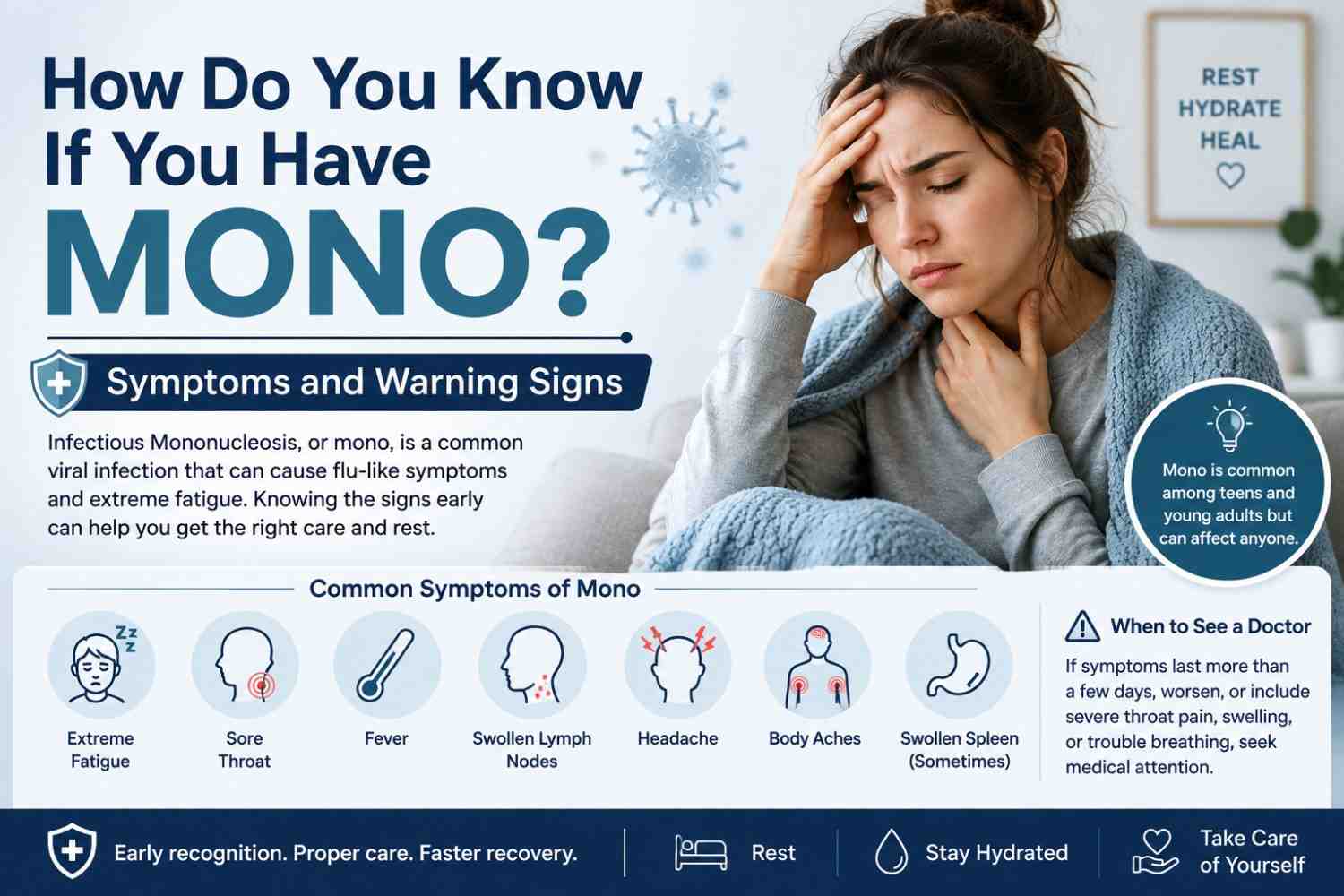
Mono symptoms can be easy to mistake for a bad cold, flu or another throat infection. You might feel unusually tired, develop a painful sore throat, notice swollen glands or run a fever, but these symptoms can have several possible causes. Mono, also known as infectious mononucleosis or glandular fever, is a viral infection that can leave you feeling unwell for weeks rather than just a few days.
For some people, the illness is relatively mild. For others, the fatigue can be so strong that normal activities, studying or working become difficult. This is why recognising the possible signs of mono and knowing when to seek medical advice can be useful.
So, what does mono actually feel like? Which symptoms should you look out for? And when should you stop assuming that you simply have a sore throat or ordinary viral infection?
Let’s take a closer look.
What Is Mono?
Mono is commonly used to describe infectious mononucleosis, a viral illness most often associated with the Epstein-Barr virus (EBV).
In the UK, you may hear it called glandular fever.
It particularly affects teenagers and young adults, although people of other ages can also develop it. The infection generally gets better without specific treatment, but recovery can take considerably longer than with many ordinary viral illnesses.
One reason mono can be confusing is that its symptoms overlap with several other infections.
A sore throat does not automatically mean mono.
Feeling tired does not automatically mean mono either.
It is the combination of symptoms, their severity and how long they continue that may prompt a healthcare professional to consider glandular fever.
What Are the Early Signs of Mono?
The early signs of mono can vary between people.
You might initially think you have a normal throat infection or flu-like illness.
Common symptoms include:
- Feeling unusually tired
- Sore throat
- High temperature
- Swollen glands
- Headache
- General weakness
- A rash in some cases
The swollen glands are often noticeable around the neck, although lymph nodes in other areas can also become enlarged.
The combination of a severe sore throat, swollen glands and significant exhaustion can be particularly suggestive of glandular fever, although only a healthcare professional can assess whether mono is actually the cause.
Is Extreme Tiredness a Sign of Mono?
Yes.
One of the symptoms that can make mono particularly disruptive is significant fatigue.
This may feel different from simply being tired after a busy week.
You might:
- Sleep for longer than usual
- Struggle to get through a normal day
- Find everyday activities exhausting
- Have difficulty concentrating
- Need more frequent rest
- Feel drained even after sleeping
The fatigue associated with glandular fever can last much longer than some of the other symptoms. NHS guidance notes that long-term tiredness can sometimes continue for several months.
This can be frustrating, particularly if your sore throat and fever have already improved.
Can Mono Cause a Severe Sore Throat?
Yes.
A sore throat is one of the common symptoms of mono.
It may be painful when swallowing and can sometimes resemble tonsillitis or another throat infection.
Some people may also develop swollen or inflamed tonsils.
Because several infections can cause similar throat symptoms, you should not assume that a severe sore throat automatically means you have glandular fever.
If your sore throat is severe, persistent or accompanied by other symptoms such as extreme tiredness and swollen glands, medical advice may be appropriate.
Are Swollen Glands a Sign of Mono?
They can be.
Swollen lymph nodes are a recognised symptom of glandular fever.
You may notice tender or enlarged glands around:
- The sides of your neck
- Under your chin
- Your armpits
- Your groin
Swollen glands are simply a sign that your immune system is responding to something. They can occur with many infections, not just mono.
So while swollen glands can be one of the signs of mono, they cannot confirm the infection by themselves.
Can Mono Cause a Fever?
Yes.
A high temperature can occur with glandular fever.
You may feel:
- Hot
- Cold
- Shivery
- Sweaty
- Generally unwell
A fever is not specific to mono, however. Many infections can cause a raised temperature.
If you have a very high temperature or your fever is not improving, it is sensible to seek medical advice.
Can You Have Mono Without All the Symptoms?
Absolutely.
Not everyone experiences the same combination of symptoms.
One person may have a particularly painful throat and swollen glands, while another may mainly notice overwhelming tiredness.
Some people may have relatively mild symptoms and may not immediately realise they have glandular fever.
This is one reason that trying to diagnose yourself from a single symptom can be misleading.
Instead, look at the overall pattern.
What Does Mono Feel Like?
If you have mono, you may feel as though you have a combination of a throat infection and a prolonged viral illness.
You might experience:
“My throat hurts.”
“My glands feel swollen.”
“I feel completely exhausted.”
“I don’t seem to be recovering as quickly as I expected.”
That last point can be particularly important.
A normal cold may gradually improve over several days.
With glandular fever, tiredness and other symptoms can persist for considerably longer. NHS guidance says people should generally start feeling better within 2 to 4 weeks, although some symptoms, particularly fatigue, can last longer.
How Long Do Mono Symptoms Last?
There is no single recovery timeline that applies to everyone.
Many people begin feeling better within 2 to 4 weeks, but recovery can take longer.
The fatigue may remain even after other symptoms have settled.
This means you might reach a point where:
- Your fever has disappeared
- Your throat feels better
- Your swollen glands are improving
…but you still feel unusually tired.
That does not necessarily mean something has gone wrong.
However, persistent or worsening symptoms should be discussed with a healthcare professional rather than simply assumed to be part of recovery.
Why Can Mono Fatigue Last So Long?
Mono is a viral illness that can affect your body quite significantly.
Even when the most obvious symptoms improve, your energy levels may take longer to return.
This can make normal responsibilities feel surprisingly difficult.
For example, you may be able to get out of bed but struggle to:
- Work a full shift
- Attend classes
- Concentrate for long periods
- Exercise
- Complete physically demanding tasks
- Socialise for extended periods
Recovery is not always a straight line.
You may have a better day followed by a day when you feel exhausted again.
Is Mono Contagious?
Yes.
Glandular fever spreads mainly through saliva.
It can be passed through activities such as kissing or sharing cups and cutlery. The virus can remain in saliva for some time after someone has been ill.
If you think you may have mono, it is sensible to avoid sharing drinks, cups or cutlery and to avoid kissing others while you are unwell.
Good hand hygiene is also important.
Can You Go to Work With Mono?
This depends on how severe your symptoms are and the type of work you do.
Someone with mild symptoms may be able to continue some normal activities.
Someone experiencing severe mono fatigue, fever or a painful throat may find working extremely difficult.
Consider your actual symptoms and your job requirements.
For example, physically demanding work may be much harder to manage when you are exhausted.
A job requiring prolonged concentration may also become challenging if fatigue is affecting your focus.
If you are unsure whether you are well enough to work, speak with a healthcare professional.
Can Mono Affect Your Ability to Work?
Yes.
The impact is not necessarily limited to physical jobs.
Mono can affect your:
- Energy
- Concentration
- Stamina
- Ability to complete long shifts
- Ability to perform strenuous tasks
- General sense of wellbeing
If symptoms are significant enough to interfere with your normal responsibilities, you may need to discuss your situation with your employer and a healthcare professional.
Depending on the circumstances, temporary adjustments or time away from work may be considered.
Should You Exercise When You Have Mono?
This is an important consideration.
The NHS advises people with glandular fever to avoid strenuous activities such as heavy lifting and sports while recovering.
This is particularly important because glandular fever can sometimes cause an enlarged spleen, and a ruptured spleen is a recognised complication.
Do not rush back into intense exercise simply because your fever or sore throat has improved.
Ask a healthcare professional when it is appropriate for you to resume strenuous activity.
How Is Mono Diagnosed?
A healthcare professional may assess your symptoms and medical history before deciding whether testing is appropriate.
A blood test may be used to help confirm glandular fever and distinguish it from other illnesses that can produce similar symptoms. NHS guidance notes that testing can look for evidence related to Epstein-Barr virus.
Testing may be particularly useful when symptoms are significant or the diagnosis is uncertain.
It is worth remembering that not every sore throat or episode of fatigue is caused by mono.
Can Mono Be Confused With Other Infections?
Yes.
Several conditions can produce similar symptoms.
For example:
- Tonsillitis
- Strep throat
- Flu
- Other viral infections
- Other causes of swollen glands
A sore throat combined with fever and swollen glands does not automatically confirm glandular fever.
This is why professional assessment can be important when symptoms are severe, persistent or unusual.
When Should You See a Doctor About Mono Symptoms?
You should consider medical advice if you have symptoms that make you concerned about glandular fever, particularly:
- Extreme tiredness
- A severe sore throat
- Swollen glands
- A high temperature
- A sore throat that is not improving
- Symptoms that are affecting normal activities
The NHS specifically recommends contacting a GP for symptoms such as a very high temperature, severe sore throat, swollen glands or extreme tiredness.
You do not need to wait until symptoms become unbearable before asking for help.
What Are the Warning Signs of Serious Mono Complications?
Most people recover from glandular fever without serious problems.
However, complications can occasionally occur.
These can include problems involving the liver, heart, kidneys, blood or nervous system, as well as an enlarged or ruptured spleen. Long-lasting fatigue is another possible issue.
Seek urgent help if you have difficulty breathing or swallowing.
The NHS advises urgent assessment for difficulty breathing or painful difficulty swallowing.
Seek emergency help if you cannot swallow your saliva.
Inability to swallow, severe difficulty breathing or severe stomach pain requires immediate medical attention.
Do not try to diagnose a potentially serious complication yourself.
Can Mono Cause Stomach Pain?
Mild digestive discomfort can occur with many viral illnesses, but severe stomach pain should not be ignored in someone with suspected or confirmed glandular fever.
This is particularly important because one rare complication is a ruptured spleen.
If you develop severe or sudden abdominal pain while you have mono, seek emergency medical attention.
What Can You Do to Feel Better While Recovering From Mono?
There is no specific routine that guarantees a faster recovery, but supportive care can make the illness easier to manage.
The NHS recommends:
- Getting plenty of rest
- Drinking enough fluids
- Taking small, frequent sips if swallowing is painful
- Using appropriate pain relief when suitable
- Avoiding strenuous activity while recovering
Listen to your body rather than trying to return immediately to your normal routine.
If an activity leaves you significantly more exhausted, it may be a sign that you are doing too much too soon.
What If Mono Is Affecting Your Work Attendance?
If your symptoms are preventing you from working normally, follow your employer’s sickness-reporting procedure.
Depending on how long you are absent, you may also need appropriate medical documentation.
In the UK, employees can generally self-certify sickness for the first 7 calendar days. If an absence continues beyond that, an employer may request a fit note.
The exact requirements can depend on your employment circumstances, so check your workplace’s policy.
When Might You Need Medical Documentation for Mono?
A period of illness does not automatically mean that you need a doctor’s note.
However, documentation may become relevant if:
- Your employer requests medical evidence
- Your absence continues beyond the self-certification period
- Your symptoms significantly affect your ability to work
- You require workplace adjustments
- You need evidence relating to your fitness for work
Make sure you understand what type of document is actually required.
A fit note, doctor’s letter and other forms of medical documentation may serve different purposes.
Need a Doctor’s Note for Mono?
If genuine mono or glandular fever symptoms have affected your ability to work and you need appropriate medical documentation, you can learn more about the Doctor’s Note for Mono service.
[View Doctor’s Note for Mono →]
Any medical documentation should accurately reflect your circumstances and be used only for its intended purpose.
Frequently Asked Questions
What are the most common mono symptoms?
The most common mono symptoms include extreme tiredness, sore throat, swollen glands and a high temperature. Headaches and a rash can also occur.
What are the early signs of mono?
Early signs of mono may include feeling unusually tired, developing a sore throat, swollen glands and a fever. Symptoms can vary considerably between people.
How do you know if you have mono?
You cannot reliably confirm mono based on symptoms alone because several other infections can cause similar problems. A healthcare professional can assess your symptoms and may recommend a blood test when appropriate.
Can you have mono without a sore throat?
Yes. People do not necessarily experience every symptom. Some may mainly notice significant fatigue or swollen glands.
Is extreme tiredness a symptom of mono?
Yes. Significant tiredness is one of the recognised symptoms of glandular fever and can sometimes continue for months after other symptoms improve.
How long do mono symptoms last?
Many people start feeling better within 2 to 4 weeks, but recovery varies. Fatigue can continue for longer in some people.
Is mono contagious?
Yes. Glandular fever spreads mainly through saliva, including through kissing and sharing cups or cutlery.
Can you work with mono?
It depends on your symptoms and the demands of your job. Significant fatigue, fever or a severe sore throat may make normal work difficult. Speak with a healthcare professional if you are unsure whether you are fit to work.
Can mono affect your ability to work?
Yes. Mono symptoms can affect energy, concentration and stamina, making normal working hours or physically demanding duties difficult for some people.
Should you exercise when you have mono?
Strenuous activity, including heavy lifting and sports, should be avoided while recovering unless a healthcare professional advises otherwise. This is important because glandular fever can sometimes affect the spleen.
When should you seek medical help for mono?
Seek medical advice if you have a severe sore throat, very high temperature, swollen glands, extreme tiredness or symptoms that are not improving.
When is mono an emergency?
Difficulty breathing, inability to swallow saliva or severe stomach pain requires urgent or emergency medical attention.
Can you get a Doctor’s Note for Mono?
A Doctor’s Note for Mono may be relevant when genuine illness has affected your ability to work and appropriate medical documentation is required. The type of documentation you need depends on your circumstances and what your employer requests.
Conclusion
Recognising mono symptoms can be difficult because glandular fever can look similar to several other infections. A sore throat, fever or swollen glands on their own do not confirm the condition.
However, a combination of extreme fatigue, severe sore throat, swollen glands and fever can be a reason to speak with a healthcare professional.
Recovery can also take longer than expected. Even after the obvious symptoms improve, tiredness may remain, so returning to a completely normal routine too quickly may leave you feeling worse.
Rest, adequate fluids and avoiding strenuous activity during recovery are important. And if you develop difficulty breathing, cannot swallow your saliva or experience severe stomach pain, seek urgent medical attention.
If your illness is affecting your ability to work and you have been asked to provide appropriate medical documentation, make sure you understand exactly what your employer requires.

Dr. Anuj provides convenient online medical consultations for patients across the UK, making it easier to speak with a doctor without the need for an in-person visit.
Through secure online consultations, Dr. Anuj can assess your symptoms, discuss your concerns, and provide appropriate medical guidance. Where medically appropriate and legally permitted, a doctor’s note or medical documentation may also be provided following the consultation.