
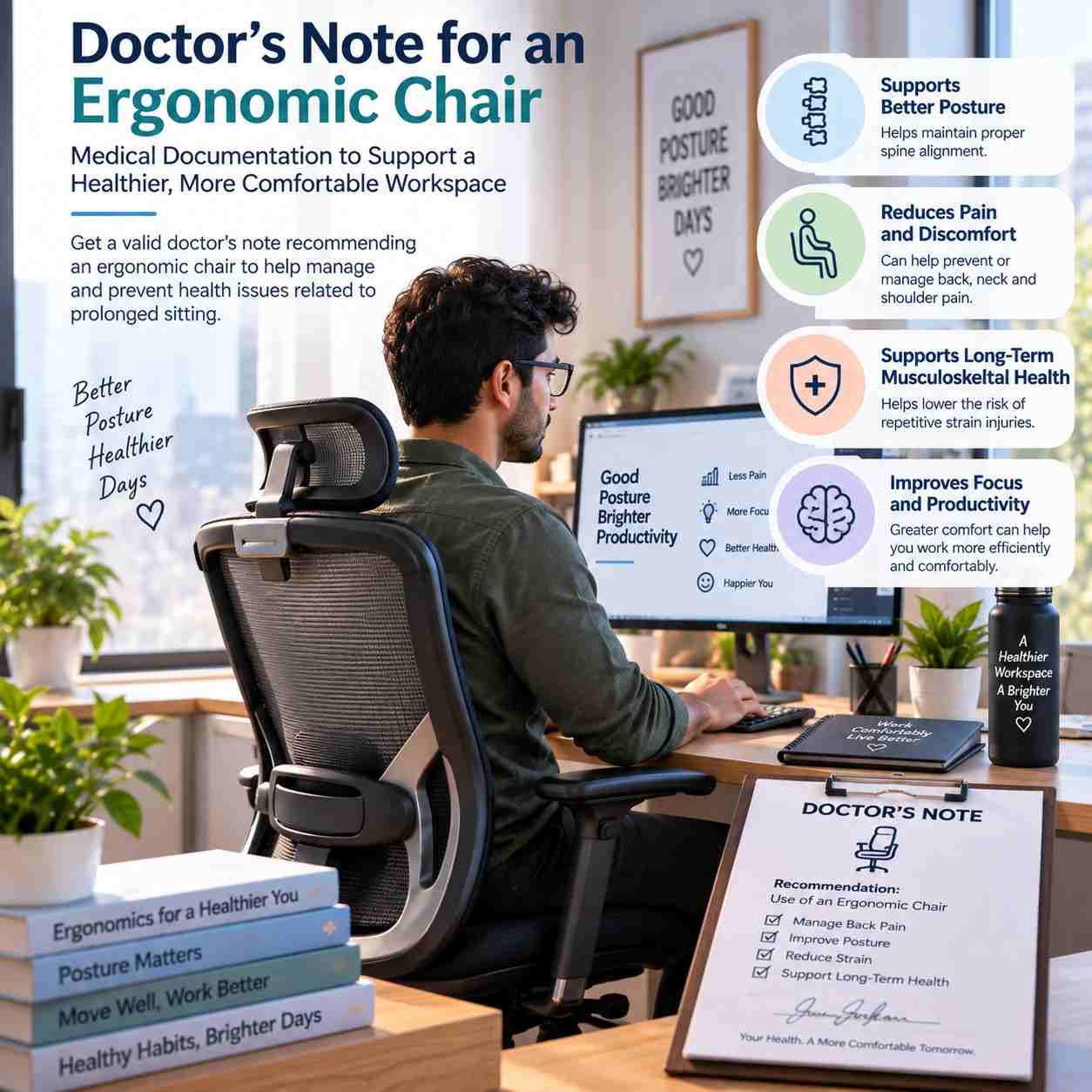


Many people spend several hours each day sitting while working at a desk or computer. For individuals with certain medical conditions or musculoskeletal concerns, a standard office chair may contribute to discomfort, reduced mobility, or difficulty performing their job comfortably. In these situations, a healthcare professional may recommend an ergonomic chair as part of a broader workplace accommodation plan.
A Doctor’s Note for an Ergonomic Chair is an official medical document issued by a licensed healthcare professional after evaluating your health, symptoms, and workplace requirements. Depending on your individual assessment, the note may recommend an ergonomic seating solution or other workplace adjustments that could help reduce discomfort and improve your ability to perform your job safely.
This guide explains what a Doctor’s Note for an Ergonomic Chair is, when it may be appropriate, what information it may include, and how healthcare professionals assess the need for workplace seating accommodations.
What Is a Doctor’s Note for an Ergonomic Chair?
A Doctor’s Note for an Ergonomic Chair is medical documentation prepared after a clinical assessment of your physical condition and workplace needs.
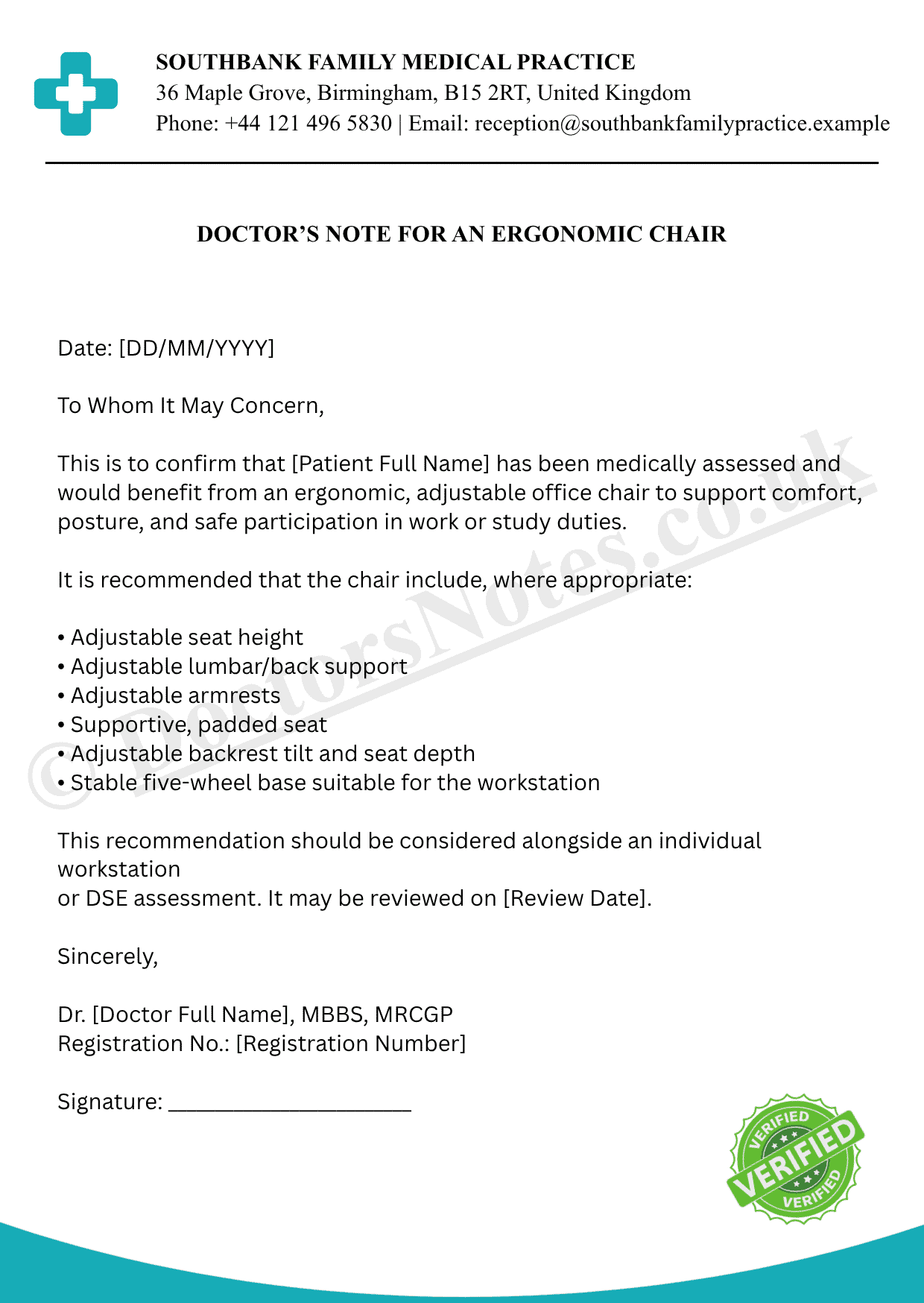
Depending on your assessment, the documentation may include:
- Confirmation that a medical evaluation has been completed.
- Recommendations for an ergonomic chair where clinically appropriate.
- Temporary or long-term workplace seating accommodations.
- Advice regarding posture support and workstation adjustments.
- Recommendations for additional ergonomic modifications if required.
- Follow-up review if your condition changes.
The documentation focuses on supporting your functional ability at work rather than simply requesting new office equipment.
When Might You Need a Doctor’s Note for an Ergonomic Chair?
Medical documentation may be appropriate when your current seating arrangement contributes to pain, discomfort, or reduced work performance.
Chronic Back or Neck Discomfort
People with ongoing musculoskeletal conditions may experience increased discomfort when sitting in chairs that provide insufficient support.
An ergonomic chair may help support:
- Better spinal alignment.
- Improved sitting posture.
- Reduced pressure on the lower back.
- Increased comfort during prolonged desk work.
Recommendations depend on your individual clinical assessment.
Recovery Following Injury or Surgery
After certain injuries or surgical procedures, prolonged sitting may become uncomfortable without appropriate seating support.
A healthcare professional may assess whether an ergonomic chair could assist during recovery while you gradually resume normal work activities.
Long Hours of Computer-Based Work
Employees who spend most of the working day at a computer may benefit from ergonomic adjustments if poor seating contributes to physical symptoms.
Examples include:
- Office administrators.
- Customer service staff.
- Software developers.
- Designers.
- Accountants.
- Call centre employees.
- Remote workers.
An ergonomic assessment may recommend seating improvements alongside other workstation modifications.
Workplace Accommodation Requests
Some employers require medical documentation before providing specialised office equipment.
A doctor’s note may support requests for:
- Ergonomic seating.
- Adjustable office furniture.
- Individual workstation assessments.
- Temporary workplace accommodations.
Approval depends on the employer’s accommodation policies and operational procedures.
What Information May Be Included in the Doctor’s Note?
The contents of the documentation depend on your assessment and workplace requirements.
A doctor’s note may include:
- Confirmation of medical consultation.
- Date of assessment.
- Functional limitations affecting prolonged sitting.
- Recommendation for an ergonomic chair where appropriate.
- Suggestions for additional workplace adjustments.
- Follow-up review recommendations if necessary.
The documentation generally focuses on functional needs rather than providing detailed diagnostic information.
Medical Conditions That May Benefit From Ergonomic Seating
An ergonomic chair may be considered as part of an overall management plan for certain medical conditions when clinically appropriate.
Examples may include:
- Chronic lower back pain.
- Neck pain.
- Degenerative spinal conditions.
- Postural disorders.
- Sciatica.
- Arthritis affecting the spine or hips.
- Recovery following musculoskeletal injury.
- Other conditions affecting sitting tolerance.
Not everyone with these conditions requires specialised seating. Recommendations are made after an individual assessment.
What Happens During the Medical Assessment?
During your consultation, the healthcare professional will evaluate your symptoms, physical function, and workplace environment to determine whether an ergonomic chair is medically appropriate.
You may be asked about:
- Where your pain or discomfort is located.
- How long symptoms have been present.
- Whether sitting worsens your symptoms.
- The type of work you perform.
- How many hours you sit each day.
- Previous injuries or surgery.
- Current treatment or physiotherapy.
- Existing workplace adjustments.
- Whether your employer requires medical documentation.
Following the assessment, the healthcare professional will determine whether a Doctor’s Note for an Ergonomic Chair or other workplace accommodation is clinically appropriate based on your individual medical needs.
Important: A Doctor’s Note for an Ergonomic Chair provides medical recommendations following an individual clinical assessment. It does not automatically require an employer to provide specialised office equipment, as workplace accommodation decisions are made according to organisational policies, occupational health procedures, and applicable employment laws.
How to Get a Doctor’s Note for an Ergonomic Chair
If sitting for extended periods causes pain, stiffness, or discomfort that affects your ability to work, you can arrange a consultation with a licensed healthcare professional. During the appointment, your symptoms, medical history, and workplace requirements will be reviewed to determine whether an ergonomic chair or other workstation adjustments are medically appropriate.
Step 1: Schedule a Medical Consultation
Book an appointment when your current office chair or workstation is contributing to ongoing physical discomfort or limiting your ability to perform your job.
A healthcare professional may assess whether your symptoms are related to:
- Poor sitting posture.
- Prolonged desk work.
- Musculoskeletal disorders.
- Previous injuries.
- Spinal conditions.
- Joint disorders.
- Repetitive workplace strain.
- Reduced sitting tolerance.
Step 2: Register or Access Your Patient Account
New patients should complete the registration process before booking an appointment. Existing patients can log in to their account and select an available consultation time.
Step 3: Complete Your Workplace Health Questionnaire
Before the consultation, you may be asked to complete a questionnaire describing your symptoms and work environment.
Typical questions may include:
- Where you experience pain or discomfort.
- How long you sit each day.
- Whether symptoms improve when standing or walking.
- Your job role and daily responsibilities.
- Your current office chair or workstation setup.
- Previous injuries or surgery.
- Current treatments or physiotherapy.
- Existing workplace accommodations.
- Whether your employer requires medical documentation.
Providing detailed information allows the healthcare professional to better understand how your work environment affects your symptoms.
Step 4: Provide Supporting Information (If Available)
If you have relevant medical or workplace documentation, it may be helpful to share it before your consultation.
Examples include:
- Physiotherapy reports.
- Orthopaedic or specialist letters.
- Previous imaging reports.
- Occupational health assessments.
- Ergonomic workstation evaluations.
- Employer accommodation request forms.
- Previous medical certificates related to your condition.
These documents may support the assessment but are not required in every case.
Step 5: Attend Your Medical Assessment
During the consultation, the healthcare professional will assess both your medical condition and how your workstation may be contributing to your symptoms.
The discussion may include:
- Your current symptoms.
- Activities that worsen or relieve discomfort.
- Sitting tolerance throughout the workday.
- Physical demands of your role.
- Current workstation layout.
- Existing ergonomic equipment.
- Previous treatments.
- Whether additional workplace adjustments may be beneficial.
In some cases, the healthcare professional may recommend other ergonomic improvements in addition to, or instead of, an ergonomic chair.
Step 6: Receive Your Doctor’s Note
If an ergonomic chair is considered medically appropriate, your Doctor’s Note for an Ergonomic Chair will be prepared after your assessment.
Depending on your individual circumstances, the documentation may include:
- Confirmation of medical assessment.
- Recommendation for an ergonomic chair.
- Advice regarding prolonged sitting.
- Temporary or ongoing workplace accommodations.
- Recommendations for workstation modifications.
- Follow-up review if your condition changes.
Important: A consultation does not automatically result in a doctor’s note or recommendation for an ergonomic chair. Documentation is issued only when supported by the healthcare professional’s clinical judgement.
What Features Might Be Recommended in an Ergonomic Chair?
Healthcare professionals usually focus on the functional support a chair should provide rather than recommending a particular manufacturer or model.
Depending on your medical needs, recommendations may include:
- Adjustable lumbar support.
- Seat height adjustment.
- Adjustable armrests.
- Seat depth adjustment.
- Reclining backrest with appropriate support.
- Adjustable headrest where appropriate.
- Adequate cushioning to improve sitting comfort.
- Stable swivel base with suitable mobility.
- Proper positioning to maintain neutral spinal alignment.
The exact features recommended depend on your symptoms, body mechanics, and the nature of your work.
Can Other Workplace Adjustments Be Recommended?
Yes. An ergonomic chair is often only one part of creating a healthier workstation.
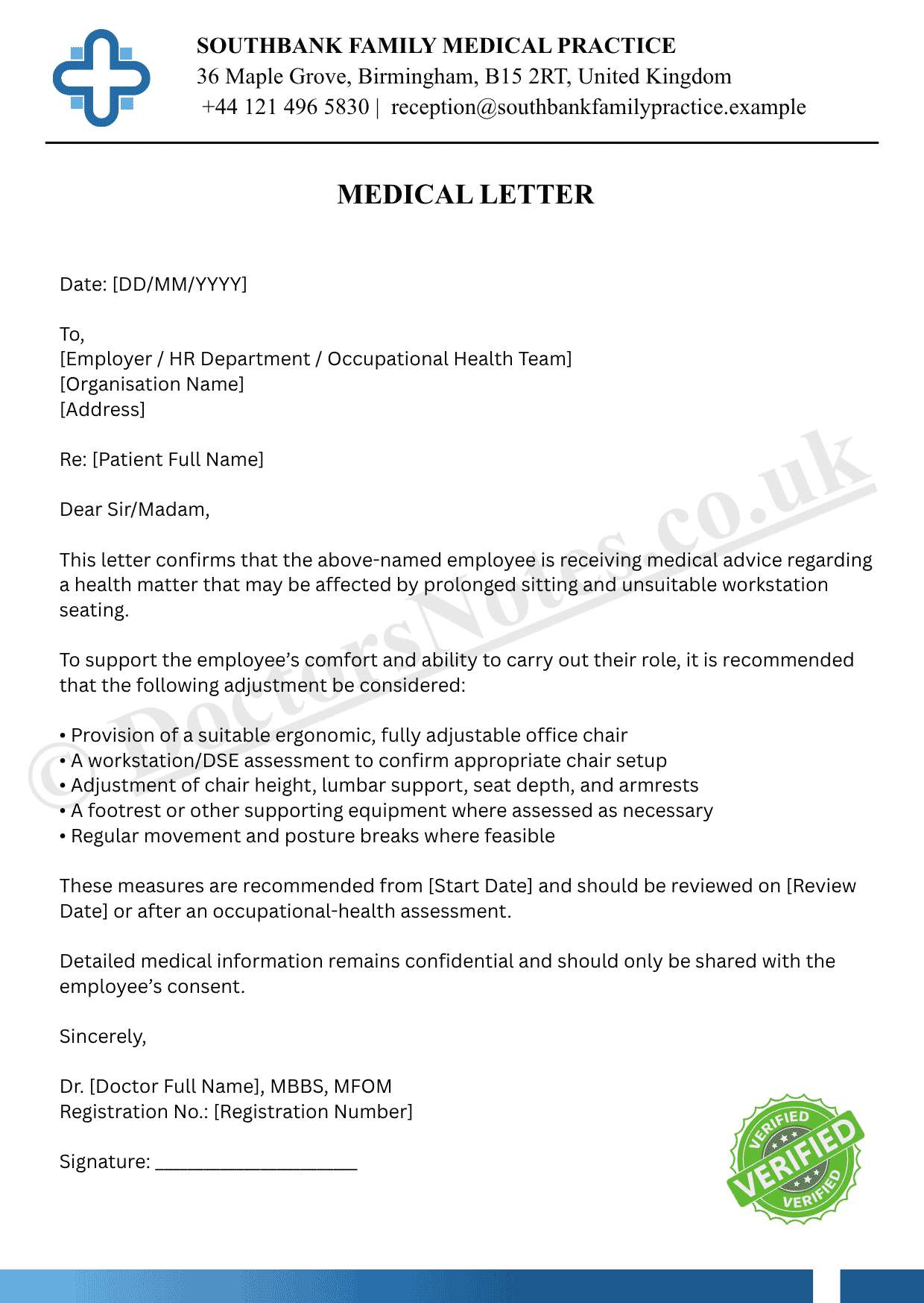
Depending on your assessment, the healthcare professional may also recommend:
- An adjustable sit-stand desk.
- A monitor positioned at eye level.
- An ergonomic keyboard and mouse.
- A footrest to improve lower limb positioning.
- Regular movement and stretching breaks.
- Reduced periods of uninterrupted sitting.
- Changes to desk height or workstation layout.
- Temporary modification of physically demanding duties.
These recommendations are intended to reduce physical strain and support long-term musculoskeletal health.
How Long Is a Doctor’s Note for an Ergonomic Chair Valid?
The duration of a Doctor’s Note for an Ergonomic Chair depends on your diagnosis, expected recovery, and whether your condition is temporary or ongoing.
Examples of Workplace Recommendations
| Clinical Situation | Possible Recommendation* |
|---|---|
| Temporary musculoskeletal strain | Ergonomic chair during recovery |
| Chronic spinal condition | Long-term ergonomic seating support |
| Recovery after surgery | Temporary workstation modifications |
| Persistent posture-related discomfort | Ergonomic assessment and seating adjustments |
| Ongoing office-based work with physical symptoms | Review of workstation and workplace ergonomics |
*These examples are provided for general information only. Recommendations are based on an individual clinical assessment.
When Should You Arrange Another Medical Review?
A follow-up consultation may be appropriate if:
- Your symptoms continue despite using ergonomic equipment.
- Pain becomes more severe or spreads to other areas.
- New symptoms such as numbness or weakness develop.
- Your job duties change significantly.
- Your employer requests updated medical documentation.
- Workplace adjustments have not improved your symptoms.
- Your healthcare professional recommends ongoing monitoring.
Regular reviews help ensure that your workplace accommodations continue to meet your medical needs and support your long-term health.
What Documents May Be Issued?
Following your assessment, the healthcare professional will determine which medical documentation is appropriate based on your symptoms, functional limitations, and workplace requirements.
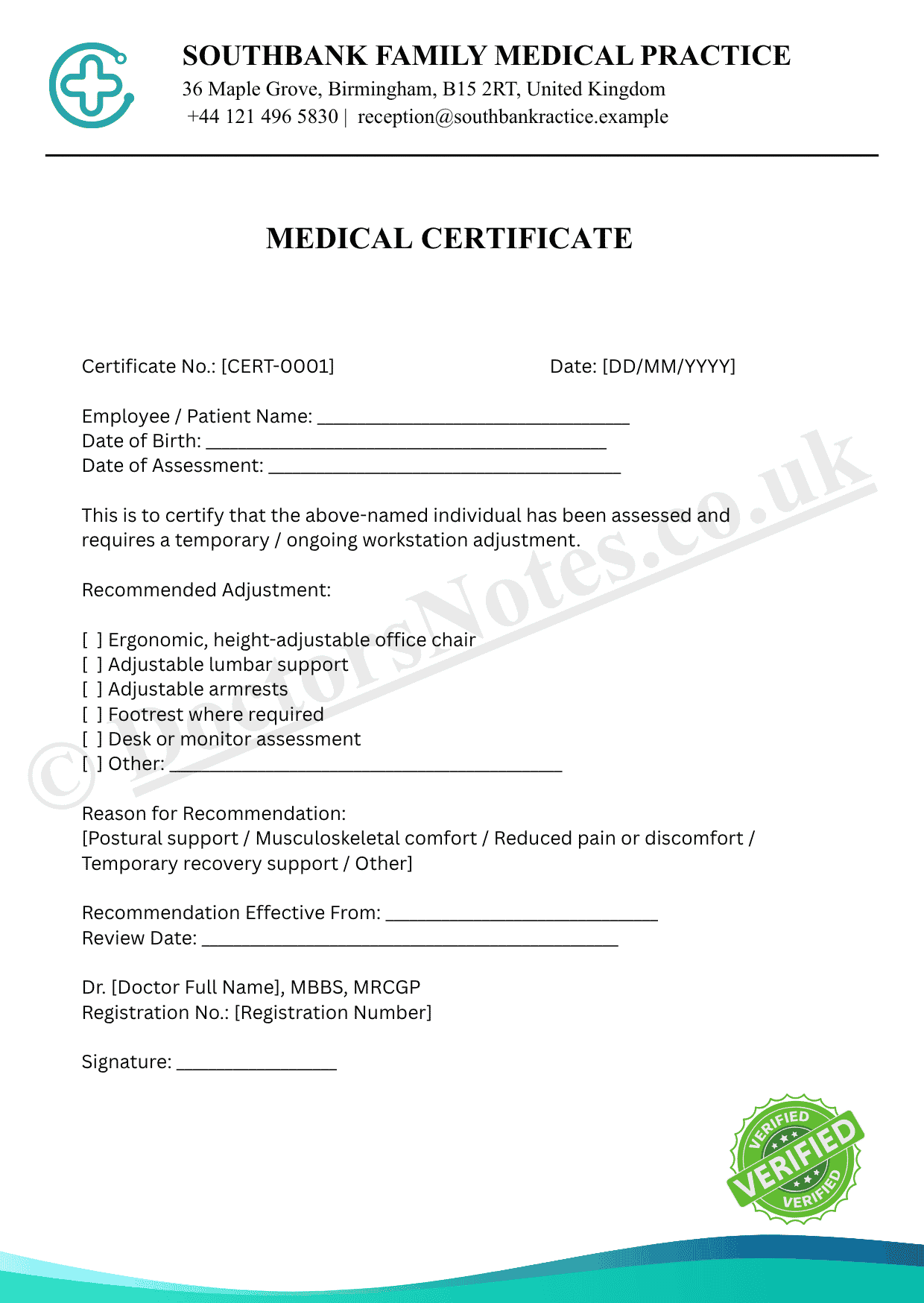
Depending on your individual circumstances, you may receive:
- Doctor’s Note for an Ergonomic Chair recommending ergonomic seating where clinically appropriate.
- A medical certificate confirming that you have completed a medical assessment.
- Documentation supporting workplace accommodations or reasonable adjustments.
- A fitness-for-work assessment outlining temporary physical limitations.
- Recommendations for modified duties if certain work activities worsen your symptoms.
- Documentation recommending additional ergonomic equipment, such as a sit-stand desk, footrest, monitor riser, or ergonomic keyboard, where appropriate.
- Referral letters to physiotherapy, occupational therapy, orthopaedics, rheumatology, or another specialist if further assessment is recommended.
- Follow-up medical documentation if your condition requires ongoing review.
- Confirmation of attendance at a medical consultation.
The documentation provided is tailored to your individual clinical assessment and functional needs rather than a standard workplace request.
Important Legal Information About a Doctor’s Note for an Ergonomic Chair
A Doctor’s Note for an Ergonomic Chair is an official medical document issued by a licensed healthcare professional after assessing whether specialised workplace seating may be medically appropriate.
Before requesting documentation, it is important to understand:
- A doctor’s note is issued only after an appropriate medical consultation and clinical assessment.
- Booking an appointment does not automatically guarantee a recommendation for an ergonomic chair or other workplace equipment.
- Healthcare professionals make recommendations based on your medical condition, physical limitations, work activities, and clinical judgement.
- The documentation may recommend ergonomic seating, workplace modifications, activity restrictions, or additional assessments where medically appropriate.
- Employers determine whether ergonomic equipment or workplace accommodations will be provided in accordance with their own policies, occupational health procedures, budget considerations, and applicable employment laws.
- Some employers may require an occupational health assessment or internal ergonomic evaluation in addition to a doctor’s note before approving equipment requests.
- A doctor’s note does not replace employer-specific accommodation forms, occupational health reports, workers’ compensation documentation, disability assessments, or insurance paperwork that may be required separately.
- Medical documentation generally focuses on your functional limitations and workplace needs while protecting your confidential health information.
- Your consultation, medical records, and personal information remain confidential and are managed in accordance with applicable healthcare privacy and data protection laws.
- If your symptoms improve, worsen, or your work responsibilities change, a follow-up assessment may be appropriate to review your workplace recommendations.
Important: If you experience sudden loss of strength, numbness affecting your arms or legs, severe spinal pain following trauma, loss of bladder or bowel control, or other emergency neurological symptoms, seek immediate medical attention. A workplace accommodation request should never delay emergency medical care.
Related Doctor’s Note :
Doctor’s Note for Back Injury
FAQ
Can I get a Doctor’s Note for an Ergonomic Chair through an online consultation?
Yes. In many cases, a healthcare professional can assess your symptoms, work activities, and functional limitations through an online consultation. If further physical examination is required, you may be referred for an in-person assessment.
Does having back or neck pain automatically qualify me for an ergonomic chair?
No. An ergonomic chair is recommended only when the healthcare professional determines that specialised seating is medically appropriate based on your individual condition and workplace requirements.
Will my employer have to provide an ergonomic chair?
Not necessarily. The doctor’s note provides medical recommendations, but the final decision regarding workplace equipment or accommodations is made by your employer according to company policies and applicable employment legislation.
Can the doctor’s note recommend other ergonomic equipment?
Yes. Depending on your assessment, recommendations may include a sit-stand desk, ergonomic keyboard, monitor riser, footrest, document holder, or other workstation modifications in addition to, or instead of, an ergonomic chair.
Will my diagnosis appear on the doctor’s note?
Usually not. Most workplace documentation focuses on your functional limitations and recommended accommodations rather than disclosing detailed medical diagnoses unless necessary or authorised by you.
Can remote employees request an ergonomic chair?
Yes. If you work from home and your symptoms are related to your workstation, the healthcare professional may consider whether ergonomic seating or other home workstation adjustments are medically appropriate.
Is an ergonomic chair intended to treat my condition?
An ergonomic chair is generally one component of a broader management plan. Depending on your condition, treatment may also include physiotherapy, exercise, medication, posture education, or other medical interventions.
Can I request an updated doctor’s note if my condition changes?
Yes. If your symptoms improve, worsen, or your job duties change, another consultation can be arranged to reassess your needs and update your medical documentation if clinically appropriate.
Can this documentation be used for insurance or workplace accommodation programmes?
Some organisations may accept a doctor’s note, while others require occupational health reports or additional documentation. Always check the requirements of the organisation requesting the information.
Is my consultation confidential?
Yes. Your consultation, medical records, and any documentation issued are confidential and managed in accordance with applicable healthcare privacy and data protection laws.
Why Choose Our Online Workplace Ergonomic Assessment?
- Licensed healthcare professionals experienced in assessing musculoskeletal and workplace health concerns.
- Convenient online consultations without unnecessary travel.
- Individual assessments based on your symptoms, work environment, and functional needs.
- Medical documentation issued only when clinically appropriate.
- Guidance on ergonomic seating, workstation adjustments, and injury prevention.
- Confidential, secure, and patient-focused care.
- Follow-up consultations available if your condition or workplace requirements change.
Conclusion
An ergonomic chair can be an important workplace accommodation for individuals whose medical condition makes prolonged sitting uncomfortable or difficult. However, the need for specialised seating should always be determined through an individual clinical assessment rather than personal preference alone.
A Doctor’s Note for an Ergonomic Chair provides professional medical documentation based on your symptoms, functional limitations, and workplace demands. When clinically appropriate, it may help support requests for ergonomic seating or other workplace adjustments that promote comfort, improve posture, and enable you to perform your job more safely and effectively while protecting your long-term musculoskeletal health.




Reviews
There are no reviews yet.