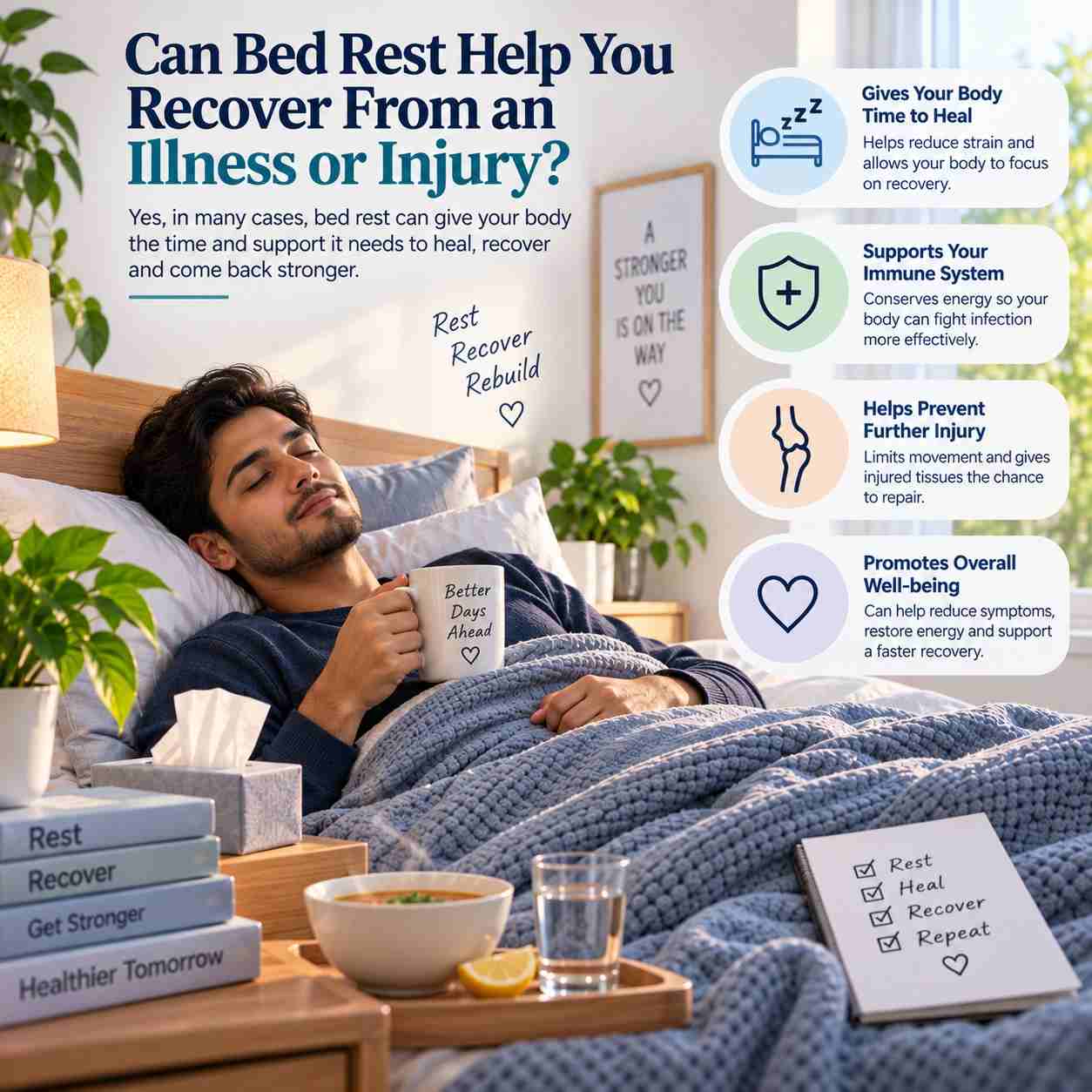
When you are ill or recovering from an injury, it is natural to think that staying in bed will help your body heal. Sometimes it can. In other situations, too much time in bed may actually make recovery harder.
The key is understanding that bed rest is not a universal treatment for illness or injury. Whether it helps depends on what is wrong, how severe your symptoms are, what treatment you are receiving, and what level of activity your healthcare professional recommends.
For some people, temporarily reducing activity can conserve energy and prevent unnecessary strain. For others, gentle movement and gradually returning to normal activities may be an important part of recovery.
Can Bed Rest Help You Recover From an Illness?
Yes, bed rest or increased rest can sometimes help during an illness, but it is not appropriate for every condition.
When you are unwell, your normal routine can become physically demanding. Working, commuting, exercising and completing household tasks may leave you feeling more exhausted than usual.
Taking a temporary break from those demands can give you more time to sleep, eat and drink adequately, manage symptoms and follow your treatment plan.
However, this does not necessarily mean spending the entire day in bed.
For many illnesses, the more useful approach is to rest when you need to while remaining as active as your condition safely allows.
NHS guidance from several hospital trusts specifically warns that unnecessary prolonged bed rest can cause deconditioning, including reduced muscle strength and mobility.
Can Bed Rest Help You Recover From an Injury?
It can be appropriate for some injuries, particularly when movement or weight-bearing could interfere with recovery.
For example, a healthcare professional may temporarily restrict certain activities after an injury and advise you to avoid putting excessive strain on the affected area.
The important distinction is between protecting an injury and becoming completely inactive.
Your recovery plan might involve resting the injured area while still allowing other forms of movement. In other situations, more significant activity restrictions may be necessary.
The correct approach depends on the injury rather than the word “rest” itself.
When Can Bed Rest Be Useful During Recovery?
The potential value of bed rest comes from reducing demands on the body when those demands are inappropriate or exhausting.
Bed Rest May Help When You Are Extremely Fatigued
Some illnesses can leave you feeling physically drained.
If ordinary activities are exhausting, temporarily reducing your workload and other demands can give you more opportunity to sleep and recover.
That does not mean unexplained or persistent fatigue should simply be treated by staying in bed. Ongoing fatigue may need medical assessment to identify its cause.
Bed Rest May Help When Movement Aggravates an Injury
An injured muscle, joint or other body part may become more painful when repeatedly used.
In such circumstances, reducing the movements that aggravate the injury can be an important part of recovery.
Your healthcare professional may recommend specific restrictions rather than complete inactivity.
Bed Rest May Be Appropriate After Certain Medical Procedures
Following some procedures or treatments, temporary restrictions may be part of the recovery plan.
The instructions can include limits on lifting, exercise, driving or other activities.
Always follow the aftercare advice given by the clinical team rather than assuming that staying in bed for longer will improve the outcome.
Rest May Be Helpful During Significant Illness
When an illness causes substantial weakness, fever, pain or exhaustion, reducing normal activities may make it easier to manage the condition.
Rest can also allow you to concentrate on basic needs such as sleep, hydration, nutrition and prescribed treatment.
Again, the appropriate level of activity depends on the illness.
Does Staying in Bed Make You Heal Faster?
Not necessarily.
This is where the idea of “more rest equals faster recovery” can become misleading.
Your body needs recovery time, but it also needs appropriate movement. Extended inactivity can reduce muscle strength and mobility and may make everyday activities more difficult afterwards. NHS hospital guidance describes this loss of physical function as deconditioning.
For that reason, a healthcare professional may recommend increasing activity gradually once it is safe to do so.
The objective is not to spend as much time in bed as possible. It is to find the appropriate level of activity for your particular stage of recovery.
Bed Rest vs Normal Recovery: What Is the Difference?
Recovery does not always look like lying down.
Depending on the illness or injury, an appropriate recovery routine could involve a combination of:
- Sleeping when tired
- Taking prescribed medication
- Eating and drinking adequately
- Reducing strenuous activities
- Sitting up for meals
- Moving around safely
- Completing basic personal care
- Following rehabilitation advice
- Gradually increasing activity
Someone recovering from a minor infection may simply need additional sleep and a temporary reduction in their usual routine.
A person recovering from a significant injury may have specific restrictions on weight-bearing or movement.
Those are very different recovery situations.
What Happens If You Stay in Bed for Too Long?
Prolonged inactivity can work against recovery.
Possible effects include:
Reduced Muscle Strength
When muscles are used less, they can become weaker. This may make walking, climbing stairs and other ordinary activities more tiring when you start moving again.
Physical Deconditioning
Your body can become less accustomed to normal physical activity. Even simple tasks may require more effort after an extended period of inactivity.
Reduced Mobility
Stiffness and weakness can make it harder to move comfortably and independently.
Greater Difficulty Returning to Your Routine
Someone who has spent a long time inactive may need to rebuild stamina before returning to exercise, physically demanding work or a full daily schedule.
Increased Dependence on Others
If strength and mobility decline, everyday tasks such as washing, dressing and preparing food can temporarily become more difficult.
These effects are particularly important during longer periods of illness or hospital recovery.
How Much Rest Do You Actually Need?
There is no standard amount of bed rest that applies to every illness or injury.
The appropriate amount depends on factors such as:
- The underlying condition
- Severity of symptoms
- Type of injury
- Treatment being received
- Your normal level of activity
- Other health conditions
- Your response to treatment
- Any restrictions provided by your healthcare professional
This means two people with apparently similar symptoms may receive different advice.
Rather than deciding that you need several days of complete bed rest, ask your healthcare professional which activities you should avoid and which activities you can safely continue.
Should You Move Around While Recovering?
If your condition allows it, some movement may form part of a healthy recovery.
That does not mean exercising intensely or ignoring medical restrictions.
It could simply mean getting up for necessary activities, changing position, walking short distances or gradually returning to everyday movement when your healthcare professional says it is appropriate.
Hospital guidance increasingly emphasises safe activity during recovery because prolonged inactivity can contribute to weakness, reduced mobility and longer recovery.
If you have been specifically told not to move or put weight on a particular area, follow those instructions.
How Do You Know When to Start Doing More?
Improvement in symptoms can be a useful sign, but it does not automatically mean that you are ready to return to everything you were doing before.
A better approach is to consider how your body responds to increasing activity.
You may be ready to gradually do more when:
- Your symptoms are improving
- Everyday activities are becoming easier
- You are tolerating movement without a significant increase in symptoms
- Your healthcare professional has confirmed that increased activity is appropriate
The progression should match the condition you are recovering from.
A person recovering from an ankle injury may need to increase weight-bearing gradually, while someone recovering from an infection may focus more on rebuilding energy and stamina.
What If Activity Makes Your Symptoms Worse?
Pay attention to your body’s response.
If a particular activity causes a significant increase in pain, dizziness, breathlessness, weakness or another concerning symptom, stop and seek appropriate medical advice.
Do not assume that pushing through worsening symptoms will make your recovery faster.
At the same time, avoid interpreting every small amount of tiredness as a reason to return to complete bed rest.
The right response depends on the symptoms and the condition being treated.
Can You Work While Recovering From an Illness or Injury?
It depends on your health and your job.
Someone recovering from a mild illness may be able to return to some normal activities relatively quickly.
Another person may be unable to work because their symptoms affect concentration, mobility, stamina or physical ability.
Your occupation also matters.
A desk-based employee and a warehouse worker may have very different physical requirements. Someone whose job involves lifting, driving or prolonged standing may need more time or workplace adjustments after an injury.
If your health affects your ability to work, a healthcare professional can assess your fitness for work and whether adjustments may be appropriate.
Can You Work From Home During Recovery?
Working from home may be possible for some people, but it is not automatically suitable simply because there is no commute.
If you are genuinely recovering and still experiencing significant fatigue, pain, dizziness or other symptoms, sitting at a computer for several hours may not be appropriate.
On the other hand, some people may be able to return to limited duties with appropriate adjustments.
The important question is whether the work is compatible with your current health rather than whether the work happens at home.
Does Bed Rest Affect Your Return to Work?
It can.
A long period of inactivity may leave you with less strength or stamina than you had before your illness or injury.
This can be particularly noticeable if your role is physically demanding.
A return to work may therefore need to happen gradually or with temporary adjustments, depending on your circumstances.
In the UK, a fit note can state that someone is “not fit for work” or “may be fit for work” with appropriate support. A fit note is based on an assessment of how the person’s health affects their ability to work.
Do You Need a Fit Note for Bed Rest?
Not simply because you are resting.
If you are off work due to illness for 7 calendar days or less, you generally do not need a fit note and can usually self-certify your sickness absence.
If you are unable to work for more than 7 days, your employer may ask for a fit note.
The document you need also depends on why you need medical evidence. A fit note is specifically concerned with fitness for work; other organisations may request different forms of medical documentation.
What If You Need Medical Documentation for Your Recovery?
Medical evidence may become relevant when an illness or injury affects your employment, travel, insurance or another formal obligation.
The appropriate documentation depends on the organisation requesting it.
For employment, a fit note may be appropriate when your absence continues beyond the initial self-certification period.
For other purposes, a medical letter or certificate may be requested instead.
If you need legitimate medical documentation, an online medical assessment may be an option where clinically appropriate. DoctorsNotes.co.uk provides online medical assessment and documentation for eligible circumstances.
Any document should reflect your genuine medical circumstances and the clinician’s assessment. It should not be used to exaggerate symptoms or create false evidence.
When Should You Seek Medical Advice Instead of Simply Resting?
Rest is not a substitute for medical assessment when symptoms need attention.
Speak with a healthcare professional if:
- Your illness is not improving as expected
- An injury is becoming more painful
- You develop new symptoms
- You are unsure how much activity is safe
- You remain unusually weak or exhausted
- You are struggling to perform normal daily activities
- Your symptoms repeatedly return when you become active
Seek urgent medical help for severe or potentially life-threatening symptoms, such as sudden severe breathing difficulty, significant chest pain, collapse or other emergency symptoms.
A Better Way to Think About Bed Rest
Instead of asking:
“Should I stay in bed until I am completely better?”
a more useful question is:
“What level of rest and activity is appropriate for my condition right now?”
That change in perspective matters.
Recovery is often a moving process. You may need substantial rest at one stage and gradually more activity at another.
The goal is not maximum inactivity. The goal is to give your body the support it needs without unnecessarily losing strength and mobility.
Bed Rest for Illness vs Bed Rest for Injury
| Recovery situation | How rest may fit into recovery |
|---|---|
| Short-term illness | Extra sleep and reduced activity may help you manage symptoms |
| Severe fatigue | Rest may reduce demands while the underlying cause is assessed or treated |
| Muscle or joint injury | Avoiding aggravating activity may protect the affected area |
| Fracture or significant injury | Specific movement or weight-bearing restrictions may be required |
| Post-procedure recovery | Temporary restrictions may form part of aftercare |
| Long-term inactivity | Excessive bed rest can contribute to weakness and deconditioning |
The exact recommendation should always come from the healthcare professional managing the condition.
Related Doctor’s Note :
Doctor’s Note for Bed Rest
Doctor’s Note for Torn Muscles
Doctor’s Note for Disability
Doctor’s note for Sick Leave
Frequently Asked Questions
Can bed rest help you recover from an illness?
Yes, appropriate rest can support recovery from some illnesses, particularly when symptoms cause significant fatigue or physical discomfort. However, complete bed rest is not necessary for every illness, and prolonged inactivity can have disadvantages.
Can bed rest help you recover from an injury?
It can be useful when an injury requires reduced activity or protection from movements that could aggravate it. The appropriate restrictions depend on the type and severity of the injury.
Does bed rest help you heal faster?
Not necessarily. Rest may be an important part of recovery, but excessive inactivity can lead to muscle weakness and deconditioning. Recovery often involves an appropriate balance between rest and safe activity.
How long should you stay in bed when you are ill?
There is no universal number of hours or days. The amount of rest you need depends on your illness, symptoms and medical advice.
Should you stay in bed all day when recovering from an injury?
Not automatically. Some injuries require significant activity restrictions, while others allow carefully controlled movement. Follow the specific advice provided for your injury.
Can too much bed rest slow recovery?
Yes. Prolonged inactivity can cause loss of strength and mobility, which may make it harder to return to normal activities. NHS hospital guidance highlights deconditioning as a consequence of excessive inactivity.
When should you stop bed rest?
You should not decide this solely by the number of days you have spent in bed. Ask your healthcare professional when it is appropriate to increase activity and whether you need to return gradually.
Can you work while on bed rest?
It depends on your medical restrictions and job. If you have been specifically advised to significantly restrict activity, normal work may not be appropriate. A fit note can provide information about fitness for work where applicable.
Can you work from home while recovering from an injury?
Possibly, but working from home is not automatically compatible with recovery. Your symptoms, job duties and medical restrictions all need to be considered.
Do you need a doctor’s note for bed rest?
Not automatically. If you need evidence for work, the relevant document may be a fit note. In the UK, you generally do not need a fit note for the first 7 calendar days of sickness, although your employer may have its own reporting procedure.
What should you do if bed rest is making you weaker?
Speak with your healthcare professional before changing your activity level. They can advise whether it is safe to begin increasing movement and whether rehabilitation or physiotherapy may be appropriate.
Conclusion
Bed rest can help recovery when reducing physical demands is medically appropriate, but it is not a cure-all for illness or injury.
For some people, temporary rest can make symptoms easier to manage, conserve energy and protect an injured or recovering body. For others, remaining in bed unnecessarily can lead to deconditioning, weakness and reduced mobility.
The most useful approach is therefore not simply “rest as much as possible.” It is to follow an appropriate recovery plan that combines rest with safe activity when your condition allows it.
If you are unsure whether you need bed rest, reduced activity or a gradual return to normal movement, speak with a healthcare professional who can assess your individual circumstances.

Dr. Anuj provides convenient online medical consultations for patients across the UK, making it easier to speak with a doctor without the need for an in-person visit.
Through secure online consultations, Dr. Anuj can assess your symptoms, discuss your concerns, and provide appropriate medical guidance. Where medically appropriate and legally permitted, a doctor’s note or medical documentation may also be provided following the consultation.