
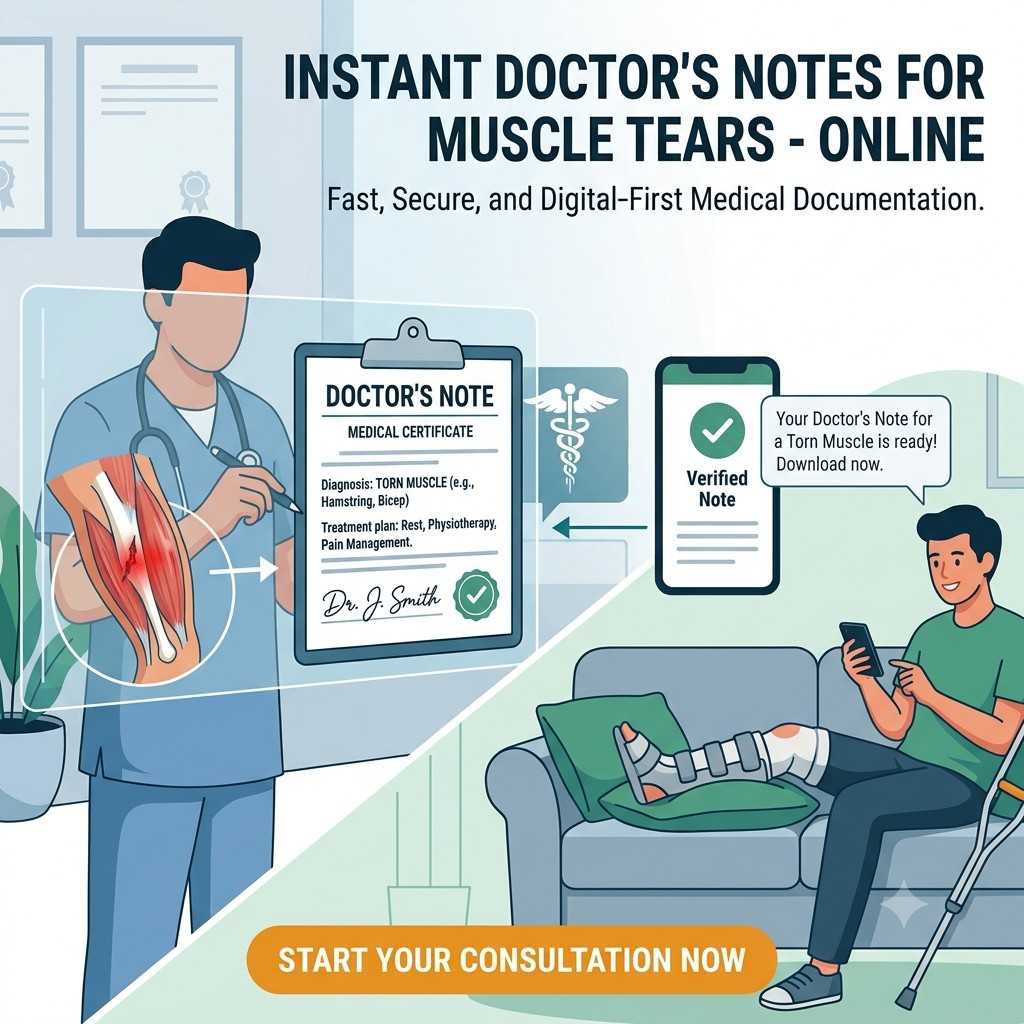




A Doctor’s Note for Torn Muscle can be helpful when a muscle injury makes it difficult to work, attend school, exercise, travel, or manage your normal daily responsibilities. A torn muscle can cause sudden pain, swelling, tenderness, weakness, bruising, and restricted movement, making even routine activities uncomfortable.
If you’ve injured a muscle and need medical documentation, an online telehealth consultation can give you a convenient way to discuss your symptoms with a healthcare professional without immediately having to travel to a clinic. Depending on your individual circumstances and clinical assessment, you may receive appropriate medical advice and, where justified, medical documentation relating to your condition.
A Torn Muscle Can Disrupt More Than Your Workout
A muscle tear isn’t only a problem for athletes.
Depending on the location and severity of the injury, you may struggle to:
- Walk normally
- Climb stairs
- Stand for long periods
- Lift or carry objects
- Bend or stretch comfortably
- Use an injured arm
- Drive or commute
- Perform physically demanding work
- Attend school or university
- Participate in sports or physical education
- Sleep comfortably
- Complete everyday household activities
If your injury has made your normal responsibilities difficult or unsafe, taking appropriate time to recover may be important.
A doctor’s note for torn muscle may provide relevant medical documentation when your injury has affected your ability to work, study, or participate in normal activities.
What Is a Doctor’s Note for a Torn Muscle?
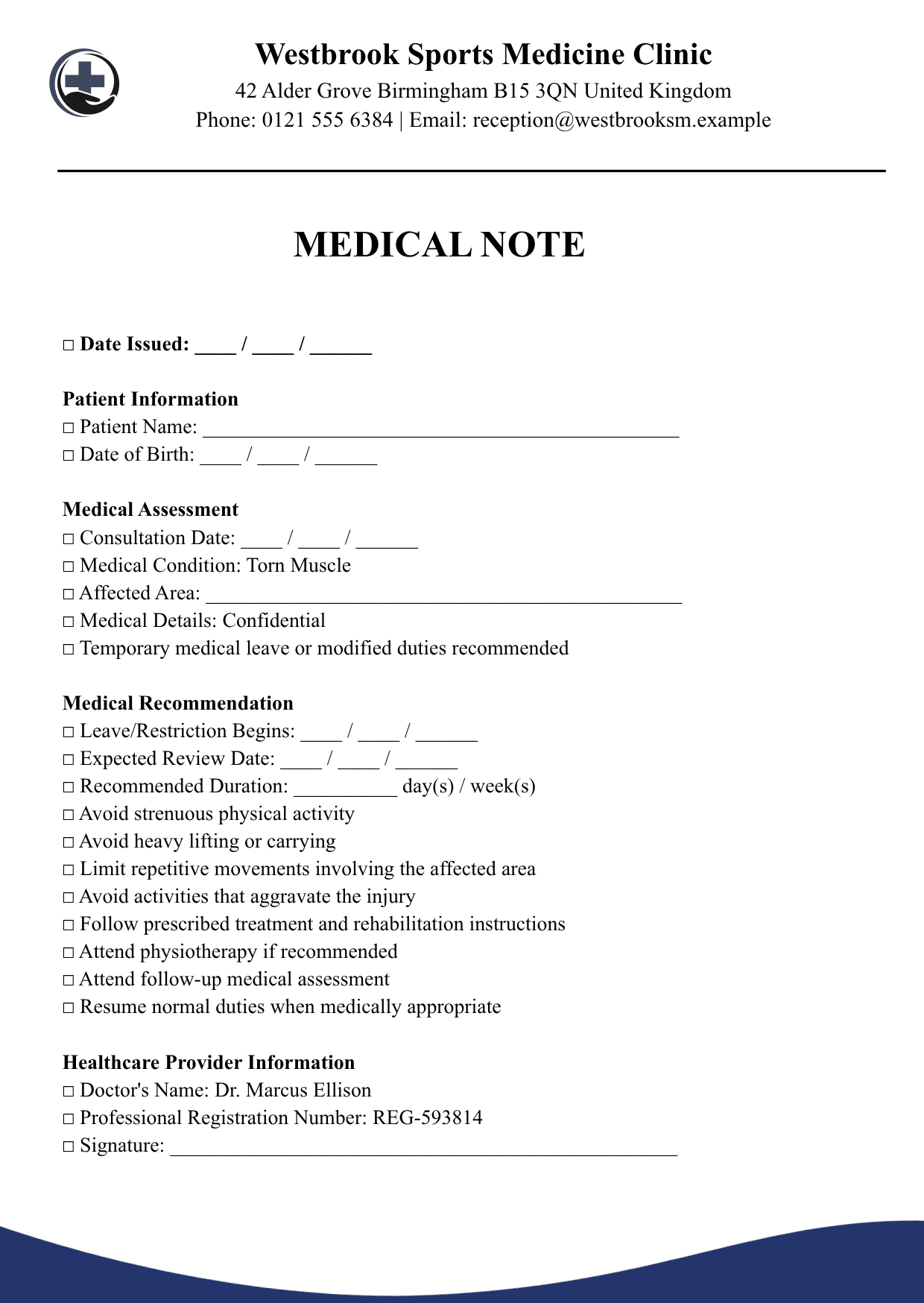
A doctor’s note for a torn muscle is medical documentation relating to a muscle injury and its effect on your health or ability to perform certain activities.
The exact information included depends on your circumstances and the healthcare professional’s assessment.
Where clinically appropriate, documentation may relate to:
- Absence from work
- Absence from school or university
- Temporary activity restrictions
- Reduced physical duties
- A period of recovery
- Restrictions on strenuous activity
- Further medical assessment or treatment
A medical note should reflect your actual health circumstances.
It isn’t simply a document that can be issued automatically because someone requests one. A healthcare professional must determine whether documentation is appropriate based on the information available and the nature of the consultation.
Muscle Tear Keeping You Off Work?
If your job involves physical activity, a torn muscle can make normal duties particularly difficult.
You may work in:
- Construction
- Warehousing
- Delivery
- Manufacturing
- Retail
- Hospitality
- Healthcare
- Cleaning
- Security
- Landscaping
- Fitness
- Transport
- Manual labour
Jobs that involve lifting, pushing, pulling, bending, carrying, climbing, standing, or repetitive movements can become challenging when you’re dealing with a muscle injury.
But physical workers aren’t the only people affected.
An office worker with a torn shoulder or back muscle may find sitting, typing, reaching, commuting, or maintaining one position uncomfortable.
If your injury is interfering with your ability to perform your normal role, discussing your symptoms with a healthcare professional can help determine whether you need temporary restrictions or time away from work.
A medical note for torn muscle can document your health situation when appropriate.
Doctor’s Note for Torn Muscle for School or University
Students can also need medical documentation after a muscle injury.
Imagine trying to attend university with a painful thigh injury that makes walking across campus difficult. Or trying to participate in physical education while experiencing significant pain in your shoulder, hamstring, calf, or back.
A muscle injury may affect:
- School attendance
- University attendance
- Physical education
- Sports activities
- Practical classes
- Examinations
- Coursework
- Travel to campus
- Concentration
- Everyday mobility
If you’ve missed educational commitments because of an injury, your school, college, or university may request supporting medical documentation.
A doctor’s note for muscle injury may be appropriate where a healthcare professional determines that the injury has genuinely affected your ability to attend or participate.
Always check the requirements of your educational institution because documentation policies vary.
What Does a Torn Muscle Feel Like?
Muscle tears can range from relatively minor injuries to more significant damage.
Common symptoms can include:
Sudden Pain
A muscle tear may cause sharp or sudden pain, particularly when the injury occurs during exercise, lifting, running, or another physical activity.
Tenderness
The affected muscle may become painful when touched or used.
Swelling
Inflammation can develop around the injured area.
Bruising
Some muscle injuries can result in visible bruising or changes in skin colour.
Weakness
You may notice that the injured muscle doesn’t feel as strong as normal.
Restricted Movement
Stretching or contracting the muscle may become difficult or painful.
Muscle Spasm
Some injuries may be accompanied by cramping or spasms.
The symptoms and severity can vary significantly depending on the muscle involved and the extent of the injury.
Common Causes of a Torn Muscle
A muscle tear can occur in many different situations.
Sports and Exercise
Running, jumping, sprinting, lifting weights, changing direction, or making sudden movements can put substantial strain on muscles.
Heavy Lifting
Trying to lift an object that is too heavy or using poor technique can result in muscle injury.
Sudden Movements
A rapid movement that the muscle isn’t prepared for can cause excessive stretching.
Falls and Accidents
A sudden impact or awkward movement during a fall can injure muscle tissue.
Overuse
Repeatedly using the same muscle without adequate recovery may contribute to injury.
Returning to Exercise Too Quickly
Training hard before a previous injury has recovered may increase the risk of another injury.
Regardless of how your injury occurred, the appropriate response depends on its severity and your individual circumstances.
Which Muscles Can Be Torn?
Muscle injuries can occur throughout the body.
Some commonly affected areas include:
- Hamstring muscles
- Calf muscles
- Quadriceps
- Groin muscles
- Shoulder muscles
- Biceps
- Triceps
- Chest muscles
- Back muscles
- Abdominal muscles
- Hip muscles
The location of the injury can have a major effect on your ability to work and perform daily activities.
For example, a torn hamstring may make walking and standing difficult, while a shoulder muscle injury may interfere with lifting, reaching, dressing, or working with your arms.
Doctor’s Note for Torn Muscle for Work
If your muscle injury affects your ability to safely perform your job, you may need to explain your situation to your employer.
Depending on your occupation, you may require:
- Temporary absence
- Reduced physical duties
- Restrictions on lifting
- Reduced standing or walking
- Temporary avoidance of repetitive movements
- Additional recovery time
A healthcare professional can assess your reported symptoms and consider how they affect your normal activities.
If appropriate, medical documentation can then support the relevant health-related absence or restriction.
The purpose isn’t simply to provide paperwork.
It’s to ensure that your health situation is properly considered.
What If You Work at a Desk?
You might assume that a torn muscle only matters if you have a physical job.
That’s not necessarily true.
For example:
A shoulder muscle injury may make typing or using a mouse uncomfortable.
A back muscle injury may make sitting for long periods difficult.
A neck muscle injury may affect your ability to maintain a fixed posture.
A leg muscle injury may make commuting or walking around the workplace difficult.
The relevant question isn’t simply, “Do you have a physical job?”
It’s:
How is the injury affecting your ability to perform your normal work safely and comfortably?
Doctor’s Note for Torn Muscle: What Happens During an Online Consultation?
An online consultation typically starts with a discussion of your symptoms and circumstances.
You may be asked:
- When did the injury happen?
- What caused it?
- Which muscle is affected?
- Did you feel sudden pain?
- Have you developed swelling or bruising?
- Can you move the affected area?
- Can you put weight on the affected limb?
- What activities make the pain worse?
- Have you taken anything for the pain?
- Have you already seen a healthcare professional?
- Has the injury affected your ability to work or study?
The healthcare professional can then determine what advice or next steps may be appropriate.
If the situation cannot be safely assessed remotely, you may be advised to seek an in-person assessment.
How to Get a Doctor’s Note for Torn Muscle Online
If you’re considering an online consultation, the process can be straightforward.
Step 1: Explain Your Injury
Provide accurate information about what happened and what symptoms you’re experiencing.
Step 2: Complete Your Telehealth Consultation
Discuss your condition with a healthcare professional remotely.
Step 3: Explain How It Affects Your Routine
Don’t only describe the pain.
Explain what you can no longer do comfortably.
For example:
“I can walk, but after ten minutes the pain becomes significantly worse.”
Or:
“My shoulder hurts whenever I lift my arm, so I can’t perform my normal work duties.”
Functional information can help the healthcare professional understand the practical impact of your injury.
Step 4: Follow the Medical Advice
You may be advised to rest, modify activities, seek further assessment, or pursue another form of treatment depending on your circumstances.
Step 5: Receive Documentation When Appropriate
If the healthcare professional determines that documentation is clinically justified, the appropriate medical documentation may be issued.
What Information Should You Have Ready?
Before starting your consultation, it can help to prepare a few basic details.
Injury Details
Know approximately when the injury occurred and what caused it.
Symptoms
Describe pain, swelling, bruising, weakness, stiffness, or restricted movement.
Location
Be specific about which part of your body is affected.
Functional Impact
Explain how the injury affects your work, studies, mobility, exercise, or everyday activities.
Previous Treatment
Mention any doctor, physiotherapist, hospital, or specialist you’ve already consulted.
Existing Documentation
If you have relevant medical records, scan results, referral letters, or previous assessments, keep them available.
Being prepared can make your consultation more useful and help you communicate your situation clearly.
Do You Need a Doctor’s Note or Medical Treatment?
These are two separate questions.
If you’re searching for a doctor’s note for muscle injury, you may primarily be concerned about explaining an absence.
But don’t overlook the injury itself.
A significant muscle tear may require appropriate treatment and rehabilitation.
Depending on the situation, healthcare professionals may recommend:
- Activity modification
- Rest
- Physiotherapy
- Rehabilitation
- Pain management
- Gradual return to activity
- Further examination
- Imaging
- Specialist assessment
The appropriate treatment depends on the specific injury.
Medical documentation should never be considered a replacement for appropriate healthcare.
Can You Get a Doctor’s Note for a Torn Muscle Online?
An online consultation may be appropriate for some situations, particularly when you need to discuss symptoms, understand your next steps, or determine whether documentation may be appropriate.
However, an online consultation cannot physically examine the injured muscle.
If your symptoms suggest a more serious injury or require physical examination, imaging, or specialist assessment, you may be directed toward in-person care.
This is an important part of responsible telehealth.
A legitimate service should assess whether online care is appropriate rather than promising that every person will receive a note.
When Should You Seek Urgent Medical Attention?
Don’t focus on obtaining documentation if your injury may require urgent treatment.
Seek appropriate urgent medical care if you experience severe or rapidly worsening symptoms, significant loss of function, major swelling, severe weakness, or another concerning symptom following an injury.
If you cannot use the affected limb normally after significant trauma, professional assessment may be particularly important.
Likewise, if you are unsure whether you have suffered a serious injury, it’s better to seek appropriate medical advice rather than attempting to manage it solely through an online documentation service.
Torn Muscle Recovery and Returning to Work
One of the most common questions people have after a muscle injury is:
“When can I go back to work?”
There isn’t one answer.
Recovery depends on factors such as:
- Which muscle is injured
- Severity of the injury
- Your symptoms
- Your occupation
- Whether your job involves physical activity
- Treatment and rehabilitation
- Your individual recovery
Someone with an office-based role may be able to return sooner than someone whose job requires heavy lifting.
Your healthcare professional can help you understand what may be appropriate based on your circumstances.
What If I Already Have a Medical Diagnosis?
If a doctor, physiotherapist, hospital, or other healthcare professional has already assessed your injury, provide that information during your consultation where relevant.
You may have:
- A clinical diagnosis
- Imaging results
- Physiotherapy notes
- A hospital discharge summary
- A referral letter
- A previous medical certificate
- Treatment instructions
Previous medical information can help provide context about your injury and recovery.
Why Choose an Online Consultation When You’re Injured?
When you’re dealing with a painful muscle injury, convenience matters.
Getting out of the house, driving, waiting in a clinic, or travelling long distances may be uncomfortable.
Telehealth can provide a convenient way to discuss your symptoms remotely when an online assessment is appropriate.
Less Travel
You can begin the consultation from a location where you’re comfortable.
Convenient Access
Useful when mobility is temporarily limited.
Clear Communication
You can explain exactly how the injury affects your work, education, and daily routine.
Appropriate Medical Assessment
A healthcare professional can determine whether online care is suitable for your circumstances.
Documentation When Clinically Appropriate
If your circumstances support medical documentation, the healthcare professional can determine whether it is appropriate to provide it.
Frequently Asked Questions
Can I get a doctor’s note for a torn muscle?
You may be able to receive medical documentation if a healthcare professional assesses your circumstances and determines that it is clinically appropriate.
Can I get a doctor’s note for a torn muscle online?
A telehealth consultation may be suitable for discussing your symptoms and determining appropriate next steps. Some injuries, however, require an in-person examination.
Can I get a sick note for a torn muscle?
If your muscle injury affects your ability to work, a healthcare professional may determine that appropriate medical documentation is justified.
Can I get a doctor’s note for a torn muscle for work?
Yes, if your injury genuinely affects your ability to perform your normal work and a healthcare professional determines that documentation is appropriate.
Can I get a doctor’s note for a torn muscle for school?
If a muscle injury has caused you to miss school, college, or university, medical documentation may be appropriate depending on the circumstances and the institution’s requirements.
What is a doctor’s note for muscle injury used for?
It can document a medically assessed injury and, where appropriate, support an absence or temporary limitation related to work or education.
How long should I stay off work with a torn muscle?
There is no universal recovery period. It depends on the severity and location of the injury, your occupation, treatment, and individual recovery.
Can an online doctor diagnose a torn muscle?
An online consultation may help assess your symptoms and determine the appropriate next step, but some muscle injuries require physical examination or further testing.
What should I tell a doctor about a muscle tear?
Explain when and how the injury occurred, where the pain is located, your symptoms, how movement is affected, and how the injury is interfering with your normal activities.
Can a torn muscle cause bruising?
Some muscle injuries can cause bruising, particularly when there is damage to blood vessels around the injured tissue. However, bruising can have multiple causes, so significant symptoms should be medically assessed.
Can I work with a torn muscle?
It depends on the injury and your job. Some people may be able to work with modified duties, while others may need temporary time away from work.
Should I exercise with a torn muscle?
You should follow appropriate medical advice regarding exercise and rehabilitation. Continuing strenuous activity despite an injury may not be appropriate.
Do I need a medical certificate for a muscle injury?
Whether you need documentation depends on why you are absent and the requirements of your employer, school, university, or other organisation.
Your Recovery Comes First. The Paperwork Comes Second.
A torn muscle can happen in seconds — during a workout, at work, on the sports field, or simply because of an unexpected movement.
The consequences can last much longer.
When pain and restricted movement make your normal responsibilities difficult, you may need more than just time to recover. You may also need appropriate medical documentation to explain why you’re unable to attend work, school, university, or other commitments.
A Doctor’s Note for Torn Muscle can help address that documentation need when a healthcare professional determines it is appropriate.
You don’t have to ignore your injury just because you need to deal with paperwork.
Start your online consultation today, explain your symptoms and how your muscle injury is affecting your normal routine, and find out what medical advice or documentation may be appropriate for you.


Reviews
There are no reviews yet.