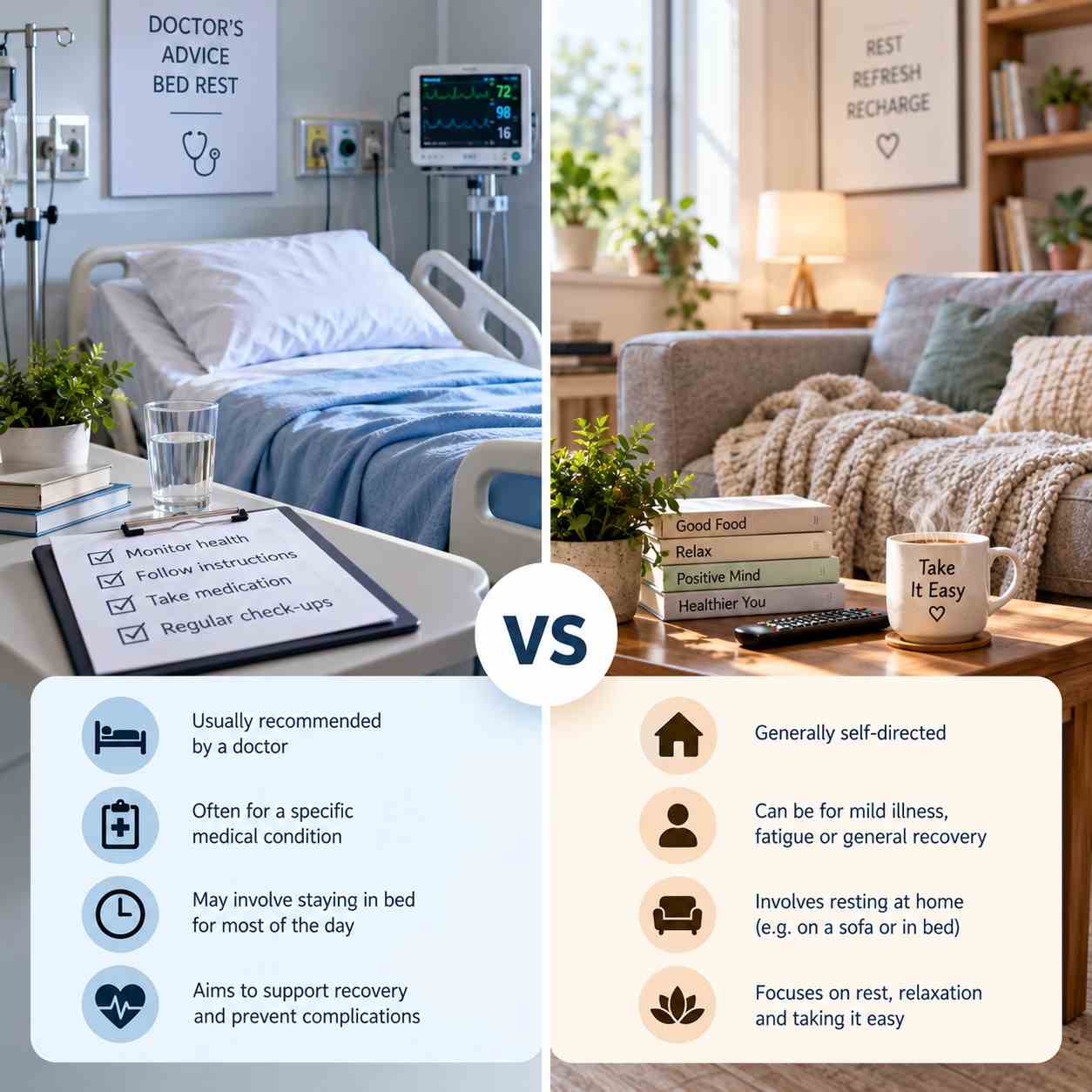
Bed rest and resting at home are not necessarily the same thing. Resting at home usually means taking time away from normal activities so your body can recover, while bed rest generally refers to a more specific medical recommendation to significantly reduce activity and spend more time resting in bed.
The distinction matters because someone can be unwell enough to stay home without actually being placed on bed rest. Conversely, a person who has been medically advised to follow bed rest may have restrictions that go beyond simply taking a sick day.
Understanding the difference can help you follow medical advice correctly, decide when you may need time away from work, and understand what medical documentation may be appropriate.
What Does Resting at Home Mean?
Resting at home is a broad term.
If you have a mild illness, infection, headache, stomach problem or general fatigue, you might choose to stay home rather than continue your usual routine. You may spend more time sitting or lying down, sleep more, drink fluids, eat when able and avoid demanding activities.
However, resting at home does not automatically mean that you have been medically instructed to remain in bed.
You might still be able to:
- Walk around your home
- Prepare simple meals
- Shower and get dressed
- Do light household activities
- Work remotely if you are well enough and your job allows it
- Take short walks if appropriate
- Attend necessary appointments
The amount of activity that is sensible depends on your symptoms and medical circumstances.
What Is Bed Rest?
Bed rest is generally more restrictive.
When a healthcare professional recommends bed rest, the intention is usually to reduce physical activity because rest may be important for managing a particular medical situation or supporting recovery.
The recommendation may involve spending substantial periods in bed and limiting activities such as:
- Prolonged standing
- Extensive walking
- Heavy lifting
- Exercise
- Physically demanding household tasks
- Manual work
- Other activities that could aggravate your condition
The exact restrictions can vary. There is no single definition that means exactly the same routine for every patient.
A doctor may therefore give you specific instructions about what you can and cannot do rather than simply saying “stay in bed.”
The Main Difference Between Bed Rest and Resting at Home
The simplest way to understand the distinction is this:
Resting at home is a general approach to recovery. Bed rest is a more specific restriction on physical activity that may be recommended for medical reasons.
Consider these examples.
Example 1: A Short-Term Illness
You develop a mild viral illness and feel tired and uncomfortable.
You decide to stay home, sleep more and avoid your normal routine.
That is resting at home.
You may still get up to make food, shower, move around your home or carry out other basic activities when you feel capable.
Example 2: A Medical Activity Restriction
You have a medical condition or injury for which a healthcare professional advises you to significantly limit physical activity.
You are told to spend substantial periods resting and avoid lifting, exercise and unnecessary physical exertion.
That is closer to medically advised bed rest or activity restriction.
The important factor is the medical recommendation and the specific restrictions involved, rather than simply how much time you personally spend in bed.
Can You Rest at Home Without Being on Bed Rest?
Yes.
This is probably the most common situation.
Someone may stay home because they are:
- Feeling unwell
- Recovering from an infection
- Experiencing pain
- Exhausted
- Dealing with digestive symptoms
- Experiencing a migraine
- Recovering after a minor illness
Being at home gives the body an opportunity to recover, but it does not necessarily mean the person has been prescribed bed rest.
You may be able to move around normally within your limits while simply avoiding strenuous activity.
Can Bed Rest Happen at Home?
Yes.
Bed rest is commonly something a person follows in their own home rather than something that requires hospital admission.
Depending on the condition, the person may spend more time in bed, reduce movement and arrange help with everyday tasks.
However, being at home does not automatically mean you are on bed rest.
Someone working from home while recovering from a minor illness is still at home, but that does not mean they have been placed on bed rest.
Bed Rest Does Not Always Mean Staying Completely Still
One common misunderstanding is that bed rest means remaining in bed without getting up.
That is not necessarily the case.
The level of restriction depends on the person’s medical circumstances and the instructions they have received.
For example, a healthcare professional may advise someone to reduce physical exertion while still allowing them to get up for:
- Food and drinks
- Personal hygiene
- Medication
- Using the bathroom
- Necessary medical appointments
- Other activities specifically permitted by their healthcare professional
Another person may have considerably stricter restrictions.
For this reason, you should not assume that another person’s bed-rest routine applies to you.
How Does This Affect Work?
The distinction can become particularly important when your health affects your ability to work.
Resting at Home
If you are simply unwell and need a short period away from work, you may stay home and recover.
For example, you might spend the morning sleeping, get up later, prepare food and rest for the remainder of the day.
Whether you can work remotely depends on how you feel, the nature of your illness and your job.
Bed Rest
If a healthcare professional has advised you to follow bed rest or significantly restrict activity, your normal work duties may not be appropriate.
This can be especially relevant if your job involves:
- Physical labour
- Lifting
- Standing
- Walking
- Driving
- Operating machinery
- Repetitive movement
Even a desk job may not be suitable if your medical circumstances require substantial rest or make concentration difficult.
The question is therefore not simply “Can I work from home?” but rather “Is working compatible with the medical restrictions I have been given?”
Does Staying Home Mean You Need a Doctor’s Note?
Not automatically.
In the UK, employees can generally self-certify sickness for up to 7 calendar days. If an absence lasts longer than this, an employer may ask for a fit note.
The requirement can depend on your employer’s sickness policy and the length of your absence.
It is also important to distinguish between different types of medical documentation.
A fit note is designed to provide information about whether someone is fit for work or may be able to work with appropriate support.
A general doctor’s letter or medical certificate may serve a different purpose and is not automatically a replacement for a fit note.
If your employer has asked for specific evidence, check exactly what they require.
Does Bed Rest Automatically Qualify You for Sick Leave?
Not necessarily.
Bed rest may make normal work impractical, but sickness absence is determined by your health and ability to work rather than the phrase “bed rest” alone.
For example, someone with a physically demanding job may be unable to work because their medical restrictions prevent lifting or prolonged standing.
Someone with a desk-based role may have different options, depending on their condition and any adjustments that could safely be made.
Your healthcare professional can assess your circumstances and provide appropriate medical advice or documentation where necessary.
What About Working From Home?
Working from home can sometimes be an option when someone is recovering, but it should not be treated as automatically suitable.
If you are resting at home with a mild illness, you might feel well enough to answer a few emails or complete limited work.
With medically advised bed rest, however, the priority may be reducing activity and allowing your body to recover.
If your symptoms make it difficult to concentrate, sit comfortably, stay awake or complete normal duties, working from home may not be realistic even if you do not need to travel to an office.
How Can You Tell Which One Applies to You?
Ask yourself what your healthcare professional has actually advised.
If the advice was simply to rest, stay home and avoid strenuous activity, you may be dealing with general home recovery rather than strict bed rest.
If you were specifically instructed to restrict activity, spend significant time resting in bed or avoid particular physical movements, the recommendation is more restrictive.
When the wording is unclear, it is better to ask the clinician rather than interpreting it yourself.
Why the Difference Matters
The distinction is useful for several reasons.
It Helps You Understand Your Medical Advice
You can make better decisions about movement, work and daily activities when you know what your healthcare professional actually expects.
It Helps You Communicate With Your Employer
If you need time away from work, your employer may need to know whether you are simply unwell or whether medical restrictions affect your ability to perform particular duties.
It Helps You Avoid Overestimating Restrictions
Not every illness requires bed rest. Treating every period of sickness as strict bed rest can lead to unnecessary inactivity.
It Helps You Avoid Underestimating Restrictions
The opposite can also be a problem. If a healthcare professional has specifically advised you to restrict activity, continuing your normal routine simply because you are at home may not be appropriate.
What If You Are Unsure Whether You Should Be on Bed Rest?
Do not rely on the terminology alone.
If you have received medical advice but are unsure whether it means:
- Complete bed rest
- Reduced activity
- Resting at home
- Avoiding exercise
- Staying off work
- Working with adjustments
ask the healthcare professional who assessed you for clarification.
A simple question such as “Which activities should I avoid, and what can I safely continue doing?” can provide much more useful guidance than trying to interpret the phrase “bed rest” yourself.
When Might Medical Documentation Be Useful?
Medical documentation can become relevant when your health affects work, insurance, travel or another formal requirement.
For example, an employer may require evidence for a longer sickness absence. An insurer may request medical evidence when assessing a claim.
The appropriate document depends on who is requesting it and why.
For employment purposes in the UK, a fit note may be relevant when the employee has been unable to work for more than 7 calendar days and the employer requests evidence.
For other situations, a medical letter or certificate may be requested instead.
If you genuinely need medical documentation, an online medical assessment may be available where clinically appropriate. DoctorsNotes.co.uk offers online medical assessment and documentation for eligible circumstances.
Any medical document should accurately reflect the person’s genuine medical circumstances. It should never be used to fabricate illness, exaggerate symptoms or provide false evidence.
Bed Rest vs Resting at Home: Quick Comparison
| Resting at Home | Bed Rest | |
|---|---|---|
| Meaning | Taking time at home to recover | A more specific reduction in physical activity |
| Always medically prescribed? | No | May be specifically recommended by a healthcare professional |
| Movement | Usually possible within your limits | May be restricted depending on the condition |
| Exercise | May be reduced depending on symptoms | Often restricted where medically advised |
| Household tasks | Light tasks may be possible | May need to be limited |
| Working | May be possible if you are well enough | May be inappropriate depending on restrictions |
| Time in bed | Can vary | Usually greater than normal, depending on medical advice |
| Medical restrictions | Not necessarily | More likely to involve specific restrictions |
Related Doctor’s Note:
Doctor’s Note for Short Term Disability
Frequently Asked Questions
Is resting at home the same as bed rest?
No. Resting at home is a broad term describing recovery away from your normal routine. Bed rest generally involves a more deliberate reduction in physical activity and may be specifically recommended for medical reasons.
Can I leave the house while resting at home?
Possibly. If you are simply recovering from an illness, you may be able to leave home when necessary and when you feel well enough. Your situation is different if a healthcare professional has specifically told you to remain at home or restrict activity.
Can I work from home while resting at home?
You may be able to if your symptoms are mild and you are well enough to work. However, being at home does not mean you are automatically fit for work.
Can I work from home while on bed rest?
Not necessarily. If your medical advice involves substantial rest or activity restrictions, working may conflict with those recommendations. Discuss your work duties with your healthcare professional.
Does bed rest mean I cannot walk?
Not always. The amount of movement permitted depends on the medical condition and the instructions provided by your healthcare professional.
Do I need a fit note if my doctor tells me to rest at home?
Not automatically. UK sickness certification depends on the length of your absence and your employer’s requirements. For sickness lasting more than 7 calendar days, your employer may ask for a fit note.
Is bed rest always better than normal activity?
No. More rest is not automatically better. The appropriate level of activity depends on the medical circumstances, and prolonged inactivity can have disadvantages. Follow the activity guidance given by your healthcare professional.
Conclusion
Resting at home and bed rest overlap, but they are not interchangeable terms.
Resting at home generally means stepping back from your normal routine while you recover. Bed rest is more likely to involve specific medical restrictions on physical activity, with the exact level depending on your condition and healthcare professional’s advice.
If you are unsure what your medical advice allows, ask what activities you can safely continue and which ones you should avoid. And if your health requires time away from work, make sure you understand whether your employer needs self-certification, a fit note or another form of medical evidence.
The most important point is simple: follow the medical advice that applies to your circumstances rather than assuming that “bed rest” means the same thing for everyone.

Dr. Anuj provides convenient online medical consultations for patients across the UK, making it easier to speak with a doctor without the need for an in-person visit.
Through secure online consultations, Dr. Anuj can assess your symptoms, discuss your concerns, and provide appropriate medical guidance. Where medically appropriate and legally permitted, a doctor’s note or medical documentation may also be provided following the consultation.