
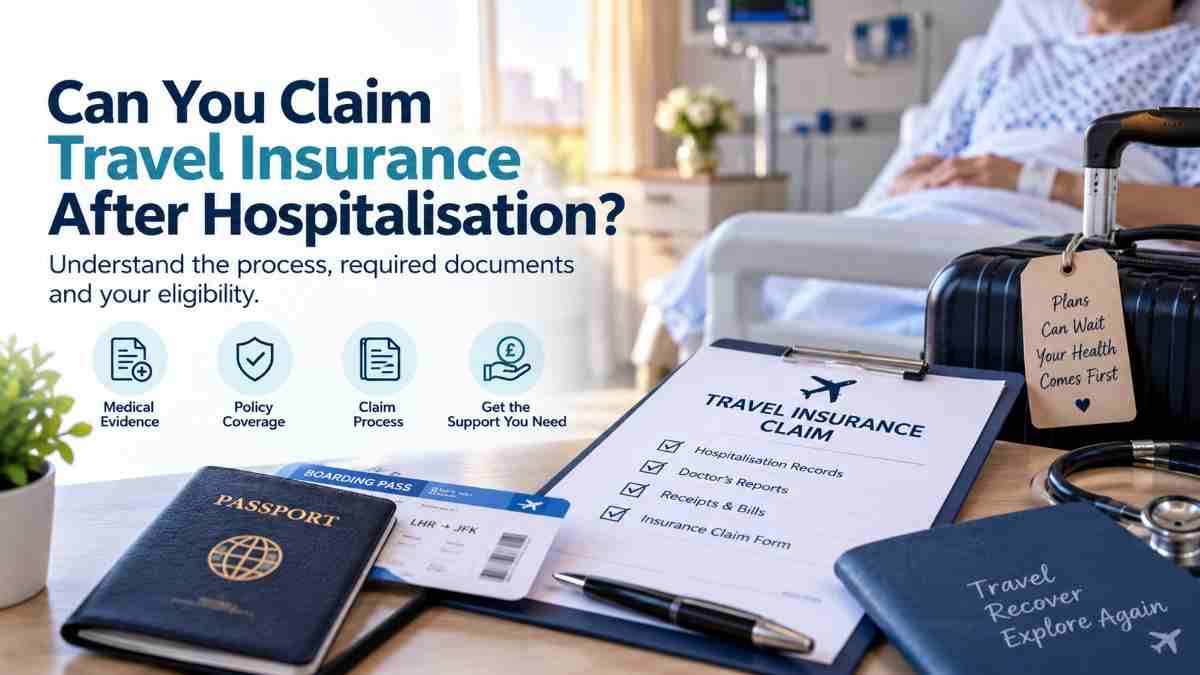
If you were admitted to hospital before your trip, your illness may affect whether you can travel and whether your cancellation cover applies. If you were hospitalised while abroad, your policy may potentially cover eligible medical treatment, additional accommodation, transport or the cost of returning to the UK, depending on the circumstances.
Hospitalisation can also provide important medical evidence for a claim. However, being admitted to hospital does not automatically mean that an insurer must pay. The medical event must fall within the policy terms, and you may need to provide records showing what happened and why it affected your travel plans.
The key issue is therefore not simply whether you were in hospital. It is whether the hospitalisation resulted from a covered event and caused a financial loss or additional expense that your policy is designed to cover.
What Can Travel Insurance Cover After Hospitalisation?
Travel insurance can contain several different types of cover, and hospitalisation may involve more than one.
Depending on the policy and circumstances, you may potentially claim for:
- emergency medical treatment abroad
- hospital and treatment costs
- prescribed medication
- emergency transportation
- medically necessary repatriation to the UK
- unused travel or accommodation costs after cutting a trip short
- additional accommodation or transport caused by a medical emergency
- cancellation costs if you could not travel because of a covered medical condition
- certain expenses incurred by a travelling companion, where the policy provides cover.
These are separate areas of cover. A policy that pays emergency medical expenses does not necessarily mean it will automatically refund a cancelled holiday.
Always check the relevant sections of your policy rather than assuming that hospitalisation itself creates a right to reimbursement.
If You Were Hospitalised Before Your Holiday
Being admitted to hospital shortly before departure can create a potential cancellation claim if your policy includes cancellation cover and the circumstances meet its requirements.
For example, suppose you have paid £2,400 for a holiday and are unexpectedly admitted to hospital several days before departure. Your doctors advise that you should not travel.
If the booking is non-refundable and your policy covers cancellation caused by the medical condition, you may be able to claim the eligible unrecoverable costs.
However, the insurer may first expect you to establish:
- that the medical problem genuinely prevented you from travelling
- when the condition occurred or changed
- that you followed the policy’s notification requirements
- how much money you could recover from the airline, hotel or travel company
- that the condition was not excluded under the policy.
The insurer may also examine your medical history if the hospitalisation relates to a condition that existed before the policy was purchased.
Does Hospitalisation Automatically Prove You Cannot Travel?
Not necessarily.
Hospital admission is strong evidence that a significant medical event occurred, but insurers may still need to establish whether the illness actually made you unable or medically unsuitable to travel.
For example, two people could be hospitalised for different reasons. One might be discharged with no restriction on travelling several weeks later, while another might be advised to avoid flying because of ongoing treatment or complications.
This is why the medical advice surrounding the hospitalisation can be just as important as the admission itself.
Your insurer may want evidence such as:
- hospital admission and discharge records
- consultant or doctor reports
- treatment records
- prescribed medication
- medical certificates
- letters explaining your diagnosis and treatment
- evidence that you were advised not to travel, where applicable.
A hospital discharge summary can therefore be useful, but it may not answer every question an insurer asks.
What If You Were Hospitalised While Abroad?
If you become seriously ill or suffer an injury during your trip and are admitted to hospital overseas, your travel insurance may potentially cover emergency medical expenses, subject to the policy.
If possible, contact your insurer’s emergency assistance service as soon as you are able.
In an emergency, treatment should not be delayed simply because you cannot reach your insurer first. However, insurers commonly advise travellers to contact them promptly and, where possible, obtain agreement for treatment.
Keep documentation from the hospital throughout your treatment.
This can include:
- admission documentation
- diagnosis
- treatment records
- discharge paperwork
- invoices
- receipts
- prescriptions
- medication receipts
- transportation records.
These documents can help establish both what treatment you received and what you paid for it.
Can You Claim the Cost of Your Hospital Treatment?
Potentially, yes, if the treatment is covered by your policy.
Emergency medical cover is one of the central purposes of travel insurance. But policies can contain exclusions, limits and conditions that affect whether particular treatment is reimbursed.
For example, insurers may consider:
- whether the treatment was medically necessary
- whether the condition was pre-existing
- whether the medical condition was declared when you bought the policy
- whether the treatment was related to an excluded activity
- whether you received appropriate authorisation where required
- whether another healthcare arrangement or entitlement applies.
If you paid the hospital yourself, retain evidence of every payment.
Do not rely only on your bank statement. Obtain proper invoices or receipts whenever possible.
What If Hospitalisation Means You Have to Cut Your Holiday Short?
A hospital admission abroad can sometimes result in curtailment, meaning you have to end your trip earlier than planned.
This is different from cancelling before the holiday starts.
For example, imagine you travel to Spain for ten days but are admitted to hospital on day four. Your medical team decides that you need to return to the UK for further care.
If your policy includes appropriate curtailment and medical cover, you may potentially claim eligible costs associated with the unused portion of the trip and necessary additional arrangements.
The exact calculation will depend on the policy.
Some policies may consider unused accommodation or travel costs, while others may provide additional benefits connected with returning home because of a medical emergency.
Do not assume that every unused holiday expense will be reimbursed.
What Happens to Your Original Flight?
Your airline and your travel insurer are separate parts of the process.
If you cannot travel because of hospitalisation, contact the airline, accommodation provider or travel company as soon as reasonably possible to find out whether any refund, credit or change is available.
If the provider gives you a refund, the amount you have actually lost may be reduced.
If the provider refuses a refund and the policy covers the cancellation, the insurer may consider the remaining eligible financial loss.
This prevents the same expense from effectively being reimbursed twice.
For example:
Holiday cost: £2,000
Refund received from travel provider: £600
Potential unrecovered amount: £1,400
Whether the £1,400 is payable depends on the policy’s cancellation terms, limits and excess.
What If You Had a Pre-Existing Medical Condition?
This is one of the most important issues in hospitalisation-related claims.
A hospital admission does not automatically create cover if the medical problem was connected to a pre-existing condition that was not properly declared or covered.
Travel insurers commonly ask questions about your medical history when you take out a policy. The exact definition of a pre-existing condition varies between insurers.
For some travellers, this could include a condition for which they recently:
- received medical advice
- had treatment
- took prescribed medication
- attended hospital
- were awaiting tests
- were waiting for surgery.
If your hospitalisation relates to a condition that existed before you purchased the policy, the insurer may review your medical history and the answers provided when the policy was arranged.
Being honest and complete during medical screening is therefore extremely important.
What If You Were Hospitalised for a New Condition?
A newly occurring medical problem can potentially be covered if it falls within the policy’s terms.
For instance, someone with no relevant previous medical history might suddenly develop appendicitis, suffer an unexpected injury or experience another acute medical emergency.
If the condition leads to hospitalisation and prevents travel, the resulting claim may potentially fall under medical or cancellation cover, depending on when it occurred and what the policy says.
The fact that something is described as a “new condition” does not by itself guarantee payment. The insurer will still assess the circumstances against the policy.
What Medical Evidence Should You Keep?
Medical documentation can make a significant difference when an insurer assesses a hospitalisation-related claim.
Try to keep a complete record rather than relying on one document.
Useful evidence may include:
- hospital admission records
- discharge summaries
- consultant letters
- GP records or letters
- medical certificates
- prescriptions
- test results where relevant
- invoices and receipts
- evidence of treatment dates
- written medical advice concerning travel
- evidence of additional travel or accommodation expenses.
Your insurer may request specific documents, so follow its claims instructions carefully.
If you need medical documentation after treatment, make sure the information accurately reflects your real medical circumstances. Documentation should support the facts of the claim rather than attempt to create eligibility that does not otherwise exist.
What If You Were Discharged Before Your Flight?
Being discharged from hospital does not necessarily mean you must travel.
Likewise, being discharged does not automatically mean you can claim.
The relevant question is whether your medical condition still prevents you from travelling and whether the policy recognises that situation.
For example, a person might leave hospital but require follow-up treatment, further observation or recovery time before travelling. Medical advice may therefore remain relevant after discharge.
If your doctor or treating clinician advises against travel, ask for appropriate documentation explaining the medical position.
That can give the insurer a clearer picture of why the trip could not reasonably proceed.
Can You Claim Without a Hospital Discharge Letter?
Possibly, but it may make the claim harder to substantiate.
The exact evidence required varies between insurers and claims.
If a discharge letter is unavailable, other records may help establish the hospital admission and treatment. Your insurer may also tell you what alternative documentation it accepts.
Do not assume that a missing document automatically means the claim will fail.
Instead, contact the insurer and ask what evidence it requires.
What If the Hospitalisation Happened After You Bought the Insurance?
This can be important.
If you purchased travel insurance and subsequently experienced an unexpected medical event, the timing may support a claim where the policy provides cover for that event.
However, simply buying insurance before becoming ill does not guarantee cancellation cover.
The insurer may examine:
- when the policy started
- when the booking was made
- when symptoms began
- when medical advice was obtained
- whether the condition was already present
- whether the policy contains relevant exclusions
- whether the cancellation occurred for a covered reason.
This is why the dates surrounding the hospitalisation should be recorded carefully.
What If You Were Already Unwell When You Bought the Policy?
This situation requires particular care.
If symptoms, investigations, treatment or a known condition existed before the policy was purchased, the insurer may consider the condition pre-existing.
That does not necessarily mean you cannot obtain travel insurance. Some insurers provide cover for travellers with medical conditions, provided the condition is declared and accepted under their terms.
The problem arises when a relevant medical condition is not disclosed or the policy specifically excludes it.
If you are arranging travel insurance after a recent hospital admission, read the medical-screening questions carefully and answer them accurately.
How Does the Insurer Calculate the Claim?
The amount paid is not necessarily the amount you originally spent.
An insurer will normally consider the covered financial loss, subject to the policy’s limits, exclusions and excess.
A simplified example might look like this:
| Cost | Amount |
|---|---|
| Flights | £900 |
| Accommodation | £1,100 |
| Refund received from providers | -£500 |
| Remaining loss | £1,500 |
| Policy excess | -£100 |
| Potential claim considered | £1,400 |
This is only an illustration. Your actual settlement could be different because insurers apply their own policy wording and claims calculations.
The cancellation limit is also important. If your policy provides less cancellation cover than the value of your holiday, you may not be able to recover the full amount.
Could a Hospitalisation Claim Be Rejected?
Yes.
Hospitalisation alone does not guarantee a successful claim.
Possible reasons for a dispute or rejection can include:
- the medical condition was excluded
- a pre-existing condition was not declared
- the policy did not include the relevant cancellation or medical cover
- the event occurred outside the policy period
- the financial loss could be recovered elsewhere
- the claim exceeded a policy limit
- the required evidence was not supplied
- an excess reduced the payable amount
- the circumstances did not meet the policy’s definition of a covered event.
If an insurer rejects your claim, read the explanation carefully against the policy wording.
If you disagree with the decision, you can use the insurer’s formal complaints process and provide additional evidence where appropriate.
Should You Get a Doctor’s Note After Hospitalisation?
If your claim depends on proving that illness or hospitalisation prevented you from travelling, medical documentation can be valuable.
A suitable medical document may help establish:
- the condition diagnosed
- when you were assessed
- treatment received
- whether you were admitted to hospital
- whether you were advised not to travel
- relevant recovery restrictions.
However, a doctor’s note should reflect genuine medical information. It should not be used to manufacture a reason for cancelling a trip.
For travellers who genuinely need medical documentation for an insurance claim, the important thing is that the document is accurate, relevant and consistent with the underlying medical records.
What Should You Do After a Hospitalisation?
Once you are medically stable, deal with the insurance side methodically.
Keep your hospital paperwork. Save admission and discharge documents, medical correspondence, prescriptions, receipts and invoices.
Check your policy. Look specifically at medical expenses, cancellation, curtailment, emergency assistance, exclusions, excesses and claim limits.
Contact the relevant travel provider. Find out whether your flight, accommodation or other booking can be refunded or changed.
Notify your insurer. Do not wait unnecessarily before reporting the incident, particularly where the insurer’s policy requires prompt notification.
Keep evidence of your financial loss. Your claim should clearly show what you paid, what you recovered and what remains outstanding.
Follow the insurer’s claims process. Submit the requested documentation and keep copies of everything you send.
What If You Need Medical Documentation for Your Claim?
Hospitalisation can generate substantial medical records, but you may still be asked for a specific form of medical evidence to support a cancellation or insurance claim.
If you genuinely need a medical document relating to your own circumstances, use an appropriate medical service and make sure the information provided is accurate.
For example, if an insurer asks for medical evidence confirming that you were medically unable to travel, the document should reflect the actual assessment and advice of the relevant healthcare professional.
This is particularly important because insurers may compare submitted evidence with other medical records when assessing a claim.
Related Doctor’s Note :
doctors note for travel insurance
Frequently Asked Questions
Can I claim travel insurance after being hospitalised?
Yes, potentially. A hospitalisation may lead to a claim for medical expenses, cancellation, curtailment or other covered costs, depending on the circumstances and your policy.
Does being admitted to hospital guarantee a travel insurance payout?
No. The hospital admission is evidence of a medical event, but the insurer will still assess whether the event is covered and whether the policy requirements have been met.
Can I claim if I was hospitalised before my holiday?
Potentially. If the hospitalisation prevents you from travelling and your policy covers cancellation for that medical reason, you may be able to claim eligible unrecoverable costs.
Can I claim if I was hospitalised abroad?
You may be able to claim eligible emergency medical expenses and, depending on your circumstances and policy, costs associated with returning home or cutting your trip short.
Does travel insurance cover a pre-existing condition that leads to hospitalisation?
It can, but only if the condition has been properly declared and accepted for cover or otherwise falls within the policy terms. Never assume that an existing condition is automatically covered.
What evidence do I need after hospitalisation?
Depending on the claim, you may need hospital records, medical certificates, discharge documents, prescriptions, invoices, receipts and other evidence showing the medical event and resulting expenses.
Can I claim if my airline gives me a partial refund?
Possibly. Travel insurance may consider the eligible financial loss that remains after you have recovered money from the airline, hotel or other travel provider.
What if my travel insurance claim is rejected?
Check the insurer’s reason for rejection against the policy wording. If you believe the decision is incorrect, you can use the insurer’s complaints procedure and provide relevant supporting evidence.
Final Thoughts
Hospitalisation can provide important evidence for a travel insurance claim, but it does not automatically guarantee compensation.
The outcome usually depends on three things: what happened medically, what financial loss resulted, and what your insurance policy actually covers.
If you were hospitalised before travelling, the issue may centre on cancellation. If you became ill abroad, medical expenses and possible curtailment or repatriation may become more important.
In either situation, keep your medical records, document your expenses, contact the relevant providers and insurer promptly, and read the policy wording before assuming that a particular cost will be reimbursed.
Most importantly, do not judge your eligibility simply by the fact that you were admitted to hospital. The connection between the hospitalisation, your ability to travel and the specific cover in your policy is what ultimately matters.

Dr. Anuj provides convenient online medical consultations for patients across the UK, making it easier to speak with a doctor without the need for an in-person visit.
Through secure online consultations, Dr. Anuj can assess your symptoms, discuss your concerns, and provide appropriate medical guidance. Where medically appropriate and legally permitted, a doctor’s note or medical documentation may also be provided following the consultation.