
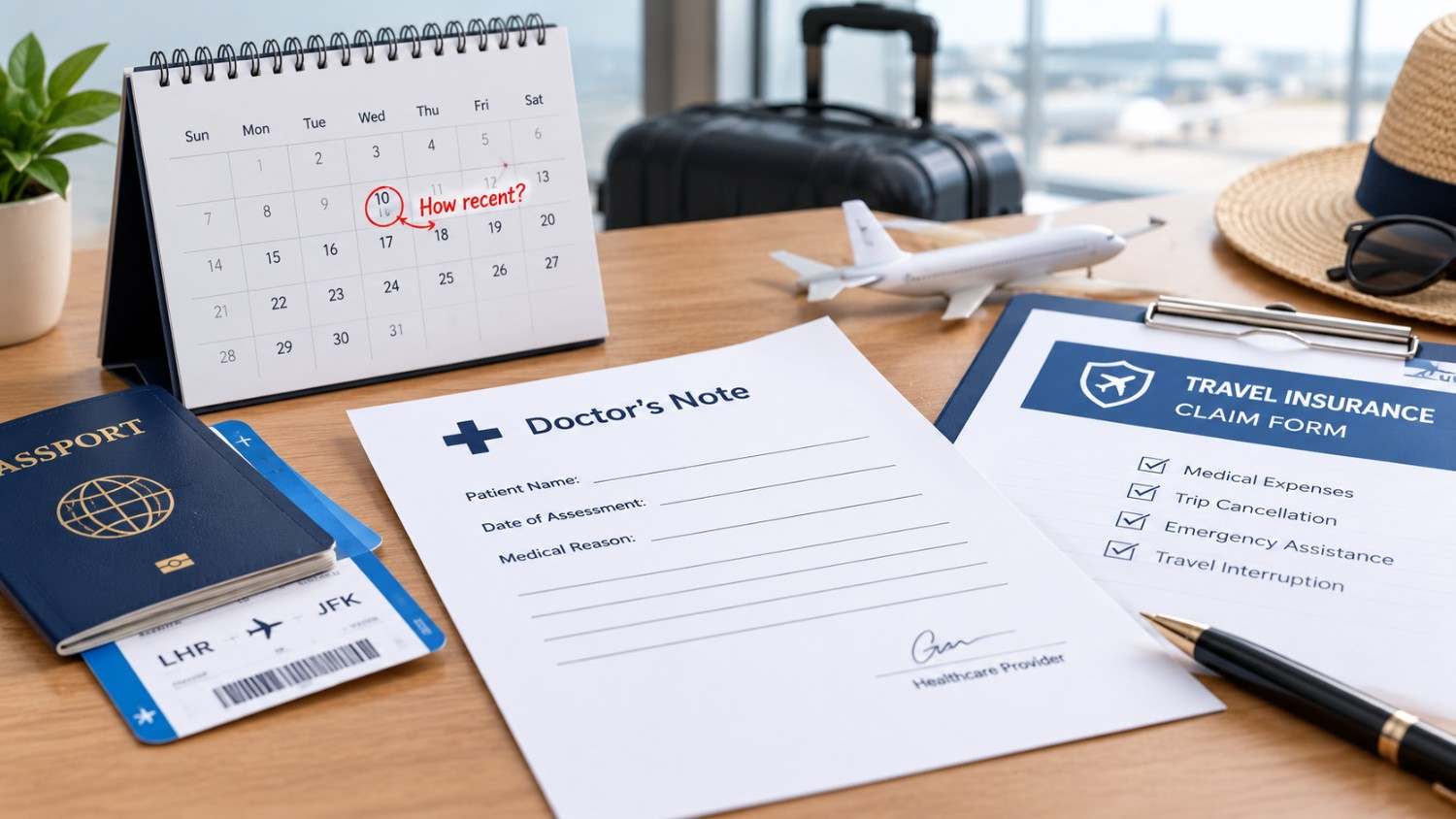
A doctor’s letter for a travel insurance claim does not usually have one universal expiry date. Whether an older letter is acceptable depends on the insurer, the policy wording, the reason for the claim and what the letter is being used to prove.
For example, a doctor’s letter written several months ago may be useful if it documents a medical condition that existed at that time. However, if you are claiming that you became too ill to travel last week, an old letter may not provide enough evidence about your current condition.
The key question is not simply:
“How old is my doctor’s letter?”
It is:
“Does the medical evidence accurately establish the medical circumstances that caused my travel insurance claim?”
If your insurer has specified a time period or provided a medical certificate that your doctor must complete, follow those requirements first.
How Recent Does a Doctor’s Letter Need to Be?
There is no standard number of days, weeks or months that applies to every travel insurance claim.
An insurer may consider:
- when the doctor assessed you
- when the illness or injury began
- when you cancelled your holiday
- your planned departure date
- whether your condition changed
- when the medical evidence was produced
- whether the letter addresses the specific reason for your claim
- whether the insurer requested a more recent assessment
For a sudden illness shortly before departure, a recent medical assessment will generally be much more relevant than an old letter.
For an ongoing or pre-existing condition, older medical records may still be relevant because they can establish your medical history.
This means “recent” is relative to the claim.
Does a Travel Insurance Medical Letter Expire?
Not necessarily.
A doctor’s letter does not normally become medically meaningless simply because a certain number of days has passed.
Instead, its usefulness depends on what it establishes.
For example, imagine that a doctor wrote a letter on 1 March confirming that you were being treated for a particular condition.
If you make a claim in September because that same condition suddenly worsened, the March letter may still be relevant to your medical history.
However, it may not be enough on its own to establish that you were medically unable to travel in September.
The insurer may therefore request additional, more recent medical evidence.
Why Does the Date of a Doctor’s Letter Matter?
The date helps the insurer establish a timeline.
For a cancellation claim, the insurer may want to understand:
When did you become ill?
↓
When did you see a doctor?
↓
When did the doctor assess your condition?
↓
When were you advised not to travel?
↓
When did you cancel the trip?
↓
What financial loss resulted?
A medical document that sits close to these events can make the timeline easier to establish.
A much older document may still be relevant, but it might not answer what happened immediately before the cancellation.
Is a Doctor’s Letter From Last Year Too Old?
Not automatically.
It depends on what the letter is being used to prove.
Example 1: Establishing medical history
You have a chronic medical condition and a doctor’s letter from last year describes your diagnosis and treatment.
That document may still be relevant as evidence of your medical history.
Example 2: Proving a recent illness
You developed a severe infection this week and cancelled your holiday.
A letter from last year would probably not establish that you had the recent infection or that you were medically unable to travel now.
Example 3: Existing condition that suddenly worsened
You have a condition documented several months ago and it has recently deteriorated.
The older letter may establish the background, while a recent consultation or medical report may establish the deterioration.
The important issue is therefore relevance, not simply age.
Does the Doctor’s Letter Need to Be Written Before You Cancel Your Holiday?
Ideally, medical evidence should reflect the circumstances as they existed when the illness or injury affected your travel plans.
If possible, seek appropriate medical advice before cancelling when your health is the reason for cancellation.
For example:
Monday: You become seriously unwell.
Tuesday: You see your doctor.
Tuesday: Your doctor advises that you should not travel.
Tuesday: You contact your insurer and cancel the holiday.
This creates a relatively clear medical timeline.
But real situations are not always that straightforward.
You may become ill outside normal surgery hours, be admitted to hospital, be unable to attend an appointment or have another genuine reason why medical assessment occurs later.
A later medical document does not automatically make a claim invalid.
However, the insurer may ask you to explain the timing and provide other evidence.
What If You Cancelled Before Seeing a Doctor?
You may still be able to make a travel insurance claim.
However, the insurer may ask why the holiday was cancelled before medical advice was obtained.
For example, you might have:
- become seriously ill overnight
- been unable to obtain an immediate GP appointment
- contacted an NHS service first
- received emergency treatment
- been admitted to hospital
- been advised by another healthcare professional not to travel
In these situations, explain what happened and provide whatever relevant evidence is available.
Do not assume that you need to create a new document simply to make the dates appear closer together.
Medical documentation should accurately reflect what actually happened.
Can a Doctor Write a Letter After the Event?
A doctor may be able to provide medical documentation after the original consultation, depending on the circumstances and the information available in the medical record.
However, there is an important distinction between:
documenting an assessment that actually took place
and
creating a new medical opinion about an event that was never assessed at the time.
An insurer may give greater weight to contemporaneous medical evidence because it records the medical circumstances closer to the event.
If you are asking a doctor for documentation after your holiday was cancelled, explain honestly:
- when you became ill
- when you cancelled
- when you received medical advice
- what treatment you received
- why you could not obtain documentation earlier
The doctor can then determine what information they are able to provide.
What Is Contemporaneous Medical Evidence?
Contemporaneous medical evidence means medical evidence created or recorded around the time the relevant event occurred.
For example:
- GP consultation on the day you became ill
- hospital record from the date of treatment
- urgent care record from shortly before departure
- prescription issued during the illness
- medical certificate completed following the consultation
This type of evidence can be particularly useful because it records the medical situation close to the time of the event.
It can help establish the chronology of a claim.
However, contemporaneous evidence is not the only evidence an insurer can consider.
The insurer may assess the complete set of documents and circumstances.
Is a Recent Doctor’s Letter Stronger Than an Old One?
Not necessarily.
A recent document is not automatically better simply because it is newer.
Consider two documents:
Letter A
Written last week but contains only:
“The patient is currently receiving treatment.”
Letter B
Written three months ago and provides detailed information about the diagnosis, consultation and treatment relevant to the claim.
Letter B could be more useful for certain aspects of the claim.
The quality and relevance of the evidence matter alongside its date.
A strong medical evidence package may therefore contain both older and newer documents.
When Might an Insurer Ask for an Updated Doctor’s Letter?
An insurer may request additional or updated medical evidence when:
Your existing letter is too old to establish the relevant event
For example, the letter describes your condition from six months ago but your claim concerns an illness this month.
Your condition has changed
The insurer may need evidence of a recent deterioration or new diagnosis.
The original letter is incomplete
The insurer may need clarification about dates, treatment or your ability to travel.
The claim concerns a specific date
For example, your holiday was due to begin on 20 September, and the insurer needs evidence concerning your condition around that date.
The insurer’s claims team specifically requests a recent assessment
If the insurer asks for updated evidence, follow that request rather than assuming that an older document will be sufficient.
How Recent Should Medical Evidence Be for a Holiday Cancellation Claim?
There is no universal rule such as:
- 7 days
- 14 days
- 30 days
- 3 months
that automatically applies to every travel insurance policy.
Instead, the insurer may look at the relationship between the medical evidence and the cancellation.
For example, if you cancel a holiday because of an unexpected illness two days before departure, evidence from a medical assessment close to that event may be particularly relevant.
If you are claiming because of a long-standing medical condition, the insurer may need a broader medical history.
The policy wording should take priority over general assumptions about how old a doctor’s letter can be.
What If the Insurer Says My Doctor’s Letter Is Too Old?
Ask the insurer exactly what it needs.
For example:
“Can you confirm the date range or medical information that the updated evidence needs to cover?”
This is much more useful than simply asking your doctor for “a newer letter”.
The insurer may need evidence confirming:
- your condition on a particular date
- when your symptoms worsened
- whether you were medically fit to travel
- whether cancellation was necessary
- when you were first assessed
- whether your condition was pre-existing
Once you know the missing information, you can ask the appropriate healthcare provider whether they can provide it.
Should You Get a New Doctor’s Letter Before Making a Claim?
Not necessarily.
If you already have medical evidence, you may want to submit the claim and allow the insurer to tell you whether anything else is required.
There is no need to automatically pay for new medical documentation simply because your existing letter is not very recent.
However, if the insurer has specifically told you that it requires an updated medical assessment, you should follow its instructions.
A practical approach is:
Check your policy → contact the insurer → identify the evidence required → provide relevant existing documents → obtain additional evidence only if necessary.
This can prevent unnecessary costs and delays.
What If Your Doctor’s Letter Is Several Months Old?
Don’t throw it away.
It may still be useful.
An older doctor’s letter can help establish:
- your diagnosis
- your medical history
- previous treatment
- the existence of a condition
- previous consultations
If the claim concerns a more recent deterioration, combine it with newer evidence where available.
For example:
Older doctor’s letter: establishes the underlying condition.
Recent GP consultation: establishes the deterioration.
Hospital record: establishes treatment.
Together, these documents may provide a much clearer medical history than a single new letter.
What About Pre-Existing Medical Conditions?
This is one situation where older medical evidence can be particularly relevant.
If you have a pre-existing condition, an insurer may need to understand:
- when the condition was diagnosed
- what treatment you received
- whether it was stable
- whether your symptoms changed
- whether you disclosed the condition when purchasing insurance
- whether the policy provides cover for it
MoneyHelper advises travellers with pre-existing medical conditions to disclose relevant health information when arranging travel insurance.
Therefore, an older medical document can sometimes be important even when the claim itself relates to a recent event.
For example:
January: medical condition documented.
March: travel insurance purchased.
July: condition worsens.
July: doctor advises against travel.
In this situation, the insurer may need both the historical evidence and recent medical evidence.
Does the Date of Your Doctor’s Letter Affect a Pre-Existing Condition Claim?
It can, but there is no simple rule that older evidence is automatically unacceptable.
The insurer may be interested in the medical timeline rather than simply the age of one particular document.
For example, if your condition existed before the insurance was purchased, an older letter may help establish that fact.
A recent letter may then establish what happened immediately before the cancellation.
The two documents serve different purposes.
Can a Hospital Record Be Better Than an Old Doctor’s Letter?
For some claims, a hospital record may provide particularly useful evidence because it records treatment close to the medical event.
For example, if you were admitted to hospital three days before your flight, the hospital documentation may help establish:
- admission date
- diagnosis
- treatment
- discharge information
- relevant medical restrictions
However, whether it is sufficient depends on what the insurer has requested.
Do not assume that one type of medical record is always superior to another.
What If You Cannot Get a Recent Doctor’s Letter?
Tell the insurer.
Explain why recent documentation is unavailable.
You may already have other evidence, such as:
- hospital records
- urgent care documentation
- prescriptions
- medical test results
- consultation records
- existing GP documentation
- treatment records
Ask the insurer what alternative evidence it will accept.
This is particularly important if you were genuinely too ill to attend a GP appointment.
Can a Doctor’s Letter Be Dated After the Holiday?
Yes, the date of the letter and the date of the medical event can be different.
For example, your doctor may provide a letter on 10 September describing an assessment that took place on 5 September.
The important information may therefore be:
Date of medical assessment: 5 September
Date the letter was prepared: 10 September
The fact that the letter was written five days later does not automatically mean it is irrelevant.
What matters is what the letter accurately documents.
What If the Doctor’s Letter Was Written Before the Holiday?
That can be useful if it records the medical assessment that led to the cancellation.
For example:
Doctor’s consultation: 12 September
Planned departure: 15 September
Doctor advises against travel: 12 September
Holiday cancelled: 13 September
This provides a relatively clear connection between the medical assessment and cancellation.
But again, the insurer will assess the circumstances against the policy.
What Should a Recent Doctor’s Letter Include?
If your insurer has asked for a doctor’s letter, check whether it has specified particular information.
Depending on the claim, relevant information may include:
- patient’s identity
- date of consultation
- medical condition
- relevant symptoms
- diagnosis where appropriate
- treatment
- relevant medical history
- changes in the condition
- effect on ability to travel
- doctor’s clinical opinion
- dates relevant to the claim
The doctor should provide only information that can be clinically supported.
You should not ask for wording that does not reflect your actual medical circumstances.
Does the Doctor’s Letter Need to Say “Not Fit to Fly”?
Only if that accurately reflects the doctor’s clinical assessment and is relevant to the insurer’s requirements.
There is no universal phrase that guarantees acceptance.
Some travel insurance claims concern general travel rather than flying specifically.
For example, a medical condition could make a particular trip unsuitable without the doctor necessarily using the phrase “not fit to fly”.
If your insurer has requested confirmation about your ability to travel, tell the doctor what the insurer has asked for and allow the doctor to provide an appropriate professional opinion.
How Does the Insurer Decide Whether the Letter Is Recent Enough?
The insurer may consider the letter alongside the complete claim.
It may ask:
Does the letter relate to the relevant illness?
Was the patient assessed around the relevant time?
Does it establish the medical reason for cancellation?
Does it provide enough information to assess the claim?
Has the patient’s condition changed since the letter was written?
Does the policy require a particular type or date of evidence?
This is why there is no universal “30-day rule” or “90-day rule” for every travel insurance claim.
What If Your Insurer Does Not Specify How Recent the Letter Must Be?
If the insurer has not given a specific timeframe, don’t automatically assume that any old letter will be accepted.
Instead, ask:
“Is my existing medical evidence sufficient, or do you require a recent medical assessment?”
This puts the decision back where it belongs—with the insurer assessing its own evidence requirements.
It can also help you avoid paying unnecessarily for another medical document.
What Medical Evidence Should You Submit With the Claim?
A travel insurance claim may involve several types of evidence.
Medical evidence
- doctor’s letter
- medical certificate
- GP records
- hospital records
- prescription records
- treatment documentation
- diagnostic results
Travel evidence
- flight booking
- hotel confirmation
- holiday itinerary
- tour booking
- cancellation confirmation
Financial evidence
- invoices
- receipts
- payment records
- cancellation charges
- refund information
Insurance documents
- policy schedule
- policy wording
- claim form
- correspondence with the insurer
Citizens Advice recommends keeping supporting paperwork when making travel insurance claims, including relevant medical documentation and financial evidence. citeturn0search1
Should You Send Your Entire Medical History?
Usually, you should provide the relevant evidence requested by the insurer rather than sending unnecessary medical information.
Medical records can contain sensitive information that has nothing to do with your claim.
If the insurer asks for particular medical information, provide the relevant evidence and follow its instructions.
If you are unsure how much information is required, ask the claims team.
Can an Old Doctor’s Letter Still Support a Travel Insurance Claim?
Yes, it can.
An older letter can remain useful when it provides relevant evidence about:
- a pre-existing condition
- previous diagnosis
- medical history
- earlier treatment
- the background to a recent medical event
But if your claim depends on a recent change in your health, an old letter may need to be supported by newer evidence.
Think of medical evidence as a timeline rather than a single document.
What If the Insurer Requests a More Recent Medical Certificate?
If your insurer specifically requests updated medical evidence, follow the request.
Ask whether it requires:
- a new doctor’s letter
- an updated medical certificate
- the insurer’s own medical form
- a GP report
- another type of medical record
Do not assume that obtaining another generic doctor’s note will solve the problem.
The best document is the one that answers the insurer’s actual question.
Can DoctorsNotes.co.uk Help With a Travel Insurance Medical Document?
If you have a genuine medical reason for making a travel insurance claim and need supporting documentation, the first step is to establish exactly what your insurer requires.
Depending on the claim, the insurer may ask for a:
- doctor’s letter
- medical certificate
- medical report
- specific insurance form
DoctorsNotes.co.uk provides medical documentation for legitimate purposes.
If you are obtaining documentation for an insurance claim, make sure the document accurately reflects your genuine medical circumstances and matches the type of evidence your insurer has requested.
Need medical documentation for a genuine travel insurance matter? Explore the relevant doctor’s letter or medical certificate service on DoctorsNotes.co.uk and check your insurer’s requirements before ordering.
Common Mistakes With Old Medical Evidence
Assuming every medical letter expires after a fixed period
There is no universal expiry period for every travel insurance claim.
Using an old letter to prove a new illness
A historical document may not establish what happened recently.
Ignoring an insurer’s request for updated evidence
If the insurer specifically requests recent documentation, address that request.
Getting a new document without knowing what information is required
You could pay for evidence that still does not answer the insurer’s question.
Confusing medical history with current medical status
An old diagnosis can establish history, but it may not establish your current ability to travel.
Waiting until after the claim to think about evidence
If possible, obtain appropriate medical advice when the illness or injury occurs.
Assuming medical evidence guarantees payment
The insurer still has to apply the policy terms to the complete claim.
Related Doctor’s Note:
Doctor’s Note for Trip Cancellation
Doctor’s Note for Travel Cancellation
Frequently Asked Questions
How old can a doctor’s letter be for a travel insurance claim?
There is no universal maximum age. The insurer will consider whether the letter is relevant to the medical circumstances and whether it provides enough evidence for the claim.
Does a doctor’s letter expire?
Not necessarily. A doctor’s letter does not automatically become invalid after a fixed period, although an insurer may require more recent evidence if the claim concerns a later change in your condition.
Is a three-month-old doctor’s letter acceptable for travel insurance?
It may be, depending on what the letter establishes and what your insurer requires. It could be useful for medical history but may not be sufficient to prove a recent illness or deterioration.
Is a six-month-old doctor’s letter too old for a travel insurance claim?
Not automatically. It may still provide relevant information about a pre-existing condition or medical history. If the claim concerns a recent event, additional evidence may be required.
Does a doctor’s letter need to be dated before I cancel my holiday?
Not necessarily. However, medical evidence created around the time of the illness can help establish the circumstances. If you obtained medical advice after cancellation, explain the timing to your insurer.
Can I use an old doctor’s letter for a pre-existing condition?
Potentially. Older medical records may help establish the history of a pre-existing condition. Your insurer may also request more recent evidence about any deterioration.
What if my insurer says my doctor’s letter is too old?
Ask exactly what information it needs and whether it requires an updated medical assessment or a specific medical certificate.
Can I get a new doctor’s letter for an old medical condition?
A healthcare professional can determine what medical information they are able to provide based on your records and assessment. The documentation should accurately reflect the medical evidence available.
Does a recent doctor’s letter guarantee my travel insurance claim?
No. The insurer will assess the medical evidence together with the policy wording, exclusions, timing and financial loss.
What if I cannot get a recent GP appointment?
Tell your insurer and ask what alternative medical evidence it will accept. Depending on your circumstances, hospital, urgent care or other relevant medical records may help.
Should I submit my old doctor’s letter with my claim?
If it is relevant to the claim, it may be useful. If you are unsure, ask the insurer whether it wants the document and whether additional recent evidence is required.
Conclusion
There is no universal rule saying that a doctor’s letter for a travel insurance claim must be less than 7, 14, 30 or 90 days old.
The value of the document depends on what it proves.
An older doctor’s letter can be useful for establishing a diagnosis, medical history or pre-existing condition. A recent medical assessment may be more important when your claim depends on a sudden illness, injury or deterioration that prevented you from travelling.
The safest approach is to:
- Check your travel insurance policy.
- Contact the insurer if its evidence requirements are unclear.
- Keep relevant medical documentation from the time of the illness.
- Provide older evidence when it helps establish your medical history.
- Obtain updated evidence if the insurer specifically requests it.
- Keep your medical and financial claim documents together.
- Make sure every document accurately reflects your genuine medical circumstances.
Ultimately, the question is not simply how old your doctor’s letter is—it is whether the evidence is relevant, reliable and sufficient to establish the medical circumstances of your claim.

Dr. Anuj provides convenient online medical consultations for patients across the UK, making it easier to speak with a doctor without the need for an in-person visit.
Through secure online consultations, Dr. Anuj can assess your symptoms, discuss your concerns, and provide appropriate medical guidance. Where medically appropriate and legally permitted, a doctor’s note or medical documentation may also be provided following the consultation.