


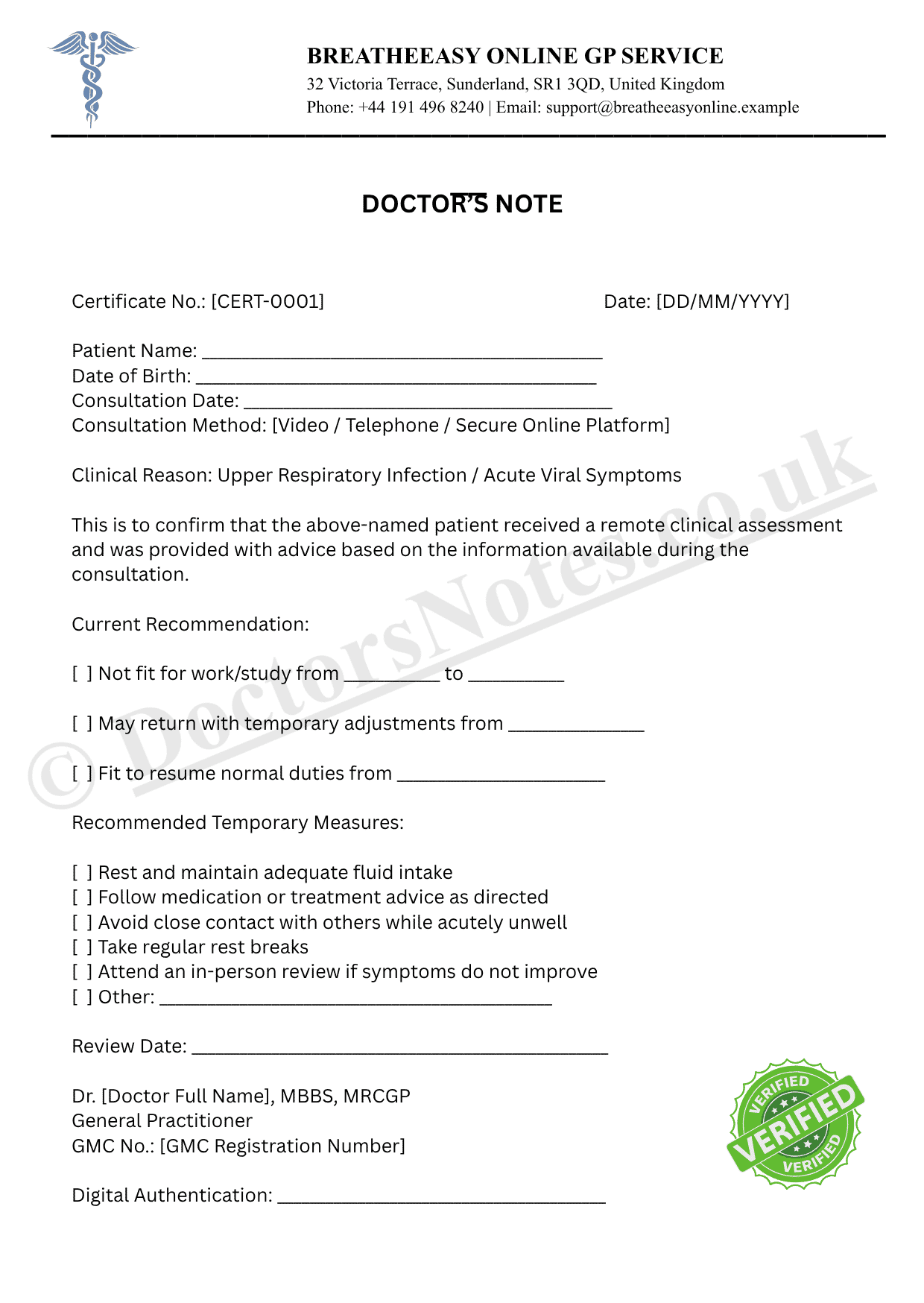
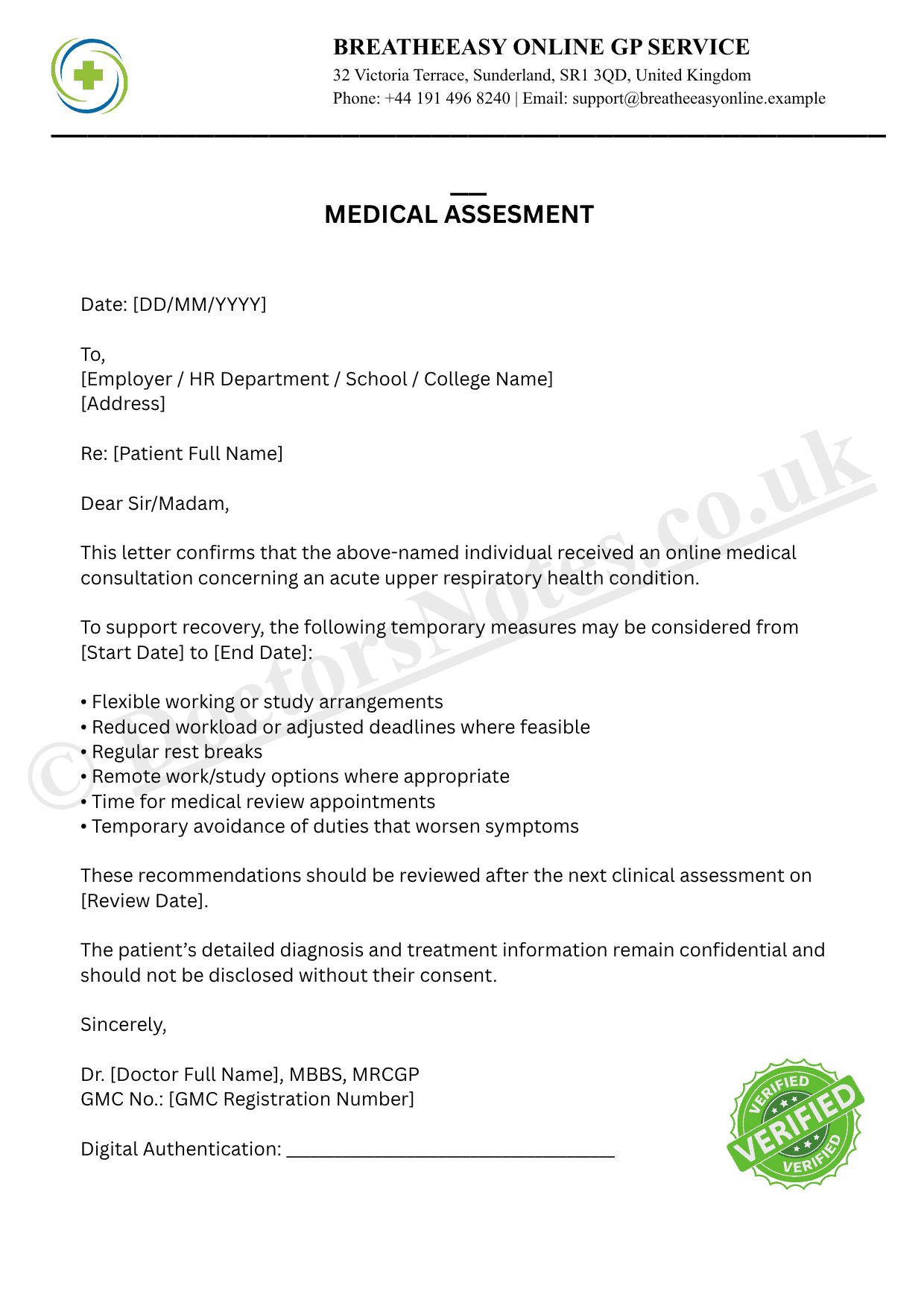


An upper respiratory infection can leave you feeling too unwell to manage a normal working day. A blocked or runny nose, sore throat, cough, headache, fever, body aches and tiredness can make even simple tasks harder.
If an upper respiratory infection is affecting your ability to work, appropriate medical documentation may help explain your sickness absence or support a discussion about temporary changes to your duties.
An online consultation can be a convenient option when your symptoms are suitable for remote assessment. You can explain what you are experiencing, discuss how it affects your normal activities and clarify what type of medical documentation may be appropriate.
Important: A doctor’s note or fit note is not guaranteed. Any medical documentation depends on an appropriate healthcare assessment.
Upper Respiratory Infection and Work at a Glance
| Situation | What it may mean for work |
|---|---|
| Mild cold-like symptoms | You may still be able to work |
| Fever and significant fatigue | Normal duties may become difficult |
| Persistent cough | Speaking or customer-facing work may be harder |
| Severe sore throat | Extended speaking may be uncomfortable |
| Headache and poor sleep | Concentration can be affected |
| Heavy congestion | Physical activity may feel more difficult |
| Feeling generally unwell | You may need time to recover |
| Symptoms worsening | Further medical assessment may be appropriate |
There is no single rule for every person with a URTI. Your symptoms, health and type of work all matter.
What Is an Upper Respiratory Infection?
An upper respiratory tract infection, often shortened to URTI, affects the upper part of the respiratory system.
This includes areas such as the:
- Nose
- Throat
- Sinuses
- Upper airways
Common upper respiratory infections include:
- Common cold
- Sinusitis
- Laryngitis
- Tonsillitis
- Pharyngitis
Upper respiratory infections are commonly caused by viruses and often improve within around one to two weeks.
What Symptoms Can an Upper Respiratory Infection Cause?
URTI symptoms can vary depending on the infection.
Common symptoms include:
- Blocked nose
- Runny nose
- Sneezing
- Sore throat
- Cough
- Headache
- Feeling tired
- Muscle aches
- Fever
- Feeling generally unwell
- Pressure around the ears or face
- Changes in taste or smell
Some people have only a few symptoms, while others feel significantly unwell.
The symptoms can also change during the course of the infection.
When Can a URTI Affect Your Ability to Work?
The diagnosis itself does not determine whether you need time away from work.
What matters is how the symptoms affect your ability to carry out your normal activities.
For example:
A receptionist
A sore throat and persistent cough may make prolonged telephone conversations difficult.
A teacher
A hoarse voice, coughing and throat discomfort can interfere with speaking throughout the day.
An office employee
Headache, fatigue and poor sleep may make prolonged concentration more difficult.
A warehouse worker
Fever, weakness or body aches may make physically demanding work difficult.
A healthcare worker
Feeling significantly unwell may affect the ability to complete a demanding shift safely.
A driver
Severe fatigue, dizziness or difficulty concentrating may make driving inappropriate.
The same infection can therefore have a very different effect from one job to another.
Doctor’s Note for Upper Respiratory Infection for Work
If you need a doctor’s note for upper respiratory infection for work, explain how your symptoms affect your actual duties.
For example:
“I have a persistent cough and severe sore throat, and my job requires me to speak with customers throughout the day.”
Or:
“I have fever, body aches and significant fatigue, so I am struggling with the physical demands of my job.”
This gives a clearer picture than simply stating that you have a respiratory infection.
During an assessment, you may be asked about:
- When your symptoms started
- Which symptoms are most troublesome
- Whether they are improving
- Whether you have a fever
- How your sleep is affected
- Any treatment you have tried
- Your normal work activities
- How the infection affects those activities
Can You Get an Online Doctor’s Note for an Upper Respiratory Infection?
For some people, an online assessment may be suitable.
A healthcare professional can discuss your symptoms and consider how they affect your ability to work.
An online consultation may cover:
- Your current symptoms
- How long you have been unwell
- Recent cold or flu-like illness
- Relevant medical history
- Medicines or treatments
- Work responsibilities
- The effect on your daily activities
- Your employer’s documentation requirements
However, an online consultation cannot replace every form of medical examination.
If you have significant breathing problems, chest pain, severe deterioration or another concerning symptom, appropriate medical care takes priority.
How to Prepare for an Online URTI Assessment
A few minutes of preparation can make the consultation more useful.
Step 1: Record when you became unwell
Think about the first symptom and how the illness developed.
Step 2: Identify your main symptoms
For example:
- Cough
- Sore throat
- Congestion
- Fever
- Headache
- Body aches
- Fatigue
Step 3: Describe the progression
Explain whether you are:
- Improving
- Staying the same
- Getting worse
- Developing new symptoms
Step 4: Mention anything you’ve taken
Include relevant medicines, home treatments or advice you have already received.
Step 5: Explain your job
Tell the healthcare professional what you normally do during a working day.
Step 6: Explain your documentation requirement
If your employer has requested medical evidence, say what they have specifically asked for.
Upper Respiratory Infection vs Common Cold
These terms are related but are not identical.
A common cold is one type of upper respiratory infection.
URTI is a broader term that can include infections affecting the nose, throat and sinuses.
| Term | Meaning |
|---|---|
| URTI | Broad category of infection affecting the upper respiratory tract |
| Common cold | A common type of viral upper respiratory infection |
| Sinusitis | Infection or inflammation involving the sinuses |
| Laryngitis | Inflammation/infection affecting the voice box |
| Tonsillitis | Inflammation/infection involving the tonsils |
This distinction matters when discussing your symptoms because different upper respiratory conditions can produce different problems.
Is an Upper Respiratory Infection the Same as Flu?
No.
Flu can cause respiratory symptoms, but it often produces a more significant systemic illness.
NHS guidance notes that a common cold usually develops gradually and mainly affects the nose and throat, while flu tends to come on more quickly and can leave someone much more exhausted and unable to continue normal activities.
If you are unsure whether your symptoms are a cold, flu or another respiratory infection, explain the symptoms rather than trying to diagnose yourself.
Can an Upper Respiratory Infection Make You Too Ill to Work?
It can.
A mild infection may not prevent you from working. However, more significant symptoms can make normal duties difficult.
You may find work harder because of:
- Fever
- Exhaustion
- Headache
- Muscle aches
- Persistent coughing
- Severe throat discomfort
- Poor sleep
- Nasal congestion
- General weakness
If you are too unwell to perform your normal duties, appropriate medical assessment can help determine what support or documentation may be suitable.
Do You Need a Sick Note for a URTI?
Not necessarily.
In the UK, employees can generally self-certify sickness absence for the first 7 calendar days, including weekends and bank holidays. A fit note becomes relevant when a healthcare professional assesses that the condition affects fitness for work and further medical evidence is needed.
Your employer may have its own sickness-reporting procedure, so check what you are expected to do.
If you are considered fit for work, you do not need a fit note simply because someone has requested one.
What Is the Difference Between a Sick Note and a Fit Note?
People often use these terms as though they mean exactly the same thing.
In UK employment terminology, the formal document is a Statement of Fitness for Work, commonly called a fit note.
A fit note provides advice about fitness for work.
It can indicate:
Not fit for work
The healthcare professional considers that the person’s condition currently prevents them from working.
May be fit for work
The person may be able to work if suitable adjustments are possible.
The advice is intended to support communication between the employee and employer.
Could You Work With an Upper Respiratory Infection?
Possibly.
Having a URTI does not automatically mean you need complete time away from work.
The decision can depend on:
- Severity of symptoms
- Type of work
- Physical demands
- Ability to concentrate
- Need to speak frequently
- Whether you have a fever
- Whether you can safely complete your duties
- Whether temporary adjustments are possible
If your symptoms are mild, you may be able to continue normal activities. If you feel too unwell to carry out your duties safely, staying home and recovering may be more appropriate.
Could Workplace Adjustments Help?
Sometimes.
Depending on your role and symptoms, temporary changes might include:
- Reduced physical duties
- More frequent rest breaks
- Temporary home working
- Reduced customer-facing activity
- Reduced speaking requirements
- Adjusted working hours
- Temporary reassignment of certain tasks
A fit note can indicate that someone may be fit for work with adjustments. The employer and employee can then discuss whether those changes are practical.
Upper Respiratory Infection and Working From Home
Working from home can reduce commuting and make it easier to rest between tasks.
However, it does not automatically mean you are fit to work.
If you have:
- Significant fatigue
- Fever
- Severe headache
- Persistent coughing
- Poor concentration
- Difficulty staying awake
you may still be unable to work effectively even from home.
The key issue is your ability to perform your duties, not simply where you perform them.
Can a URTI Affect Concentration?
Yes.
Concentration can become harder when you are dealing with:
- Headaches
- Poor sleep
- Fatigue
- Fever
- Persistent coughing
- General illness
This may be particularly relevant to jobs involving:
- Computer work
- Data entry
- Driving
- Financial decisions
- Customer support
- Detailed paperwork
- Safety-sensitive tasks
If concentration is a major problem, explain the specific tasks you are struggling with.
Upper Respiratory Infection and Customer-Facing Work
Customer-facing roles can be challenging when you have a cough, sore throat or frequent sneezing.
Examples include:
- Receptionists
- Retail employees
- Teachers
- Call-centre staff
- Hospitality workers
- Healthcare staff
A healthcare professional may consider the symptoms and their functional effect when assessing fitness for work.
You should also follow your workplace’s infection-control and sickness procedures.
Upper Respiratory Infection and Physical Work
Physical activity may feel harder when you have fever, fatigue or body aches.
This can be especially relevant if your job requires:
- Lifting
- Carrying
- Climbing
- Walking long distances
- Outdoor work
- Repetitive movement
- Heavy manual activity
Do not assume that a diagnosis automatically means you cannot work. Explain what you can and cannot comfortably and safely do.
How Long Does an Upper Respiratory Infection Last?
Many upper respiratory infections improve within around one to two weeks.
However, symptoms do not always disappear at the same speed.
For example, a cough can continue after other symptoms have improved. NHS guidance notes that an acute cough may last for several weeks.
If symptoms are getting worse, failing to improve or continuing for longer than expected, seek appropriate medical advice.
What Can You Do While Recovering?
For many uncomplicated respiratory infections, self-care can help.
Useful measures include:
- Getting enough rest
- Drinking plenty of fluids
- Eating normally where possible
- Using appropriate symptom relief
- Asking a pharmacist about suitable medicines
- Avoiding smoking
NHS guidance recommends rest and fluids for respiratory infections and notes that antibiotics do not help viral infections.
Do not assume antibiotics are necessary simply because symptoms are uncomfortable.
When Should You Seek Medical Advice?
Contact an appropriate healthcare service if:
- Your symptoms are getting worse
- You feel very unwell
- A high temperature persists
- You have a long-term health condition that increases your risk
- You have a weakened immune system
- Your cough continues for several weeks
- You are concerned about your symptoms
NHS guidance specifically recommends medical advice for respiratory infections when symptoms worsen, a high temperature lasts more than three days, blood is coughed up, a cough lasts more than three weeks, or certain risk factors are present.
When Is an Upper Respiratory Infection an Emergency?
A doctor’s note should never delay urgent medical treatment.
Seek urgent help if you develop serious symptoms such as:
- Significant difficulty breathing
- Chest pain
- Coughing up blood
- Severe deterioration
- Other symptoms that make you feel seriously unwell
NHS guidance advises urgent assessment for respiratory symptoms involving breathing difficulty or chest pain.
If you believe you are experiencing an emergency, seek appropriate emergency medical care rather than arranging an online documentation consultation.
Can a Doctor’s Note for URTI Be Backdated?
Do not assume that a fit note can simply be backdated to match the dates requested by an employer.
If you have already been assessed by a healthcare professional, details from that assessment may be relevant.
Any documentation covering previous sickness should reflect the healthcare professional’s assessment and clinical judgement.
How Long Can a Fit Note for a URTI Last?
There is no standard number of days that applies to every upper respiratory infection.
The appropriate duration depends on:
- Your symptoms
- Severity
- Recovery
- Functional limitations
- Type of work
- Clinical assessment
GOV.UK guidance states that during the first six months of a health condition, a fit note can be issued for a maximum of three months at a time. A review date can also be set where appropriate.
Who Can Issue a Fit Note for an Upper Respiratory Infection?
Current UK guidance allows these five professions to certify fit notes:
- Doctors
- Nurses
- Occupational therapists
- Pharmacists
- Physiotherapists
The healthcare professional must have the appropriate knowledge, skills, training and clinical responsibility to assess fitness for work.
A fit note may also be based on relevant written information from another healthcare professional, with the eligible professional retaining responsibility for the certification.
What If Your Employer Wants Medical Evidence?
First, find out exactly what your employer requires.
They may ask for:
- A fit note
- Medical evidence
- A medical report
- Confirmation of treatment
- Other sickness documentation
These documents are not necessarily interchangeable.
If your employer specifically asks for a fit note, make sure you understand that a general medical letter may not meet the same requirement.
What Should You Tell the Healthcare Professional?
Before your consultation, make a quick note of:
Your illness
☐ When symptoms began
☐ Main symptoms
☐ Whether symptoms are improving
☐ Whether you have a fever
☐ Whether you have breathing symptoms
☐ Any treatment already taken
Your daily function
☐ Sleep affected
☐ Concentration affected
☐ Speaking affected
☐ Physical activity affected
☐ Normal activities difficult
Your work
☐ Job duties
☐ Physical demands
☐ Customer contact
☐ Driving
☐ Speaking requirements
☐ Workplace adjustments that may be possible
Documentation
☐ Employer’s request
☐ Dates of absence
☐ Previous medical assessment
☐ Relevant medical information
Why Consider an Online Assessment?
When an online consultation is clinically appropriate, it can remove some of the practical difficulty of travelling while unwell.
You can explain:
- What symptoms you have
- How long you have been ill
- How the illness affects your work
- What treatment you have tried
- What documentation your employer requires
The healthcare professional can then decide whether remote assessment is appropriate and what, if any, medical documentation is justified.
If a physical examination or urgent treatment is needed, you should use the appropriate in-person service instead.
How Many Days Off Work Do You Need for an Upper Respiratory Infection?
The number of days off work you need for an upper respiratory infection depends on your symptoms, the cause of the infection, and the type of work you do. Many common respiratory infections improve within 7–10 days, although a cough or tiredness may last longer. If you have a fever, persistent coughing, a sore throat, congestion, or significant fatigue, taking time off may help you rest and reduce the risk of spreading an infectious illness to others.
A healthcare provider can assess your symptoms and recommend an appropriate period of rest based on your condition. If medically necessary, they may provide a doctor’s note documenting the recommended absence dates or temporary work restrictions. You may need additional time off if your symptoms are severe, your job involves strenuous physical activity, or you work closely with vulnerable people. The appropriate leave period varies from person to person.
Before returning to work, consider whether your symptoms are improving and follow your workplace’s illness policy and applicable public health guidance. Contact a healthcare professional if your symptoms worsen, your fever persists, or you are not improving as expected. Seek urgent medical care if you experience difficulty breathing, chest pain, confusion, or other severe symptoms.
FAQs
Can I get a doctor’s note for an upper respiratory infection?
You may receive appropriate medical documentation if a healthcare professional assesses your condition and considers it clinically justified.
Can I get a doctor’s note for a URTI for work?
If the infection affects your fitness for work, a healthcare professional can assess whether a fit note or other appropriate documentation is suitable.
Can I get an online doctor’s note for an upper respiratory infection?
Some uncomplicated respiratory infections may be suitable for online assessment. However, symptoms requiring physical examination or urgent treatment should be assessed through the appropriate medical service.
What symptoms can an upper respiratory infection cause?
Common symptoms include a blocked or runny nose, sneezing, sore throat, cough, headache, fever, aches and feeling generally unwell.
Is a common cold an upper respiratory infection?
Yes. A common cold is one type of upper respiratory infection.
Is sinusitis an upper respiratory infection?
Yes. Sinusitis is included among upper respiratory infections affecting the upper airways.
Can an upper respiratory infection stop me from working?
It can, particularly when symptoms such as fever, severe fatigue, headaches, persistent coughing or significant throat symptoms interfere with your normal duties.
Can I work from home with a URTI?
Possibly, if you are well enough to work. Working from home does not automatically mean you are fit for work.
Do I need a sick note for the first 7 days?
Generally, no. Employees can self-certify sickness absence for the first 7 calendar days.
Who can issue a fit note for a URTI in the UK?
Doctors, nurses, occupational therapists, pharmacists and physiotherapists can certify fit notes when they meet the relevant requirements and can appropriately assess fitness for work.
Can a fit note recommend temporary changes to my work?
Yes. A fit note can state that someone may be fit for work with adjustments. The employer and employee can then discuss whether suitable changes are possible.
How long does an upper respiratory infection usually last?
Many respiratory infections improve within one to two weeks, although some symptoms, particularly cough, can last longer.
Do upper respiratory infections need antibiotics?
Not usually when the infection is viral. Antibiotics do not treat viral respiratory infections.
Can a URTI cause a cough that lasts for weeks?
Yes. A cough can continue after other respiratory symptoms improve. A persistent cough lasting more than three weeks should be medically assessed.
Can an upper respiratory infection cause a fever?
Yes. A high temperature can occur with respiratory infections. Persistent or worsening fever should be medically assessed.
Can a doctor’s note for a URTI be backdated?
It should not be assumed that documentation can be backdated simply to cover dates requested by an employer. Previous clinical information may be considered where appropriate.
Is an upper respiratory infection doctor’s note guaranteed?
No. Medical documentation depends on the outcome of an appropriate healthcare assessment.
When should I seek urgent medical help for a respiratory infection?
Seek urgent medical help if you develop significant difficulty breathing, chest pain, cough up blood or become seriously unwell.
Can I use an online assessment instead of emergency care?
No. If your symptoms require urgent medical attention, seek appropriate urgent or emergency care rather than using an online consultation primarily for documentation.
Discuss Your Upper Respiratory Infection and Work Situation
An upper respiratory infection may start like an ordinary cold but can still interfere with work when symptoms become more intense.
If coughing, fever, fatigue, headaches, congestion or throat symptoms are making your normal duties difficult, an appropriate medical assessment can help clarify your situation.
Have your symptoms, work responsibilities and any employer documentation requirements ready before your online consultation.


Reviews
There are no reviews yet.