
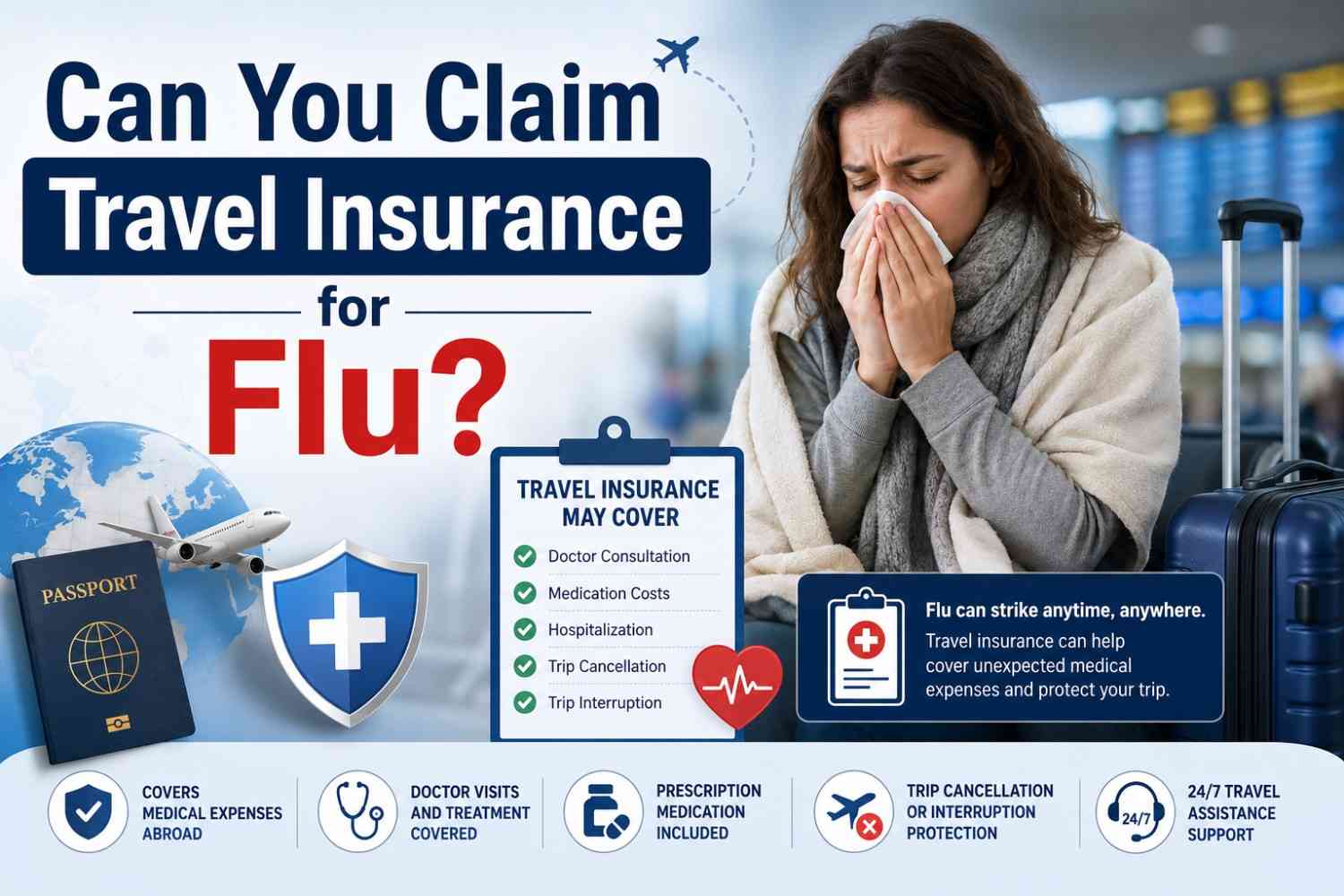
Getting flu just before a holiday can leave you wondering whether you should still travel, whether you can recover the money you’ve already spent and, most importantly, can you claim travel insurance for flu?
The answer is: potentially, yes, but it depends on your travel insurance policy, the severity of your illness, when you became unwell and whether a medical professional considers you fit to travel.
Flu can sometimes be more than an inconvenience. High fever, severe fatigue, body aches, breathing difficulties and other symptoms may make flying or travelling unsafe or unrealistic. If your illness means you cannot travel or you need medical treatment while abroad, your policy may provide relevant cover. However, cancellation and medical claims are subject to policy conditions and exclusions.
Can You Claim Travel Insurance for Flu?
You may be able to claim travel insurance for flu if your illness meets the requirements of your policy.
Many travel insurance policies can provide cover when an insured traveller becomes unexpectedly ill and has to cancel or cut short a trip. Travel insurance can also cover eligible emergency medical treatment if you become seriously ill while abroad. However, policies differ considerably, so you need to check the exact wording of your cover.
A flu-related claim could potentially involve:
- Cancelling your holiday before departure
- Cutting your trip short because of illness
- Emergency medical treatment abroad
- Additional travel expenses in certain circumstances
- Unused accommodation, depending on the policy
- Other eligible non-refundable costs
Simply having flu does not automatically mean your insurer will pay a claim.
The insurer will normally consider the circumstances, the medical evidence and the terms of your policy.
Can You Cancel a Holiday Because of Flu?
Possibly.
If you develop significant flu symptoms before your departure date and a healthcare professional advises that you are not fit to travel, your travel insurance may provide cancellation cover if the circumstances are included in your policy.
Travel insurance commonly provides cancellation protection for certain unexpected illnesses, but policies may specify exactly what qualifies as a covered medical reason.
Before cancelling your booking, it is sensible to check:
- Your travel insurance policy
- Your airline’s cancellation or rebooking terms
- Your accommodation provider’s refund policy
- Your tour operator’s terms
- Whether your insurer requires medical evidence
The ABI recommends speaking to your airline, travel agent or tour operator about available options before relying on travel insurance.
How Sick Do You Have to Be to Cancel a Holiday?
There isn’t a universal flu symptom threshold that automatically qualifies you for an insurance claim.
For example, having a mild cough may not be enough to establish that you were medically unable to travel.
A more serious illness may be different.
If you have symptoms such as:
- High temperature
- Severe weakness
- Significant body aches
- Serious respiratory symptoms
- Persistent vomiting
- Difficulty breathing
- Severe dehydration
- Symptoms that prevent normal daily activities
you may need medical assessment.
If a healthcare professional determines that you are medically unfit to travel, their assessment may become important evidence for a cancellation claim.
Does Travel Insurance Cover Flu if You Get Sick Abroad?
Potentially, yes.
Overseas medical cover is one of the main components of travel insurance. Depending on the policy, it can include eligible emergency medical treatment, hospital costs and ambulance expenses if you become ill abroad. Some policies can also cover returning you to the UK if you cannot use your original travel arrangements because of your medical condition.
If you develop severe flu symptoms while travelling, contact your insurer’s emergency assistance service as soon as it is safe to do so.
However, medical treatment should not be delayed because you are unsure about insurance.
In an emergency, seek appropriate medical care first and contact your insurer afterwards if necessary.
What If Flu Means You Have to Cut Your Holiday Short?
This is known as curtailment.
If you become seriously ill during your trip and the circumstances satisfy your policy, your travel insurance may potentially cover certain additional costs associated with returning home early and, depending on the policy, some unused holiday expenses.
Before arranging expensive changes to your journey, contact your insurer where practical.
Your insurer may want to:
- Speak with your treating doctor
- Confirm your medical condition
- Arrange appropriate travel
- Approve additional accommodation or transport
- Explain which expenses may be covered
Do not assume that every unused holiday cost will automatically be reimbursed.
Can You Claim for a Flight If You Have Flu?
Possibly, but your circumstances matter.
If you become ill before departure and your policy provides cancellation cover for the relevant medical circumstances, you may be able to claim eligible non-refundable costs.
However, your first step should usually be to ask the airline or travel provider what options are available.
You may be offered:
- A refund
- A flight change
- A travel credit
- Rebooking
- Another form of compensation
Travel insurance is not necessarily the first source of reimbursement. The ABI advises travellers to check with their travel provider before making an insurance claim.
What If the Airline Refuses to Refund You Because of Flu?
This is where your travel insurance may become relevant.
If your airline’s terms do not provide a refund and your travel insurance includes cancellation cover for the circumstances, you may be able to claim eligible unrecoverable costs.
Your insurer may ask for evidence that:
- You were genuinely unwell
- The illness occurred at the relevant time
- You were medically advised not to travel, where required
- The booking was cancelled
- The amount you are claiming cannot be recovered elsewhere
Keep all correspondence with your airline or travel provider.
Can a Doctor’s Note Help With a Flu Travel Insurance Claim?
Yes, medical evidence can be important when claiming travel insurance for flu, particularly if your claim is based on being medically unable to travel.
A healthcare professional’s documentation may help establish:
- When you became unwell
- Your diagnosis or symptoms
- The severity of the illness
- Whether you were medically fit to travel
- Any treatment recommended
- Whether you were advised to avoid travel
However, a doctor’s note does not guarantee that an insurance claim will be accepted.
The insurer will still assess the claim according to the policy terms.
What Should a Doctor’s Note for Travel Insurance Include?
If your insurer specifically requests medical documentation, ask what information it requires.
Depending on the circumstances, relevant information could include:
- Patient identification
- Date of medical assessment
- Relevant illness or diagnosis
- Clinical findings
- Treatment or advice provided
- Whether travel was medically appropriate
- Recommended recovery period
- Healthcare professional details
The documentation should be accurate and based on an actual medical assessment.
Can You Claim Travel Insurance for Flu Without Seeing a Doctor?
This depends on the insurer and the type of claim.
Some policies may require medical evidence for cancellation claims, particularly where the reason for cancellation is illness.
If you simply decide not to travel because you feel unwell but have no medical assessment, you may find it more difficult to demonstrate that the illness meets the policy’s requirements.
If you are seriously unwell or believe your illness may affect your travel plans, getting appropriate medical advice can be important both for your health and for documenting the circumstances.
Do You Need a Positive Flu Test for Travel Insurance?
Not necessarily.
There is no universal requirement across all travel insurance policies that every flu claim must be supported by a positive flu test.
The evidence an insurer requires depends on its policy wording and claims process.
Your insurer may instead ask for medical records, a doctor’s assessment or other evidence supporting the illness.
Always check your policy or ask your insurer what evidence is required before submitting a claim.
Can You Claim Travel Insurance for Flu if You Have a Pre-Existing Condition?
This can be more complicated.
If you have a pre-existing medical condition that could affect your health while travelling, you may need to disclose it when purchasing travel insurance.
The ABI and GOV.UK both advise travellers to declare relevant existing medical conditions and follow the insurer’s medical screening requirements. Failure to disclose relevant information can affect your cover.
For example, if you have an existing respiratory condition and subsequently develop flu, the insurer may consider whether the pre-existing condition was declared and whether it is relevant to the claim.
That does not automatically mean the claim will be rejected.
It means the policy needs to have been arranged appropriately.
What If You Already Had Flu Symptoms Before Buying Travel Insurance?
This is an important distinction.
Travel insurance is generally designed to cover unexpected insured events, rather than problems that you already knew about when purchasing the policy.
If you were already ill, had symptoms or had been advised not to travel before taking out the policy, you should not assume that a later cancellation will be covered.
The ABI warns that travel insurance may not cover situations where you already knew of a reason you might need to cancel and did not check the position with your insurer.
Always be honest about your circumstances when buying insurance.
Can You Buy Travel Insurance After You Get Flu?
Buying travel insurance after becoming ill does not normally turn an existing illness into a new insured event.
Travel insurance should generally be purchased before you travel, and ideally when you book your holiday so that cancellation protection can apply from the appropriate point.
If you already know you are sick and then purchase a policy expecting it to cover the illness, you could encounter exclusions or a rejected claim.
What Evidence Do You Need to Claim Travel Insurance for Flu?
The exact requirements vary between insurers, but you should keep relevant evidence such as:
- Medical notes or certificates
- Doctor’s letters
- Prescription information
- Medical treatment records
- Receipts for medication
- Flight bookings
- Hotel or accommodation bookings
- Cancellation confirmations
- Correspondence with travel providers
- Receipts for eligible additional expenses
- Your travel insurance policy details
If you receive medical treatment abroad, keep receipts and documentation. Citizens Advice specifically recommends keeping evidence of medical treatment and medication when making a travel insurance claim.
How Do You Make a Travel Insurance Claim for Flu?
Although each insurer has its own process, the general steps are straightforward.
Step 1: Check Your Policy
Look at the sections covering:
- Medical expenses
- Cancellation
- Curtailment
- Exclusions
- Pre-existing conditions
- Medical evidence
- Excesses
- Claim deadlines
Step 2: Contact Your Insurer
Use the contact details provided in your policy.
Step 3: Contact Your Travel Provider
Ask whether your flight, accommodation or holiday booking can be refunded, changed or rescheduled.
Step 4: Collect Your Evidence
Keep medical documentation, receipts and booking information.
Step 5: Submit Your Claim
Complete the insurer’s claim form and provide the requested supporting evidence.
Citizens Advice recommends checking the policy’s claim time limits, cover and excess before submitting a claim.
What Happens If Your Flu Travel Insurance Claim Is Rejected?
Do not immediately assume that you have no further options.
Read the insurer’s explanation carefully.
Check whether the rejection relates to:
- A policy exclusion
- A pre-existing condition
- Missing medical evidence
- Lack of cancellation cover
- Failure to notify the insurer
- Costs that could have been recovered from another provider
- A missed claims deadline
If you believe the insurer has made an incorrect decision, follow its formal complaints procedure.
For eligible disputes, you may eventually be able to approach the Financial Ombudsman Service after completing the insurer’s complaints process.
Does a GHIC Cover Flu Treatment Abroad?
A GHIC can provide access to medically necessary state healthcare under applicable arrangements in certain European countries, but it is not a substitute for travel insurance.
It does not provide the same protection as travel insurance for things such as emergency repatriation and other travel-related losses.
If you are travelling abroad, having appropriate travel insurance remains important.
Should You Travel With Flu?
If you are seriously unwell, travelling may not be appropriate.
Flu can cause significant fatigue, fever and other symptoms that can make a journey extremely difficult. If you are unsure whether you are medically fit to travel, seek advice from a healthcare professional.
If a healthcare professional advises you not to travel, keep evidence of that advice if you may need to discuss cancellation with your insurer.
Do not travel simply because you are worried about losing the money you’ve spent on your holiday.
Your health should come first.
How Can You Avoid Problems With a Flu Travel Insurance Claim?
A few simple steps can make the process easier.
Buy Insurance Early
The ABI recommends purchasing travel insurance as soon as you book your holiday because cancellation protection can be important if you later become ill.
Declare Relevant Medical Conditions
Be honest when answering medical screening questions.
Read the Cancellation Section
Do not assume every illness automatically qualifies.
Keep Medical Evidence
If you see a healthcare professional, retain relevant documentation.
Keep Receipts
Medical treatment, medication and other eligible expenses may need to be supported by receipts.
Save the Emergency Assistance Number
Keep your insurer’s contact details accessible while travelling.
FAQ
Can you claim travel insurance for flu?
Yes, potentially. A travel insurance policy may cover eligible cancellation, curtailment or medical expenses resulting from flu, but the illness and circumstances must meet the policy’s conditions.
Can I cancel my holiday because I have flu?
You may be able to claim cancellation costs if your policy covers illness and your circumstances meet its requirements. Medical evidence may be required.
Does travel insurance cover flu treatment abroad?
Potentially. Overseas travel insurance commonly includes emergency medical treatment, but exactly what is covered depends on the policy.
Can I claim for a flight I missed because of flu?
Possibly, depending on your policy and the circumstances. Check with the airline first and then your insurer if the costs remain unrecoverable and the event is covered.
Do I need a doctor’s note for a flu travel insurance claim?
You may need medical evidence, particularly for a cancellation claim based on being medically unable to travel. Check your insurer’s requirements.
Do I need a positive flu test to claim travel insurance?
Not necessarily. Requirements vary between insurers. Your provider may accept other medical evidence depending on the policy.
Can I claim if I had flu symptoms before buying insurance?
You should not assume you are covered. Travel insurance generally does not provide cover for circumstances you already knew about when purchasing the policy. Check with your insurer.
Can I claim travel insurance for flu if I have a pre-existing medical condition?
Potentially, but you may need to declare the condition when buying your insurance. Failure to disclose relevant medical information can affect your cover.
Can flu stop me from travelling?
Yes. If your symptoms are significant, you may be medically advised not to travel. If this happens, keep evidence of the medical advice and contact your insurer.
Can you claim travel insurance if you get flu abroad?
Potentially. Your policy may cover eligible emergency medical treatment or, in some circumstances, the costs associated with cutting your trip short.
What documents are needed for a flu travel insurance claim?
Depending on the claim, you may need medical documentation, receipts, booking confirmations, cancellation evidence and correspondence with your travel provider.
What should I do if my flu travel insurance claim is rejected?
Read the reason for rejection, compare it with your policy wording and follow the insurer’s complaints process if you believe the decision is incorrect.
Need Medical Documentation for a Travel Insurance Claim?
If flu has affected your travel plans and your insurer requires medical evidence, make sure you understand exactly what documentation it needs.
If a healthcare professional has assessed your illness and you need appropriate documentation for a travel insurance matter, you can learn more about our Doctor’s Note for Travel Insurance service.
Medical documentation should accurately reflect your circumstances and should only be used for its intended purpose.
Conclusion
So, can you claim travel insurance for flu?
Potentially—but having flu alone does not guarantee a successful claim.
Your chances depend on your policy, the circumstances of your illness, whether you were medically fit to travel, whether relevant medical conditions were declared and what evidence you can provide. Travel insurance may potentially help with eligible cancellation costs before departure or emergency medical expenses if you become ill abroad.
If you become seriously unwell before travelling, don’t simply cancel your holiday and hope your insurer pays. Check your policy, seek appropriate medical advice, speak with your travel provider and keep documentation of what happened.
And if you become ill while abroad, prioritise medical care first and contact your insurer as soon as it is safe to do so.

Dr. Anuj provides convenient online medical consultations for patients across the UK, making it easier to speak with a doctor without the need for an in-person visit.
Through secure online consultations, Dr. Anuj can assess your symptoms, discuss your concerns, and provide appropriate medical guidance. Where medically appropriate and legally permitted, a doctor’s note or medical documentation may also be provided following the consultation.