
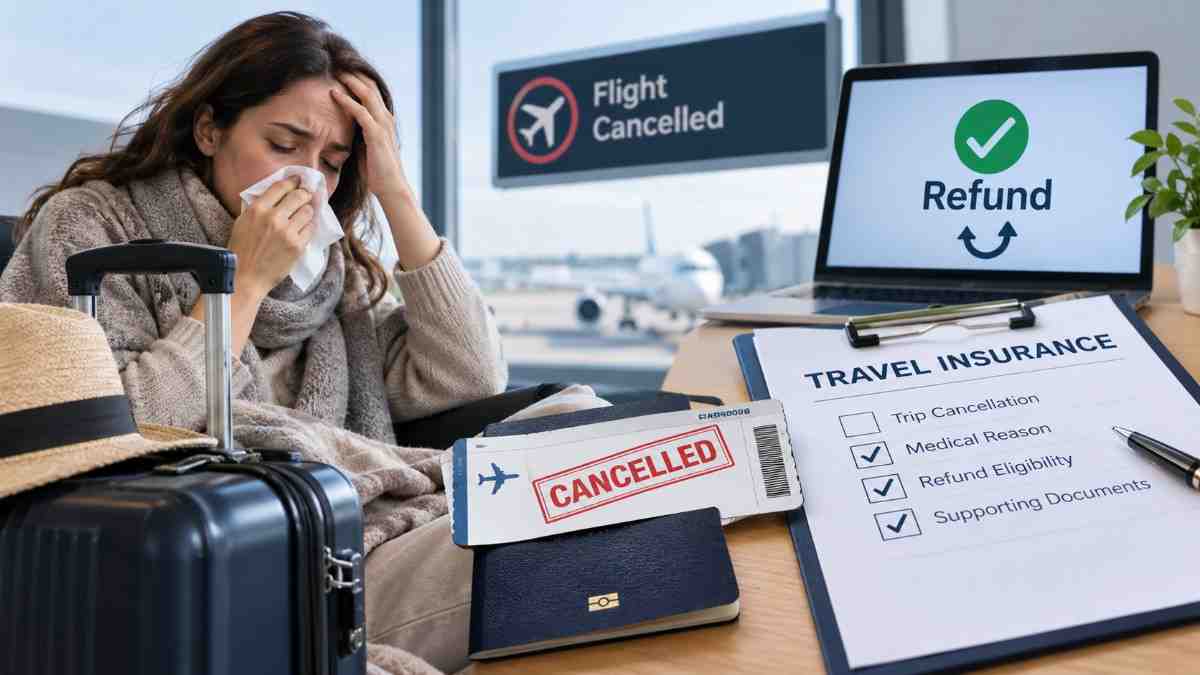
You have a holiday booked, but you are now too sick to travel. The flights are paid for, the hotel has been reserved and some of the bookings may be non-refundable. Naturally, the first question is: can you get a travel insurance refund if you are too sick to travel?
The answer is often possibly, but it depends on your travel insurance policy and the reason you cannot travel.
Travel insurance does not normally work like an automatic refund service. If your illness is covered under the cancellation section of your policy, you may be able to claim back eligible financial losses that you cannot recover from the airline, hotel or travel company. The insurer will normally want evidence showing what happened and why you were unable to take the trip.
Understanding the difference between an airline refund, a travel-company refund and an insurance claim can make the process much easier.
Is a travel insurance refund the same as a holiday refund?
Not exactly.
If you cancel a holiday, there may be several different routes through which you could recover money.
The travel company might offer a refund under its own cancellation terms. Your airline might allow a change or refund depending on your ticket. Your travel insurance may then cover certain losses that remain after those options have been considered.
For example, imagine you paid £1,800 for flights and accommodation. You become seriously ill before departure and cancel the trip.
The airline refunds £400, while the hotel keeps £1,000 under its cancellation conditions. If your travel insurance covers the medical reason for cancellation, the insurer may consider the remaining eligible loss, subject to your policy’s limits and excess.
So, travel insurance is generally there to cover an insured loss, not to provide a second refund for money you have already received back.
Does travel insurance cover you if you are too sick to travel?
It can.
Many travel insurance policies include cancellation cover for certain medical circumstances before departure. However, the policy must cover the particular situation.
An insurer may consider factors such as:
- What illness you developed
- When you became unwell
- Whether you were medically advised not to travel
- Whether the illness was already known
- Whether a pre-existing condition was disclosed
- What cancellation cover your policy provides
- How much money you actually lost
- Whether the costs could be recovered elsewhere
This is why the phrase “too sick to travel” by itself is not enough to determine whether a claim will be accepted.
Two travellers with similar symptoms could potentially have different outcomes because their policies, medical circumstances or booking arrangements are different.
What illnesses can lead to a travel insurance cancellation claim?
There is no single list of illnesses that guarantees a payout.
Travel insurance normally looks at whether the circumstances meet the conditions of the policy rather than simply checking the name of the illness.
A sudden illness that genuinely prevents you from travelling may potentially be covered. Examples could include a significant infection, serious injury, acute illness or another medical problem that makes travel inappropriate.
However, having symptoms does not automatically create a valid claim.
For example, a mild headache or common cold may not meet the policy’s requirements for cancellation. A more serious medical event may do so, particularly where appropriate medical advice confirms that travelling would not be suitable.
The policy wording is therefore more important than trying to find a universal list of “covered illnesses”.
What if a doctor says you are not fit to travel?
Medical advice can be important evidence in a cancellation claim.
If you become seriously unwell and a GP or another appropriate healthcare professional assesses you and advises that you should not travel, keep the relevant medical documentation.
This can help establish the circumstances behind the cancellation.
It is important to understand what medical evidence can and cannot do. A doctor’s note does not automatically guarantee an insurance payment. The insurer will still compare your circumstances with the policy conditions.
Likewise, you should never request medical documentation containing information that is not medically accurate.
If an insurer has asked you to provide a doctor’s note or other medical documentation for a genuine travel insurance matter, you can explore our Doctor’s Note for Travel Insurance service to understand the documentation process and what may be appropriate for your circumstances.
Related Doctor’s Note:
Doctor’s Note for Cruise Refund
Do you need to cancel the holiday before making a claim?
Usually, the travel provider and insurer both need to be involved, but the exact process varies.
If you know that you cannot travel, check your policy and contact the insurer as soon as reasonably possible. At the same time, find out what your airline, hotel, tour operator or booking provider can refund.
This matters because the insurer will generally want to know what financial loss remains after any refunds or credits have been applied.
Keep confirmation of cancellations and refunds.
For example, if a hotel confirms that £300 is refundable but £900 is non-refundable, keep that confirmation. It can help demonstrate the amount you are actually claiming.
How much money can travel insurance pay back?
There is no standard travel insurance refund amount.
The maximum depends on the cancellation limit in your policy, while the amount you actually receive depends on your eligible financial loss.
Suppose your holiday cost £4,000, but your cancellation cover has a £2,500 limit. Even if the entire booking becomes non-refundable, the policy may not cover more than its stated limit.
There may also be an excess.
An excess is the amount you are responsible for under the policy before the insurer pays the remaining eligible claim.
For this reason, check the cancellation limit and excess when buying travel insurance rather than looking only at the premium.
What happens to non-refundable flights?
This is one of the situations where travel insurance can potentially be useful.
Airline tickets can have different rules depending on the fare, route and booking conditions. A non-refundable ticket may not become refundable simply because you are ill.
However, if your illness falls within the cancellation cover of your travel insurance, the insurer may consider the financial loss associated with the unused flight.
You should still contact the airline.
If the airline offers a refund, credit, rebooking option or partial reimbursement, tell the insurer. Your claim should reflect your actual remaining loss.
What happens to a non-refundable hotel booking?
The same principle applies to accommodation.
A hotel may have a strict cancellation policy, particularly when the booking was made at a discounted or non-refundable rate.
If you are too sick to travel and your insurance covers the cancellation, the insurer may consider the non-refundable portion of the accommodation cost.
But you should first establish exactly what the hotel or booking platform will return.
Keep the cancellation confirmation because the insurer may ask for evidence of the amount that could not be recovered.
What if you have booked a package holiday?
Package holidays can involve different cancellation arrangements from independently booked flights and hotels.
If you have booked a package through a tour operator, contact the provider to understand its cancellation and refund terms.
The amount you can recover from the provider may affect any subsequent insurance claim.
Travel insurance can potentially cover eligible cancellation losses, but the exact position depends on the policy and the booking arrangement.
Do not assume that a package holiday and an independently booked flight and hotel will be treated in exactly the same way.
What if your illness is a pre-existing condition?
This is an important area to check before making a claim.
A pre-existing medical condition may be treated differently from a new and unexpected illness. Travel insurers have their own definitions and medical screening requirements.
If you already had a medical condition when you purchased the policy, the insurer may have asked you questions about it. Depending on the answers, the condition might have been accepted, excluded or covered under specific terms.
If that condition later becomes worse and prevents you travelling, the insurer may look at the information provided when the policy was purchased as part of its assessment.
This is why being honest during medical screening matters.
Do not assume that a condition does not need to be mentioned simply because it is currently under control.
What if you become sick after buying the policy?
A new illness that develops after you have bought travel insurance can potentially be covered if it falls within the policy’s cancellation conditions.
The timing can therefore be significant.
Imagine you purchase travel insurance in January and your holiday is in July. In June, you develop an unexpected illness that makes you medically unable to travel.
The insurer may consider the claim under the cancellation section, assuming the illness and circumstances satisfy the policy.
But the existence of insurance does not mean every illness that happens after purchase is automatically covered. The policy conditions still apply.
What if your health changes after you buy insurance?
A change in your health can sometimes affect your insurance position.
For example, you might buy a policy while your health is stable and then receive a new diagnosis, start treatment or experience a significant deterioration before travelling.
Check your policy and contact the insurer if you believe there has been a material change that may be relevant to your cover.
Do not wait until you are making a claim to discover that the insurer expected you to report a change in circumstances.
The exact requirements vary between policies, so follow the instructions in your own documents.
What evidence will the insurer ask for?
A cancellation claim needs more than an explanation that you were ill.
The insurer may ask for evidence supporting both the medical reason and the financial loss.
Depending on the claim, this could include:
- Medical documentation
- Evidence of medical advice
- Your travel insurance certificate
- Flight or holiday booking confirmations
- Cancellation receipts
- Evidence of non-refundable costs
- Refund information from the travel provider
- Receipts or payment records
- Details of any alternative compensation received
You do not necessarily need every item listed above.
The insurer will tell you what it requires for your particular claim.
The best approach is to keep your records from the moment you realise you cannot travel.
Can you claim without seeing a doctor?
This depends on the circumstances and the insurer’s requirements.
If you are claiming that a medical condition made you unable to travel, medical evidence may be important.
A claim can become more difficult if there is no independent evidence of the illness or its impact on your ability to travel, particularly when the policy specifically requires medical confirmation.
That does not mean every illness requires the same type of documentation.
If you are genuinely unwell, seek appropriate healthcare advice based on your symptoms and circumstances. Do not delay necessary treatment simply to obtain paperwork for an insurance claim.
What if you recover before the departure date?
This can create a different situation.
Suppose you become ill a week before your holiday and initially believe you cannot travel, but then recover sufficiently before departure.
Whether you should continue with the trip depends on your health and appropriate medical advice.
From an insurance perspective, you should not cancel a booking and submit a claim for a loss that did not ultimately arise from a covered circumstance.
If you have already notified your insurer about a potential claim, update them if your circumstances change.
Good communication can prevent confusion later.
What if you are too sick to travel but someone else paid for the holiday?
The person who paid for the booking and the person who is insured can sometimes be different.
For example, a partner may have paid for the entire family holiday, or an employer may have paid for a business trip.
The policy will determine who is covered, what losses can be claimed and how the claim should be documented.
Do not assume that the person who paid automatically has the right to receive the insurance payment.
Check the policy and provide evidence showing the booking, payments and relationship between the people involved where relevant.
Can you get money back if you simply decide not to travel because you are unwell?
Not necessarily.
There is a significant difference between:
“I do not feel like travelling because I am worried about becoming unwell.”
and
“I have developed a medical condition and have been advised that I should not travel.”
Travel insurance cancellation cover generally operates according to defined insured events and conditions.
Feeling uncomfortable about travelling, changing your mind or deciding that the holiday is no longer convenient does not automatically create an insured claim.
If you are medically unfit to travel, appropriate medical evidence can help establish the circumstances.
What should you do if your travel insurance claim is rejected?
If your insurer rejects the claim, read the decision carefully before assuming the matter is finished.
The insurer should explain why it believes the claim falls outside the policy.
Check:
- Which policy condition was used to make the decision.
- Whether the insurer says information was missing.
- Whether the medical evidence supports the circumstances.
- Whether any part of the booking was refundable.
- Whether an exclusion or pre-existing-condition clause applies.
If you disagree with the decision, follow the insurer’s formal complaints procedure.
Keep copies of your policy, medical evidence, booking records and correspondence. If the complaint cannot be resolved with the insurer, you may be able to take the matter to the Financial Ombudsman Service, depending on your circumstances and eligibility.
How can you improve your chances of a smooth claim?
The strongest approach is preparation rather than trying to build a claim after everything has happened.
When buying travel insurance, check the cancellation limit against the amount you could lose. Make sure you understand the medical screening questions and disclose information accurately.
After booking, keep your travel documents together.
If illness occurs, obtain appropriate medical advice and contact the relevant travel provider. Ask what portion of your booking can be refunded and retain the response.
Then contact your insurer and follow its claims procedure.
This creates a clear record of the medical event, the cancellation and the financial loss.
When should you buy travel insurance?
Ideally, buy travel insurance soon after booking your holiday.
Waiting until the day before departure can leave you without protection for events that happen between booking and the purchase of the policy.
Early purchase can be particularly useful because cancellation cover is relevant before you travel, not just while you are overseas.
It also gives you time to check whether the policy is appropriate for your circumstances, particularly if you have an existing medical condition.
Frequently Asked Questions
Can I get a travel insurance refund if I am too sick to travel?
You may be able to recover eligible non-refundable costs if your illness is covered by your policy’s cancellation section. The insurer will assess your medical circumstances and financial loss.
Does travel insurance refund the whole holiday?
Not necessarily. The payout depends on the covered financial loss, policy cancellation limit, excess, exclusions and any refunds you receive from the travel provider.
Can I claim travel insurance for a non-refundable flight if I am ill?
Potentially. If the illness is covered under your cancellation insurance, the non-refundable portion of the flight may form part of an eligible claim.
Do I need a doctor’s note to cancel a holiday because of illness?
You may need medical evidence to support the claim. The exact requirements depend on the insurer and the circumstances.
What happens if my airline gives me a partial refund?
Tell your insurer about the refund. Your insurance claim will generally be based on the eligible loss that remains after recoverable amounts have been taken into account.
Can I claim if I have a pre-existing medical condition?
Possibly. It depends on whether the condition was disclosed and whether the insurer agreed to cover it under the policy.
Can I claim if I become ill after purchasing travel insurance?
A new illness may be covered if it meets the policy’s cancellation conditions. Buying insurance does not automatically make every subsequent medical event claimable.
How long do travel insurance claims take?
There is no single timeframe. It depends on the insurer, complexity of the claim and whether all required medical and financial evidence has been supplied.
Can I claim for a hotel that refuses to refund me?
Potentially. If the hotel cost is covered under your cancellation insurance and the circumstances meet the policy requirements, the non-refundable loss may be considered.
Should I cancel my holiday before contacting my insurer?
Check your policy and contact the insurer as soon as practical. If you need urgent medical care, deal with your health first. Your insurer can explain the required claims process.
Final thoughts
If you are too sick to travel, you may not have to accept the entire financial loss yourself.
A travel insurance cancellation claim can potentially recover eligible non-refundable costs when your illness falls within the cover provided by your policy. But the result depends on the details: the illness, the policy wording, your medical evidence, your booking conditions and the money you can actually recover elsewhere.
Think of the process as establishing three things: why you could not travel, whether your policy covers that reason and how much money you genuinely lost.
Keep your medical and booking records, communicate promptly with the travel provider and insurer, and do not assume that every illness automatically qualifies for a refund.
If your insurer requires medical documentation for a genuine claim, our Doctor’s Note for Travel Insurance service can help you understand what documentation may be appropriate for your circumstances.
The earlier you understand your policy and the evidence it requires, the easier it can be to deal with an unexpected illness without adding unnecessary financial uncertainty to an already stressful situation.

Dr. Anuj provides convenient online medical consultations for patients across the UK, making it easier to speak with a doctor without the need for an in-person visit.
Through secure online consultations, Dr. Anuj can assess your symptoms, discuss your concerns, and provide appropriate medical guidance. Where medically appropriate and legally permitted, a doctor’s note or medical documentation may also be provided following the consultation.