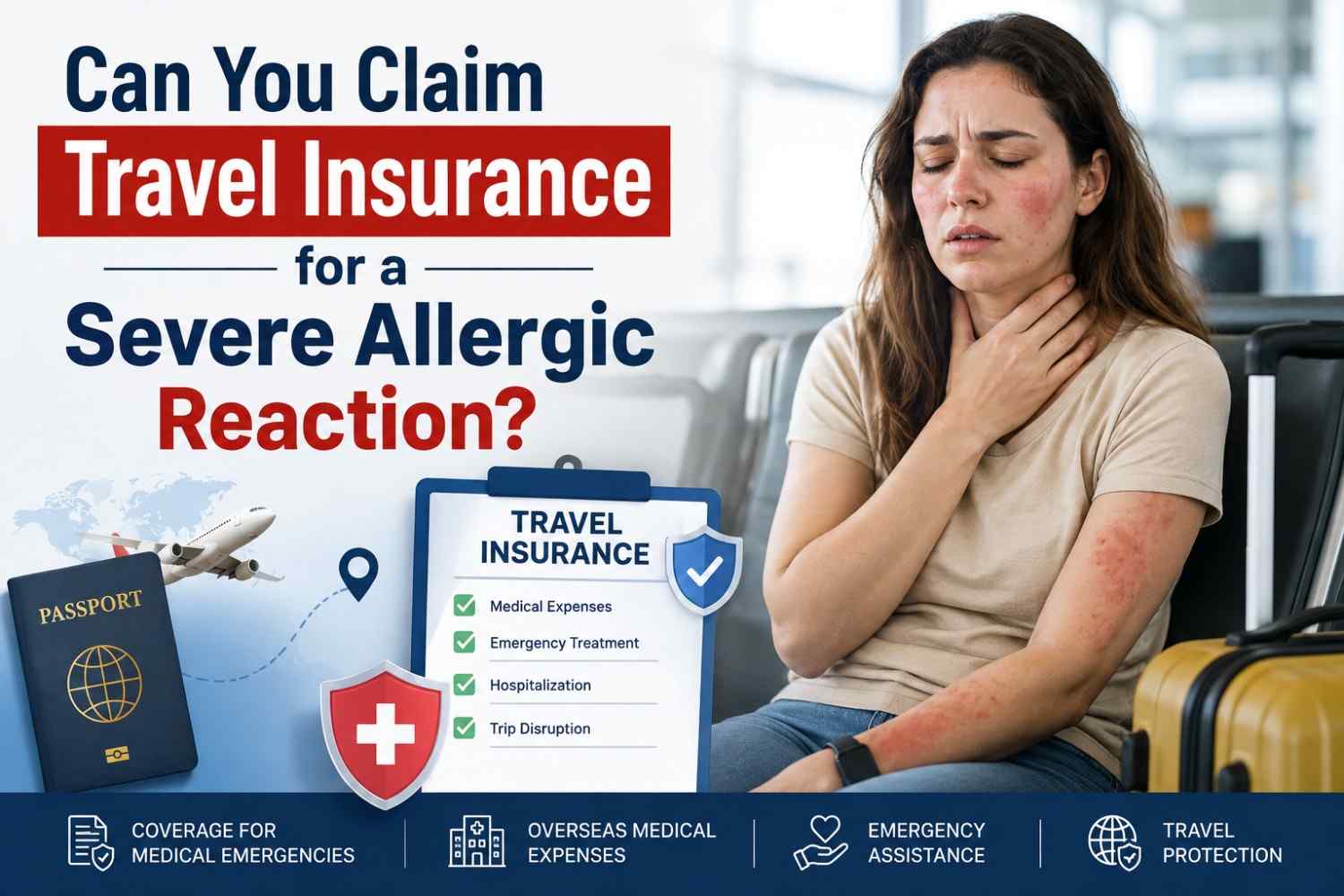
A severe allergic reaction while travelling can turn a planned holiday into a medical emergency, leaving you with questions about treatment costs, cancelled flights, unused accommodation and whether your travel insurance will actually pay. In some circumstances, travel insurance can cover medical treatment or cancellation costs related to an allergic reaction, but it depends on the wording of your policy, when the reaction occurred and whether you had an existing allergy or related medical condition.
For UK travellers, understanding the difference between medical expenses, trip cancellation, cutting a holiday short and pre-existing medical conditions is particularly important. Travel insurance policies do not all provide the same level of protection, so you should check your individual policy rather than assuming that an allergic reaction will automatically be covered.
Can You Claim Travel Insurance for a Severe Allergic Reaction?
You may be able to claim travel insurance for a severe allergic reaction, but there is no automatic guarantee that every policy will cover every allergy-related claim.
Travel insurance commonly provides cover for emergency medical treatment abroad and, depending on the policy, cancellation or cutting a trip short because of an unexpected illness or injury. However, exclusions and conditions can apply.
For example, your claim could depend on:
- Whether the allergic reaction was unexpected
- Whether you had a known allergy before buying the policy
- Whether you declared relevant medical conditions
- Whether a doctor advised you not to travel
- Whether the policy includes cancellation cover
- Whether you followed the insurer’s claims procedure
- Whether the costs are covered under your particular policy
Does Travel Insurance Cover Emergency Treatment for an Allergic Reaction?
Many travel insurance policies include overseas medical expenses, which can include emergency treatment when you become ill or injured while abroad.
A severe allergic reaction could potentially require:
- Emergency medical assessment
- Hospital treatment
- Medication
- Ambulance transportation
- Observation
- Follow-up medical care
- Emergency repatriation in appropriate circumstances
The Association of British Insurers explains that overseas travel insurance commonly covers emergency medical treatment, hospital charges and ambulance fees, although the precise cover depends on the policy.
If you experience a medical emergency abroad, get appropriate medical treatment first. Contact your insurer or its emergency assistance service as soon as it is safe to do so.
What If an Allergic Reaction Means You Cannot Travel?
This is slightly different from claiming for medical treatment abroad.
Suppose you develop a severe allergic reaction shortly before your holiday and a doctor advises that you should not travel.
Depending on your policy, you may potentially claim for certain non-refundable cancellation costs.
Travel insurance can provide cancellation cover when you or certain other insured people become unexpectedly ill, but the circumstances covered are usually specifically defined in the policy.
Before cancelling everything, check whether your airline, hotel, tour operator or travel provider can offer a refund, credit or alternative booking. Travel insurance may operate after other sources of compensation have been considered.
Can You Claim If You Have an Existing Allergy?
This is one of the most important questions.
If you already knew that you had an allergy before purchasing your travel insurance, the insurer may treat it as a pre-existing medical condition.
That does not necessarily mean you cannot get cover.
However, you may need to disclose the condition when applying for insurance, and the insurer may:
- Accept the condition
- Charge an additional premium
- Apply specific terms
- Offer limited cover
- Direct you towards specialist insurance
The ABI advises travellers to disclose pre-existing medical conditions fully and honestly because failing to do so can affect whether a claim is covered.
So if you have a known food allergy, medication allergy or history of serious allergic reactions, do not assume that a standard policy automatically covers it.
What Counts as a Pre-Existing Medical Condition for Travel Insurance?
The exact definition depends on the insurer and policy wording.
It can include medical conditions, symptoms, treatment or medication that existed before you purchased your cover.
For example, if you have:
- A diagnosed food allergy
- A history of anaphylaxis
- A known medication allergy
- A condition requiring an adrenaline auto-injector
- Ongoing allergy treatment
you should check whether the insurer requires you to declare it.
Different insurers may ask different medical screening questions, so the safest approach is to answer their questions fully and ask the insurer if you are uncertain.
What If You Have an Allergic Reaction for the First Time Abroad?
A first-time allergic reaction may be treated differently from a known pre-existing allergy, but the outcome still depends on your policy.
If you suddenly develop symptoms while abroad, seek appropriate medical treatment.
Do not delay emergency care because you are worried about whether your insurance will pay.
After you are safe, contact your insurer’s assistance service and explain what happened.
Keep documentation relating to the incident because it may be relevant if you later submit a claim.
Can You Claim Travel Insurance for Anaphylaxis?
Potentially, yes.
Anaphylaxis is a severe allergic reaction that requires urgent medical attention.
If an insured traveller develops an unexpected severe reaction abroad, their travel insurance may potentially cover eligible emergency medical costs, subject to the policy terms.
If anaphylaxis occurs before departure and a medical professional advises the traveller not to travel, cancellation cover may potentially apply if the policy’s conditions are met.
The important distinction is that medical cover and cancellation cover are separate parts of many travel insurance policies.
Always check your policy wording.
What Should You Do If You Have a Severe Allergic Reaction Abroad?
A severe allergic reaction is a medical emergency.
Your priority should be getting appropriate emergency treatment.
Once it is safe:
1. Contact Your Travel Insurer
Use the emergency assistance number provided with your policy.
2. Explain What Happened
Tell them when the reaction occurred, where you received treatment and what medical care was provided.
3. Keep Your Medical Documentation
Ask for relevant medical records, discharge paperwork or treatment documentation where appropriate.
4. Keep Receipts
Keep receipts for eligible medical expenses, medication, transport and other costs you may need to claim.
5. Follow the Insurer’s Instructions
Your insurer may have specific procedures for approving treatment or arranging further assistance.
Citizens Advice recommends contacting your insurer promptly about medical treatment where possible and keeping receipts and medical certificates to support a claim.
What Evidence Do You Need for an Allergic Reaction Travel Insurance Claim?
The exact documents vary between insurers, but useful evidence can include:
- Medical reports
- Hospital or clinic records
- Prescriptions
- Medication receipts
- Doctor’s letters
- Proof of cancellation
- Flight booking confirmation
- Accommodation invoices
- Receipts for additional expenses
- Evidence of medical advice not to travel
- Your travel insurance policy details
For cancellation claims, evidence explaining why you could not travel can be particularly important.
Citizens Advice recommends keeping paperwork such as receipts and medical certificates and providing copies when making a claim.
Can a Doctor’s Note Help With a Travel Insurance Claim?
It can, depending on what your insurer is asking you to prove.
For example, if you had a severe allergic reaction before departure and your claim relates to cancelling your holiday because you were medically unable to travel, the insurer may require medical evidence supporting that decision.
A medical document may help establish:
- The date of the illness
- The nature of the medical problem
- The severity of the symptoms
- Whether you were advised against travelling
- Relevant treatment or follow-up requirements
However, a doctor’s note does not guarantee that an insurer will approve a claim. The insurer will assess the claim against the policy terms and exclusions.
Can You Claim for Cancelled Flights Because of an Allergic Reaction?
Possibly.
If a severe allergic reaction makes you medically unable to travel, your travel insurance may provide cancellation cover for eligible non-refundable expenses.
But before making an insurance claim, check whether the airline or travel provider can provide a refund, rebooking or other solution.
The ABI advises travellers to speak to their airline, travel agent or tour operator about available options before cancelling and relying on insurance.
Your insurer may also require evidence that the cancellation was medically necessary.
What If You Had Already Booked Your Holiday Before the Allergic Reaction?
If you purchased appropriate travel insurance before the reaction occurred, cancellation cover may potentially help with eligible unrecoverable costs.
This is one reason the ABI recommends buying travel insurance as soon as you book a holiday rather than waiting until just before departure.
However, the policy’s terms still matter.
If you already knew about a medical issue when buying the policy, disclosure requirements may apply.
What If Your Allergic Reaction Happens During the Holiday?
The claim may instead relate to emergency medical expenses or, in some circumstances, cutting your trip short.
Depending on the policy, cover might include eligible:
- Hospital treatment
- Emergency transportation
- Medication
- Additional accommodation
- Repatriation
The ABI notes that travel insurance can cover emergency treatment and, where appropriate, returning a traveller to the UK following medical treatment abroad.
Again, do not assume every expense is automatically covered. Your policy wording determines what is eligible.
Can Travel Insurance Pay for Cutting Your Holiday Short After an Allergic Reaction?
It may, if the circumstances satisfy the policy conditions.
For example, if a severe allergic reaction requires treatment and you are medically advised to return home, your policy may potentially provide cover for certain additional travel costs and unused holiday arrangements.
Citizens Advice notes that cancellation and curtailment claims are generally subject to specific qualifying reasons and policy terms.
Speak to your insurer before arranging an expensive change of travel where it is safe and practical to do so.
Why Might an Allergic Reaction Travel Insurance Claim Be Refused?
There are several possible reasons.
The Allergy Was Not Declared
If you had a relevant pre-existing condition and did not disclose it when required, the insurer may refuse related cover.
The Policy Excludes the Circumstances
Every policy has exclusions and limitations.
You Did Not Meet the Policy Conditions
For example, the insurer may require specific medical evidence or notification.
The Costs Are Not Covered
Not every expense resulting from a disrupted holiday is necessarily insured.
Another Provider Is Responsible
You may need to seek reimbursement from an airline, tour operator or another provider before claiming certain losses through insurance.
Does a GHIC Replace Travel Insurance for an Allergic Reaction?
No.
If you are travelling within applicable European countries, a GHIC can provide access to certain state healthcare arrangements, but it does not replace travel insurance.
It does not provide the full range of protection that travel insurance can offer, including all medical costs or emergency repatriation.
For that reason, UK travellers should consider both their healthcare entitlement and appropriate travel insurance before travelling.
How Can You Make an Allergic Reaction Travel Insurance Claim?
The process varies between insurers, but it generally involves:
Step 1: Contact your insurer or assistance service.
Step 2: Explain the medical emergency and circumstances.
Step 3: Follow instructions about treatment and documentation.
Step 4: Collect medical records and receipts.
Step 5: Submit the claim within the insurer’s stated deadline.
Step 6: Provide any additional information requested.
Citizens Advice recommends checking the policy’s claim time limits, excess and exclusions before submitting a claim.
What Should You Check Before Travelling With a Severe Allergy?
If you have a known allergy, insurance is only one part of preparing for your trip.
Before travelling, consider:
- Checking your travel insurance cover
- Declaring relevant medical conditions
- Carrying prescribed emergency medication
- Keeping important medical information accessible
- Understanding your insurer’s emergency contact process
- Checking destination-specific healthcare arrangements
- Planning how you will communicate your allergy
- Keeping important medical documents available
If you have previously experienced a severe allergic reaction, speak with your healthcare professional about appropriate preparation for travel.
What Should You Do If Your Travel Insurance Claim Is Rejected?
A rejected claim is not necessarily the end of the process.
First, read the insurer’s explanation carefully and compare it with your policy wording.
Check:
- What exclusion was relied upon
- Whether the insurer believes the condition was pre-existing
- Whether documentation is missing
- Whether an excess applies
- Whether the insurer says another provider should pay
- Whether you can provide additional evidence
If you believe the decision is incorrect, you can make a formal complaint through the insurer’s complaints process.
Citizens Advice explains that if an insurer does not resolve a complaint satisfactorily, eligible consumers can take the matter to the Financial Ombudsman Service after following the insurer’s internal complaints procedure.
FAQ
Can you claim travel insurance for a severe allergic reaction?
Yes, potentially. Travel insurance may cover eligible emergency medical expenses or cancellation costs caused by a severe allergic reaction, but the claim must meet the conditions of your specific policy.
Can I claim travel insurance for an allergic reaction before travelling?
Potentially. If a severe allergic reaction occurs before departure and a medical professional advises you not to travel, cancellation cover may apply if your policy covers the circumstances and the costs are eligible.
Does travel insurance cover anaphylaxis?
It may cover eligible emergency medical treatment for anaphylaxis, subject to the policy terms. If you have a history of anaphylaxis, check whether it must be declared as a pre-existing medical condition.
Can I claim if I have a pre-existing allergy?
Possibly. Having a pre-existing allergy does not automatically mean you cannot obtain travel insurance, but you may need to declare it and obtain appropriate cover.
Can a doctor’s note help with a travel insurance claim for an allergic reaction?
Medical evidence can help demonstrate the nature and severity of an illness and, where relevant, that you were medically advised not to travel. However, it does not guarantee that an insurer will accept the claim.
Can I claim for a cancelled holiday because of an allergic reaction?
Potentially, if your policy includes cancellation cover and the allergic reaction meets the policy’s definition of a covered medical event. Check whether you can recover money from the airline, accommodation provider or tour operator first.
What documents do I need for an allergic reaction insurance claim?
Depending on the claim, you may need medical records, certificates, prescriptions, receipts, booking information, cancellation evidence and proof of additional expenses.
What if I have an allergic reaction abroad?
Seek emergency medical care first. Once it is safe, contact your travel insurer’s assistance service and keep medical records and receipts relating to your treatment.
Can I claim for medical treatment abroad after an allergic reaction?
Potentially. Emergency overseas medical treatment is commonly included in travel insurance, but the exact treatment and expenses covered depend on your policy.
Why might an allergic reaction travel insurance claim be rejected?
Possible reasons include an undeclared pre-existing condition, a policy exclusion, failure to meet claim conditions or expenses that fall outside the cover provided.
Need Medical Documentation for a Travel Insurance Claim?
If a severe allergic reaction has affected your travel plans and your insurer requires medical evidence, it’s important to understand exactly what documentation they are asking for.
If a healthcare professional has assessed your condition and you need appropriate medical documentation for an insurance-related matter, you can learn more about our Doctor’s Note for Travel Insurance service.
Explore Doctor’s Note for Travel Insurance →
Any medical documentation should accurately reflect your circumstances and should be used only for its intended purpose.
Conclusion
A severe allergic reaction can create significant medical and financial difficulties when it happens before or during a trip. Travel insurance may provide protection for eligible medical expenses, cancellation or cutting a trip short, but coverage depends on the individual policy and the circumstances surrounding the reaction.
If you have a known allergy, one of the most important steps is to disclose relevant medical information when buying insurance. If something happens while you are away, seek medical attention first, contact your insurer as soon as it is safe and keep the documentation and receipts that may support your claim.
Most importantly, don’t rely on a general assumption that allergies are covered. Read your policy carefully, understand its medical and cancellation provisions and ask your insurer about anything you are unsure about before travelling.

Dr. Anuj provides convenient online medical consultations for patients across the UK, making it easier to speak with a doctor without the need for an in-person visit.
Through secure online consultations, Dr. Anuj can assess your symptoms, discuss your concerns, and provide appropriate medical guidance. Where medically appropriate and legally permitted, a doctor’s note or medical documentation may also be provided following the consultation.