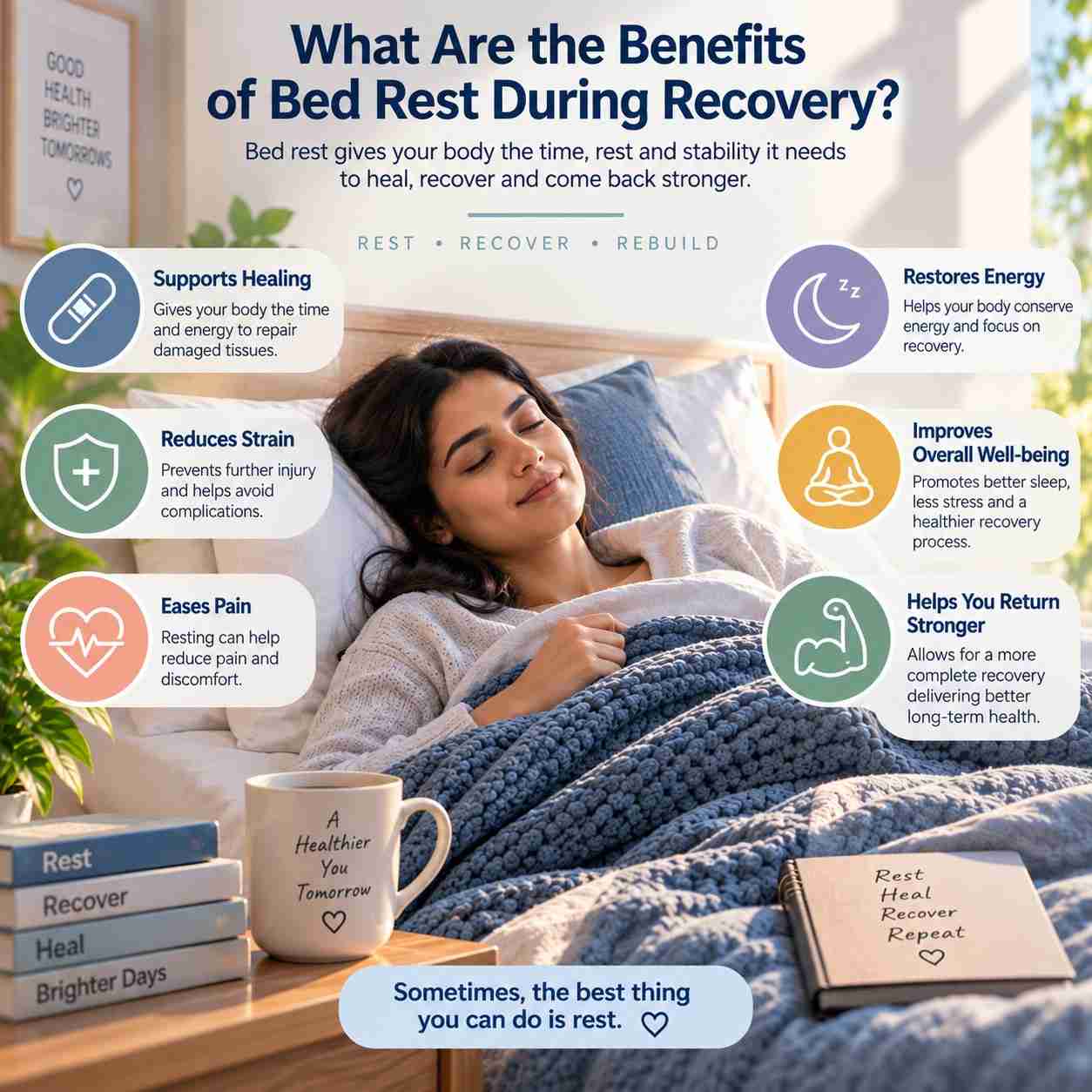
When your body is dealing with an illness, injury or another medical problem, rest can be an important part of recovery. In some situations, a healthcare professional may recommend bed rest or significant activity restriction to reduce physical demands while the body recovers.
However, bed rest is not automatically beneficial for every illness. Modern medical care generally focuses on the right amount of activity and rest for the individual condition, because prolonged inactivity can also create problems.
So, what are the potential benefits of bed rest during recovery, and when might it actually be useful?
What Is the Purpose of Bed Rest?
Bed rest is intended to reduce physical demands on the body when a healthcare professional believes that limiting activity may support recovery or help manage symptoms.
Depending on the medical situation, resting may help you:
- Conserve energy
- Reduce physical strain
- Manage fatigue
- Avoid activities that aggravate symptoms
- Give an injured area time to recover
- Make daily symptoms easier to manage
- Follow temporary medical restrictions
- Reduce the demands of normal work and physical activity
The benefits depend heavily on why bed rest has been recommended in the first place.
Bed rest should therefore be viewed as part of an individual recovery plan rather than a treatment that is automatically appropriate for everyone.
1. It Can Help Conserve Energy
Illness can place considerable demands on the body.
When you are dealing with infection, significant fatigue, pain or another health problem, ordinary activities may require more effort than usual. Walking around, working, exercising and completing household chores can all consume energy that your body may need for recovery.
Taking time to rest can reduce those demands.
For someone who is genuinely exhausted or unwell, spending more time resting may make everyday symptoms more manageable and allow them to focus on recovering rather than maintaining their normal routine.
2. Rest Can Reduce Physical Strain
Some medical conditions become more uncomfortable when the body is repeatedly subjected to physical exertion.
Reducing activity can therefore help limit unnecessary strain.
For example, someone recovering from an injury may need to avoid activities involving:
- Lifting
- Repeated movement
- Prolonged standing
- Exercise
- Pressure on an injured area
The purpose is not necessarily to remain completely motionless. Instead, the person may need to avoid activities that place excessive demands on the affected part of the body.
3. It Can Make Pain Easier to Manage
Movement can sometimes aggravate pain, particularly after certain injuries or during periods of acute illness.
A period of appropriate rest may make it easier to manage discomfort while other aspects of treatment take effect.
That does not mean staying in bed will eliminate pain or treat its underlying cause. Pain that is severe, persistent or worsening may require further medical assessment.
4. Rest Can Support Recovery After an Injury
Some injuries require temporary limitations on normal activity.
For example, a healthcare professional may advise someone with a significant injury to avoid putting excessive strain on the affected area.
Rest may then form part of a broader recovery plan alongside other appropriate measures.
The important point is that rest alone does not determine how quickly an injury heals. The type and severity of the injury, treatment, general health and medical advice all matter.
5. It Can Help When Fatigue Makes Normal Activities Difficult
Fatigue is different from simply feeling a little sleepy.
During some illnesses, a person may feel physically drained and struggle with activities they would normally manage without difficulty.
In these circumstances, reducing commitments and allowing more time for sleep and rest may make it easier to cope with daily life.
A prolonged or unexplained period of significant fatigue should not simply be treated with bed rest without identifying the possible underlying cause.
6. It Can Give the Body a Break From Physically Demanding Work
Some occupations place considerable physical demands on the body.
Construction workers, warehouse employees, cleaners, delivery workers and other physically active employees may spend much of their working day lifting, walking, standing or performing repetitive movements.
When illness or injury makes these activities inappropriate, temporary rest may help prevent unnecessary physical strain.
In some circumstances, a healthcare professional may advise time away from work or recommend adjustments rather than complete inactivity.
7. Rest Can Help You Manage Symptoms While Recovering at Home
Recovery is not always comfortable.
You may experience:
- Weakness
- Headaches
- Body aches
- Fatigue
- Dizziness
- Reduced appetite
- General discomfort
Having time to rest can make it easier to manage these symptoms while you recover.
It can also give you the opportunity to maintain basic routines such as taking prescribed medication, drinking fluids, eating when able and attending follow-up appointments.
8. It Can Temporarily Remove Unnecessary Physical Demands
Normal life involves constant movement and activity.
You may commute, work, shop, cook, clean, exercise, care for family members and complete countless small tasks throughout the day.
During recovery, attempting to maintain all of those activities may not be realistic.
A temporary period of reduced activity can remove some of those demands and allow you to concentrate on getting better.
This can be particularly useful when your illness makes ordinary activities unusually tiring.
9. It May Help Prevent You From Pushing Through Symptoms
Many people continue working or maintaining their normal routine despite feeling unwell.
While determination can be useful in everyday life, repeatedly pushing through significant symptoms is not always appropriate.
A medically advised period of rest can provide a clear reason to step back from activities that may be unsuitable during recovery.
This can be especially relevant when a person’s job or daily responsibilities involve substantial physical effort.
10. It Can Make Recovery More Manageable Emotionally
Being ill can be frustrating, particularly when you feel pressure to continue working or meeting everyday responsibilities.
Taking appropriate time away from normal demands can provide an opportunity to slow down and focus on recovery.
That does not mean bed rest itself treats anxiety, depression or other mental health conditions. Instead, reducing unnecessary demands may make a period of physical recovery easier to manage.
If you are experiencing significant or persistent changes in mood, seek appropriate medical support rather than relying on bed rest alone.
Does More Bed Rest Mean Faster Recovery?
Not necessarily.
This is one of the most important points to understand.
Rest can be useful when it is appropriate for your medical condition, but spending more time in bed does not automatically mean your body will recover faster.
Too much inactivity can contribute to problems such as:
- Loss of muscle strength
- Reduced physical conditioning
- Stiffness
- Reduced mobility
- Difficulty returning to normal activities
For some medical conditions, healthcare professionals may recommend gentle movement or gradually increasing activity when it is safe to do so.
The right approach is therefore not “as much bed rest as possible.”
It is the appropriate balance between rest and activity for your particular situation.
When Is Bed Rest More Likely to Be Helpful?
The potential value of bed rest depends on the underlying medical circumstances.
A healthcare professional may recommend increased rest or activity restriction when physical exertion could reasonably worsen symptoms, interfere with recovery or place excessive strain on the body.
Examples may include certain:
- Injuries
- Acute illnesses
- Post-treatment recovery periods
- Episodes of severe fatigue
- Conditions involving significant pain
- Situations where specific physical activity needs to be restricted
However, whether bed rest is appropriate cannot be determined from a diagnosis alone.
Two people with the same condition may receive different advice depending on symptom severity, treatment, age, general health and other circumstances.
When Rest May Not Be Enough
Rest can be helpful, but it is not a substitute for medical assessment when symptoms require attention.
You should seek appropriate medical advice if:
- Your symptoms are getting worse
- You are not recovering as expected
- Pain is severe or persistent
- You develop new concerning symptoms
- You are repeatedly exhausted without an obvious explanation
- You are unsure whether your activity restrictions are still appropriate
If you experience symptoms that could indicate an emergency, seek urgent medical help.
How Long Should You Rest?
There is no universal number of hours or days that applies to everyone.
The appropriate duration depends on the reason for the rest recommendation and how your condition changes over time.
Some illnesses may require only a short period of reduced activity. Other situations can involve longer recovery periods with restrictions gradually changing as the person improves.
If your healthcare professional has given you specific instructions, follow those rather than extending bed rest on your own.
What Should You Do When You Start Feeling Better?
Improvement is usually a positive sign, but returning immediately to your full routine may not always be appropriate.
Depending on your condition, you may need to gradually increase activity.
For example, you might begin by managing basic daily activities before returning to more physically demanding tasks.
Your healthcare professional can advise you about when it is appropriate to increase activity, exercise or return to work.
How Does Bed Rest Affect Work?
A period of medically advised rest can affect your ability to work, particularly when your job requires physical effort.
If you are unable to work because of illness, UK employees can generally self-certify sickness for up to 7 calendar days. For sickness lasting longer than 7 calendar days, an employer may ask for a fit note.
A fit note can provide information about whether you are fit for work or may be able to work with appropriate support.
The medical advice should reflect your actual health circumstances rather than simply stating that you need “bed rest.”
Do You Need Medical Documentation for Bed Rest?
Not every period of rest requires a medical document.
However, documentation may be relevant if an employer, insurer or another organisation needs evidence of your medical circumstances.
The type of document required depends on the purpose.
For example, employment-related sickness lasting more than 7 calendar days may involve a fit note, while an insurance claim could require different medical evidence.
If you genuinely need medical documentation, an online medical assessment may be suitable in some circumstances. DoctorsNotes.co.uk provides online medical assessment and documentation for eligible situations.
Any documentation should accurately reflect the person’s genuine medical circumstances and the assessment provided by an appropriate healthcare professional.
Bed Rest Is Part of Recovery — Not the Whole Treatment
It is useful to think of bed rest as one possible component of recovery rather than a complete treatment in itself.
Depending on the condition, recovery may also involve:
- Prescribed medication
- Follow-up appointments
- Appropriate nutrition and hydration
- Sleep
- Treatment of the underlying condition
- Gradual return to activity
- Physiotherapy or rehabilitation where appropriate
- Work adjustments
The appropriate combination depends on the individual’s medical circumstances.
Related Doctor’s Note :
Doctor’s Note for Bed Rest
Doctor’s Note for Torn Muscles
Doctor’s Note for Disability
Doctor’s note for Sick Leave
Frequently Asked Questions
Is bed rest actually good for recovery?
It can be beneficial when a healthcare professional recommends reduced activity for a particular medical reason. However, bed rest is not automatically appropriate for every condition, and prolonged inactivity can have disadvantages.
Does bed rest help the body heal faster?
Not necessarily. Appropriate rest may support recovery, but more time in bed does not automatically result in faster healing. The underlying condition and recommended treatment are more important.
Does bed rest help with fatigue?
Rest can make it easier to manage fatigue during an illness, particularly when normal activities are exhausting. Persistent or unexplained fatigue should be assessed by a healthcare professional.
Can I get out of bed during recovery?
That depends on the restrictions you’ve been given. Some forms of bed rest still allow necessary movement, while other medical circumstances may require stricter limitations.
Should I exercise while on bed rest?
Do not assume that your normal exercise routine is safe during bed rest. Follow the activity restrictions provided by your healthcare professional and ask when it is appropriate to resume exercise.
Can I work from home while recovering?
Possibly, depending on your condition and the type of work you do. If medical advice specifically requires substantial rest or activity restriction, working may not be appropriate.
Can bed rest be used instead of medical treatment?
No. Bed rest does not replace diagnosis, treatment or follow-up care when those are needed.
Can prolonged bed rest cause problems?
Yes. Extended inactivity can contribute to reduced muscle strength, stiffness and loss of physical conditioning. The appropriate duration and level of activity should therefore be guided by your medical circumstances.
Conclusion
The main benefit of bed rest is that it can temporarily reduce physical demands on the body when rest or activity restriction is medically appropriate.
It may help conserve energy, reduce physical strain, make symptoms easier to manage and support recovery from certain illnesses or injuries.
But bed rest is not automatically better than normal activity, and more time in bed does not necessarily mean faster healing. The goal should be to follow the specific balance of rest and activity recommended for your condition.
If your illness or injury is affecting your ability to work, make sure you understand your employer’s requirements for sickness absence and medical evidence. Where documentation is needed, it should accurately represent your genuine medical circumstances and be based on an appropriate medical assessment.

Dr. Anuj provides convenient online medical consultations for patients across the UK, making it easier to speak with a doctor without the need for an in-person visit.
Through secure online consultations, Dr. Anuj can assess your symptoms, discuss your concerns, and provide appropriate medical guidance. Where medically appropriate and legally permitted, a doctor’s note or medical documentation may also be provided following the consultation.