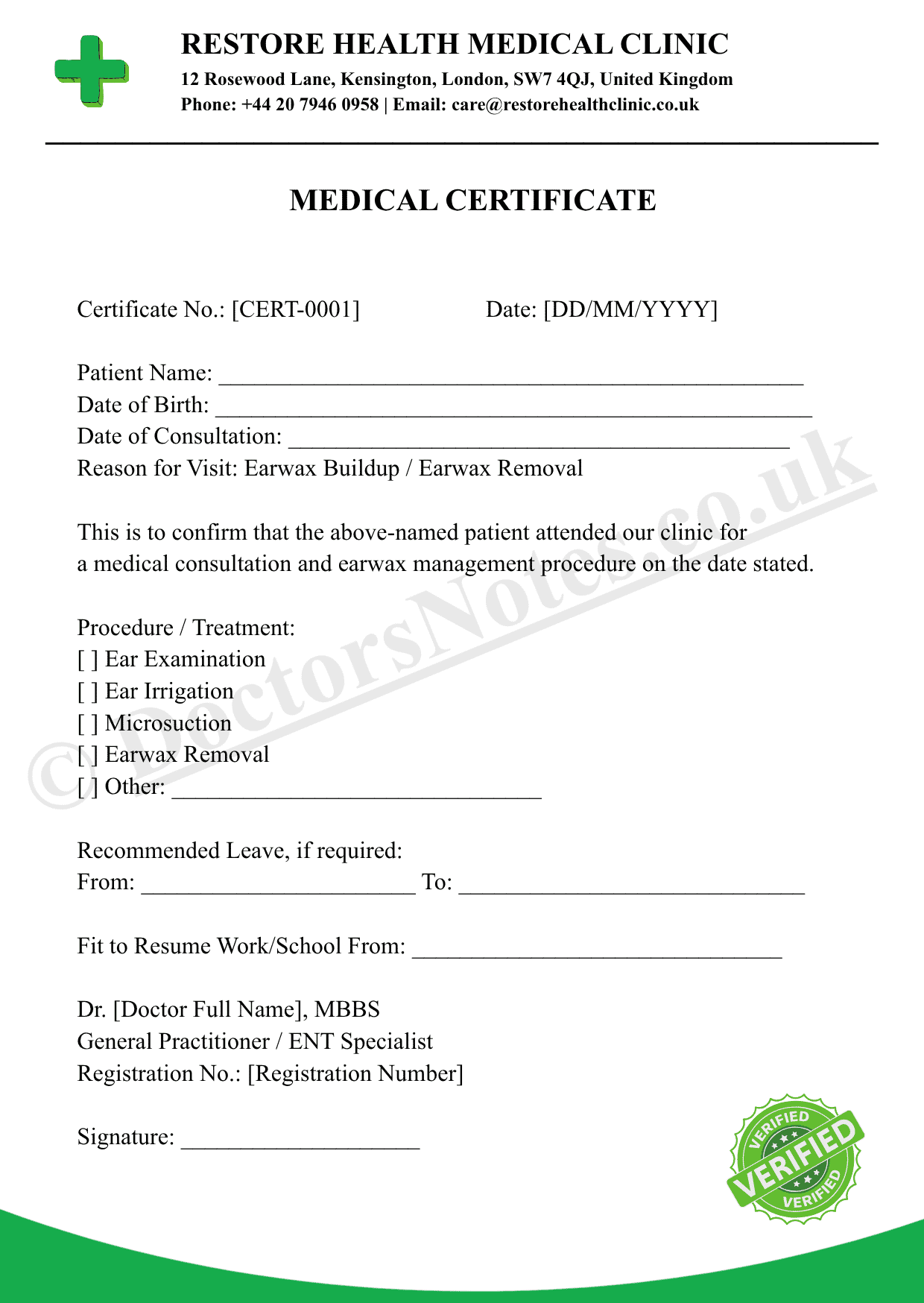

A blocked ear can be more than a minor inconvenience. Earwax build-up can affect hearing, cause discomfort, create a blocked-ear sensation and sometimes contribute to tinnitus or dizziness. If these symptoms are making it difficult to carry out your normal work, attend an important shift or perform your duties safely, you may need medical advice and appropriate documentation.
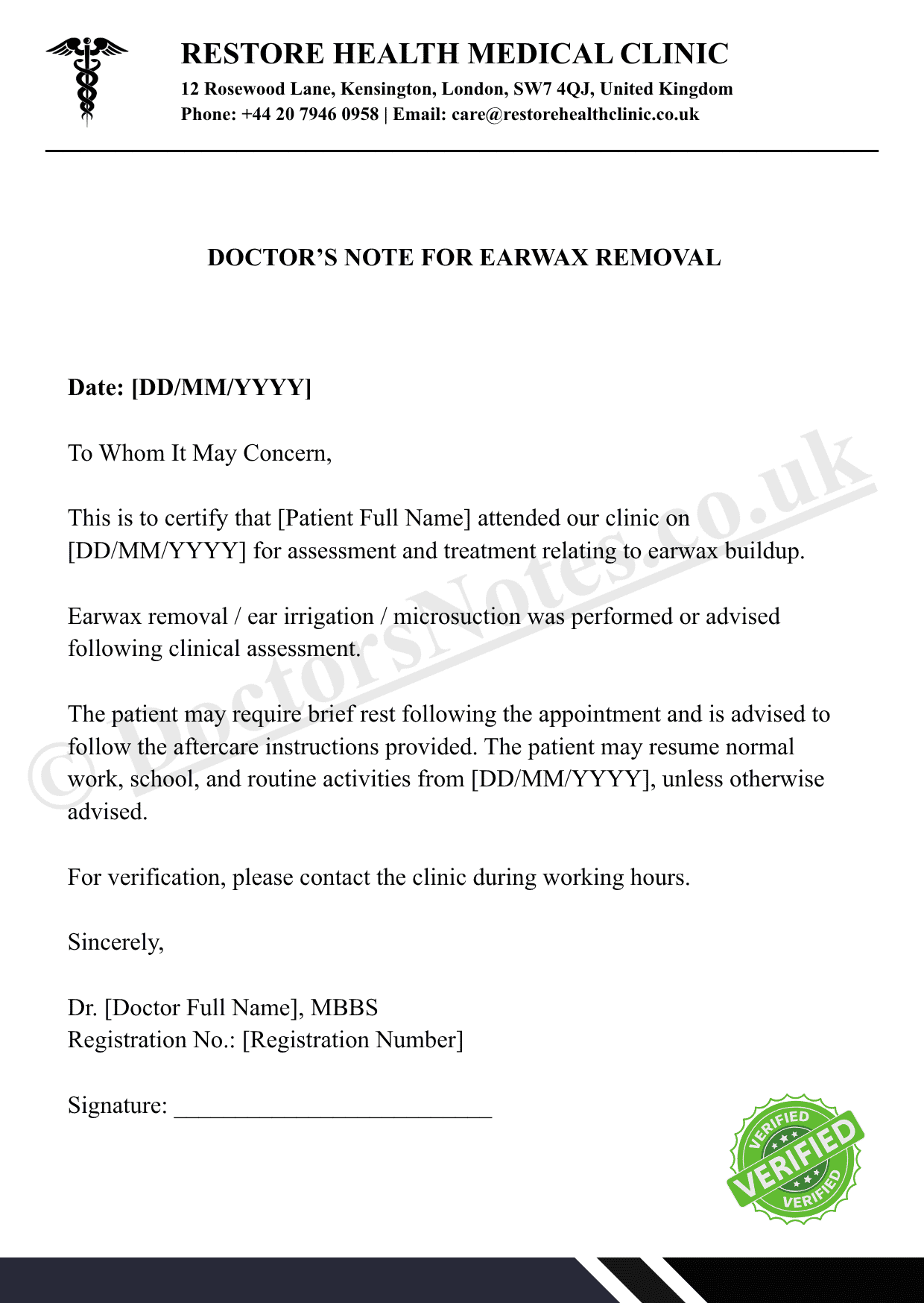
A doctor’s note for earwax removal may be relevant when earwax-related symptoms affect your fitness for work and a healthcare professional considers medical documentation appropriate following an assessment.
Our online medical assessment service provides a convenient way to discuss your symptoms, explain how they are affecting your work and understand what documentation may be appropriate.
Important: A doctor’s note or fit note is not automatically issued because you request one. A healthcare professional must assess your circumstances and decide whether documentation is clinically appropriate.
Earwax Blocking Your Hearing or Affecting Work?
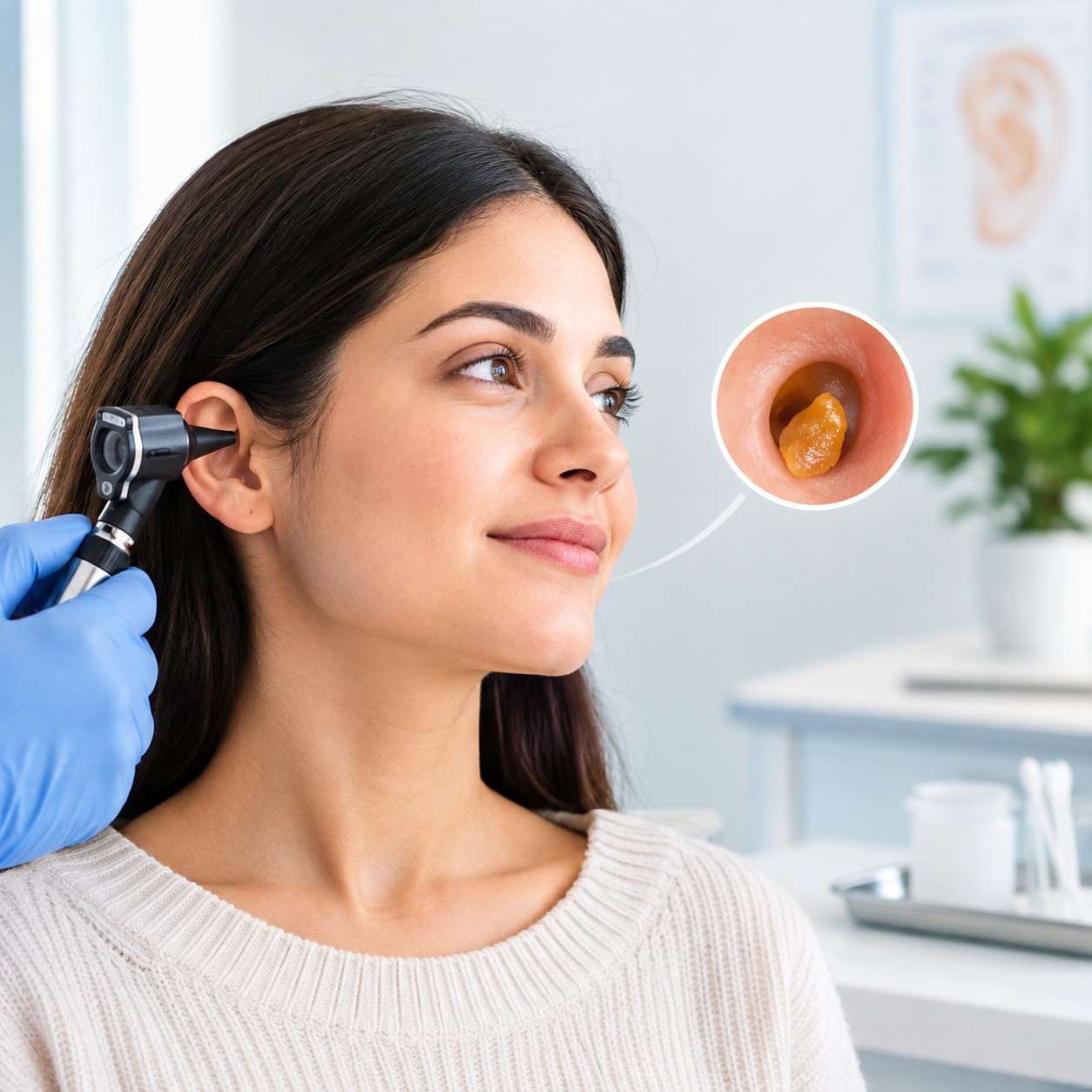
Earwax normally protects the ear canal and usually leaves the ear naturally. Problems can occur when wax builds up and becomes impacted.
You may notice:
- Muffled hearing
- A blocked or full feeling in the ear
- Earache or discomfort
- Ringing or buzzing sounds
- Difficulty following conversations
- Trouble hearing on the telephone
- Reduced awareness of surrounding sounds
- Dizziness or vertigo
- Difficulty concentrating because of hearing problems
These symptoms can become particularly disruptive at work.
For example, a receptionist may struggle to hear callers. A teacher may find classroom communication difficult. Someone working around machinery may have concerns about hearing important sounds or instructions.
NHS guidance lists hearing loss, earache or a blocked-ear sensation, tinnitus and vertigo among symptoms associated with earwax build-up.
Quick Answers About a Doctor’s Note for Earwax Removal
| Question | Answer |
|---|---|
| Can earwax affect your ability to work? | Yes. Significant blockage can affect hearing, communication, concentration or safety-sensitive tasks. |
| Can I get a doctor’s note for earwax removal? | A healthcare professional may provide appropriate documentation if your health affects your fitness for work. |
| Can impacted earwax cause hearing problems? | Yes. Hearing loss is a recognised symptom of earwax build-up. |
| Can earwax cause dizziness? | It can be associated with vertigo or dizziness. |
| Can earwax be removed online? | The removal procedure itself requires appropriate physical treatment. An online consultation can help assess symptoms and determine the next step. |
| What is microsuction? | Microsuction is one method healthcare services may use to remove impacted earwax. |
| Can a fit note be issued for earwax problems? | It may be appropriate if a healthcare professional assesses that the condition affects fitness for work. |
| Do I need a fit note for 7 days or less? | Generally, employees can self-certify sickness absence for the first 7 calendar days. |
| Is a doctor’s note guaranteed? | No. Documentation depends on clinical assessment. |
| Can I work while waiting for earwax removal? | Some people can. Others may need temporary adjustments depending on their symptoms and job. |
What Is Earwax Build-Up?
Earwax build-up occurs when wax accumulates inside the ear canal and begins to cause symptoms.
Earwax is not normally something that needs to be removed. It helps protect the ear from dirt and germs.
However, impacted earwax can interfere with hearing and cause discomfort.
The NHS recommends speaking to a pharmacist about earwax treatment and notes that some GP surgeries or other services may remove wax using methods such as electronic ear irrigation, microsuction or a small removal instrument.
When Can Earwax Become a Work Problem?
Not every case of earwax build-up affects employment.
The issue becomes more significant when symptoms interfere with the functions you need to perform.
You may find work difficult if you cannot:
- Hear colleagues clearly
- Understand telephone conversations
- Follow verbal instructions
- Participate in meetings
- Hear alarms or warnings
- Communicate with customers
- Concentrate because of discomfort
- Work safely around machinery
- Drive safely where hearing or dizziness is relevant
- Maintain your usual level of performance
Your occupation matters because the functional effect of reduced hearing can be very different from one job to another.
Earwax Symptoms and Different Types of Work
| Job situation | How earwax symptoms may interfere |
|---|---|
| Call centre | Difficulty hearing customers |
| Reception | Problems understanding visitors and telephone calls |
| Teaching | Difficulty hearing pupils or colleagues |
| Healthcare | Communication difficulties with patients and staff |
| Office work | Trouble following meetings or conversations |
| Retail | Difficulty communicating with customers |
| Hospitality | Difficulty hearing orders or instructions |
| Construction | Reduced awareness of verbal warnings |
| Factory work | Difficulty hearing alarms or machinery-related sounds |
| Driving | Hearing or dizziness concerns may affect safety |
| Remote work | Problems with headphones, calls and virtual meetings |
This does not mean earwax automatically makes someone unfit for work.
A healthcare professional considers the functional effect of the condition when assessing fitness for work.
What Does Impacted Earwax Feel Like?
The experience varies depending on how much wax has accumulated and whether one or both ears are affected.
You might notice:
A blocked ear
Your ear may feel full, plugged or as though something is stopping sound from entering normally.
Reduced hearing
Sounds can become muffled or quieter.
Ear discomfort
Some people experience earache or pressure.
Tinnitus
You may notice ringing, buzzing or other sounds.
Dizziness
Some people with earwax build-up experience vertigo or dizziness.
Communication problems
You may repeatedly ask people to repeat themselves or increase the volume of your phone, television or computer.
Can Earwax Cause Hearing Loss?
Yes.
Impacted earwax can reduce the amount of sound reaching the eardrum, resulting in temporary hearing loss.
This can be particularly frustrating at work because you may still feel physically capable of working while communication becomes difficult.
If your hearing suddenly changes or you are unsure whether earwax is actually responsible, do not assume that wax is the cause. Hearing loss can have other causes and may require prompt medical assessment.
Doctor’s Note for Earwax Removal for Work
A doctor’s note for earwax removal for work may be relevant when symptoms have temporarily affected your ability to perform your normal duties.
For example, you may need documentation if:
- Your hearing is significantly reduced
- You are experiencing substantial ear discomfort
- Dizziness is affecting your ability to work safely
- You cannot perform important communication tasks
- Your job depends heavily on hearing
- You have been advised to avoid certain activities
- You need temporary workplace adjustments
- You require time to attend treatment or recover
The important factor is not simply having earwax.
The healthcare professional must consider whether your health is actually affecting your fitness for work.
Can You Get a Doctor’s Note for Earwax Removal Online?
You can discuss earwax-related symptoms through an online medical assessment where remote assessment is clinically appropriate.
However, an online consultation does not physically remove earwax.
The healthcare professional may assess:
- Your symptoms
- How long they have been present
- Whether one or both ears are affected
- Hearing changes
- Ear pain
- Tinnitus
- Dizziness
- Previous ear problems
- Previous ear surgery
- Any treatment already attempted
- How the symptoms affect your work
Based on that assessment, you may be advised about appropriate next steps.
If physical examination or earwax removal is required, you may need an in-person service.
How Is Earwax Removed?
The appropriate removal method depends on the individual.
Healthcare services may use methods such as:
Microsuction
Microsuction uses a small suction device to remove earwax under visual guidance.
Ear Irrigation
Electronic ear irrigation uses controlled water flow to help remove suitable earwax.
Manual Removal
A healthcare professional may use a small instrument to remove wax where appropriate.
NHS guidance lists electronic ear irrigation, microsuction and removal using a small instrument among methods used by some services.
Not every method is suitable for every person.
Can You Remove Earwax Yourself?
Some earwax problems can improve with appropriate ear-softening treatment.
The NHS advises that olive or almond oil drops may be used in certain circumstances to soften earwax. However, almond oil should not be used by someone with an almond allergy, and ear drops should not be used if you have a perforated eardrum.
Avoid putting objects inside your ear
Do not use:
- Cotton buds
- Fingers
- Hairpins
- Pens
- Other objects
Trying to dig wax out can push it deeper and make the blockage worse.
Ear candles and ear vacuums are also not recommended as effective earwax-removal methods by the NHS.
How to Get a Doctor’s Note for Earwax Problems Online
The process starts with your symptoms rather than the document.
1. Explain the ear problem
Tell the healthcare professional what you are experiencing and which ear is affected.
2. Describe the impact
Explain whether the problem affects hearing, communication, concentration, balance or your ability to perform your job safely.
3. Provide your medical information
Mention relevant ear conditions, previous procedures, medications and treatment you have already tried.
4. Complete the assessment
The healthcare professional reviews your information and decides whether remote assessment is suitable.
5. Discuss medical documentation
If your condition affects your fitness for work, the healthcare professional can determine whether a fit note or other appropriate documentation is justified.
What Information Should You Provide During an Earwax Consultation?
A clear description of your symptoms can make the consultation more useful.
Ear symptoms
- Which ear is affected?
- Is one or both ears blocked?
- When did the problem start?
- Has your hearing changed?
- Do you have earache?
- Do you have tinnitus?
- Are you experiencing dizziness?
Treatment history
- Have you used ear drops?
- Have you already had wax removed?
- Have you seen a GP or pharmacist?
- Have you had previous ear surgery?
Work information
- What type of job do you do?
- Do you need to communicate by telephone?
- Do you work around machinery?
- Do you drive for work?
- Do you rely heavily on hearing instructions?
- Are you currently missing work?
Earwax Removal and Workplace Safety
Hearing loss is not simply an inconvenience in every workplace.
Some jobs depend on being able to hear:
- Alarm systems
- Vehicle warnings
- Machinery
- Verbal instructions
- Customers
- Colleagues
- Emergency announcements
If reduced hearing or dizziness creates a safety concern, tell the healthcare professional exactly what your job involves.
Do not continue a safety-sensitive activity if you believe your symptoms make it unsafe.
Can Earwax Affect Driving?
If you are experiencing significant hearing changes, dizziness or vertigo, consider whether driving is safe.
The relevant issue is not simply whether you have earwax. Your actual symptoms and their effect on safe driving matter.
If you experience significant dizziness or other symptoms that could affect your ability to drive safely, seek appropriate medical advice before driving.
Earwax Removal and the UK Fit Note
In the UK, the formal document commonly called a fit note is the Statement of Fitness for Work, also known as a Med 3.
A fit note provides medical advice about how a health condition affects a person’s fitness for work.
A healthcare professional can assess whether someone is:
- Not fit for work, or
- May be fit for work subject to advice
The assessment focuses on the functional effects of the health condition.
Who Can Issue a Fit Note in the UK?
Current UK guidance allows the following healthcare professionals to certify fit notes:
- Doctors
- Nurses
- Occupational therapists
- Pharmacists
- Physiotherapists
The professional must undertake an appropriate health and work assessment. This assessment can take place face to face, by video or telephone, or in some circumstances through consideration of a written report from another healthcare professional.
Do You Need a Fit Note for the First Week Off Work?
Usually, no.
If you are off sick for 7 calendar days or less, you can generally self-certify your sickness absence.
This includes weekends and bank holidays.
If your absence continues beyond 7 calendar days, your employer may ask for a fit note.
Always follow your employer’s own sickness-reporting procedure.
Can a Fit Note Recommend Adjustments Instead of Time Off?
Yes.
A person does not necessarily need to stop working completely.
Depending on the circumstances, a healthcare professional may consider whether temporary changes could help someone remain in or return to work.
Possible adjustments can include:
- Altered working hours
- Amended duties
- Reduced exposure to communication-heavy tasks
- Temporary changes to safety-sensitive duties
- Working from home where appropriate
- A phased return
The fit note is advisory. It helps the employee and employer discuss practical ways to support continued or returning work.
What If You Only Need Time Off for Earwax Removal?
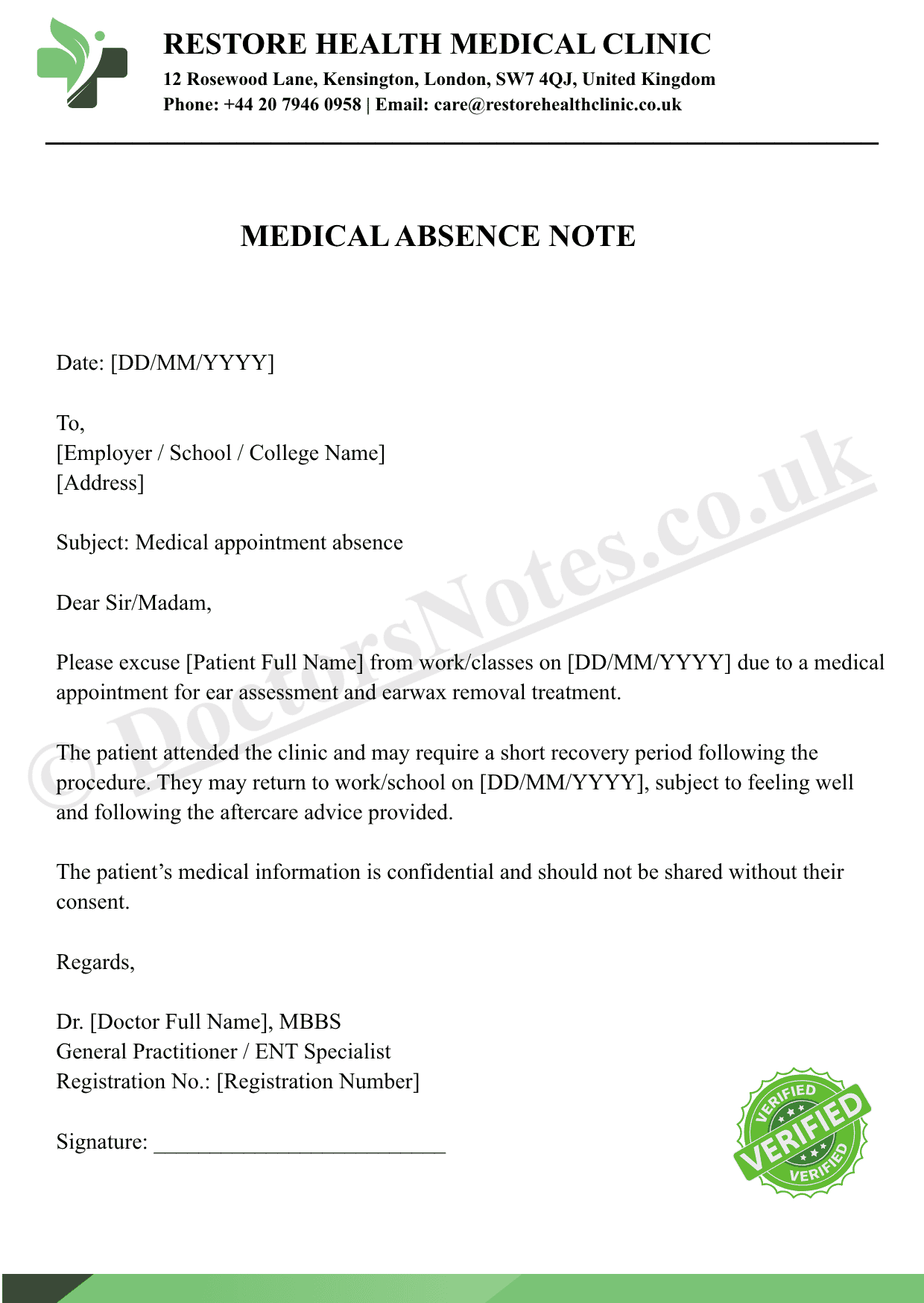
A medical appointment and sickness absence are not necessarily the same thing.
You may simply need time to attend an earwax-removal appointment.
Whether you require medical documentation depends on:
- Your symptoms
- Your employer’s policy
- The length of absence
- Whether the condition affects your fitness for work
- The healthcare professional’s assessment
If your employer has specifically requested evidence, check exactly what type of document they accept.
How Long Can an Earwax-Related Fit Note Last?
There is no standard number of days for every earwax-related problem.
Some people improve after appropriate treatment. Others may require further assessment if symptoms continue.
The duration of any fit note depends on the healthcare professional’s clinical judgement.
For the first six months of a health condition, UK guidance states that a fit note can be issued for a maximum of three months at a time.
Can an Earwax Doctor’s Note Be Backdated?
Do not assume that documentation can simply be backdated because you have already missed work.
A healthcare professional must consider the available clinical information and determine what period, if any, can appropriately be covered.
If you have already been absent, be ready to explain:
- When your symptoms began
- When you stopped working
- Whether your hearing changed
- Whether you received treatment
- Whether symptoms have improved
- Whether the problem is still affecting you
When Should You See a Healthcare Professional About Earwax?
Consider getting medical advice if your symptoms do not improve with appropriate self-care or if the ear becomes badly blocked.
The NHS advises contacting a healthcare service if earwax symptoms have not cleared after 5 days or if the ear is badly blocked and you cannot hear anything.
You should also seek advice if you are unsure whether earwax is actually responsible for your symptoms.
When Should You Seek Urgent Help?
Do not assume every ear symptom is caused by wax.
Seek appropriate urgent medical advice if you develop symptoms such as:
- Sudden hearing loss
- Significant or rapidly worsening symptoms
- Severe dizziness
- Severe ear pain
- Discharge from the ear
- Symptoms following a significant injury
- Other symptoms that make you seriously unwell
Sudden hearing changes can have causes other than earwax and should not simply be treated as a blocked ear.
What If Earwax Treatment Does Not Fix Your Hearing?
Persistent hearing problems deserve further assessment.
If your hearing remains reduced after wax has been removed, another cause may need to be investigated.
Possible explanations can include:
- Ear infection
- Inner-ear conditions
- Eardrum problems
- Noise-related hearing damage
- Age-related hearing loss
- Other causes of hearing impairment
Removing wax does not guarantee that every hearing problem will disappear.
Doctor’s Note for Earwax Removal After Treatment
You may still experience temporary symptoms after treatment.
For example, your ear may remain uncomfortable or your hearing may take some time to return to normal.
If post-treatment symptoms affect your ability to work, explain this during your medical assessment.
Your healthcare professional can consider the current symptoms rather than simply relying on the fact that you have undergone earwax removal.
Can Earwax Removal Help You Return to Work?
For some people, treating the underlying blockage can make normal activities easier.
However, recovery depends on:
- The severity of the blockage
- The symptoms you experienced
- The treatment used
- Whether another ear condition is present
- Your type of work
If your symptoms have improved and you feel able to return, follow your healthcare professional’s advice and your employer’s return-to-work process.
Why Use an Online Medical Assessment?
When you are dealing with a blocked ear, the last thing you may want is unnecessary travel or another difficult appointment.
An online assessment can be useful for discussing:
- Your symptoms
- Work-related difficulties
- Existing medical information
- Whether your symptoms require further care
- Whether medical documentation may be appropriate
However, remote assessment does not replace physical ear examination or earwax removal when those are clinically required.
Get Prepared Before Your Online Assessment
Ear problem
☐ Affected ear
☐ Date symptoms started
☐ Hearing changes
☐ Ear pain or pressure
☐ Tinnitus
☐ Dizziness or vertigo
Previous care
☐ Ear drops used
☐ Previous wax removal
☐ GP/pharmacist consultation
☐ Previous ear surgery
☐ Known ear conditions
Work
☐ Job role
☐ Main responsibilities
☐ Communication requirements
☐ Safety-sensitive duties
☐ Driving requirements
☐ Dates of missed work
Documentation
☐ Employer’s evidence requirements
☐ Dates requiring documentation
☐ Any requested fit-note details
☐ Workplace adjustments you may need
Related Doctor’s Note:
Doctor Note for Ear Infection
Doctor Note for Vertigo
Doctor Note for Hearing Loss
FAQs
Can I get a doctor’s note for earwax removal?
A healthcare professional may provide appropriate medical documentation if your earwax-related symptoms affect your fitness for work and the assessment supports it.
Can impacted earwax make me unfit for work?
It can affect your ability to work when hearing loss, pain, dizziness or other symptoms interfere with your normal duties. Fitness for work must be assessed individually.
Can I get an online doctor’s note for earwax?
You may be able to complete an online medical assessment where remote assessment is appropriate. The healthcare professional decides whether documentation can be issued.
Can I get a fit note for blocked ears?
A fit note may be appropriate if the underlying health problem affects your fitness for work. A blocked ear alone does not automatically qualify someone for a fit note.
Can earwax cause temporary hearing loss?
Yes. Impacted earwax can reduce hearing and cause sounds to seem muffled.
Can earwax cause tinnitus?
Tinnitus, including ringing or buzzing sounds, can occur with earwax build-up.
Can earwax cause vertigo?
Vertigo can occur with earwax build-up, although dizziness has many possible causes. Persistent or significant dizziness should be medically assessed.
What is the best way to remove impacted earwax?
The appropriate method depends on the individual. Healthcare services may use microsuction, electronic ear irrigation or manual removal.
Can I use cotton buds to remove earwax?
It is not recommended. Cotton buds and other objects can push wax deeper into the ear and make the blockage worse.
Can I remove earwax before going to work?
Some mild cases can be managed with appropriate ear-softening treatment, but significant blockage may require professional assessment or removal.
Do I need a doctor’s note for an earwax removal appointment?
Not necessarily. Whether you need medical evidence depends on your employer’s policy, the length of absence and your circumstances.
Can a pharmacist help with earwax?
Yes. NHS guidance recommends speaking to a pharmacist for advice about earwax build-up and suitable treatments.
Can I work while I have impacted earwax?
Possibly. It depends on your symptoms and your job. If hearing loss, dizziness or discomfort affects your ability to work safely, seek medical advice.
Can I get a fit note after earwax removal?
If symptoms continue to affect your fitness for work, a healthcare professional can assess whether a fit note is appropriate.
Is a doctor’s note for earwax removal guaranteed?
No. Medical documentation depends on an appropriate healthcare assessment. A responsible service should never guarantee a medical document before assessing your circumstances.
Need a Doctor’s Note for Earwax Problems?
A blocked ear can interfere with much more than your hearing. When symptoms affect communication, concentration, balance or workplace safety, getting the right medical advice matters.
With an online medical assessment for a doctor’s note for earwax removal, you can explain your symptoms, describe how they affect your work and find out whether medical documentation is appropriate for your situation.
Start your online assessment today and tell us what you’re experiencing. A healthcare professional will assess your circumstances and advise you on the appropriate next step.
Doctor’s Note for Earwax Removal — convenient assessment, clear medical guidance, and documentation when clinically appropriate.




Reviews
There are no reviews yet.