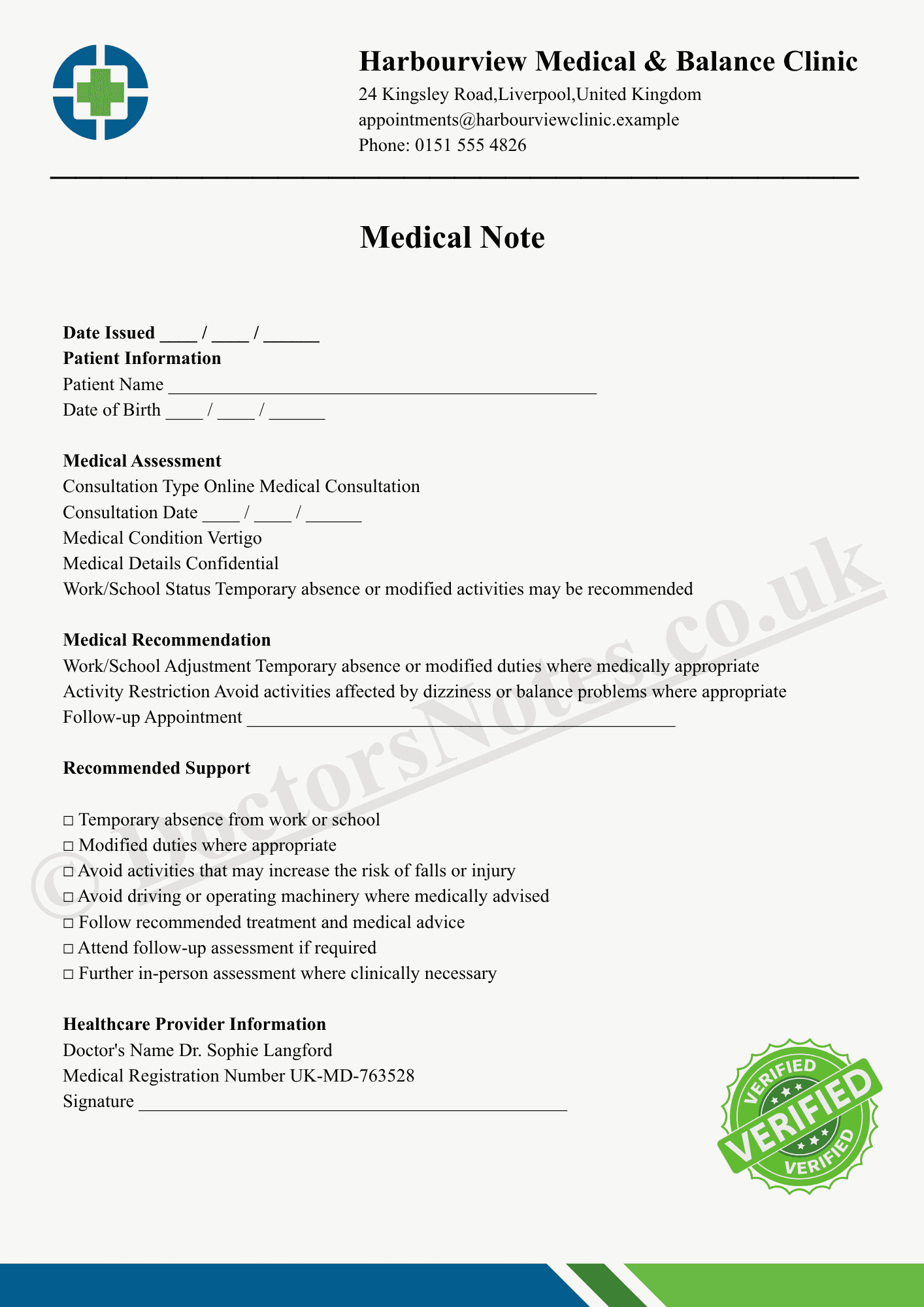


A doctor’s note for vertigo can provide medical documentation when vertigo or related balance problems affect your ability to work, study, travel, or carry out normal activities. The right documentation depends on your symptoms, their effect on your daily life, and the outcome of a healthcare assessment.
Vertigo is more than ordinary dizziness. It can create a sensation that you or your surroundings are spinning. As a result, even simple activities such as walking, commuting, using screens, or concentrating at work may become difficult.
If your symptoms are interfering with your responsibilities, an online medical assessment may be a convenient way to discuss your situation with a healthcare professional and understand what documentation may be appropriate.
Quick Guide: Doctor’s Note for Vertigo
| Question | Short answer |
|---|---|
| What is vertigo? | A sensation that you or your surroundings are spinning or moving. |
| Can vertigo affect work? | Yes. Balance problems, nausea, visual disturbance and difficulty concentrating can interfere with many jobs. |
| Can I request a doctor’s note for vertigo? | You can request an assessment. Whether documentation is appropriate depends on the healthcare professional’s assessment. |
| Can vertigo be assessed online? | In some situations, yes. However, certain symptoms may require an in-person examination. |
| Do I need a fit note for the first 7 days? | Employees can generally self-certify sickness absence for the first 7 calendar days. |
| Can a fit note recommend adjustments? | Yes. Where appropriate, it can indicate that someone may be fit for work with adjustments. |
| Is a doctor’s note guaranteed? | No. Medical documentation should only be issued when supported by an appropriate assessment. |
How Vertigo Can Disrupt Your Day
A short episode may pass quickly, but vertigo can still make normal routines difficult while it is happening.
For example, you may struggle to:
- Walk safely around the workplace
- Stand for long periods
- Focus on a computer screen
- Travel to work
- Use machinery or equipment
- Climb stairs
- Work at height
- Drive safely
- Concentrate on detailed tasks
- Attend meetings
- Complete physically demanding duties
The effect can vary considerably from one person to another. Someone working at a desk may mainly struggle with concentration or screen use. By contrast, a construction worker, driver, warehouse operative, or healthcare worker may face additional safety concerns.
Therefore, the important question is not simply whether you have vertigo. Instead, the assessment needs to consider how the symptoms affect your ability to perform your particular duties safely.
What Is a Doctor’s Note for Vertigo?
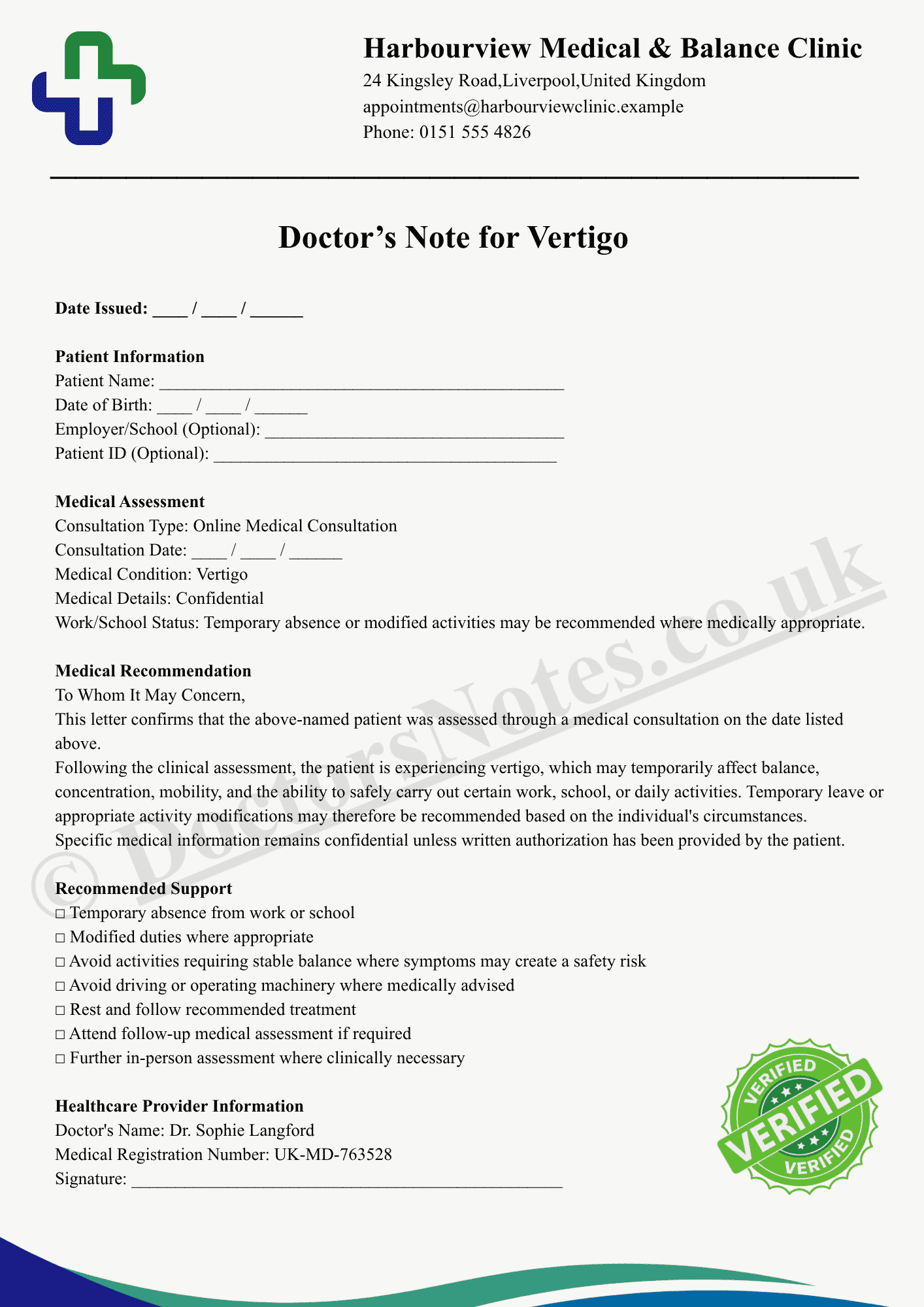
A doctor’s note for vertigo is medical documentation relating to vertigo and its effect on your health or ability to carry out normal activities.
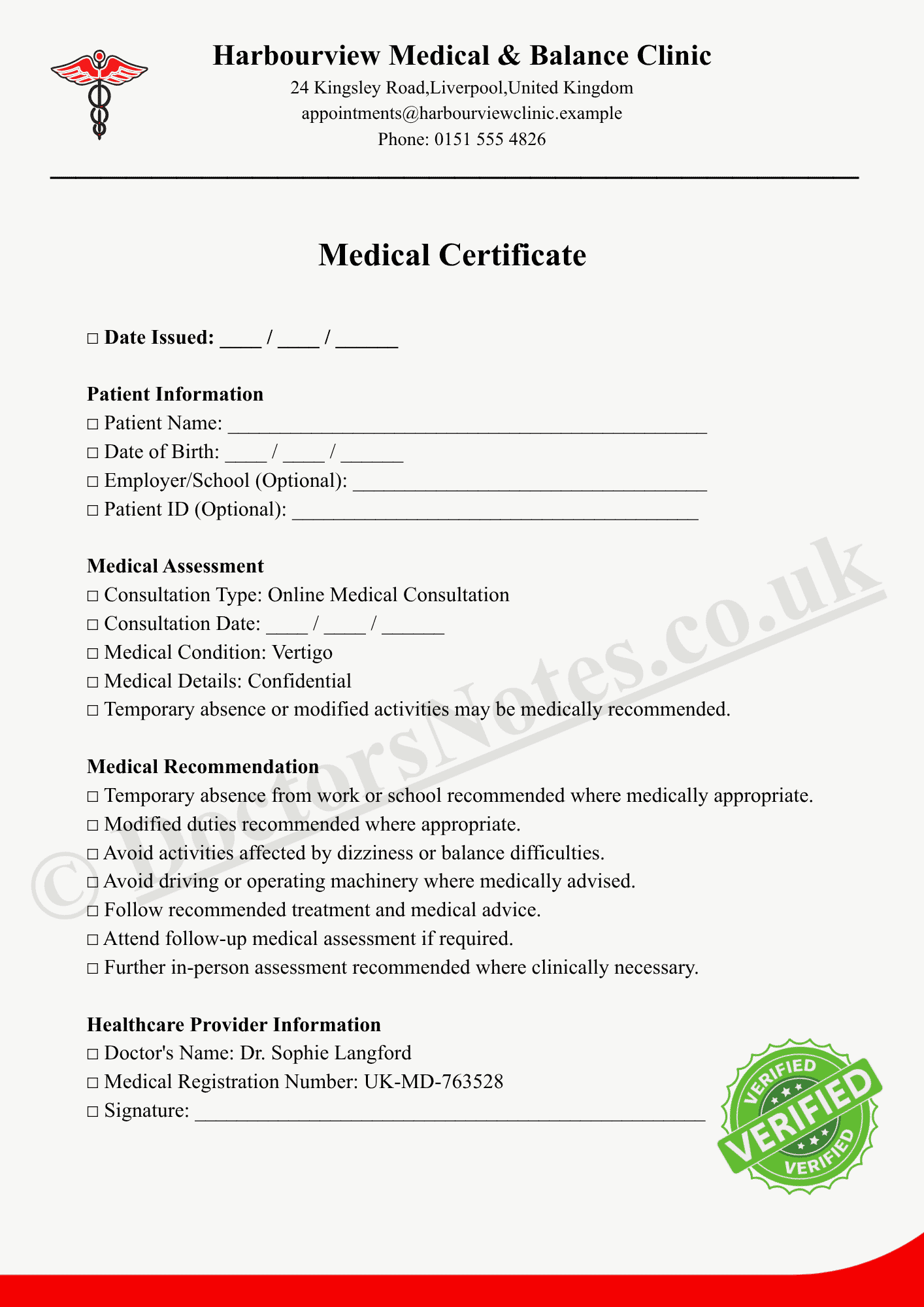
In the UK, people often use terms such as doctor’s note, sick note, and medical certificate when talking about evidence for sickness absence. However, the formal employment document is generally known as a fit note or Statement of Fitness for Work.
A healthcare professional decides whether a fit note or another form of medical documentation is appropriate after assessing the individual’s circumstances.
Depending on the assessment, documentation may relate to:
- A period when you are unable to work
- A need for temporary workplace adjustments
- Restrictions affecting particular duties
- A health condition affecting your ability to work
- A possible return-to-work arrangement
The document should reflect the healthcare professional’s assessment rather than simply the wording requested by the patient.
Vertigo Doctor’s Note for Work: When Might It Be Relevant?
Vertigo can affect work in several different ways.
Some people experience spinning sensations when moving their head. Others may have nausea, balance problems, visual disturbance or difficulty concentrating. Consequently, a job that normally feels manageable may become difficult or unsafe during an episode.
A vertigo doctor’s note for work may therefore become relevant when your symptoms have a meaningful effect on your ability to perform your normal duties.
Your job can make a difference
| Type of work | Possible issue caused by vertigo |
|---|---|
| Office work | Difficulty concentrating, screen discomfort or sitting upright |
| Driving | Dizziness can create a serious safety concern |
| Warehouse work | Increased risk around moving equipment and uneven surfaces |
| Construction | Working at height or around machinery may become unsafe |
| Healthcare | Walking, transferring patients or responding quickly may be difficult |
| Retail | Standing, walking and assisting customers may become challenging |
| Hospitality | Carrying items, moving quickly and working around hazards may be affected |
| Manual work | Balance and coordination may be important for safe performance |
| Education | Standing, moving between rooms and supervising others may become harder |
| Remote work | Screen use and concentration can still be affected |
This is why a healthcare assessment should consider your actual role rather than treating every case of vertigo in exactly the same way.
Online Doctor’s Note for Vertigo – Can You Be Assessed Remotely?
An online doctor’s note for vertigo may be possible when a remote consultation is clinically suitable.
During an online assessment, the healthcare professional can ask about your symptoms, when they started, how often they occur, possible triggers, existing medical conditions and the effect they are having on your daily activities.
They may also ask about:
- A spinning sensation
- Balance problems
- Nausea or vomiting
- Headaches
- Hearing changes
- Ringing in the ears
- Recent infections
- Previous episodes
- Medicines
- Recent injuries
- Your ability to walk
- Your work responsibilities
However, online assessment is not suitable for every situation. If your symptoms suggest that you need an examination, urgent assessment or further testing, you may be advised to seek face-to-face medical care instead.
How an Online Vertigo Assessment Works
The process is straightforward, although the outcome depends on the clinical assessment.
1. Describe what you are experiencing
Explain what the dizziness feels like and whether you experience a true spinning sensation.
2. Explain when it happens
Mention whether symptoms appear continuously, come in episodes, or occur after particular movements.
3. Discuss the effect on your routine
Tell the healthcare professional what you are struggling to do. For example, you may be unable to commute safely or complete your normal duties.
4. Explain your occupation
Your work environment matters. Driving, working at height and operating machinery can create different safety considerations from ordinary office work.
5. Provide relevant medical information
Mention previous vertigo episodes, recent illnesses, medicines, diagnosed conditions and any other information that may help the assessment.
6. Follow the clinical advice
After reviewing your situation, the healthcare professional can explain the appropriate next step. Where medical documentation is justified, they can determine what form of documentation is suitable.
What Should You Tell the Healthcare Professional?
Good information makes an assessment more useful.
Before your appointment, consider making a short note of the following:
Symptoms
- Spinning sensation
- Unsteadiness
- Nausea
- Vomiting
- Headache
- Hearing changes
- Tinnitus
- Visual symptoms
- Difficulty walking
- Difficulty concentrating
Timing
- When the symptoms began
- How long episodes usually last
- How frequently they occur
- Whether they are becoming more frequent
- Whether certain movements trigger them
Work impact
- Your normal job duties
- Whether you drive for work
- Whether you operate machinery
- Whether you work at height
- Whether you need to stand or walk for long periods
- Whether screen work makes symptoms worse
Medical background
- Existing conditions
- Recent infections
- Recent injuries
- Current medicines
- Previous vertigo or dizziness
- Relevant appointments or diagnoses
A clear description is more useful than simply saying that you feel “dizzy”.
Doctor’s Note for Dizziness and Vertigo: Are They the Same?
Not exactly.
Dizziness is a broad term. It can describe feeling lightheaded, faint, unsteady or off-balance.
Vertigo usually refers to the specific sensation that you or your surroundings are spinning or moving.
The distinction matters because different symptoms can have different causes. Therefore, describe exactly what you are experiencing rather than choosing a medical term based only on an internet search.
Common Reasons Vertigo Can Happen
Vertigo has several possible causes.
Inner-ear problems are among the common causes. These can include:
- Benign paroxysmal positional vertigo (BPPV)
- Labyrinthitis
- Vestibular neuritis
- Ménière’s disease
Other possible causes include migraine and certain medicines.
The cause is not always obvious. For that reason, persistent or recurring symptoms should be assessed rather than self-diagnosed.
Vertigo Sick Note: Do You Automatically Need One?
No.
If you are off work for 7 calendar days or less, you can generally self-certify your sickness absence rather than providing a fit note.
After that period, your employer may ask for medical evidence. If your health condition affects your fitness for work, an eligible healthcare professional may issue a fit note when appropriate.
Your employer may also have its own sickness-reporting procedure. Therefore, check your workplace policy so you know what evidence and notification process your employer expects.
Fit Note for Vertigo: What Could It Say?
A fit note for vertigo does not simply mean “off work”.
Depending on the assessment, a healthcare professional may decide that you are:
- Not fit for work
- May be fit for work with appropriate adjustments
Possible adjustments can include changes such as:
- Temporary changes to duties
- Reduced physical demands
- Altered working hours
- Avoiding certain safety-sensitive tasks
- Temporary restrictions on particular activities
The actual recommendation depends on the individual assessment.
A fit note is also advisory. Your employer considers the advice and decides what workplace arrangements can reasonably be made.
Can Vertigo Affect Driving?
Yes, and this is an important safety issue.
Vertigo can affect balance, spatial awareness and your ability to function safely. Therefore, driving while experiencing significant symptoms may be unsafe.
If you drive, check the relevant DVLA guidance and follow medical advice about whether you should drive.
The same principle applies to other safety-sensitive activities. Avoid activities such as operating heavy machinery, working at height or using hazardous equipment when dizziness or vertigo makes them unsafe.
Doctor’s Note for Vertigo and Workplace Adjustments
A temporary absence is not always the only option.
In some cases, someone may be able to continue working if their duties are modified. For example, an assessment might support temporary changes such as:
- More frequent breaks
- Reduced standing
- Temporary desk-based duties
- Avoiding ladders or heights
- Avoiding machinery
- Reduced travel requirements
- Flexible working hours
- Working from home where practical
These examples are not automatic recommendations. Instead, they illustrate how health and work requirements can sometimes be considered together.
What If You Can Still Work With Vertigo?
Having vertigo does not automatically mean that you must stop working.
Your symptoms may be mild enough for you to continue with your usual duties. Alternatively, you might be able to work if certain activities are changed temporarily.
For instance, an office employee may be able to work with regular breaks and reduced screen exposure. Someone who drives for a living may have different safety considerations.
Ultimately, the decision should reflect your symptoms, your role and the healthcare professional’s assessment.
How Long Can a Doctor’s Note for Vertigo Last?
There is no single duration that applies to everyone.
The appropriate period depends on the clinical assessment and the expected effect of the condition on your fitness for work.
Vertigo can be short-lived for some people. In other cases, symptoms may continue or return over time.
During the first six months of a condition, a fit note can generally cover a maximum of three months at a time. A healthcare professional can recommend review or reassessment where appropriate.
If symptoms continue after the documented period, you may need another assessment.
Can You Get a Doctor’s Note for Vertigo Retrospectively?
Do not assume that documentation can automatically be backdated.
If you were previously unable to work because of vertigo, explain the dates and circumstances during your assessment. The healthcare professional can then decide what documentation is clinically appropriate.
Therefore, provide accurate information about when the symptoms began and how they affected you.
When Is an Online Assessment Not Appropriate?
Online medical assessment has practical limits.
You may need face-to-face or urgent medical care if your symptoms require physical examination, further testing or immediate treatment.
In particular, seek urgent medical advice if vertigo occurs with symptoms such as:
- A severe headache
- Repeated vomiting or feeling very sick
- A very high temperature
- Significant worsening of symptoms
Seek emergency help if vertigo occurs with:
- Double vision or loss of vision
- New hearing loss
- Difficulty speaking
- Weakness in an arm or leg
- Numbness or tingling
- Other symptoms suggesting a serious neurological problem
If you experience an emergency, medical treatment should always come before obtaining work documentation.
Managing Vertigo While You Recover
Simple measures may help some people manage symptoms.
For example:
- Sit or lie down when the spinning sensation begins.
- Move your head slowly.
- Get up gradually after sitting or lying down.
- Rest in a quiet environment if symptoms are severe.
- Keep lights on when moving around at night.
- Take care to reduce the risk of falling.
- Avoid driving or dangerous activities while dizzy.
If vertigo keeps returning or does not improve, arrange an appropriate medical assessment.
Doctor’s Note for Vertigo for School or University
Vertigo can also interfere with education.
Students may struggle with:
- Travelling to campus
- Walking between classes
- Sitting through lectures
- Concentrating on coursework
- Using computers
- Attending examinations
- Participating in practical sessions
If your symptoms are affecting attendance or academic activities, explain the specific difficulties during your assessment.
Your institution may have its own evidence requirements, so check its policy before requesting documentation.
What Makes a Vertigo Medical Assessment More Useful?
A focused consultation can save time and make your situation easier to understand.
Before starting, have these details available:
☐ Date your symptoms began
☐ Description of the spinning sensation
☐ Frequency of episodes
☐ Typical duration
☐ Possible triggers
☐ Other symptoms
☐ Current medicines
☐ Previous medical history
☐ Recent illness or infection
☐ Your occupation or course
☐ Main duties affected
☐ Dates you were unable to work or study
☐ Any workplace or education requirements
This information gives the healthcare professional a clearer picture of your circumstances.
Why Choose Online Medical Documentation for Vertigo?
Vertigo can make travelling to an appointment uncomfortable or difficult. An online consultation may remove some of that practical pressure when remote assessment is appropriate.
It can also allow you to discuss your symptoms from home while explaining exactly how they are affecting your work or studies.
Most importantly, the process should remain assessment-led. The purpose is not simply to obtain a document. Instead, it is to discuss your health situation and determine whether medical documentation is appropriate.
Is a Doctor’s Note for Vertigo Guaranteed?
No.
A doctor’s note for vertigo should only be provided when a healthcare professional considers it appropriate following an assessment.
You should not rely on any service that promises documentation regardless of your symptoms or medical circumstances.
The assessment outcome may instead be advice to continue working, seek further medical care, arrange an in-person examination, or consider workplace adjustments.
Related Doctor’s Note:
Doctor Note for Hypertension Review
Frequently Asked Questions
Can I get a doctor’s note for vertigo online?
An online assessment may be suitable for some cases of vertigo. However, documentation is not automatic. A healthcare professional must assess your circumstances and decide what is appropriate.
Can I get an online doctor’s note for vertigo for work?
Yes, an online consultation may be an option when remote assessment is clinically suitable. Your symptoms, occupation and ability to work will all be relevant to the assessment.
What is a vertigo sick note?
“Vertigo sick note” is a common phrase for medical evidence relating to sickness absence caused by vertigo. In the UK, the formal employment document is generally called a fit note.
Can vertigo stop me from working?
It can. Severe spinning sensations, poor balance, nausea and difficulty concentrating may make some duties difficult or unsafe. The impact depends on the individual and their job.
Do I need a fit note for the first week of vertigo?
Generally, no. Employees can usually self-certify sickness absence for the first 7 calendar days. Your employer may still have specific procedures for reporting sickness.
Can a fit note for vertigo recommend lighter duties?
Potentially. If the healthcare professional believes you may be able to work with adjustments, the fit note can provide relevant advice about workplace changes.
Can I work from home if I have vertigo?
That depends on your symptoms and job. Working from home may remove commuting and some physical demands, although screen use and concentration can still be difficult during an episode.
Can I drive with vertigo?
You should take particular care because vertigo can affect safe driving. Do not drive when your symptoms make driving unsafe, and check the applicable DVLA guidance if you have vertigo.
Can I get a doctor’s note for dizziness and vertigo?
You can request a medical assessment for dizziness or vertigo. The healthcare professional will consider your symptoms and decide whether medical documentation is appropriate.
Can a doctor’s note for vertigo be backdated?
Do not assume that it can. Explain when your symptoms started and when they affected your work. The healthcare professional can then determine what documentation is appropriate.
How long can a fit note for vertigo last?
The duration depends on the healthcare professional’s assessment. During the first six months of a condition, a fit note can generally cover up to three months at a time.
What should I tell a doctor about my vertigo?
Explain what the sensation feels like, when it occurs, how long episodes last, possible triggers, other symptoms and how the condition affects your work or daily activities.
When should vertigo be assessed urgently?
Seek urgent medical advice if vertigo occurs with a severe headache, repeated vomiting or a very high temperature. Emergency help may be needed if you develop symptoms such as loss of vision, difficulty speaking, weakness or numbness.
Is a medical certificate for vertigo the same as a fit note?
Not necessarily. “Medical certificate” is a broad term, while a fit note is the formal UK document used to provide evidence and advice about fitness for work.
Is an online doctor’s note for vertigo guaranteed?
No. Medical documentation depends on an appropriate healthcare assessment. No legitimate assessment should guarantee an outcome before your circumstances have been reviewed.
Discuss Your Vertigo and Documentation Needs Online
If vertigo is affecting your ability to work, study or manage your normal responsibilities, an online medical assessment may be a convenient starting point when remote care is suitable.
Explain your symptoms clearly, provide accurate information about your circumstances, and describe the duties you are struggling to perform. From there, a healthcare professional can assess your situation and advise whether medical documentation is appropriate.
Need medical documentation related to vertigo? Start your online assessment and discuss your symptoms with a healthcare professional.


Reviews
There are no reviews yet.