


Sinusitis can make an ordinary working day surprisingly difficult. A blocked nose, facial pressure, headache, tiredness and trouble concentrating can affect how you feel and how well you can carry out your normal duties.
If sinusitis is affecting your ability to work, appropriate medical documentation may help explain your sickness absence or support a conversation about temporary changes to your duties.
An online medical assessment can be a convenient option when your symptoms are suitable for remote review. You can explain what you are experiencing, how it affects your work and what documentation your employer has requested.
Important: Medical documentation is subject to clinical assessment. Requesting a doctor’s note does not guarantee that one will be issued.
Sinusitis and Work: The Important Points
Sinusitis affects people differently. Some people can continue working, while others may find their symptoms make normal duties difficult.
| Sinusitis symptom | How it may affect your working day |
|---|---|
| Blocked nose | Difficulty breathing comfortably, especially during physical activity |
| Facial pain or pressure | Discomfort when concentrating or moving around |
| Headache | Difficulty focusing on tasks |
| Reduced sense of smell | May affect certain jobs |
| Tiredness | Lower energy during the working day |
| Persistent nasal symptoms | Discomfort during meetings or customer-facing work |
| Poor sleep from symptoms | Fatigue and reduced concentration |
| Dizziness or feeling unwell | May affect safety-sensitive activities |
The effect on your ability to work depends on the severity of your symptoms and the demands of your role.
What Is a Doctor’s Note for Sinusitis?
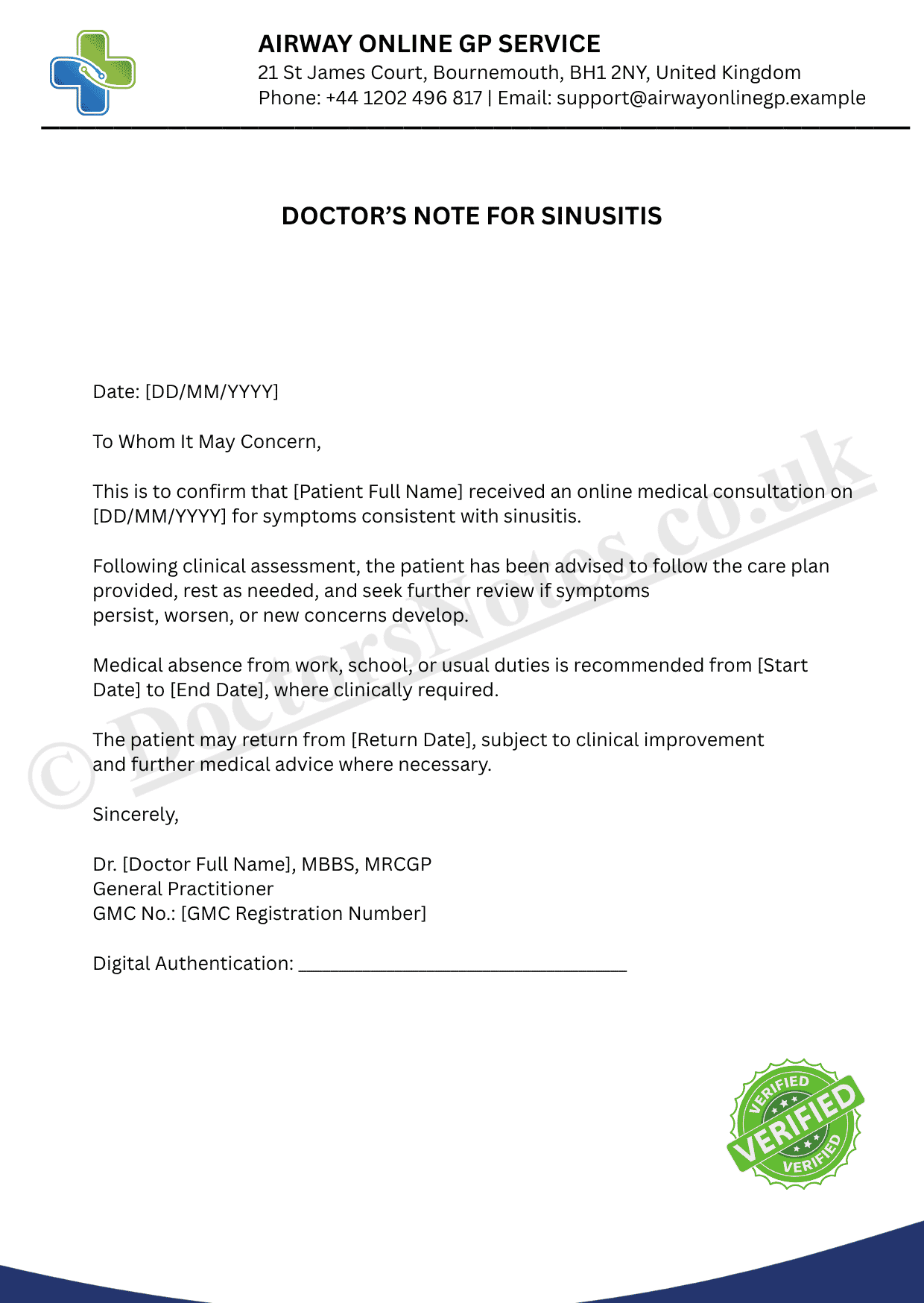
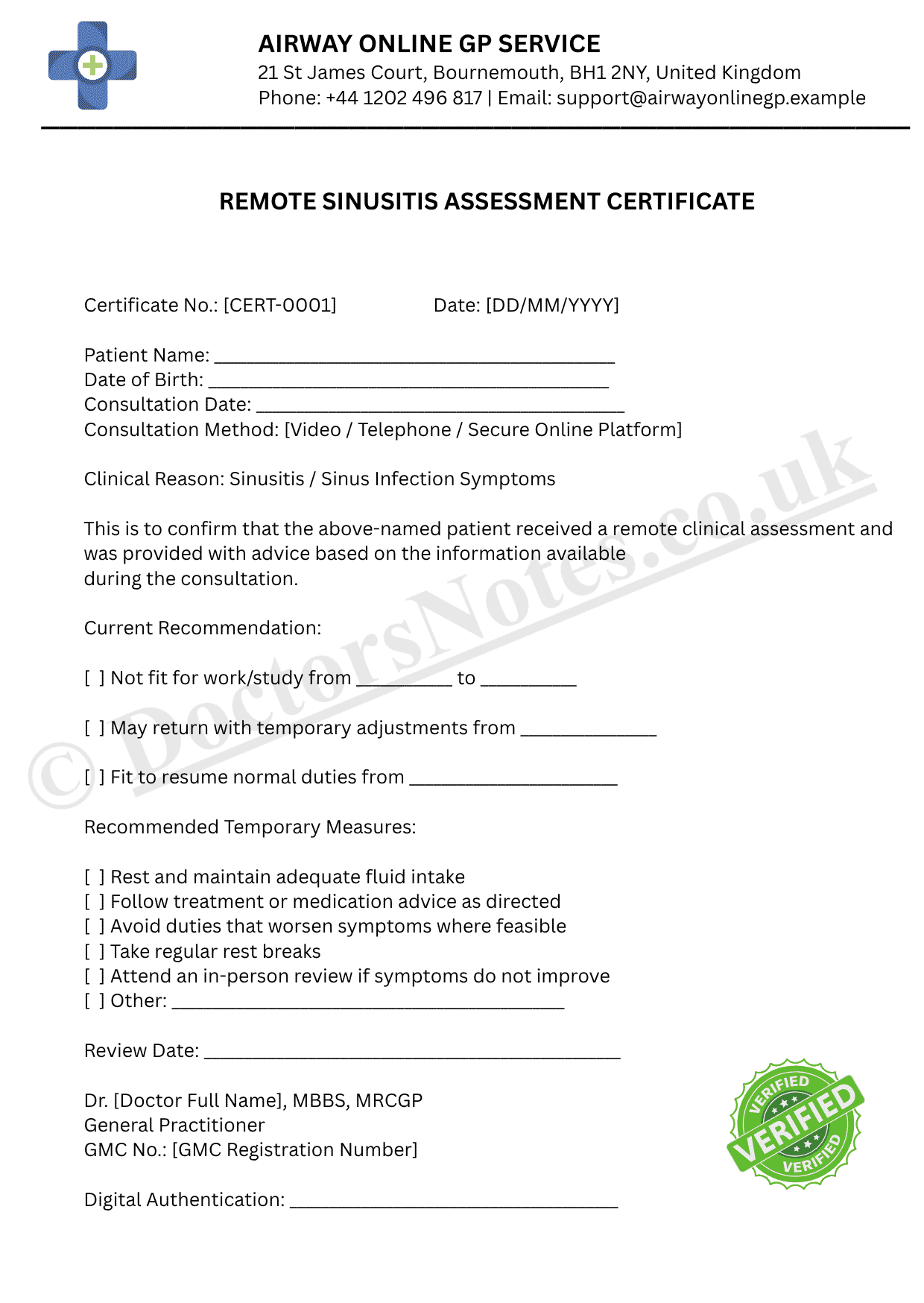
A doctor’s note for sinusitis is a general term people use for medical documentation relating to sinusitis and its effect on their health or ability to work.
In the UK, the formal document used to provide advice about fitness for work is called a Statement of Fitness for Work, commonly known as a fit note.
A fit note is issued following an assessment of how a health condition affects your fitness for work. It can indicate that you are not fit for work or that you may be fit for work with adjustments.
The healthcare professional decides whether a fit note is appropriate based on the assessment.
What Is Sinusitis?
Sinusitis is inflammation of the sinuses, the air-filled spaces around the nose, cheeks and forehead.
It commonly develops after a cold or flu and can cause symptoms including:
- A blocked or runny nose
- Facial pain or pressure
- Headache
- Reduced sense of smell
- Cough
- Bad breath
- Toothache
- Tiredness
- Fever in some cases
NHS guidance notes that sinusitis is usually caused by a viral infection and often gets better without antibiotics.
When Can Sinusitis Make Work Difficult?
A mild case may not prevent you from working. More troublesome symptoms can make certain tasks harder.
For example, you might struggle with:
Concentration:
Headaches, facial pressure and poor sleep can make it harder to focus.
Communication:
A blocked nose or persistent cough may make speaking for long periods uncomfortable.
Physical work:
Feeling unwell or experiencing facial pressure can make demanding activity harder.
Driving:
If you feel significantly unwell, dizzy or unable to concentrate safely, driving may not be appropriate.
Customer-facing work:
Frequent coughing, nasal symptoms or discomfort may make a full shift challenging.
The relevant question is how your symptoms affect your ability to perform your normal duties.
Doctor’s Note for Sinusitis for Work
If you are looking for a doctor’s note for sinusitis for work, explain the practical effect of the condition rather than simply giving the diagnosis.
For example:
“My sinusitis is causing severe facial pressure and headaches. I am struggling to concentrate during prolonged computer work.”
That gives useful information about functional impact.
Other details worth discussing include:
- How long symptoms have lasted
- Whether they are getting better or worse
- Whether you have a fever
- Whether your sleep is affected
- Whether you can concentrate normally
- Whether your job involves physical exertion
- Whether you need to drive
- Whether your workplace exposes you to dust or irritants
Can You Get an Online Doctor’s Note for Sinusitis?
An online assessment may be appropriate for some people with sinusitis.
A healthcare professional may discuss:
- Your symptoms
- How long they have been present
- Whether you recently had a cold or flu
- Your current treatments
- Your medical history
- Any relevant workplace factors
- How the symptoms affect your normal activities
However, remote assessment is not suitable for every situation.
If your symptoms suggest a complication or you require a physical examination, you may need face-to-face medical care.
How to Prepare for an Online Sinusitis Assessment
You can make the consultation more useful by preparing a few details beforehand.
1. Note when your symptoms began
Mention whether they appeared after a cold, flu or another illness.
2. List your main symptoms
For example:
- Facial pressure
- Blocked nose
- Runny nose
- Headache
- Reduced smell
- Cough
- Tiredness
3. Explain how you feel today
Tell the healthcare professional whether the symptoms are improving, staying the same or getting worse.
4. Mention anything you have already tried
Include medicines, nasal sprays or other treatments if relevant.
5. Explain your work
Describe the duties you are currently struggling to perform.
6. Clarify your documentation requirement
If your employer has asked for a fit note or other medical evidence, explain exactly what they require.
Sinusitis After a Cold or Flu
Sinusitis often develops after an upper respiratory infection.
You may initially experience:
Cold or flu → nasal congestion → sinus inflammation → facial pressure and other sinus symptoms
This does not mean every blocked nose is sinusitis.
If your symptoms persist, worsen or become difficult to manage, appropriate medical advice can help determine what is happening.
Can Sinusitis Cause Headaches?
Yes.
Sinusitis can cause headaches and facial pressure, particularly around the forehead, cheeks or eyes.
A headache can become especially disruptive when your job requires:
- Concentrated computer work
- Reading
- Long meetings
- Detailed decision-making
- Driving
- Continuous communication
If headaches are a major part of your symptoms, mention them during your assessment rather than focusing only on nasal congestion.
Can Sinusitis Affect Concentration at Work?
It can.
Concentration may become more difficult when you are dealing with:
- Persistent facial pressure
- Headache
- Poor sleep
- Fatigue
- Feeling generally unwell
- Frequent coughing or nasal symptoms
If your work requires sustained attention, explain how your symptoms affect your actual performance.
This is more useful than simply saying that you “feel sick.”
Sinusitis and Different Types of Work
The same symptoms can have different consequences depending on your job.
| Type of work | Possible difficulty |
|---|---|
| Office work | Concentration, headaches and prolonged screen use |
| Call-centre work | Speaking for extended periods |
| Teaching | Continuous speaking and classroom interaction |
| Driving | Concentration and feeling generally unwell |
| Construction | Physical exertion and exposure to dust |
| Warehouse work | Physical activity and prolonged movement |
| Healthcare work | Long shifts, communication and patient-facing duties |
| Outdoor work | Weather and environmental exposure may affect comfort |
This does not mean that someone in any particular job automatically needs time off. A healthcare professional assesses the individual situation.
Can You Work With Sinusitis?
Possibly.
Some people with sinusitis continue working while managing their symptoms. Others may need temporary changes or time away from work.
Factors that may matter include:
- Symptom severity
- Type of work
- Physical demands
- Ability to concentrate
- Sleep disruption
- Exposure to workplace irritants
- Whether temporary adjustments are possible
A fit note may indicate that someone is not fit for work or may be fit for work with adjustments, depending on the assessment.
Could Workplace Adjustments Help?
Time away from work is not always the only option.
Depending on your situation, temporary changes might include:
- More opportunities for rest
- Reduced physically demanding tasks
- Temporary home working where practical
- Adjusted working hours
- Reduced exposure to dust or other irritants
- Temporary changes to duties
A fit note can provide advice about fitness for work, while the employee and employer discuss whether practical changes can be made.
Sinusitis and Working From Home
Working from home can sometimes make a difficult day more manageable, but it does not automatically mean you are fit to work.
If headaches, fatigue or facial pain make concentration difficult, working remotely may not solve the underlying problem.
The important issue is whether you can safely and effectively carry out your duties.
Do You Need a Sick Note for Sinusitis?
Not necessarily.
In the UK, employees can generally self-certify for the first 7 calendar days of sickness absence. A fit note may be required for longer periods of sickness absence, depending on the circumstances and your employer’s requirements.
Your employer may also have its own sickness-reporting procedure, so check what you are expected to do.
If you are well enough to work and your fitness for work is not impaired, a healthcare professional does not need to issue a fit note simply because an employer asks for one.
Who Can Issue a Fit Note for Sinusitis?
Current UK guidance allows the following eligible healthcare professionals to certify fit notes:
- Doctors
- Nurses
- Occupational therapists
- Pharmacists
- Physiotherapists
The professional must have the appropriate knowledge, skills and clinical responsibility to assess fitness for work.
A fit note is based on an assessment rather than simply a patient’s request for documentation.
How Long Can a Sinusitis Fit Note Last?
There is no standard number of days that applies to everyone with sinusitis.
The duration depends on factors such as:
- Severity of symptoms
- How the condition is progressing
- Treatment
- Functional limitations
- Type of work
- Clinical assessment
During the first six months of a health condition, GOV.UK guidance states that a fit note can be issued for a maximum of three months at a time. A review can be recommended where appropriate.
What If Your Sinusitis Keeps Coming Back?
Occasional sinusitis is different from recurrent or persistent symptoms.
If you keep developing sinusitis, or symptoms continue for a prolonged period, further medical assessment may be appropriate.
NHS guidance advises that a GP may refer someone to an ENT specialist when sinusitis continues after three months of treatment, keeps returning or affects only one side of the face.
A recurring problem should be assessed medically rather than repeatedly relying on short-term documentation.
When Should You Seek Medical Advice for Sinusitis?
You should seek appropriate medical advice if:
- Symptoms are severe
- Symptoms are getting worse
- Symptoms are not improving
- Sinusitis keeps returning
- You have significant facial pain
- You are concerned about your symptoms
- The condition is interfering substantially with normal activities
Most sinusitis cases improve without antibiotics, but persistent or recurrent symptoms may require further assessment.
When Is an Online Assessment Not Enough?
An online consultation is not the right option for every situation.
You may need face-to-face assessment if:
- Your symptoms require physical examination
- The diagnosis is uncertain
- Symptoms are severe or unusual
- You may have a complication
- You need examination or investigation that cannot be performed remotely
If you are seriously unwell, seek appropriate urgent medical care rather than prioritising a doctor’s note.
Can a Sinusitis Doctor’s Note Be Backdated?
Do not assume that a fit note can simply be backdated to cover dates requested by an employer.
If you were previously seen by a healthcare professional, information from that assessment may be relevant.
Any documentation covering previous sickness should reflect the healthcare professional’s assessment and clinical judgement.
What If Your Employer Asks for Proof?
First, clarify what type of evidence your employer wants.
They may ask for:
- A fit note
- Medical evidence
- A healthcare report
- Other sickness documentation
These terms are not necessarily interchangeable.
If your employer specifically requests a fit note, make sure the document you provide meets that requirement.
What Can a Sinusitis Fit Note Say?
A fit note can provide advice about how your health condition affects your fitness for work.
Depending on the assessment, it may indicate:
Not fit for work
Your condition currently prevents you from working.
May be fit for work
You may be able to work if appropriate adjustments can be made.
The fit note is intended to support communication between the employee and employer about health and work.
What Should You Have Ready Before Requesting Medical Documentation?
Keep these details nearby:
Health information
☐ Date symptoms started
☐ Main symptoms
☐ Severity of facial pain or pressure
☐ Nasal symptoms
☐ Headaches
☐ Changes in smell
☐ Sleep problems
☐ Fever or other symptoms
☐ Treatments already tried
Work information
☐ Job title or type of work
☐ Main responsibilities
☐ Physical demands
☐ Driving requirements
☐ Communication requirements
☐ Workplace exposures
☐ Tasks currently affected
Documentation information
☐ What your employer requested
☐ Dates of absence
☐ Any previous medical assessment
☐ Relevant treatment information
How Many Days Off Work Do You Need for Sinusitis?
The number of days off work you need for sinusitis depends on the severity of your symptoms and how they affect your daily activities. Mild sinusitis may allow you to continue working, while more severe symptoms, such as facial pain, sinus pressure, headaches, nasal congestion, and fatigue, may make it difficult to concentrate or complete your usual duties. Many cases improve within 7–10 days, but some symptoms can last longer.
A healthcare provider can assess your condition and recommend whether you need time off work. If medically appropriate, they may provide a doctor’s note documenting the recommended absence dates or temporary work restrictions. For example, you may need a short period of rest if severe headaches, facial pressure, or fatigue prevent you from working comfortably. The appropriate duration depends on your recovery, job responsibilities, and medical assessment.
Before returning to work, consider whether your symptoms are improving and whether you can perform your duties safely. Contact a healthcare professional if symptoms worsen, last more than 10 days without improvement, or improve and then become worse again. Seek urgent medical attention for swelling around the eyes, vision changes, severe headache, or confusion.
FAQs
Can I get a doctor’s note for sinusitis?
You may receive appropriate medical documentation if a healthcare professional assesses your condition and determines that documentation is clinically appropriate.
Can I get a doctor’s note for sinusitis for work?
If sinusitis affects your fitness for work, a healthcare professional can assess whether a fit note or other appropriate documentation is suitable.
Can I get an online doctor’s note for sinusitis?
Some sinusitis symptoms may be assessed remotely. However, an in-person examination may be necessary when symptoms are severe, unusual or require further investigation.
Can sinusitis make you too ill to work?
It can affect your ability to work when symptoms such as headaches, facial pressure, fatigue or severe congestion interfere with your normal duties.
Can I work with sinusitis?
Some people can continue working, while others may need temporary adjustments or time away. The appropriate advice depends on the symptoms and the nature of the job.
How long does sinusitis usually last?
Many cases improve without antibiotics. Persistent or recurrent symptoms may need further assessment.
Can sinusitis cause headaches?
Yes. Headache and facial pressure are common symptoms associated with sinusitis.
Can sinusitis affect concentration?
Symptoms such as headache, facial pressure, fatigue and disrupted sleep can make concentration more difficult.
Can I work from home with sinusitis?
Working from home may be possible for some people, but it does not automatically mean you are fit to work. Your ability to perform your duties remains the important consideration.
Do I need a fit note during the first week of sinusitis?
Generally, employees can self-certify sickness absence for the first 7 calendar days. Your employer may have its own reporting requirements.
Who can issue a fit note for sinusitis in the UK?
Doctors, nurses, occupational therapists, pharmacists and physiotherapists can certify fit notes when they meet the relevant requirements and can assess fitness for work.
Can a fit note recommend reduced duties for sinusitis?
A fit note can state that someone may be fit for work with adjustments. The employee and employer can then discuss whether suitable changes are possible.
Can sinusitis be caused by a cold?
Yes. Sinusitis commonly develops after a cold or flu.
Does sinusitis always require antibiotics?
No. NHS guidance states that sinusitis is usually caused by a virus and antibiotics are rarely needed.
Can recurrent sinusitis require specialist assessment?
It can. NHS guidance says a GP may refer someone to an ENT specialist when sinusitis continues after three months of treatment, keeps returning or occurs only on one side of the face.
Can a sinusitis doctor’s note be backdated?
It should not be assumed that documentation can be backdated simply because an employer requests particular dates. Previous clinical information may be considered where relevant.
Is a doctor’s note for sinusitis guaranteed?
No. Medical documentation depends on an appropriate clinical assessment. A healthcare professional may decide that a fit note is not clinically justified.
When should I seek further help for sinusitis?
Seek medical advice if symptoms are severe, worsening, persistent, recurrent or significantly interfering with normal activities.
Can I use an online assessment instead of urgent medical care?
No. If you have symptoms requiring urgent assessment, seek appropriate medical care rather than using an online consultation primarily to obtain documentation.
Discuss Your Sinusitis and Work Situation Online
Sinusitis can affect more than your nose. Facial pressure, headaches, tiredness, poor sleep and persistent congestion can interfere with concentration and everyday work.
If your symptoms are suitable for remote assessment, an online consultation gives you an opportunity to explain what you are experiencing, discuss how it affects your work and clarify what medical documentation may be appropriate.
Have your symptom details, work requirements and any previous treatment information ready for your consultation.


Reviews
There are no reviews yet.