

When a health condition, injury or recovery period makes your usual work duties difficult, you may not need to stop working completely. In some situations, a healthcare professional may recommend temporary work restrictions or workplace adjustments to help you continue working safely while you recover.
A Work Restriction Doctor’s Note can provide medical documentation explaining that your health may affect your ability to carry out certain work activities and that temporary adjustments may be appropriate. Depending on your individual circumstances and clinical assessment, recommendations may include avoiding heavy lifting, limiting prolonged standing, reducing physically demanding tasks, adjusting working hours, taking additional breaks, or temporarily changing certain duties.
What Is a Work Restriction Doctor’s Note?
A Work Restriction Doctor’s Note is medical documentation that may explain how a health condition affects your ability to perform certain work-related activities.
For example, your medical assessment may indicate that you can work but should temporarily:
- Avoid heavy lifting
- Avoid strenuous physical activity
- Limit prolonged standing or walking
- Avoid repetitive movements
- Reduce working hours
- Take regular rest breaks
- Avoid night shifts
- Work from home where appropriate
- Perform lighter or amended duties
- Follow a phased return-to-work plan
- Avoid specific workplace activities that could worsen your condition
The exact restrictions should be based on your health circumstances and the healthcare professional’s clinical judgement. UK guidance specifically recognises amended duties, altered hours, phased returns and workplace adaptations as possible ways of supporting someone who may be fit for work.
When Might You Need a Work Restriction Doctor’s Note?
You may consider medical documentation if you are struggling to perform your normal duties because of a health condition, injury, treatment or recovery period.
Common situations may include:
Back Pain or Back Injury
If lifting, bending, carrying or prolonged standing aggravates your symptoms, temporary restrictions on manual handling or physically demanding tasks may be appropriate following assessment.
Muscle or Joint Injury
A sprain, strain or other musculoskeletal problem may make repetitive movement, lifting, walking or standing difficult.
Recovery After Surgery
After certain procedures, you may be able to return to work but require temporary restrictions while your body recovers.
Workplace-Related Pain
If particular tasks appear to aggravate your symptoms, medical advice may help you and your employer discuss temporary changes to your duties.
Fatigue or Reduced Stamina
Some health conditions can make long shifts, prolonged physical activity or demanding schedules difficult. Adjusted hours or additional breaks may sometimes be considered.
Pregnancy-Related Restrictions
Depending on the circumstances and clinical assessment, temporary changes to duties, hours or physical activities may be recommended.
Stress, Anxiety or Other Health Conditions
Where a health condition affects your ability to manage particular work demands, a healthcare professional may recommend appropriate workplace adjustments.
Recovery From an Illness
You may feel well enough to work but not yet ready to perform every part of your normal role. A temporary restriction can help support a safer return to normal duties.
What Can a Work Restriction Note Recommend?
There is no single restriction that applies to everyone. Your recommendation should reflect your individual health circumstances and the type of work you perform.
Possible recommendations can include:
| Possible Restriction | What It May Mean |
|---|---|
| No heavy lifting | Avoid lifting or carrying heavy objects temporarily |
| Limited standing | Reduce prolonged periods of standing |
| Limited walking | Reduce excessive walking where clinically appropriate |
| Avoid strenuous activity | Temporarily avoid physically demanding tasks |
| Amended duties | Carry out alternative or lighter tasks |
| Altered hours | Temporarily change the length or timing of shifts |
| Additional breaks | Allow regular rest periods where appropriate |
| Phased return | Gradually increase duties or working hours |
| Workplace adaptation | Modify aspects of the working environment |
| Remote working | Work from home where suitable and agreed |
| Avoid repetitive tasks | Reduce movements that aggravate symptoms |
UK Government guidance confirms that workplace changes can include altered hours, amended duties, workplace adaptations, working from home and phased returns.
Work Restriction vs. Sick Leave: What’s the Difference?
This is an important distinction.
A sick note/fit note stating “not fit for work” indicates that the healthcare professional considers you unable to work.
A “may be fit for work” recommendation can instead support a conversation about temporary adjustments that could allow you to remain at work or return to work.
For example:
Without restrictions:
You are expected to complete your normal duties.
With temporary restrictions:
You may continue working but avoid certain activities while recovering.
Not fit for work:
Your health condition prevents you from carrying out work of any kind at that time.
The appropriate option depends on your individual clinical assessment.
Examples of Workplace Restrictions
A restriction may be particularly useful when your normal job involves physical or repetitive activities.
For example:
Office worker:
“May benefit from regular breaks and temporary limitation of prolonged sitting.”
Warehouse worker:
“Should temporarily avoid heavy lifting and strenuous manual handling.”
Retail worker:
“May benefit from reduced prolonged standing and amended duties.”
Construction worker:
“Should avoid strenuous physical activity and heavy manual tasks during the recommended recovery period.”
Driver:
“Work duties should be reviewed in relation to the individual’s symptoms and ability to perform driving-related tasks safely.”
These are examples only. Your actual medical recommendation should be based on your own circumstances and assessment rather than selecting restrictions simply because they appear on a list.
Why Get Medical Documentation for Work Restrictions?
Explaining your situation verbally to your employer may not always be enough.
Appropriate medical documentation can help provide a clearer basis for a conversation about your temporary work requirements.
It can help you:
- Explain how your health is affecting your work
- Discuss temporary changes to your duties
- Request appropriate workplace adjustments
- Support a phased return to work
- Document recommended restrictions
- Communicate medical advice to your employer
- Plan a safer return to your normal responsibilities
The purpose is not simply to avoid work. In many cases, appropriate adjustments can help an employee stay in work or return to work safely.
What Information May Be Included?
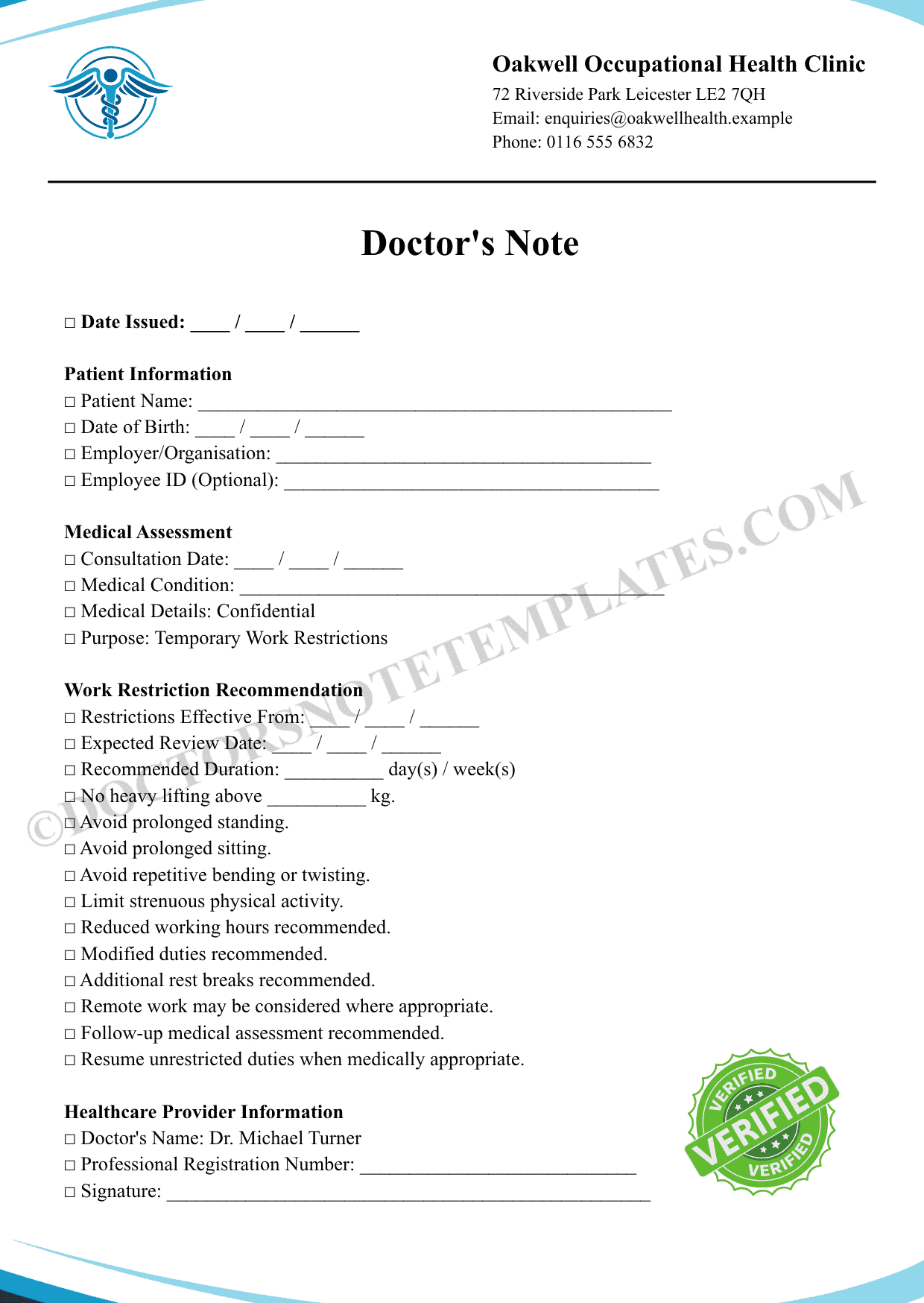
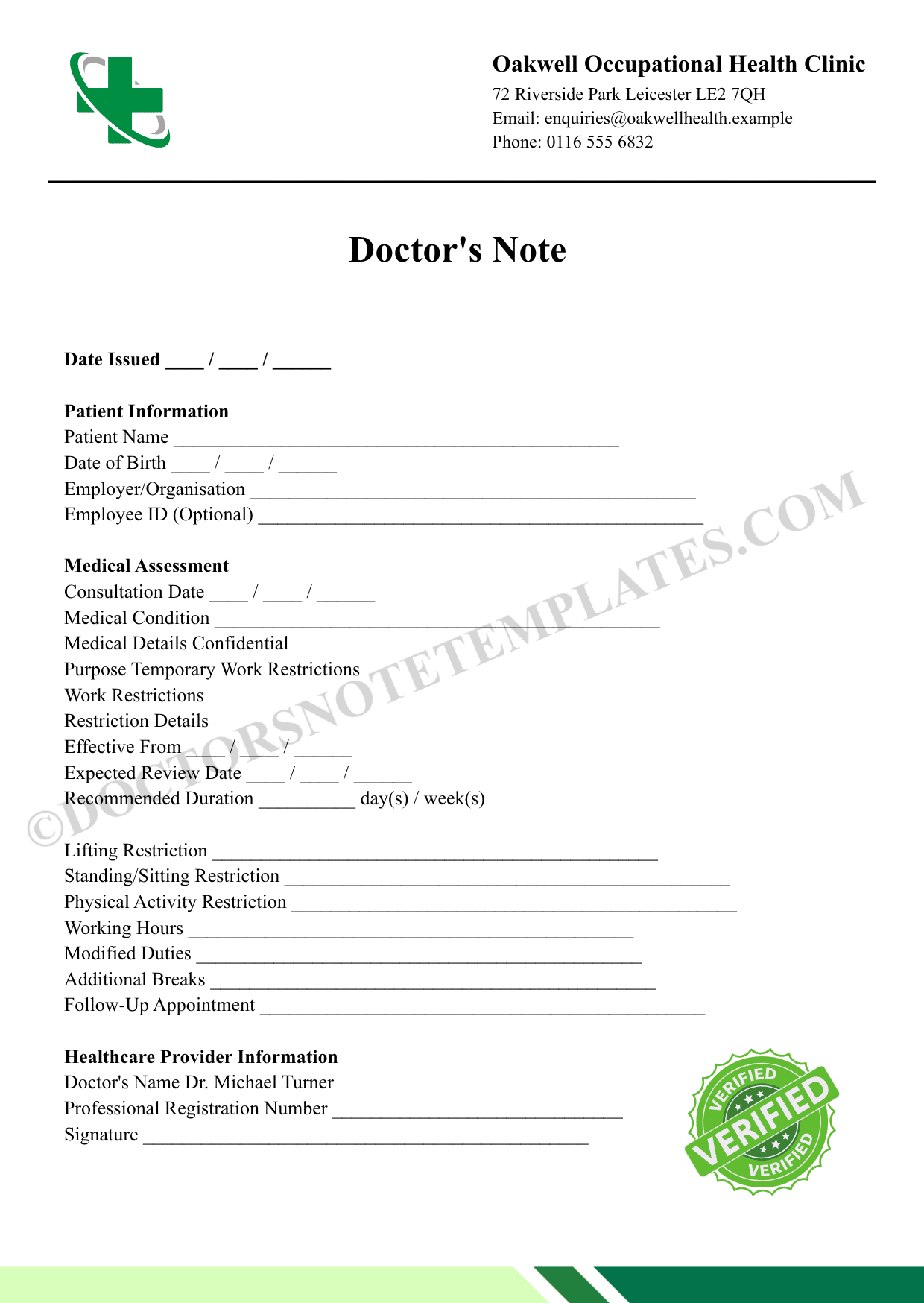
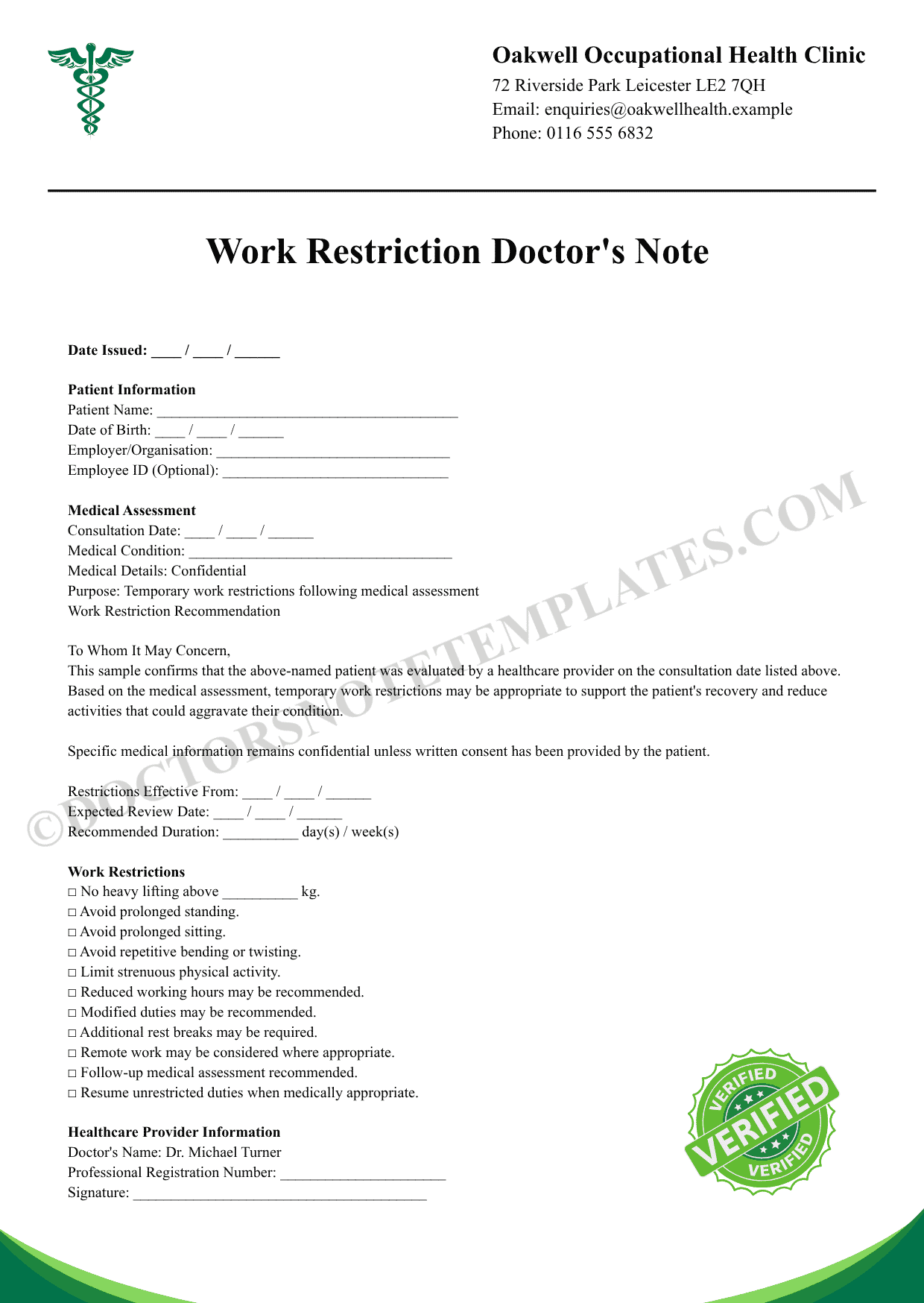
Depending on the type of medical documentation issued and your assessment, it may include information such as:
- Patient name
- Assessment date
- Relevant health condition or functional limitation
- Fitness-for-work assessment
- Recommended work restrictions
- Suggested workplace adjustments
- Recommended duration
- Review information, where appropriate
- Healthcare professional details
- Medical practice details
- Date of issue
How Long Can Work Restrictions Last?
The appropriate duration depends on the health condition, expected recovery and clinical judgement.
Some restrictions may only be needed for a short period, while others may require review or continuation.
For UK fit notes, Government guidance states that during the first six months of a condition, a fit note can generally be issued for up to three months at a time; after six months, there is no specified maximum duration provided the period is clinically appropriate.
Your employer may also have its own workplace procedures for reviewing temporary restrictions.
What Happens After You Receive the Note?
A work restriction note is usually the beginning of a conversation rather than the end of one.
You should provide the relevant documentation to your employer or HR department and discuss how the recommended restrictions can be accommodated.
Your employer may consider options such as:
- Changing your duties
- Adjusting your working hours
- Changing your work location
- Allowing temporary home working
- Providing different equipment
- Reducing physically demanding tasks
- Introducing a phased return
- Making temporary workplace adaptations
Government guidance recommends that employers discuss suggested adjustments with employees and consider whether a risk assessment or occupational health input is appropriate.
Can My Employer Refuse a Work Restriction?
A healthcare professional provides clinical advice based on your health assessment. They do not control your employer’s workplace arrangements.
Your employer should consider the recommendations and discuss possible adjustments with you. However, the practical changes that can be made may depend on your role, workplace and circumstances.
If an employer cannot make the suggested changes, UK guidance explains that where a fit note says “may be fit for work” but the recommended support cannot be provided, the note is treated as if it says “not fit for work.”
For complex situations, an employer may also consider an occupational health assessment.
How to Get a Work Restriction Doctor’s Note
Getting appropriate medical documentation should start with a healthcare assessment.
Step 1: Request an Assessment
Choose the relevant service and provide information about your health concern and how it is affecting your work.
Step 2: Explain Your Work Duties
Be specific about what your job involves.
For example, tell the healthcare professional if your role requires:
- Heavy lifting
- Prolonged standing
- Long periods of sitting
- Driving
- Repetitive movements
- Manual handling
- Night shifts
- Physical exertion
- Frequent walking
- Customer-facing responsibilities
This information can help the healthcare professional understand how your condition affects your functional ability.
Step 3: Complete Your Medical Assessment
The healthcare professional will assess your circumstances and determine whether medical documentation is appropriate.
Step 4: Discuss Possible Restrictions
If clinically appropriate, the healthcare professional may recommend temporary changes such as amended duties, altered hours or workplace adaptations.
Step 5: Receive Your Documentation
If a fit note or other appropriate medical documentation is issued following the assessment, check the details carefully, including the dates and recommendations.
Step 6: Discuss It With Your Employer
Give the relevant documentation to your employer and discuss how the recommendations can be implemented.
What Should You Tell the Healthcare Professional?
To make your assessment useful, don’t simply say, “I need a work restriction note.”
Explain what is actually happening.
You may want to tell them:
What is wrong?
Describe your symptoms or health problem.
What work do you normally do?
Explain your usual responsibilities.
Which tasks are difficult?
Be specific about lifting, standing, walking, typing, driving, concentrating or other activities.
What makes your symptoms worse?
Explain whether particular movements, schedules or workplace activities trigger problems.
What can you still do?
If you can perform some duties comfortably, mention them.
What changes have already helped?
Tell them if shorter shifts, additional breaks, lighter tasks or working from home have made a difference.
This gives the healthcare professional useful information when considering your fitness for work.
Can a Work Restriction Note Be Used for Any Job?
Not necessarily.
A fit note is generally about your fitness for work and the functional effects of your condition rather than being a guarantee that your employer must permanently redesign your specific job.
For example, someone with a lifting restriction may still be able to perform office-based duties, while someone whose role is entirely manual may have fewer suitable alternatives.
Your employer will need to consider the recommendations alongside the requirements of your workplace.
Is a Work Restriction Doctor’s Note the Same as a Disability Accommodation Letter?
No.
Although both may relate to workplace adjustments, they are not necessarily the same type of document or used for the same purpose.
A work restriction/fit note generally addresses fitness for work and temporary or ongoing adjustments related to a health condition.
A workplace accommodation letter may be used for a more specific request for adjustments and may have different requirements depending on the circumstances.
If you need a particular type of documentation for your employer, check what your HR department or organisation requires before ordering.
Important: Medical Assessment Is Required
A Work Restriction Doctor’s Note should never be used as a substitute for medical care.
Documentation should only be issued where a healthcare professional considers it clinically appropriate following an assessment.
We do not guarantee that every request will result in a work restriction recommendation. The healthcare professional must make an independent clinical decision based on the information available.
If your symptoms are severe, worsening or potentially urgent, seek appropriate medical attention rather than relying on workplace documentation.
Is a Work Restriction Doctor’s Note Right for You?
It may be worth considering if:
- You can work but cannot safely perform every normal duty
- You are recovering from an injury
- Your symptoms are aggravated by particular work activities
- You need temporary changes to your duties
- You need reduced or altered working hours
- You are returning to work after illness or treatment
- You need documentation to discuss workplace adjustments
- Your employer has requested medical evidence
If you are unsure whether you need a work restriction note, the healthcare professional can assess your situation and advise whether appropriate documentation can be provided.
Why Choose Our Online Doctor’s Note Service?
We understand that arranging healthcare documentation around a busy working schedule can be difficult.
Our online service is designed to make the process straightforward, convenient and easy to understand.
You can provide relevant information about your circumstances, complete the appropriate medical assessment process and, where clinically appropriate, receive the documentation you require.
Simple Online Process
1. Start Your Request
Select the Work Restriction Doctor’s Note service and provide your details.
2. Tell Us About Your Situation
Explain your health concern, symptoms and how your work is affected.
3. Complete the Medical Assessment
A healthcare professional reviews your information and assesses whether documentation is appropriate.
4. Receive the Appropriate Documentation
If clinically appropriate, the relevant medical documentation can be issued.
5. Share It With Your Employer
Use the documentation to support a discussion about temporary work restrictions or workplace adjustments.
What Makes a Good Work Restriction Recommendation?
A useful recommendation should be clear enough for you and your employer to understand what changes may be appropriate.
For example, rather than simply stating:
“Employee has back pain.”
A clinically appropriate recommendation might explain the relevant functional limitation, such as avoiding heavy lifting for a specified period, where that restriction is supported by the healthcare professional’s assessment.
The purpose is to communicate how the health condition affects work-related activities, rather than unnecessarily disclosing private medical information. UK guidance specifically emphasises functional effects and workplace adaptations in fit-note advice.
Frequently Asked Questions
Can I get a Work Restriction Doctor’s Note online?
Online medical assessment services may be able to assess your circumstances remotely. Whether documentation can be issued depends on the healthcare professional’s clinical assessment and whether an appropriate assessment can be completed.
Can a doctor recommend lighter duties?
Yes. Where clinically appropriate, a healthcare professional may recommend amended duties. UK fit-note guidance specifically recognises amended duties as one possible adjustment for someone who may be fit for work.
Can a doctor recommend reduced working hours?
Yes. Altered hours can be recommended where appropriate following assessment. This may involve temporarily reducing the length or changing the timing of working hours.
Can a doctor recommend no heavy lifting?
A healthcare professional may recommend avoiding heavy lifting where the person’s health condition and clinical assessment support that restriction.
Can I use the note to request workplace adjustments?
Medical documentation can support a conversation with your employer about appropriate adjustments. The actual arrangements will depend on your workplace and circumstances.
How long will my work restrictions last?
The recommended period depends on your condition and clinical assessment. Some restrictions may be temporary and may need review.
Does my employer have to follow the recommendation?
A fit note provides healthcare professional advice. Your employer should consider the advice and discuss possible adjustments with you, but the practical arrangements depend on the workplace and circumstances.
Do I need a work restriction note if I can still work?
Possibly. If you can work but cannot safely perform some of your usual duties, medical documentation may help you and your employer discuss temporary changes.
Can I return to normal duties before my note expires?
In England, an employee can return to work before a fit note expires if they feel able to do so; they do not generally need to return to the healthcare professional simply to obtain another fit note. However, workplace safety and employer procedures should still be considered.
Is a Work Restriction Doctor’s Note the same as a sick note?
Not necessarily. A fit note can state that someone is “not fit for work” or “may be fit for work” with appropriate support. A work restriction recommendation generally relates to adjustments that may allow someone to remain in or return to work.
What if my employer cannot accommodate the recommended restrictions?
If a fit note states “may be fit for work” but the employer cannot make the recommended changes, UK guidance says the fit note is treated as if it stated “not fit for work.”
Important Information Before Ordering
Please provide accurate and complete information during your assessment.
Medical documentation is issued only where clinically appropriate. Completing a request does not guarantee that a healthcare professional will issue a particular recommendation.
Your employer may also have additional requirements regarding workplace adjustments, occupational health assessments or internal medical documentation.
For current UK fit-note rules and employer guidance, refer to official Government and NHS information.
Ready to Discuss Your Work Restrictions?
You don’t always have to choose between working normally and taking time completely away from work.
If your health is affecting particular tasks, a properly assessed work restriction recommendation may help you and your employer explore a safer and more manageable way to continue working while you recover.
Start your Work Restriction Doctor’s Note request today and complete the online medical assessment to find out whether appropriate documentation can be provided for your circumstances.


Reviews
There are no reviews yet.