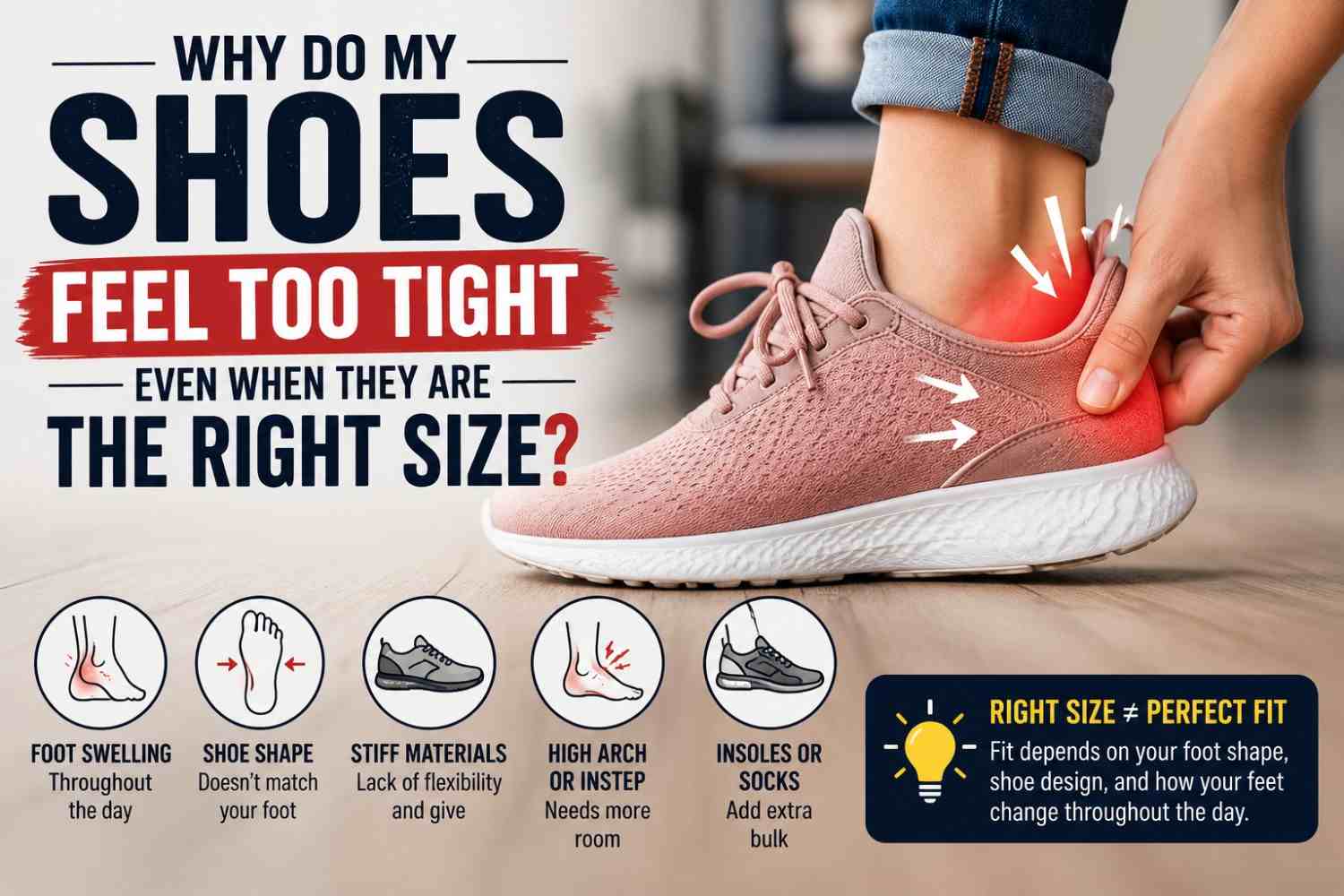
Have you ever bought your usual shoe size only to find that your shoes feel uncomfortable after wearing them for a while? Shoes can feel too tight even when they are the right size for several reasons. The problem may not be the length of the shoe at all. Your feet can change throughout the day, and factors such as swelling, foot shape, previous injuries or conditions like bunions and arthritis can make ordinary footwear feel much more restrictive.
You may notice pressure around your toes, tightness across the top of your foot, rubbing at the sides or discomfort that gets worse after walking or standing. Sometimes the solution is simply finding a better shape or width. In other cases, uncomfortable footwear may be a sign that an underlying foot problem needs attention.
Why Do Shoes Feel Tight When They Are the Right Size?
The number inside a shoe only tells you its approximate length. It does not tell you whether the shoe is suitable for the shape of your foot.
A correctly sized shoe can still feel tight if it is:
- Too narrow
- Too shallow
- Too tight around the toes
- Too restrictive across the top of the foot
- Too narrow around the widest part of your foot
- Unsuitable for your arch or heel shape
Different brands and shoe styles can also fit very differently.
This is why you may comfortably wear one pair in your usual size while another pair in exactly the same size feels painfully tight.
Can Your Feet Get Bigger During the Day?
Yes.
Your feet can become slightly larger throughout the day, particularly after walking or standing for several hours.
You may notice more fullness around your:
- Toes
- Forefoot
- Arch
- Ankles
This can make a shoe that feels comfortable in the morning become noticeably tighter later.
For people who experience swollen feet, this difference can be even more obvious.
That is why it can be useful to try shoes at the time of day when your feet are normally at their largest.
Could Your Shoes Be Too Narrow Even If the Length Is Correct?
Absolutely.
This is one of the biggest reasons people think their shoe size is wrong when the real problem is width.
A shoe may have enough length but still squeeze the sides of your foot.
You might notice:
- Toes being pushed together
- Pressure around the little toe
- Red marks along the sides
- Rubbing near a bunion
- Pain across the front of the foot
- A cramped feeling after walking
If this sounds familiar, moving up a full shoe size may not be the best solution.
You may simply need a wider fitting shoe.
Does Foot Shape Affect How a Shoe Fits?
Very much.
Everyone’s feet have slightly different shapes.
You may have:
- A wide forefoot
- A narrow heel
- A high arch
- Flat feet
- A high instep
- Long toes
- A prominent big-toe joint
- One foot that is slightly larger than the other
A shoe designed for a narrow foot may feel uncomfortable even if its length is correct.
This is why choosing footwear based only on the size number can sometimes lead to problems.
Can Bunions Make Shoes Feel Too Tight?
Yes.
A bunion creates a prominent area around the base of the big toe. When footwear presses against this area, you may experience:
- Pain
- Redness
- Tenderness
- Burning
- Rubbing
- Swelling
The problem is often worse with narrow or pointed shoes.
You may find that the shoe technically fits your foot, but the toe area does not provide enough room for the bunion.
A wider toe box can reduce pressure, although persistent bunion pain should be assessed.
Can Arthritis Make Normal Shoes Feel Tight?
Yes.
Arthritis affecting the foot or ankle can cause pain, swelling and stiffness. Over time, changes around the joints may also affect the way your footwear fits.
You may notice that:
- Shoes you used to wear comfortably now feel tight
- Your foot becomes more swollen after activity
- Certain parts of the shoe press painfully against your joints
- Your toes feel restricted
- Walking becomes uncomfortable
If your feet have become noticeably different from how they used to be, the issue may not simply be the shoe.
Can Swollen Feet Make Shoes Feel Too Tight?
Yes.
Swollen feet and tight shoes often go together.
Your feet may swell because of:
- Prolonged standing
- Long periods of sitting
- Warm weather
- Pregnancy
- An injury
- Certain medicines
- Fluid retention
- An underlying health condition
When the foot becomes swollen, there is naturally less room inside the shoe.
You may feel pressure across the top of the foot or around the toes.
If swelling is persistent, severe or unexplained, it is important to consider the underlying cause rather than simply buying bigger shoes.
Why Does One Shoe Feel Tighter Than the Other?
Your feet are not necessarily identical.
One foot may be:
- Slightly longer
- Wider
- More swollen
- Affected by an old injury
- Different in shape
- Affected by a bunion or another condition
This can explain why one foot hurts more than the other when wearing shoes even though you are wearing the same pair.
When buying footwear, make sure the shoe comfortably accommodates the larger or more sensitive foot.
Can an Old Ankle or Foot Injury Change Shoe Fit?
Yes.
A previous injury can sometimes leave behind swelling, stiffness, altered movement or changes in foot shape.
For example, after an ankle sprain, you may notice that:
- One foot remains slightly swollen
- Certain shoes create pressure
- Your walking pattern has changed
- The affected side becomes uncomfortable after several hours
If the difference continues long after the original injury, it may be worth having the foot or ankle assessed.
Why Do My Shoes Feel Tight Across the Top of My Foot?
If the top of the foot feels compressed, the problem may be shoe depth rather than length.
This can happen with:
- A high instep
- Swelling
- Thick socks
- Orthotic inserts
- Certain shoe designs
- Foot deformities
You may notice that the laces or straps leave marks on your skin.
A shoe with more depth or an adjustable fastening may be more comfortable.
Why Do My Toes Feel Squashed in My Shoes?
Your toe box may not have enough width or depth.
Your toes need room to sit naturally while you walk.
A narrow front can cause pressure on:
- The big toe
- Little toe
- Toenails
- Bunions
- Corns
- Hammer toes
If your toes are constantly being pushed together, the shoe may simply be the wrong shape for your feet.
Can Poorly Fitting Shoes Cause Foot Problems?
They can certainly make existing foot problems worse, and repeated pressure and rubbing can contribute to issues such as:
- Blisters
- Corns
- Calluses
- Toe pain
- Forefoot discomfort
- Bunion irritation
You may also change the way you walk when your footwear hurts.
Over time, that altered movement can make your feet feel even more uncomfortable.
The goal should not be to “break in” a painful pair of shoes at any cost.
Your footwear should feel comfortable without causing persistent pressure or pain.
Why Do Shoes Hurt More After Walking for Several Hours?
You may put your shoes on in the morning and feel completely comfortable.
Then, several hours later, the same shoes start feeling tight.
This can happen because:
- Your feet have swollen slightly
- You have been standing for a long time
- Repeated pressure has built up
- Your feet have become fatigued
- An underlying foot problem has become more noticeable
Pay attention to this pattern.
If your feet consistently hurt after a certain amount of walking or standing, that information may help identify the problem.
Is It Better to Buy Shoes Later in the Day?
For people whose feet tend to swell, trying shoes later in the day can provide a more realistic idea of how they will fit during everyday use.
When trying them on:
- Wear your usual socks
- Stand up
- Walk around
- Check your toe room
- Make sure your heel feels secure
- Look for pressure points
Do not choose a shoe based on how it feels for 30 seconds while sitting down.
You need to know how it feels when your weight is actually on your feet.
Should You Buy a Bigger Size if Your Shoes Feel Tight?
Not necessarily.
Going up a whole size can solve a width problem by creating too much extra length.
That can lead to:
- Heel slipping
- Your foot sliding forward
- Blisters
- Poor stability
- Difficulty walking comfortably
Instead, consider whether you actually need:
- A wider shoe
- A deeper shoe
- A roomier toe box
- Adjustable straps
- A different shape
The best shoe is not necessarily the biggest one.
It is the one that fits the shape of your feet properly.
Can Insoles Make Correctly Sized Shoes Feel Too Tight?
Yes.
An insole, orthotic or thick insert takes up space inside the shoe.
If the shoe already fits closely, adding an insert can make the foot feel compressed.
You may notice:
- Pressure across the top
- Less room around the toes
- A tighter heel area
This does not necessarily mean the insole is wrong.
You may simply need footwear with greater internal depth to accommodate both your foot and the insert.
What If Orthopaedic or Medical Footwear Feels Too Tight?
Specialist footwear still needs to fit properly.
If medical or orthopaedic footwear causes:
- Pain
- Rubbing
- Numbness
- Red marks
- Pressure
- Difficulty walking
speak with the relevant healthcare professional or footwear specialist.
You may need a different size, width, depth or style.
Could a Medical Condition Be the Reason Normal Shoes No Longer Fit?
Yes.
Several conditions can change the shape, size or sensitivity of your feet.
These may include:
- Bunions
- Arthritis
- Diabetes-related foot problems
- Foot deformities
- Chronic swelling
- Previous fractures
- Long-term foot pain
- Some neurological conditions
When a medical condition changes the way your foot fits inside a shoe, simply buying a larger size may not solve the problem.
You may need footwear designed around your specific needs.
Can Diabetes Make Shoes Feel Uncomfortable?
Diabetes can sometimes affect sensation and circulation in the feet.
Reduced sensation can make it harder to notice pressure, rubbing or small injuries caused by footwear.
This means a shoe may be causing irritation before you fully realise something is wrong.
If you have diabetes and notice new swelling, pain, skin damage or other changes in your feet, seek medical advice rather than assuming the problem is only the shoe.
What Shoes Are Better for Feet That Feel Too Tight?
The best choice depends on the reason your shoes feel restrictive.
In general, look for footwear with:
- Adequate toe room
- Enough width
- Sufficient depth
- A comfortable sole
- Secure but adjustable fastening
- No obvious pressure points
You may prefer:
- Wider shoes
- Stretchable uppers
- Adjustable sandals
- Lace-up shoes
- Shoes with removable insoles
Avoid footwear that forces your toes into an uncomfortable position.
What If Your Feet Need More Room Because of a Medical Condition?
This is where ordinary footwear may not always be enough.
Someone with a significant foot deformity, chronic swelling, arthritis or another medical problem may need a style of footwear that provides additional space, support or protection.
In some circumstances, specialist or orthopaedic footwear may be considered.
The appropriate choice should be based on the individual’s condition and professional advice.
What If Your Employer Requires Specific Footwear?
This can become a real problem when standard work shoes are uncomfortable because of a medical condition.
Examples include:
- Safety shoes
- Protective boots
- Formal work shoes
- Uniform footwear
- Occupation-specific footwear
You may be able to do your job perfectly well, but the required shoes may aggravate your feet.
In that situation, discuss the problem with your employer and seek appropriate medical advice.
Depending on your circumstances, medical documentation may support a request for alternative footwear or a workplace accommodation.
When Might You Need a Doctor’s Note for Shoes?
A Doctor’s Note for Shoes may be relevant when a genuine medical condition makes standard footwear unsuitable and an employer, school or other organisation requests supporting documentation.
This could relate to:
- Chronic foot swelling
- Bunions
- Arthritis
- Diabetes-related foot problems
- A previous foot or ankle injury
- Foot deformity
- Chronic pain
- Reduced sensation
- A need for additional support or space
The exact documentation required depends on the organisation and your circumstances.
Need Documentation for Different Footwear?
If a medically assessed foot condition is making your normal shoes difficult or unsuitable to wear, you can learn more about our Doctor’s Note for Shoes service.
When Should You See a Doctor About Shoes That Feel Too Tight?
Sometimes changing your footwear solves the problem.
But consider getting medical advice if:
- Pain continues after changing shoes
- One foot is significantly more swollen than the other
- You have persistent numbness or tingling
- Your foot changes colour
- You develop a significant deformity
- Walking becomes difficult
- The pain is getting worse
- A previous injury has not fully recovered
- Your feet repeatedly swell for no obvious reason
The important question is whether the footwear is causing the problem or whether the footwear is simply revealing an underlying foot condition.
Can Tight Shoes Cause Permanent Foot Problems?
Constantly wearing painful or poorly fitting footwear is not something you should ignore.
Repeated pressure and rubbing may contribute to problems such as corns, calluses and blisters, while narrow footwear can aggravate existing deformities.
However, not every foot problem is caused by shoes.
If your feet remain painful even when you wear comfortable, well-fitting footwear, the underlying cause may need medical assessment.
Frequently Asked Questions
Why do my shoes feel too tight even when they are the right size?
The shoe may be the correct length but too narrow, shallow or restrictive for the shape of your feet. Swelling, bunions, arthritis, injuries and other foot conditions can also make shoes feel tighter.
Why do my shoes fit in the morning but feel tight later?
Your feet can become slightly larger or swollen during the day, especially after long periods of standing or walking.
Should I buy a bigger shoe if my shoes feel tight?
Not necessarily. You may need a wider or deeper shoe instead of a longer one. A larger size can cause heel slipping and other fit problems.
Can swollen feet make shoes feel too tight?
Yes. Swelling reduces the available space inside your shoes and can create pressure around your toes, forefoot and the top of your foot.
Can bunions make correctly sized shoes painful?
Yes. A bunion can create pressure against the side or front of the shoe, particularly when the toe box is narrow.
Can arthritis change the way shoes fit?
Yes. Arthritis can cause swelling, stiffness and changes around the joints, which may make previously comfortable footwear feel restrictive.
Why does one shoe feel tighter than the other?
Your feet may naturally differ in size or shape. One foot may also have more swelling, an injury or another medical condition.
Can insoles make shoes too tight?
Yes. Orthotic and cushioned inserts take up space inside the shoe. You may need footwear with extra depth to accommodate them comfortably.
When should I see a doctor about tight shoes?
Seek medical advice if foot pain persists despite changing footwear, swelling is unexplained or significant, you develop numbness, your foot changes colour or walking becomes difficult.
Can a medical condition mean I need different shoes?
Yes. Some health conditions can make normal footwear unsuitable. Depending on the circumstances, specialist footwear or workplace adjustments may be considered.
Can I get a Doctor’s Note for Shoes if normal footwear is uncomfortable?
A Doctor’s Note for Shoes may be relevant when a medically assessed condition means standard footwear is unsuitable and an organisation needs appropriate documentation to support a footwear-related request.
Final Thoughts
When shoes feel too tight even though they are the right size, the problem may have nothing to do with the length printed on the label.
Your feet can swell during the day, one foot may be slightly larger than the other, or the shape of your feet may not suit the design of the shoe. Conditions such as bunions, arthritis, previous injuries and other foot problems can also make normal footwear uncomfortable.
Before going up a full shoe size, check whether the real issue is width, depth, toe room or swelling.
And if your feet remain painful even when you wear comfortable footwear, don’t assume the shoes are always to blame. Persistent foot pain can sometimes point to an underlying condition that deserves attention.
When a genuine medical condition means ordinary footwear is unsuitable for work, school or another setting, appropriate medical documentation may help support a request for different shoes.

Dr. Anuj provides convenient online medical consultations for patients across the UK, making it easier to speak with a doctor without the need for an in-person visit.
Through secure online consultations, Dr. Anuj can assess your symptoms, discuss your concerns, and provide appropriate medical guidance. Where medically appropriate and legally permitted, a doctor’s note or medical documentation may also be provided following the consultation.