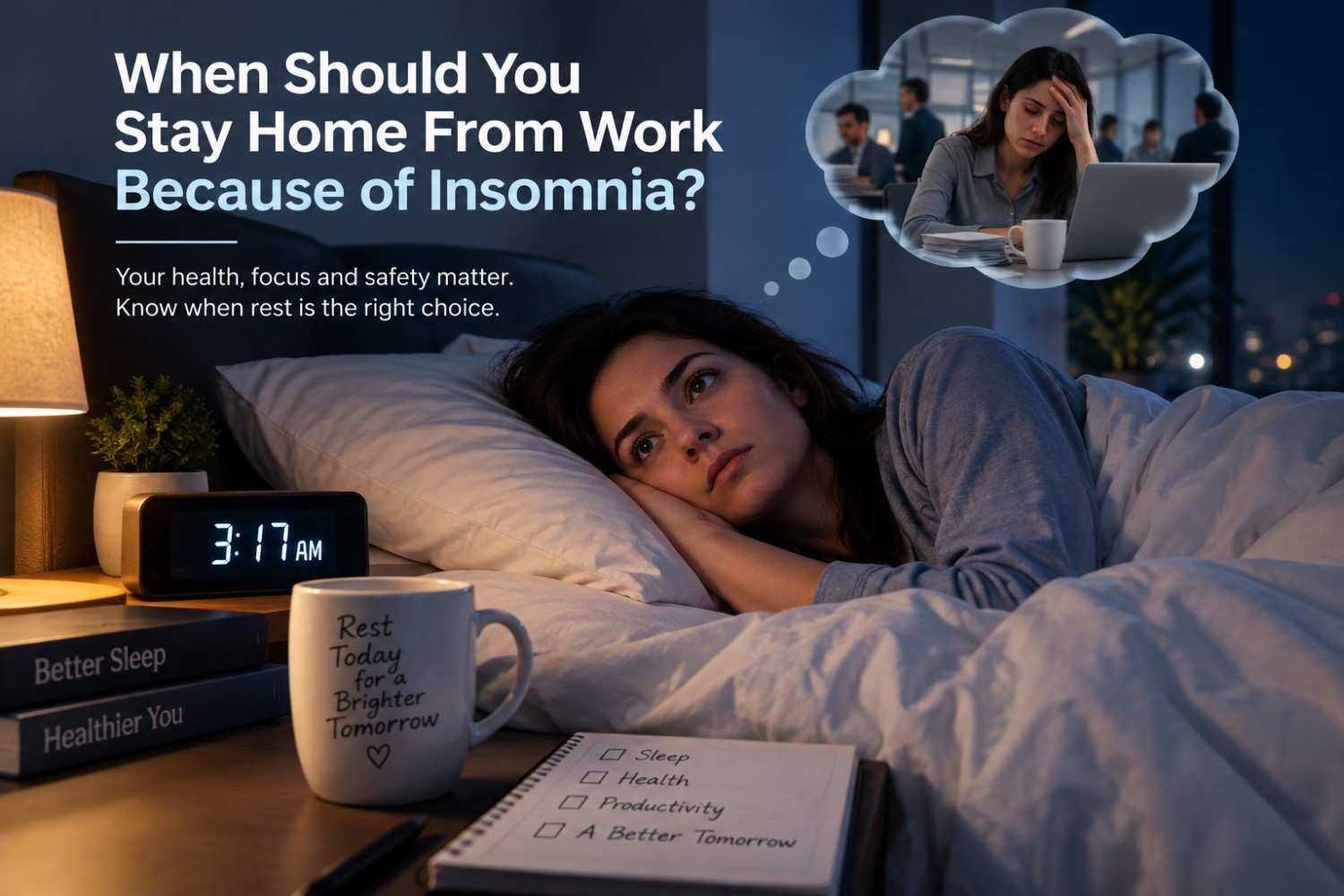
Not every bad night of sleep means you need to miss work. However, there are situations where insomnia can leave you too exhausted, unfocused or impaired to work safely and effectively.
If you have spent much of the night awake and are struggling to stay alert the following day, the decision should be based on more than simply how tired you feel. Consider what your symptoms are doing to your concentration, judgement, performance and safety, as well as the demands of your job.
For some people, staying home for a short period may be sensible. For others, working with temporary adjustments may be possible. When insomnia becomes persistent, a healthcare assessment can help determine what is appropriate.
When should you stay home from work because of insomnia?
There is no universal rule saying that a particular number of hours of sleep automatically means you should stay home.
Instead, consider whether you can reasonably perform your job without putting yourself or other people at risk.
Staying home or seeking medical advice may be appropriate if you are:
- Struggling to remain awake
- Unable to concentrate on routine tasks
- Making significant or repeated mistakes
- Finding it difficult to think clearly
- Experiencing severe daytime fatigue
- Too tired to drive safely
- Unable to perform safety-sensitive duties reliably
- Experiencing significant anxiety or emotional distress alongside insomnia
- Physically or mentally unable to manage your normal workload
The type of work you do matters considerably. Severe fatigue can have different consequences for an office worker compared with someone operating machinery or driving for a living.
Is being tired enough to call in sick?
Feeling tired and being unfit for work are not necessarily the same thing.
You may feel sluggish after a poor night’s sleep but still be capable of completing your normal duties. In contrast, someone who is repeatedly nodding off, unable to concentrate or struggling to make safe decisions may not be in a suitable condition to work.
Think about function rather than a specific sleep target.
Ask yourself:
Can I carry out today’s duties safely, accurately and responsibly?
If the honest answer is no, it may be time to stay home and seek appropriate advice.
What if you have had no sleep at all?
A completely sleepless night can leave you severely fatigued, but the appropriate response depends on your symptoms and your circumstances.
The risk becomes particularly important if you need to drive, operate machinery, work at height or carry out another activity where reduced alertness could have serious consequences.
If you are too sleepy to drive safely, do not attempt the journey simply because you are expected at work.
Similarly, you should not operate hazardous equipment if you are struggling to remain alert.
If you are unsure whether you are fit to perform your role, consider speaking with a healthcare professional.
When is insomnia more concerning than ordinary tiredness?
Occasional tiredness is common. Persistent insomnia is different.
You may need to take the problem more seriously when poor sleep is repeatedly followed by noticeable problems during the day.
For example, you might:
- Forget important information
- Lose concentration during conversations
- Struggle with simple decisions
- Make unusual errors
- Become unusually irritable
- Feel unable to cope with normal workplace pressure
- Need excessive effort to complete ordinary tasks
If this pattern continues, it may indicate that the sleep problem is having a meaningful effect on your health and functioning.
Does your type of job make a difference?
Absolutely.
The consequences of severe sleepiness depend partly on what you are expected to do at work.
Office-based work
You may notice slower thinking, difficulty concentrating, reduced productivity or mistakes in emails, documents and other routine tasks.
Driving jobs
Fatigue can create a significant safety concern because remaining alert is essential when operating a vehicle.
Machinery and industrial work
Reduced attention can be particularly concerning around moving equipment or hazardous machinery.
Construction and work at height
Poor alertness may increase the consequences of an error when working around heights, tools or heavy equipment.
Healthcare and care work
People working with patients or vulnerable individuals may need sustained attention and reliable judgement.
The presence of insomnia does not automatically make someone unable to perform these jobs. The important issue is whether the current level of fatigue is compatible with safe performance.
Can you work from home instead of taking sick leave?
Sometimes working from home may reduce certain practical difficulties, but it does not automatically make you fit for work.
If you are too exhausted to concentrate, make decisions or complete your responsibilities, moving from an office to your home does not remove the underlying problem.
On the other hand, if you are mildly tired but otherwise capable of working, remote work may be an option if your employer allows it.
The decision should be based on your actual ability to function, not simply your location.
Could changing your hours be better than staying home?
In some situations, yes.
If your insomnia is connected with shift patterns or unusually early starts, a temporary change in working hours may be worth discussing.
Depending on your circumstances, possible adjustments could include:
- Starting later
- Temporarily changing shifts
- Modifying duties
- Reducing particularly demanding tasks
- Avoiding safety-critical responsibilities
- Making other appropriate temporary changes
Whether an adjustment is possible depends on your employer, occupation and individual circumstances.
If your symptoms are severe, however, adjustments may not be enough and a healthcare assessment may be more appropriate.
What if stress is causing your insomnia?
Stress-related sleep problems can create a difficult cycle.
You may lie awake thinking about work, deadlines or personal problems. The following day, exhaustion can make those same pressures harder to manage.
If this continues, the problem may extend beyond sleep itself.
You might experience:
- Persistent worry
- Irritability
- Low mood
- Anxiety
- Difficulty concentrating
- Loss of motivation
- Feeling overwhelmed by ordinary responsibilities
If these symptoms are interfering with your ability to work, explain the full picture to a healthcare professional rather than focusing only on the number of hours you slept.
Should you stay home if insomnia makes you unsafe to drive?
If you are too sleepy to drive safely, do not drive simply because you need to get to work.
This is particularly important for people whose jobs involve driving professionally, but the same principle applies to commuting by car.
Severe sleepiness can impair alertness and your ability to respond appropriately to hazards.
If you are concerned that you are not alert enough to drive, consider alternative arrangements and seek appropriate advice.
What should you do if you are unsure whether to go to work?
Look at the practical consequences of your symptoms.
Consider:
How alert am I?
Can you remain awake without struggling?
Can I concentrate?
Could you follow instructions and maintain attention on important tasks?
Can I make sensible decisions?
Are you thinking clearly enough to perform your responsibilities?
Is my job safety-sensitive?
Would fatigue create a meaningful risk to you or someone else?
How severe is the problem?
Is this a single poor night or part of an ongoing pattern?
If you remain uncertain, contacting an appropriate healthcare professional can help you decide what support you may need.
Do you need a sick note if you stay home because of insomnia?
Not necessarily.
For sickness lasting 7 calendar days or less, employees in the UK can generally self-certify rather than providing a fit note.
If you remain off work for more than 7 calendar days, your employer may ask for a fit note.
You should still follow your employer’s own sickness-reporting procedure, including notifying the appropriate person within the required timeframe.
A fit note is medical evidence concerning your fitness for work. It is not automatically required every time you miss a day because you slept badly.
Can a doctor give you a fit note for insomnia?
Potentially.
A healthcare professional can assess your sleep problem and its effect on your ability to work. They may consider your daytime symptoms, overall health, occupation and whether you can safely perform your normal duties.
Depending on the assessment, you may be considered:
- Fit to work
- Not fit to work
- Potentially fit to work with appropriate adjustments
The decision should be based on your genuine health circumstances.
What should you tell a healthcare professional?
If insomnia is affecting your work, explain what happens during the day, not just what happens at night.
Useful details include:
- How long your sleep problems have been occurring
- How frequently they happen
- Whether you struggle to fall asleep or stay asleep
- How you feel after waking
- Whether you experience severe daytime fatigue
- Whether concentration has changed
- Whether your mood has changed
- How your job is being affected
- Whether you drive or perform safety-sensitive work
- Whether stress, anxiety, medication or another health problem may be involved
This provides a much clearer picture than simply saying, “I have insomnia.”
What if insomnia keeps happening every week?
Repeatedly staying home without addressing the underlying sleep problem is unlikely to be a sustainable solution.
If insomnia is regularly affecting your work, consider getting professional advice.
A healthcare professional can help assess whether there is an underlying issue contributing to your sleep difficulties and discuss appropriate management.
Your employer may also be able to consider temporary workplace adjustments if your health is affecting your working pattern.
The goal should be to address the problem rather than relying indefinitely on individual days of absence.
Can insomnia be a reason for longer sick leave?
It can contribute to a longer period of sickness absence when the condition is significantly affecting your health and fitness for work.
There is no fixed number of days that applies to everyone.
The appropriate period depends on factors such as:
- Severity of symptoms
- Underlying causes
- Response to treatment
- Your general health
- The demands of your job
- Whether adjustments could allow you to work
A healthcare professional can assess your individual situation and determine what medical certification, if any, is appropriate.
What if your employer asks for medical evidence?
First, establish exactly what they need.
For a short absence, self-certification may be sufficient. A longer absence may require a fit note.
If your employer asks for a particular document, make sure you obtain the correct type. A general doctor’s letter is not necessarily the same as a formal fit note.
Providing the appropriate evidence can prevent confusion during sickness-absence or return-to-work discussions.
When should insomnia be medically assessed?
You do not necessarily need medical attention after one restless night.
Consider seeking professional help if your sleep difficulties:
- Keep returning
- Are affecting your daytime functioning
- Are interfering with your job
- Are causing persistent exhaustion
- Are affecting your mood
- Are becoming difficult to manage
If insomnia occurs alongside severe depression, thoughts of self-harm or concerns about your immediate safety, seek urgent medical support.
Need medical documentation for an insomnia-related absence?
If your insomnia is genuinely affecting your ability to work and your employer requires medical documentation, DoctorsNotes for insomnia can help you explore the appropriate documentation option for your circumstances.
The right document depends on what your employer requires and your individual situation. Medical documentation should accurately reflect genuine health circumstances and should only be used for legitimate purposes.
Related Doctor’s Note:
Doctor Note for Sleep Apnea
Doctor Note for hyper Tension Review
Doctor note for Mental Health
Frequently Asked Questions
Should I stay home from work if I have insomnia?
If insomnia has left you unable to work safely or effectively, staying home and following your employer’s sickness procedure may be appropriate. The decision depends on your symptoms and the nature of your job.
How do I know if I am too tired to work?
Consider whether you can remain alert, concentrate, make appropriate decisions and perform your duties safely. If you cannot, seek appropriate advice rather than forcing yourself to work.
Can one sleepless night make you unfit for work?
It can, depending on how severely it affects you and what your job involves. Someone performing safety-critical work may need to take fatigue particularly seriously.
Can I call in sick because of insomnia?
If insomnia is genuinely preventing you from working safely or effectively, you should follow your employer’s sickness-reporting procedure. For a short absence, you can generally self-certify.
Do I need a doctor’s note for one day off with insomnia?
Usually, no. UK employees can generally self-certify for sickness lasting up to 7 calendar days, although you must follow your employer’s reporting requirements.
Can insomnia affect workplace safety?
Yes. Severe fatigue can make concentration and alertness more difficult. This is particularly important in jobs involving driving, machinery, heights or other safety-sensitive activities.
Can I work from home if I am too tired to go to work?
Working from home does not automatically solve the problem. If you are too exhausted to concentrate or perform your duties properly, you may still need to treat the situation as a health issue.
Can insomnia lead to a fit note?
Potentially. If a healthcare professional determines that your symptoms affect your fitness for work, they may issue a fit note where appropriate.
Final takeaway
You should consider staying home from work when insomnia has left you unable to perform your duties safely, reliably or effectively. There is no magic number of hours of sleep that determines whether you are fit to work; the effect on your daytime functioning and the demands of your job are more important.
A single poor night may not require medical attention. Repeated sleep problems that interfere with concentration, mood, performance or safety deserve a more careful response.
If you do need time away from work, follow your employer’s sickness procedure. For up to 7 calendar days, you can generally self-certify; if the illness continues beyond that, a fit note may be requested.
Most importantly, if insomnia is repeatedly disrupting your working life, look beyond the immediate absence. Getting the underlying sleep problem assessed can help you find a sustainable way back to normal work.

Dr. Anuj provides convenient online medical consultations for patients across the UK, making it easier to speak with a doctor without the need for an in-person visit.
Through secure online consultations, Dr. Anuj can assess your symptoms, discuss your concerns, and provide appropriate medical guidance. Where medically appropriate and legally permitted, a doctor’s note or medical documentation may also be provided following the consultation.