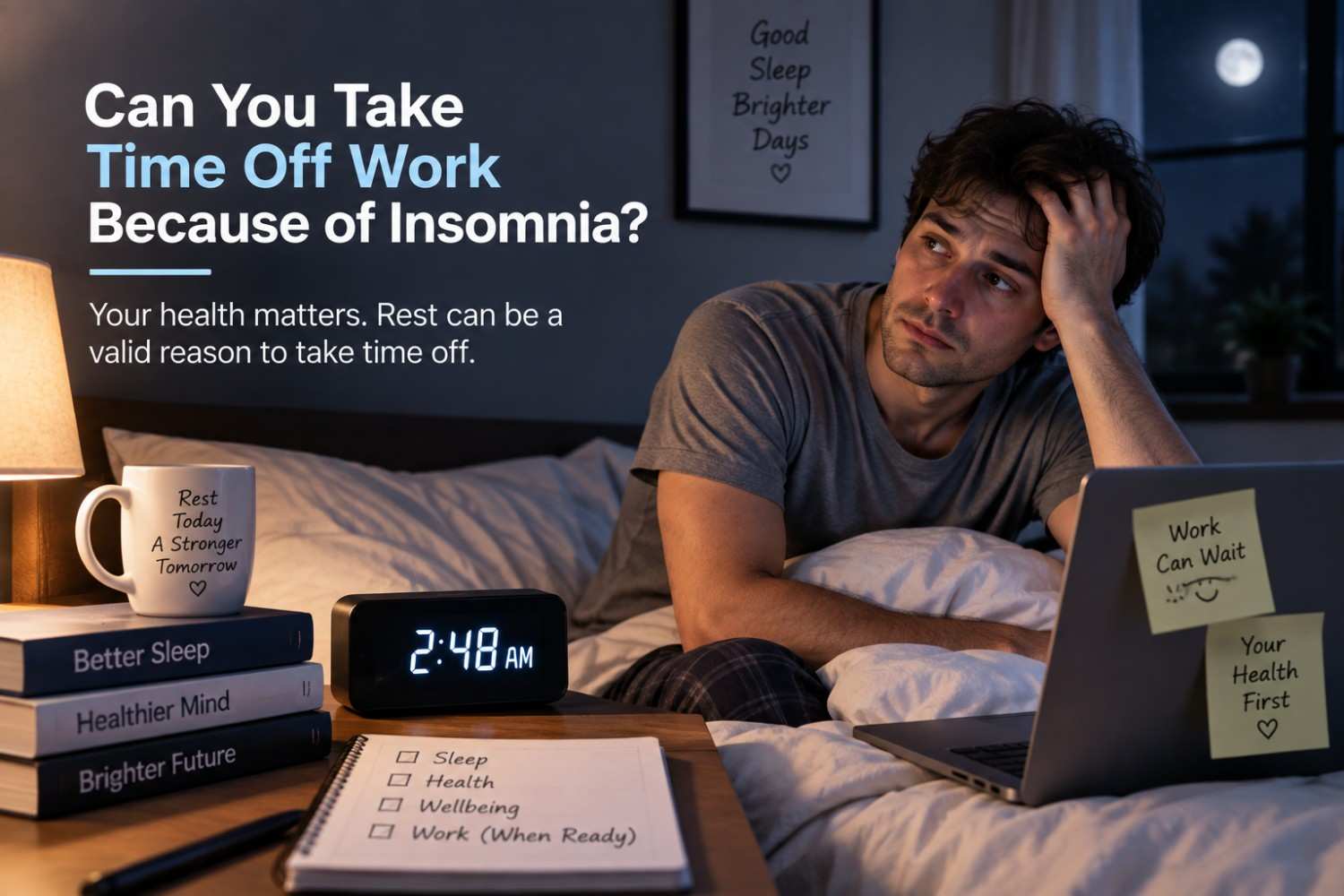
Yes, you can take time off work because of insomnia when poor sleep is genuinely affecting your ability to work safely or effectively. Persistent insomnia can cause exhaustion, poor concentration, reduced alertness, irritability, and difficulty completing normal tasks.
Whether sick leave is appropriate depends on the severity of your symptoms, the duties of your role, workplace policy, and whether you can work safely. In the UK, the evidence your employer can request also depends on how long you are absent.
Can insomnia be a legitimate reason to take time off work?
It can be.
Insomnia is more than simply choosing to stay up late. Someone with insomnia may have difficulty falling asleep, wake repeatedly during the night, wake much earlier than intended or remain awake despite feeling tired.
When this happens repeatedly, the resulting lack of sleep can affect daytime functioning.
You may find it difficult to:
- Concentrate on work
- Stay alert throughout the day
- Remember instructions
- Make decisions
- Complete routine tasks
- Manage workplace pressure
- Communicate effectively with colleagues or customers
- Carry out safety-sensitive duties
If these problems are significant, taking time away from work may be appropriate while you address the underlying problem.
Does one night of poor sleep mean you should call in sick?
Not necessarily.
Almost everyone has an occasional night when they sleep badly. A stressful event, noisy environment, travel or temporary change in routine can affect sleep without creating a long-term health problem.
One poor night’s sleep does not automatically mean you are medically unfit for work.
The situation may be different if you are extremely tired, unable to concentrate or concerned that you cannot perform your job safely.
Your occupation matters too. Severe sleepiness may carry considerably greater risks for someone who drives professionally or operates machinery than for someone doing routine desk-based work.
When might time off be more appropriate?
There is no single symptom or number of hours of sleep that determines whether someone should take sick leave.
Instead, consider the overall effect.
Time away from work may be worth discussing with a healthcare professional when:
- Insomnia has continued for several nights or longer
- You are struggling to remain awake during the day
- Concentration has become noticeably worse
- You are making unusual mistakes at work
- Your mood has significantly changed
- You cannot safely perform your normal duties
- Your work requires a high level of alertness
- Sleep problems are connected with another health condition
The decision should be based on your genuine circumstances rather than simply trying to obtain documentation for an absence.
Can insomnia make you too tired to work safely?
Yes.
Fatigue becomes particularly important when your job involves activities where reduced alertness could put you or someone else at risk.
Examples include:
- Driving
- Operating heavy machinery
- Working at height
- Construction work
- Certain healthcare responsibilities
- Security work
- Working around hazardous equipment
If you are struggling to stay awake or remain attentive, attempting to work as though nothing is wrong may not be sensible.
The same applies to travelling to work. If you are too sleepy to drive safely, do not ignore the risk simply because you are expected at work.
Can stress and insomnia be a reason for sick leave?
Sometimes insomnia is part of a wider problem.
Work pressure, financial worries, relationship difficulties or other stressful circumstances can interfere with sleep. In turn, repeated poor sleep can make stress increasingly difficult to manage.
Some people also experience insomnia alongside anxiety, depression or another mental-health condition.
If this applies to you, explain the wider symptoms to a healthcare professional rather than focusing only on the fact that you cannot sleep.
For example, mention whether you are experiencing:
- Persistent worry
- Low mood
- Panic or anxiety
- Difficulty concentrating
- Loss of motivation
- Irritability
- Exhaustion
- Difficulty coping with everyday activities
The underlying cause may be important when assessing your fitness for work.
How should you tell your employer you need time off?
Follow your employer’s sickness-absence procedure.
Many workplaces specify who you need to contact, when you need to report an absence and what information you need to provide.
You do not necessarily need to provide a detailed medical explanation to every colleague or manager. However, you should give your employer the information required under their sickness policy.
If medical evidence is requested, find out exactly what type of document they need.
A fit note, general doctor’s letter and other forms of medical documentation are not necessarily interchangeable.
Do you need a doctor’s note for a short absence?
Usually, not immediately.
In the UK, employees can generally self-certify sickness for up to 7 calendar days rather than obtaining a fit note straight away.
If you remain off work for more than 7 calendar days, your employer may ask for a fit note.
Your employer’s own sickness policy may also contain additional procedures, so it is sensible to check it.
This means you should not assume that you need to obtain medical documentation after missing only one or two days of work.
When do you need a fit note for insomnia?
If your illness continues beyond 7 calendar days, your employer may require a fit note to support your continued absence.
A fit note provides information about your fitness for work following a healthcare assessment.
Depending on your circumstances, it may indicate that you:
- Are not fit for work
- May be fit for work with appropriate support
The assessment should reflect your actual health condition and how it affects your ability to work.
Can a fit note say you are able to work with adjustments?
Yes.
Being affected by insomnia does not necessarily mean you have to stop working completely.
Depending on your circumstances and job, temporary adjustments may make it possible to continue working.
Potential examples include:
- Changing working hours
- Adjusting shift patterns
- Temporarily changing duties
- Reducing particularly demanding tasks
- Avoiding safety-critical responsibilities
- Making other appropriate workplace changes
Whether any of these options are suitable depends on the individual situation.
For example, someone whose sleep problems are closely associated with rotating night shifts may benefit from discussing their working pattern with their employer.
How long can you take off work because of insomnia?
There is no standard amount of sick leave specifically for insomnia.
The appropriate period depends on factors such as:
- The severity of your symptoms
- How long the sleep problem has continued
- Whether another condition is contributing
- Your response to treatment or support
- The type of work you perform
- Whether workplace adjustments are possible
One person may need only a short period away from work. Another may require longer-term assessment and support.
A healthcare professional can consider your circumstances rather than applying a fixed number of days.
What should you tell a doctor about your insomnia?
If you are seeking medical advice, describe how the problem affects your everyday life.
Useful information includes:
Your sleeping pattern
Explain when you normally go to bed, how long it takes to fall asleep, whether you wake during the night and when you wake in the morning.
Your daytime symptoms
Mention tiredness, poor concentration, headaches, irritability, anxiety, low mood or difficulty staying alert.
The effect on your job
Explain which duties have become difficult and whether you have concerns about making mistakes or working safely.
How long it has been happening
A recent sleep problem can be different from persistent insomnia.
Possible contributing factors
Mention stress, shift work, medication, illness, changes in routine or other factors that may be affecting your sleep.
Accurate information helps a healthcare professional assess the situation properly.
Can you take time off while waiting for insomnia treatment?
Possibly.
If your symptoms are currently affecting your ability to work, you should follow your employer’s sickness procedure and seek appropriate healthcare advice.
Treatment and management of insomnia can vary depending on the underlying cause. A healthcare professional may also consider whether you can continue working, need temporary adjustments or require a period away from work.
Taking time off should not be viewed as the only possible solution.
For some people, addressing the cause of the sleep problem while making temporary changes at work may be more appropriate.
What if your employer questions your absence?
Your employer may have procedures for managing sickness absence, including requests for medical evidence where appropriate.
If there is a disagreement about your absence, follow the relevant workplace process and provide any evidence that is legitimately required.
A fit note can provide medical information about fitness for work, but it does not mean every employment issue is automatically resolved.
Your employment contract and workplace sickness policy remain important.
Can you get a doctor’s note for insomnia?
If medical documentation is required, an appropriate healthcare professional can assess your circumstances and determine whether a fit note or other medical documentation is appropriate.
The document should be based on a genuine assessment.
A legitimate medical document is not simply confirmation that someone wants to stay away from work. It should accurately reflect the person’s health and, where relevant, their fitness for work.
If you need documentation, check whether your employer specifically wants a fit note or another type of medical evidence.
What if insomnia is affecting your work but you do not want to take sick leave?
Sick leave is not necessarily the only option.
If you are still able to work but are struggling with particular duties, you could discuss appropriate workplace support or adjustments.
For example, a temporary change in working hours may be more practical than complete absence in some circumstances.
You should not, however, continue performing safety-critical work if your level of fatigue makes it unsafe.
When should you seek medical help for insomnia?
Occasional sleep difficulties are common, but persistent insomnia deserves attention when it starts interfering with everyday life.
Consider speaking with a healthcare professional if:
- Your sleep problems continue
- You regularly feel exhausted during the day
- Concentration is becoming difficult
- Your work is being affected
- You are experiencing persistent anxiety or low mood
- You are struggling to manage normal activities
If you have thoughts of harming yourself or feel unable to keep yourself safe, seek urgent medical or emergency support rather than waiting for a routine appointment.
Need medical documentation for time off work?
If insomnia is genuinely affecting your ability to work and you need supporting medical documentation, explore our doctor’s note for insomnia service. you explore the appropriate documentation option for your circumstances.
The correct document depends on what your employer requires and your individual situation. Medical documentation should always accurately reflect genuine circumstances and be used for a legitimate purpose.
Related Doctor’s Note :
Doctor Note for Sleep Apnea
Doctor Note for hyper Tension Review
Doctor Note for Depression
Frequently Asked Questions
Can I take a day off work because of insomnia?
If insomnia has left you genuinely unable to work safely or effectively, you can follow your employer’s sickness-absence procedure. For a short absence, you can generally self-certify rather than obtaining a fit note immediately.
Can insomnia be considered a medical reason for sick leave?
Yes. When insomnia significantly affects your health or ability to perform your work, it can contribute to sickness absence.
How many days can I take off work for insomnia?
There is no fixed number of days specifically for insomnia. The appropriate period depends on your symptoms, health, job and recovery.
Do I need a fit note after one day off with insomnia?
Generally, no. UK employees can usually self-certify for sickness lasting up to 7 calendar days. Your employer may have its own reporting requirements.
Can I get a fit note for insomnia?
Potentially. A healthcare professional can assess how your insomnia affects your fitness for work and determine whether a fit note is appropriate.
Can I work while suffering from insomnia?
Yes, many people can continue working while experiencing sleep difficulties. However, if severe fatigue makes your work unsafe or prevents you from functioning effectively, you should seek appropriate advice.
Can stress-related insomnia lead to time off work?
It can, particularly when stress and sleep problems are significantly affecting your health or ability to work. A healthcare professional can assess the wider situation.
Can insomnia affect your ability to drive to work?
Severe sleepiness can make driving unsafe. If you are too tired to drive safely, do not ignore the risk simply because you need to get to work.
Final takeaway
You can take time off work because of insomnia when your symptoms are genuinely affecting your ability to work safely or effectively. There is no requirement for every person with insomnia to take sick leave, and one poor night’s sleep does not automatically mean you are unfit for work.
For a short absence, you can generally self-certify. If you remain off work for more than 7 calendar days, your employer may ask for a fit note.
If insomnia is repeatedly interfering with your work, consider speaking with a healthcare professional. Understanding the cause of the sleep problem and how it affects your daytime functioning can help determine whether you need time away from work, workplace adjustments or another form of support.

Dr. Anuj provides convenient online medical consultations for patients across the UK, making it easier to speak with a doctor without the need for an in-person visit.
Through secure online consultations, Dr. Anuj can assess your symptoms, discuss your concerns, and provide appropriate medical guidance. Where medically appropriate and legally permitted, a doctor’s note or medical documentation may also be provided following the consultation.