
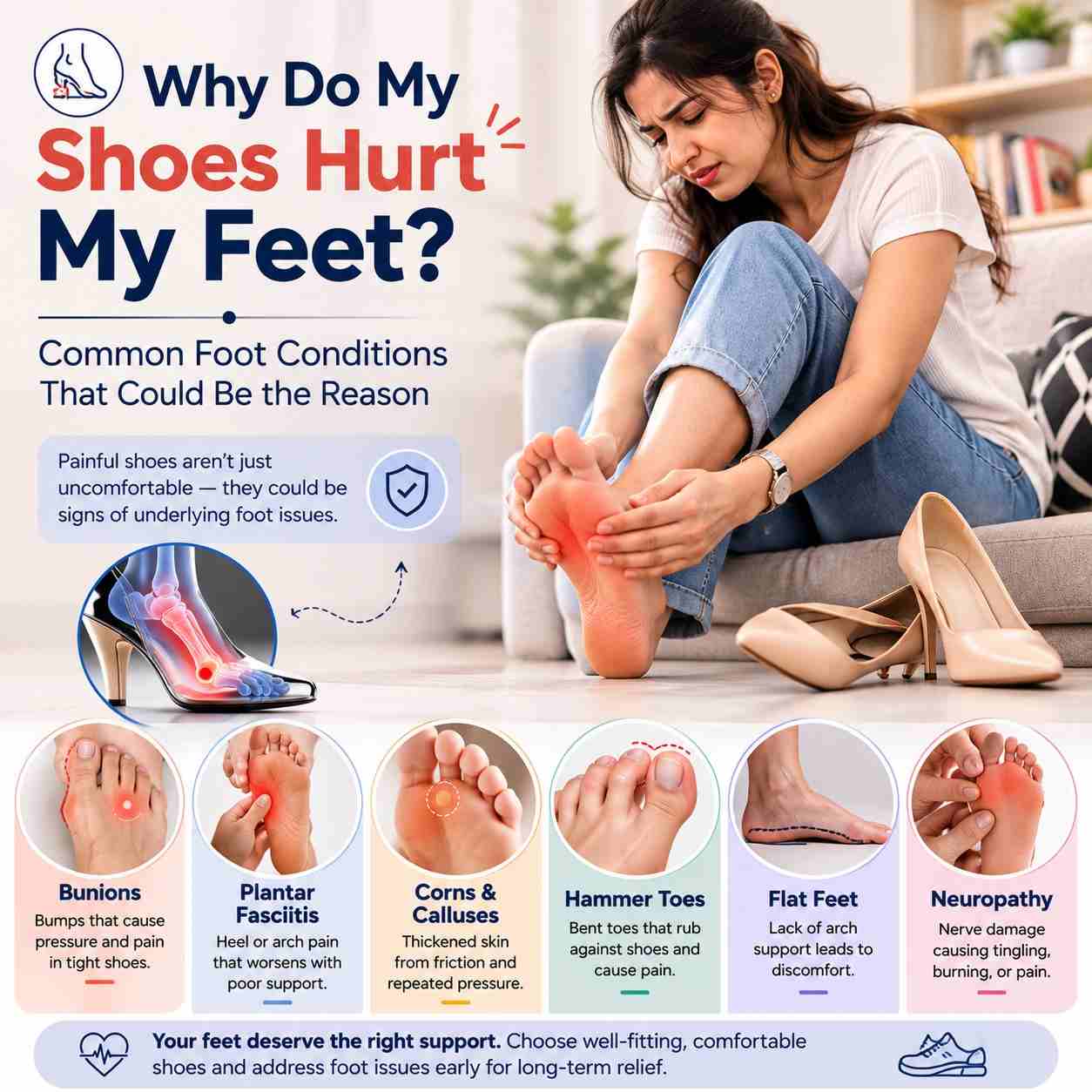
If your shoes regularly leave your feet aching, sore or uncomfortable, the problem may not be the shoes alone. Foot pain from shoes can sometimes be linked to an underlying foot condition that makes ordinary footwear harder to tolerate. A shoe that seems perfectly comfortable for someone else may create pressure on your toes, heel, arch or joints if the shape or structure of your feet has changed.
Foot pain can have many causes, ranging from temporary irritation to conditions that need professional assessment. Bunions, plantar fasciitis, flat feet, hammer toes, arthritis and nerve-related problems can all affect how your feet respond to footwear.
The important thing is to understand where the pain occurs, when it appears and whether particular shoes consistently make it worse.
Why Do My Shoes Hurt My Feet?
Shoes can hurt your feet for several reasons.
Sometimes the footwear simply does not fit properly. In other cases, a foot condition may make standard footwear uncomfortable even when the shoe is the correct size.
Common reasons include:
- Shoes that are too narrow
- Insufficient toe room
- Poor cushioning
- Excessive pressure on the heel or arch
- Foot deformities
- Swelling
- Arthritis
- Nerve problems
- Changes in the way you walk
If your feet hurt in multiple pairs of shoes, rather than just one, an underlying foot problem may be worth considering.
What Foot Conditions Can Make Shoes Painful?
Several common foot conditions can change how footwear feels.
Some affect the toes, while others involve the heel, arch or joints.
The most common possibilities include:
- Bunions
- Hammer toes
- Plantar fasciitis
- Flat feet
- Arthritis
- Corns and calluses
- Neuropathy or nerve-related problems
- Foot deformities
- Swelling caused by certain conditions
The location and type of pain can sometimes provide useful clues, although only a healthcare professional can diagnose the underlying cause.
Can Bunions Make Shoes Hurt?
Yes. A bunion can make footwear uncomfortable because it creates a prominence around the base of the big toe.
When a shoe presses against this area, you may experience:
- Pain
- Redness
- Swelling
- Tenderness
- Skin irritation
- Difficulty finding comfortable shoes
Narrow or pointed footwear can be particularly uncomfortable because it may put additional pressure around the front of the foot.
Why Do My Shoes Rub Against My Bunion?
A bunion changes the shape of the front of the foot.
If your shoe is not wide enough to accommodate that shape, the side of the footwear may repeatedly rub against the prominent joint.
Over time, this friction can contribute to irritation or thickened skin.
Choosing footwear with sufficient room around the affected area may reduce pressure, although it does not correct the bunion itself.
Can Hammer Toes Cause Foot Pain in Shoes?
They can.
A hammer toe causes one of the smaller toes to bend at a joint. The raised portion of the toe may then press against the top of the shoe.
This can lead to:
- Toe pain
- Pressure
- Friction
- Corns
- Calluses
- Redness
You may find that shoes with a shallow toe box are particularly uncomfortable.
If your toe pain appears mainly when wearing certain footwear, the shape and depth of the shoe may be contributing to the problem.
Can Plantar Fasciitis Make Shoes Hurt?
Yes. Plantar fasciitis commonly causes pain around the heel or bottom of the foot.
Some people find that footwear with little cushioning or inadequate support makes their symptoms more noticeable.
You may experience:
- Heel pain
- Arch discomfort
- Stiffness after resting
- Pain during the first few steps
- Increased discomfort after prolonged standing
Different people respond differently to footwear, so there is no single shoe that works for everyone with plantar fasciitis.
Why Does My Heel Hurt More in Certain Shoes?
The heel can be sensitive to repeated impact and pressure.
Shoes with very thin soles or little cushioning may feel uncomfortable for some people with heel pain.
On the other hand, a shoe that feels supportive to one person may feel too firm or restrictive to another.
If heel pain persists regardless of footwear, consider getting it assessed rather than assuming the shoes are the only cause.
Can Flat Feet Cause Foot Pain When Wearing Shoes?
Flat feet can affect the way weight is distributed across the feet during standing and walking.
Some people with flat feet have no symptoms, while others experience:
- Arch discomfort
- Heel pain
- Foot fatigue
- Pain after prolonged standing
- Discomfort in certain footwear
The shape of the arch can also influence how shoes feel.
A shoe that does not feel supportive enough may become uncomfortable during a long day on your feet.
Why Do My Arches Hurt in My Shoes?
Arch pain may have several causes.
Flat feet, overuse, plantar fasciitis and unsuitable footwear can all contribute to discomfort around the arch.
If your shoes feel as though they are pressing directly into the arch, the design or fit may not be appropriate for your feet.
Persistent arch pain should be assessed rather than treated solely by changing shoes.
Can Arthritis Make Shoes Painful?
Yes.
Arthritis can affect joints in the feet and may cause pain, stiffness and swelling.
When a joint becomes swollen or changes shape, footwear may feel tighter than it previously did.
You might notice:
- Stiff toes
- Pain when walking
- Swollen joints
- Difficulty putting shoes on
- Increased discomfort in rigid footwear
If your feet have changed shape because of joint problems, standard shoes may no longer provide enough room.
Can Corns and Calluses Make Shoes Hurt?
Yes.
Corns and calluses develop when areas of skin experience repeated pressure or friction.
If your footwear continually rubs against a particular part of the foot, thickened skin can develop.
You may notice pain around:
- The toes
- Ball of the foot
- Heel
- Sides of the feet
If the same corn or callus repeatedly returns, it is useful to identify what is creating the pressure instead of simply removing the thickened skin.
Can Nerve Problems Make Shoes Uncomfortable?
Nerve-related conditions can change the way your feet feel.
Some people experience:
- Burning
- Tingling
- Numbness
- Pins and needles
- Increased sensitivity
- Reduced sensation
Reduced sensation can be particularly concerning because you may not notice pressure or rubbing from your footwear.
If numbness or unusual sensations are persistent or worsening, medical assessment is important.
Why Do My Feet Feel Numb Inside My Shoes?
Numbness can have several possible causes.
Footwear that is excessively tight may temporarily compress areas of the foot, but persistent numbness should not automatically be blamed on your shoes.
Nerve irritation, circulation problems and certain medical conditions can also affect sensation.
If numbness continues after removing your shoes or repeatedly occurs, consider speaking with a healthcare professional.
Can Swollen Feet Make Shoes Hurt?
Yes.
Swelling can reduce the amount of space available inside your footwear.
A pair of shoes that feels comfortable earlier in the day may become tight later, particularly after prolonged standing or walking.
Swollen feet can make shoes feel:
- Tight around the toes
- Restrictive across the top
- Uncomfortable around the sides
- Difficult to put on
If swelling is frequent, severe or occurs suddenly, it should be assessed rather than assumed to be a footwear issue.
Why Do My Feet Hurt in Work Shoes?
Work footwear can be challenging because it often needs to be worn for several hours at a time.
The problem may be more noticeable if your job involves:
- Long periods of standing
- Frequent walking
- Hard surfaces
- Safety footwear
- Protective boots
- Uniform shoes
An underlying foot condition may become much more noticeable during a full working shift.
Can a Foot Condition Make Required Work Shoes Difficult to Wear?
Yes.
If a bunion, plantar fasciitis, hammer toe, arthritis or another medically assessed condition makes required footwear painful, you may need to discuss the issue with your employer and healthcare professional.
Depending on your circumstances, suitable medical documentation may support a request for alternative footwear or another appropriate workplace adjustment.
Safety requirements should still be maintained when considering workplace footwear alternatives.
Why Do My Feet Hurt Even When My Shoes Are the Right Size?
Shoe size only tells you part of the story.
Two shoes with the same stated size can have very different:
- Widths
- Toe-box shapes
- Depths
- Cushioning
- Heel structures
- Internal designs
Your individual foot shape also matters.
For example, someone with a bunion may need additional width at the front, while someone with hammer toes may need more vertical space.
This is why a correctly sized shoe can still feel uncomfortable.
Can the Wrong Shoe Shape Cause Foot Pain?
Absolutely.
The shape of the footwear should accommodate the natural shape of your foot.
Problems may occur when:
- The toe box is too narrow
- The shoe is too shallow
- The heel slips excessively
- The sole is unsuitable for your activity
- A seam presses against your foot
- The shoe bends in an uncomfortable location
A good fit should feel secure without creating concentrated pressure points.
What Type of Footwear May Help Painful Feet?
The best footwear depends on the cause of your pain.
However, many people look for shoes that provide:
- Adequate toe room
- Appropriate width
- Enough depth
- Comfortable cushioning
- A secure heel
- Suitable support
- Minimal internal rubbing
If you have a specific foot condition, footwear should ideally accommodate that condition rather than simply being chosen based on appearance.
Should I Choose Shoes With a Wide Toe Box?
A wider toe box can be useful when your toes need more room.
It may be particularly helpful for people with:
- Bunions
- Hammer toes
- Swollen toes
- Certain foot deformities
However, a shoe should not be so wide that your foot moves excessively inside it.
Both comfort and stability matter.
What Can I Do If My Shoes Keep Hurting My Feet?
Start by identifying the exact location of the pain.
Ask yourself:
- Is the pain in my toes?
- Is it around the heel?
- Does my arch hurt?
- Is there pressure over a joint?
- Does the pain occur only in one pair?
- Is it worse after standing?
- Does it continue when I am barefoot?
These details can help you understand whether footwear is likely to be contributing.
You can also try footwear with a more suitable shape and adequate room, while avoiding shoes that repeatedly trigger symptoms.
When Is Foot Pain More Than a Shoe Problem?
Persistent foot pain should not always be dismissed as a poor shoe choice.
Consider medical assessment if:
- Pain keeps returning
- Symptoms occur in several different pairs of shoes
- Walking becomes difficult
- Your foot shape changes
- You develop persistent swelling
- You experience numbness or tingling
- Pain continues when barefoot
- Symptoms are getting worse
A healthcare professional can help determine whether the problem is related to footwear or an underlying foot condition.
What Foot Pain Should Be Checked Promptly?
Seek prompt medical attention if foot pain is severe or sudden, particularly after an injury or if it is accompanied by significant swelling, colour changes, an open wound, fever or an inability to bear weight.
These symptoms may require more than a change of footwear.
Can a Doctor’s Note for Shoes Help With a Foot Condition?
If a healthcare professional has assessed a genuine foot condition that makes standard or required footwear unsuitable, a Doctor’s Note for Shoes may be relevant in certain circumstances.
This may be particularly useful when a person has difficulty wearing:
- Required work shoes
- Safety footwear
- Uniform shoes
- Standard footwear because of a medically assessed foot condition
Medical documentation may help support a request for more suitable footwear or an appropriate workplace adjustment, depending on the circumstances.
Need Medical Documentation for Footwear?
If a medically assessed foot condition is making your normal or required shoes difficult to wear, you can learn more about our Doctor’s Note for Shoes service.
Frequently Asked Questions
Why do my shoes hurt my feet?
Shoes can hurt your feet because of poor fit, pressure, friction or an underlying condition such as bunions, plantar fasciitis, hammer toes, flat feet or arthritis.
Can bunions cause pain when wearing shoes?
Yes. Footwear can press against the prominent joint created by a bunion, causing pain, redness and irritation.
Can plantar fasciitis make shoes uncomfortable?
Yes. Some people with plantar fasciitis find shoes with little cushioning or inadequate support more uncomfortable, particularly during prolonged walking or standing.
Can flat feet cause foot pain in shoes?
Flat feet can affect foot mechanics and pressure distribution. Some people experience arch or heel discomfort, particularly after prolonged activity.
Why do my toes hurt in normal shoes?
Toe pain may be caused by a narrow toe box, pressure from footwear or conditions such as bunions, hammer toes, corns or arthritis.
Why do my feet hurt even though my shoes are the correct size?
The stated shoe size does not account for width, depth, toe-box shape or your individual foot structure. A correctly sized shoe can still be a poor fit.
Can arthritis make normal shoes uncomfortable?
Yes. Joint pain, stiffness, swelling or changes in foot shape associated with arthritis can make standard footwear more difficult to wear.
Can numb feet make shoes difficult to wear?
Numbness can change how you perceive pressure from footwear. Persistent numbness should be medically assessed rather than automatically attributed to shoe fit.
What shoes are better for painful feet?
There is no single shoe that works for everyone. Footwear with adequate room, appropriate width and depth, a secure fit and comfortable cushioning may be more suitable depending on the cause of your pain.
When should I see a doctor about foot pain from shoes?
Seek medical advice if the pain is persistent, worsening, affects your ability to walk or occurs alongside swelling, numbness, an injury or changes in the shape or appearance of your foot.
Can I get a Doctor’s Note for Shoes because of foot pain?
A Doctor’s Note for Shoes may be relevant when a healthcare professional has assessed a foot condition that makes standard or required footwear unsuitable and medical documentation is needed.
Final Thoughts
If your shoes repeatedly hurt your feet, it is worth looking beyond the footwear itself. Poor fit can certainly cause pressure and friction, but persistent foot pain from shoes can also be a sign that an underlying condition is affecting the way your feet interact with footwear.
Bunions, hammer toes, plantar fasciitis, flat feet, arthritis, corns and calluses and nerve-related problems can all affect shoe comfort in different ways.
Pay attention to where the pain occurs and whether it appears only in particular shoes or continues regardless of what you wear. Choosing footwear with appropriate width, depth, support and cushioning may improve comfort, but ongoing symptoms deserve proper assessment.
If a medically assessed foot condition makes your required footwear unsuitable, appropriate medical documentation may also help support a request for more suitable shoes or a workplace adjustment.

Dr. Anuj provides convenient online medical consultations for patients across the UK, making it easier to speak with a doctor without the need for an in-person visit.
Through secure online consultations, Dr. Anuj can assess your symptoms, discuss your concerns, and provide appropriate medical guidance. Where medically appropriate and legally permitted, a doctor’s note or medical documentation may also be provided following the consultation.