

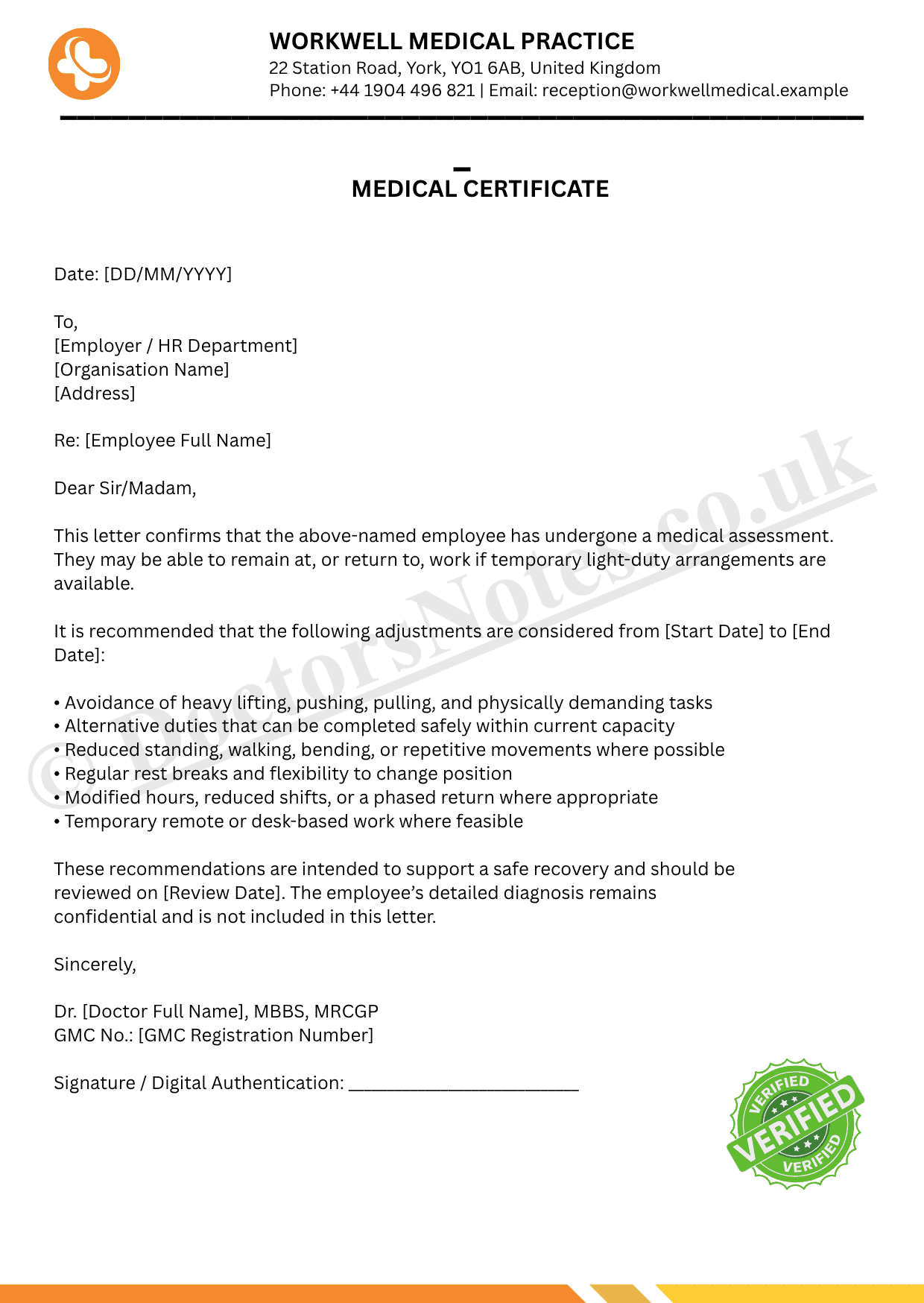



You may be able to work but still need to avoid certain tasks.
For example, you might need to avoid heavy lifting, long periods of standing, strenuous activity or other duties while you recover. In these situations, a doctor’s note for light-duty work can help document how your health affects your ability to work.
A healthcare professional can assess your condition and explain whether you may be fit for work with suitable adjustments.
What Does Light-Duty Work Mean?
Light-duty work means changing some work tasks because of a health condition, injury or recovery period.
It does not always mean working fewer hours.
You might continue your normal working hours but temporarily perform different duties.
For example:
- No heavy lifting
- Less physical activity
- More seated work
- Fewer repetitive movements
- Reduced climbing or bending
- Fewer customer-facing tasks
- Shorter periods of standing
- Temporary changes to normal duties
The right restrictions depend on your health and your job.
Light-Duty Work
| Question | Answer |
|---|---|
| Can a doctor recommend light duties? | A healthcare professional can advise that you may be fit for work with adjustments. |
| Is light duty the same as sick leave? | No. Light duty allows you to continue working with suitable changes. |
| Can a fit note mention amended duties? | Yes. “Amended duties” is one of the recognised fit-note options. |
| Can light duty include shorter hours? | It can. Altered hours may be recommended where appropriate. |
| Can you request a light-duty note online? | An online assessment may be suitable in some cases. |
| Does an employer have to offer light duty? | The fit note provides medical advice. Your employer decides what adjustments are possible. |
| Is a light-duty note guaranteed? | No. It depends on a healthcare assessment. |
When Might You Need a Light-Duty Doctor’s Note?
Light duties may become relevant when you can work but cannot safely perform all your normal tasks.
This can happen after:
- An injury
- Surgery
- An illness
- A flare-up of an existing condition
- Back or neck problems
- A broken bone
- Muscle or joint problems
- Pregnancy-related limitations
- Recovery from an accident
- Another health condition affecting physical ability
The important question is not simply whether you are unwell.
It is what you can safely do at work.
Doctor’s Note for Light-Duty Work After an Injury
Injuries are a common reason for temporary work restrictions.
You may be able to work while recovering from:
- A sprained ankle
- Knee injury
- Back pain
- Shoulder injury
- Wrist injury
- Broken finger
- Broken wrist
- Leg injury
- Whiplash
- Muscle strain
For example, a warehouse worker with a wrist injury may struggle with lifting boxes but still be able to complete administrative tasks.
A healthcare professional can assess the functional impact of the injury.
Light Duties After Surgery
Recovery does not always mean complete absence from work.
Your return may depend on:
- The type of surgery
- Your recovery
- Pain or discomfort
- Mobility
- Medication
- Physical demands of your job
- Risk of complications
A healthcare professional may advise temporary changes if some work is possible.
Possible changes could include:
- No heavy lifting
- Reduced physical activity
- More seated tasks
- Shorter shifts
- Gradual return to normal duties
Follow the specific recovery advice given after your procedure.
What Can a Light-Duty Doctor’s Note Include?
A fit note focuses on how a health condition affects your ability to work.
Where appropriate, it can indicate that you may be fit for work with adjustments.
Possible adjustments include:
Amended duties
Your normal duties may be changed temporarily.
Altered hours
You may work different hours or fewer hours.
Phased return
You may gradually increase your hours or duties.
Workplace adaptations
The workplace itself may be changed to support your return.
These options are recognised within the UK fit-note system.
Can You Get a Doctor’s Note for Light-Duty Work Through Telehealth?
Yes, you may be able to get a doctor’s note for light-duty work through telehealth. A licensed healthcare provider can assess your symptoms, medical history, and job responsibilities through a video or phone consultation to determine whether temporary work restrictions are appropriate.
If medically necessary, the provider may recommend avoiding heavy lifting, prolonged standing, repetitive movements, or other tasks that could worsen your condition. The note may explain the restrictions, how long they should last, and when you may need a follow-up assessment.
However, telehealth may not be suitable for every condition, and some situations require an in-person examination. Employer policies and local requirements also vary, so a note does not guarantee that light-duty work will be available or approved. Follow your healthcare provider’s advice and ask your employer about its documentation requirements.
Examples of Light-Duty Restrictions
A healthcare professional may provide advice about functional limitations.
Examples can include:
| Limitation | Possible work adjustment |
|---|---|
| Cannot lift heavy objects | Avoid heavy lifting |
| Cannot stand for long periods | Use seated duties |
| Limited walking | Reduce walking-based tasks |
| Pain with bending | Avoid repeated bending |
| Limited hand movement | Reduce manual tasks |
| Fatigue | Alter working hours |
| Reduced stamina | Gradual return |
| Difficulty with prolonged screen use | Take regular breaks |
These examples do not mean that a healthcare professional will recommend the same restrictions for everyone.
The advice must reflect the individual’s condition.
Can a Doctor Write “Light Duty” on a Fit Note?
The formal fit-note system uses categories such as “may be fit for work” with advice about suitable adaptations.
The healthcare professional can use the comments section to provide more detail about functional limitations and possible workplace changes.
So, rather than focusing only on the phrase “light duty,” it is useful to explain exactly what you can and cannot do.
For example:
Unable to perform heavy lifting temporarily.
That gives the employer useful information for discussing alternative duties.
Light Duty vs Being Off Work
These are different situations.
| Light duty | Off work |
|---|---|
| Some work remains possible | Work is not currently possible |
| Duties may change | Normal work stops |
| Restrictions may apply | Full absence may be advised |
| Employer and employee discuss adjustments | Employee follows sickness-absence process |
| May support an earlier return | Return happens when medically appropriate |
GOV.UK guidance says healthcare professionals should consider whether someone can do some form of work before advising that they are not fit for any work.
Can You Ask for Light Duties at Work?
Yes.
You can discuss your situation with your employer.
If you have medical advice supporting changes, this can make the conversation more specific.
You may want to explain:
- What tasks are difficult
- What you can still do
- How long the restriction may be needed
- Whether your hours need changing
- Whether you need workplace adjustments
Your employer will need to consider what changes are practical.
Does a Fit Note Force Your Employer to Give Light Duties?
Not automatically.
A fit note provides medical advice about your fitness for work.
It does not guarantee that your employer can provide every suggested adjustment.
GOV.UK guidance says employers should discuss possible changes when an employee is assessed as “may be fit for work.” If the employer cannot offer the advised support, the fit note is treated as if it says “not fit for work.”
What If Your Employer Cannot Offer Light Work?
This can happen.
Some jobs have very limited flexibility.
For example, a warehouse role may require lifting. A construction role may require climbing and physical work. A delivery role may require driving and carrying loads.
If your employer cannot make suitable changes, discuss the situation with them and follow the medical advice provided.
You may not need another fit note simply because the suggested adjustment is unavailable.
Light-Duty Work for Physical Jobs
Physical jobs often require clearer restrictions.
Examples include:
- Construction
- Warehouse work
- Delivery driving
- Manufacturing
- Cleaning
- Hospitality
- Landscaping
- Security
- Healthcare support
- Retail
A restriction such as “avoid heavy lifting” can have a major effect in these roles.
That is why your healthcare assessment should include details about your actual job.
Light-Duty Work for Office Jobs
Office workers can also need temporary adjustments.
Possible issues include:
- Sitting for long periods
- Walking between departments
- Carrying equipment
- Using a keyboard
- Screen work
- Concentration
- Fatigue
- Commuting
Possible adjustments may involve:
- More frequent breaks
- Different working hours
- Reduced travel
- Temporary remote work
- Alternative tasks
- Changes to workstation arrangements
The appropriate adjustment depends on the health condition and the role.
What Should You Tell the Healthcare Professional?
Do not simply say:
“I need light duties.”
Explain why.
A useful assessment should cover:
Your condition
What health problem are you dealing with?
Your symptoms
What makes work difficult?
Your normal duties
What does your job require?
Your restrictions
What can you not safely do right now?
What you can still do
Which tasks are manageable?
Your recovery
Are your symptoms improving, staying the same or getting worse?
Your work environment
Are there physical or other workplace demands that affect your condition?
This information helps the healthcare professional consider your fitness for work.
Light-Duty Work After an Accident
An accident can leave you partially able to work.
For example:
Before the accident:
A delivery worker regularly lifts and carries packages.
After the injury:
They can walk and drive but cannot safely lift heavy items.
In this situation, alternative duties may be possible if the employer can provide them.
A healthcare professional can assess the person’s functional limitations and advise about fitness for work.
Can a Light-Duty Note Be Used After a Workplace Injury?
It may be relevant.
If you were injured at work, follow your employer’s accident-reporting procedure as well as seeking appropriate medical care.
Medical documentation and workplace accident records serve different purposes.
A doctor’s note does not replace an accident report or an employer’s internal process.
Can You Get a Light-Duty Doctor’s Note Online?
An online assessment may be appropriate in some circumstances.
The healthcare professional can discuss:
- Your symptoms
- Your diagnosis or suspected condition
- Your current abilities
- Your job
- Your work restrictions
- Your recovery
However, an online consultation cannot replace an in-person examination when one is clinically necessary.
If your condition requires physical examination, imaging or urgent treatment, you may be directed to appropriate in-person care.
How to Prepare for an Online Light-Duty Assessment
Before your appointment, make a simple list.
Your job
Write down your main duties.
Your restriction
Explain which tasks you cannot currently perform.
Your symptoms
Note pain, weakness, fatigue, reduced movement or other problems.
Your timeline
Record when the problem started or when the injury occurred.
Your current treatment
Include medicines, physiotherapy, surgery or other care.
Your work goal
Explain whether you want to return with temporary restrictions or need further time away.
Do You Need a Fit Note for Light Duties?
Not necessarily.
If you have been sick for 7 calendar days or less, you can normally self-certify your absence.
If your sickness lasts longer than 7 days, your employer can ask for a fit note.
A fit note is only issued when a healthcare professional considers that your health affects your fitness for work.
Sick Note vs Fit Note for Light Duty
“Sick note” is the phrase many people use.
The formal UK term is fit note.
| Phrase | What it means |
|---|---|
| Sick note | Common everyday term |
| Fit note | Formal Statement of Fitness for Work |
| Light-duty note | Informal description of documentation supporting temporary work restrictions |
| Medical certificate | General term for medical evidence |
| Self-certification | Used for sickness lasting up to 7 calendar days |
For a light-duty situation, the important part is the healthcare professional’s advice about what you can do at work.
How Long Can Light Duties Last?
There is no single period that applies to every worker.
The duration depends on the condition and clinical assessment.
A fit note should cover the period for which the healthcare professional expects the person to need adaptations or be unable to work. A review date can be included when appropriate.
For the first six months of a condition, a fit note can be issued for up to three months at a time.
Can Light Duties Be Part of a Phased Return?
Yes.
A phased return can gradually increase your working hours or duties.
For example:
Week 1: Shorter hours and simple duties
Week 2: Longer hours with some normal tasks
Week 3: More normal duties
Later: Return to usual working pattern if appropriate
The actual plan depends on the person’s condition and workplace.
Can Light Duties Include Working From Home?
Sometimes.
Working from home is one type of workplace adaptation that may be considered.
It could help when commuting, mobility or the physical workplace is difficult.
However, remote work is not suitable for every job.
It also depends on whether your employer can support it.
Can a Light-Duty Note Be Backdated?
It may be possible for a fit note to cover an earlier period when the healthcare professional considers that your condition affected your fitness for work during that period.
This is not automatic.
Discuss the dates clearly during your assessment. GOV.UK guidance explains that the period covered by a fit note can include a previous period when the healthcare professional considers this appropriate.
What If Your Employer Wants More Detail?
A fit note focuses on fitness for work rather than simply listing symptoms.
You can explain to the healthcare professional what tasks are difficult.
For example:
- Heavy lifting
- Prolonged standing
- Repeated bending
- Long-distance walking
- Driving
- Manual handling
- Extended screen use
Functional information can make workplace discussions more useful.
Who Can Issue a Fit Note?
In the UK, fit notes can be certified by:
- Doctors
- Registered nurses
- Pharmacists
- Physiotherapists
- Occupational therapists
The healthcare professional must carry out an appropriate assessment before issuing the note.
Can a Light-Duty Doctor’s Note Be Guaranteed?
No.
Medical documentation depends on a healthcare assessment.
A healthcare professional must decide whether your health affects your fitness for work and what advice is appropriate.
A legitimate medical service should not promise a light-duty note before assessing your circumstances.
Light-Duty Assessment Checklist
Before your consultation, have these details ready:
☐ Your job title
☐ Your main work duties
☐ The health problem affecting you
☐ Your main symptoms
☐ Tasks you cannot currently perform
☐ Tasks you can still perform
☐ When the problem started
☐ Current treatment
☐ Any previous medical assessment
☐ Your expected recovery, if known
☐ Your employer’s requirements for medical evidence
Frequently Asked Questions
Can you get a doctor’s note for light-duty work?
You may receive medical documentation supporting modified duties after a healthcare professional assesses your fitness for work.
Can a doctor recommend light duties?
A healthcare professional can assess whether you may be fit for work with amended duties or other adjustments.
What is a light-duty doctor’s note?
It is a common description for medical documentation supporting temporary changes to work duties because of a health condition.
Can a fit note say light duty?
The formal fit-note wording is generally based on whether you are “may be fit for work” or “not fit for work,” with advice about possible adjustments.
What does “amended duties” mean on a fit note?
It means changing work duties to take account of a health condition.
Can a fit note restrict heavy lifting?
A healthcare professional can provide advice about functional limitations, such as avoiding heavy lifting, where clinically appropriate.
Can a fit note recommend reduced hours?
Yes. Altered hours are one of the adjustments that may be included when someone is assessed as may be fit for work.
Can light duty be used after surgery?
It may be appropriate during recovery if you can work but cannot safely perform all normal duties.
Can I get a light-duty note after an injury?
You can request a healthcare assessment. The professional can then assess your ability to work and advise on suitable restrictions.
Can I get a light-duty doctor’s note online?
An online assessment may be suitable in some cases. An in-person assessment may be needed if examination or further investigation is required.
Does my employer have to provide light duties?
Not necessarily. A fit note provides medical advice. The employer considers whether suitable adjustments can be provided.
What happens if my employer cannot offer light duties?
The fit note can generally be used as evidence for sickness procedures if suitable adjustments cannot be agreed. You should discuss the situation with your employer.
How long can light duties last?
The duration depends on your condition and healthcare assessment. A review may be included.
Can light duties be part of a phased return?
Yes. A phased return can gradually increase your hours or duties as you recover.
Can light duties include working from home?
They can where appropriate. Working from home is one possible workplace adaptation.
Do I need a fit note for the first 7 days?
Usually, no. You can normally self-certify sickness for the first 7 calendar days.
Can a light-duty note be backdated?
A fit note may cover an earlier period when the healthcare professional considers that appropriate. It is not automatically backdated.
Is a light-duty doctor’s note guaranteed?
No. It depends on a healthcare professional’s assessment.
Get Medical Documentation for Light-Duty Work
You do not always need to choose between working normally and staying completely off work.
Sometimes, the safer option is a temporary change in duties while you recover.
If a health condition is limiting what you can safely do at work, an online medical assessment may give you a convenient way to discuss your situation with a healthcare professional.
Explain your normal duties. Be clear about the tasks you cannot currently manage. The healthcare professional can then assess your fitness for work and explain what medical documentation or adjustments may be appropriate.
Discuss your work restrictions with a healthcare professional through an online assessment.



Reviews
There are no reviews yet.