
Oral surgery can involve more than having a tooth removed. Procedures affecting the mouth, gums, jaw or surrounding tissues may leave you with pain, swelling, bruising, restricted jaw movement or difficulty eating and speaking. These symptoms can make your usual work difficult, especially during the early recovery period.
If you have undergone oral surgery and your recovery is affecting your ability to work, a doctor’s note for oral surgery may be relevant. An online medical assessment gives you a convenient way to discuss your current symptoms, explain your work requirements and find out whether appropriate medical documentation is suitable for your circumstances.
A healthcare professional must assess your health before issuing documentation. A doctor’s note or fit note is not guaranteed simply because you have undergone oral surgery.
Had Oral Surgery and Need Time Away From Work?
The phrase oral surgery covers a range of procedures.
Your recovery may be very different depending on what treatment you received.
For example, oral surgery can include:
- Surgical tooth removal
- Wisdom tooth removal
- Removal of impacted teeth
- Gum surgery
- Treatment of certain oral lesions
- Removal of cysts or other oral abnormalities
- Surgical treatment involving the jaw
- Bone grafting
- Procedures associated with dental implants
- Other minor or major oral surgical procedures
Some procedures cause only temporary discomfort. Others can result in noticeable swelling, bruising, restricted mouth opening or difficulty eating for several days.
Cambridge University Hospitals notes that after surgery to the mouth and jaws, discomfort, pain, swelling and bruising can occur and normally begin to settle after a few days.
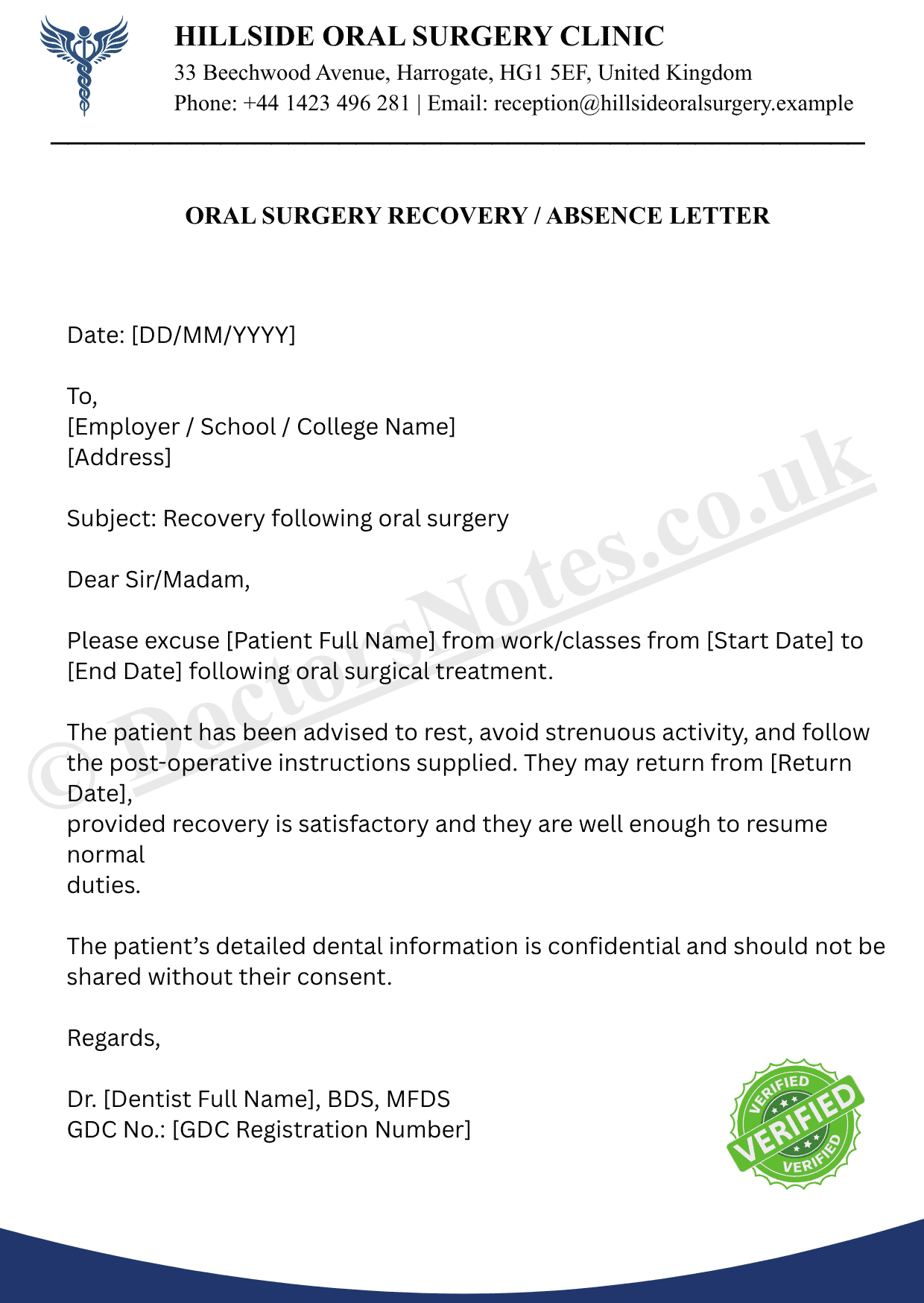
Doctor’s Note for Oral Surgery
| Question | Answer |
|---|---|
| Can I get a doctor’s note after oral surgery? | Medical documentation may be appropriate when your recovery affects your fitness for work and a healthcare professional considers it justified. |
| Can oral surgery make you unable to work? | It can temporarily affect work through pain, swelling, restricted jaw movement, medication effects or other symptoms. |
| Can I get an oral surgery doctor’s note online? | An online health assessment may be suitable for discussing your recovery and work situation. |
| Does every oral surgery procedure require time off? | No. Recovery varies according to the procedure, symptoms and type of work. |
| Can oral surgery cause facial swelling? | Yes. Swelling and bruising can occur after surgery involving the mouth and jaws. |
| Can I get a fit note after oral surgery? | An eligible healthcare professional can assess whether your health affects your fitness for work and whether a fit note is appropriate. |
| Can a dentist issue a formal UK fit note? | Dentists are not among the five professions currently authorised to certify formal fit notes. |
| Do I need a fit note for the first week? | Employees can generally self-certify sickness absence for the first 7 calendar days. |
| Can a fit note recommend reduced duties? | Yes. Where appropriate, it can support advice about altered hours, amended duties or other workplace adjustments. |
| Is a doctor’s note guaranteed? | No. Medical documentation depends on an appropriate assessment. |
What Is Oral Surgery?
Oral surgery is a branch of dental and surgical care involving procedures on the mouth, teeth, gums, jaw or related oral tissues.
It can range from relatively minor procedures to more complex operations.
The term may be used for procedures such as:
Tooth and wisdom-tooth procedures
- Surgical extraction
- Impacted wisdom-tooth removal
- Removal of difficult or retained teeth
Gum procedures
- Surgical treatment of gum problems
- Treatment of abnormal gum tissue
- Procedures involving the tissue surrounding teeth
Jaw and bone procedures
- Bone grafting
- Procedures involving the jaw
- Preparation for certain dental implants
Other oral procedures
- Removal or biopsy of certain lesions
- Treatment of cysts
- Other procedures performed by an oral surgeon or maxillofacial team
Your exact procedure matters when considering recovery and fitness for work.
Why Can Oral Surgery Affect Your Ability to Work?
Your mouth plays an important role in communication, eating and everyday comfort.
After surgery, several temporary symptoms can interfere with normal activities.
You may experience:
- Pain
- Facial swelling
- Bruising
- Jaw stiffness
- Difficulty opening your mouth
- Difficulty chewing
- Difficulty speaking
- Mouth numbness while anaesthetic wears off
- Tiredness
- Bleeding or blood-stained saliva
- Discomfort when swallowing
- Medication-related effects
Not everyone experiences all of these symptoms.
The extent of the problem also depends on the procedure you underwent.
Oral Surgery Recovery and Different Jobs
Your occupation can determine how much your symptoms interfere with your working day.
| Occupation | Possible impact after oral surgery |
|---|---|
| Teacher | Prolonged speaking may become uncomfortable |
| Call-centre worker | Continuous conversation may aggravate jaw discomfort |
| Receptionist | Speaking and customer interaction may be difficult |
| Healthcare professional | Communication and concentration may be affected |
| Retail worker | Customer-facing duties may be uncomfortable with swelling or pain |
| Hospitality worker | Speaking, eating patterns and long shifts may be difficult |
| Office worker | Pain or medication effects may interfere with concentration |
| Manual worker | Physical exertion may be unsuitable during early recovery |
| Driver | Sedation or medication may affect safe driving |
| Public speaker | Swelling and restricted mouth movement can directly affect speech |
| Performer | Jaw discomfort may interfere with speaking or performance |
These examples are not automatic reasons for sickness absence.
A healthcare professional should consider your actual symptoms and the functional demands of your role.
Doctor’s Note for Oral Surgery for Work
A doctor’s note for oral surgery for work may become relevant when your post-operative symptoms prevent you from performing your usual duties.
You may need medical documentation if:
- Your pain makes normal duties difficult
- You cannot speak comfortably for prolonged periods
- Facial swelling affects customer-facing work
- Your jaw movement is significantly restricted
- You are experiencing complications
- Medication affects your ability to work safely
- Your job involves strenuous physical activity
- You have been advised to rest during recovery
- You cannot safely perform your normal duties
The presence of an oral-surgery procedure alone does not determine whether you are fit for work.
The focus is on how your health affects your ability to function.
Can You Get a Doctor’s Note for Oral Surgery Online?
An online medical assessment may be appropriate when your current symptoms can be discussed and assessed remotely.
You may be asked about:
- The procedure you underwent
- When the surgery took place
- Your current symptoms
- Pain and swelling
- Your ability to eat and drink
- Your ability to speak
- Medication
- Any complications
- Your occupation
- Your current ability to perform your normal duties
The healthcare professional can then decide whether further medical assessment is required and whether appropriate documentation can be issued.
An online consultation does not replace the oral surgeon, dentist or hospital team responsible for treating the surgical site.
If you have a significant post-operative complication, you may need direct dental or medical care.
How to Get a Doctor’s Note for Oral Surgery Online
The process should start with your health and recovery.
Step 1: Explain what procedure you had
Provide the name of the procedure if you know it.
If you do not know the exact medical term, describe what happened in ordinary language.
Step 2: Describe your recovery
Mention your current pain, swelling, bruising, jaw stiffness or other symptoms.
Step 3: Explain your work
Tell the healthcare professional what your normal job involves.
For example, explain whether you:
- Talk throughout the day
- Drive
- Operate machinery
- Perform physical work
- Work with customers
- Work in healthcare
- Need high concentration
Step 4: Provide relevant treatment information
Have your discharge instructions, medication details or follow-up information available where relevant.
Step 5: Complete the medical assessment
Your symptoms and functional limitations can then be considered.
Step 6: Discuss appropriate documentation
If your health affects your fitness for work, the healthcare professional can determine whether a fit note or other suitable medical evidence is appropriate.
What Should You Have Ready for an Oral Surgery Assessment?
A little preparation can make it easier to describe your situation accurately.
Procedure details
☐ Name of procedure
☐ Date of surgery
☐ Reason for surgery
☐ Area treated
☐ Whether stitches were used
☐ Whether sedation or general anaesthesia was involved
Recovery symptoms
☐ Pain
☐ Swelling
☐ Bruising
☐ Bleeding
☐ Jaw stiffness
☐ Difficulty opening your mouth
☐ Difficulty eating
☐ Difficulty speaking
☐ Numbness
☐ Fever or feeling unwell
Work information
☐ Job title
☐ Normal working hours
☐ Physical demands
☐ Speaking requirements
☐ Driving requirements
☐ Safety-sensitive responsibilities
☐ Date you stopped working
Medical information
☐ Medication
☐ Post-operative instructions
☐ Follow-up appointment
☐ Previous relevant conditions
☐ Any complications reported by your dental team
What Does Recovery From Oral Surgery Usually Involve?
Recovery depends heavily on the procedure.
After surgery involving the mouth and jaws, local anaesthetic can leave the mouth numb for a period. Once it wears off, pain, swelling and bruising may develop. Cambridge University Hospitals advises that these symptoms normally begin to settle after a few days.
Your surgical team may also provide specific instructions concerning:
- Eating and drinking
- Oral hygiene
- Exercise
- Smoking
- Alcohol
- Pain relief
- Mouth rinsing
- Follow-up appointments
Always follow the instructions given by the clinician who performed your procedure.
Can Oral Surgery Cause Facial Swelling?
Yes.
Swelling is a common part of recovery from many procedures involving the mouth and jaw.
The amount can depend on:
- Type of surgery
- Location of the procedure
- Complexity
- Individual healing
- Whether complications develop
Swelling can make customer-facing or speaking-intensive work uncomfortable.
It can also make eating and normal mouth movement more difficult.
Can Oral Surgery Affect Speech?
It can.
Speaking may be uncomfortable when you have:
- Jaw stiffness
- Swelling
- Pain
- Stitches
- Restricted mouth opening
- Numbness
This matters particularly for people whose jobs involve constant communication.
A teacher, presenter or call-centre employee may experience a very different work impact from someone whose role involves little verbal communication.
Can Oral Surgery Affect Eating?
Yes.
After certain procedures, your dental team may recommend softer foods while the surgical site heals.
You may also find chewing uncomfortable because of:
- Pain
- Swelling
- Stitches
- Restricted jaw movement
- Sensitivity around the surgical area
If eating difficulties are significant, explain them during your medical assessment.
Oral Surgery and Physical Work
Physical activity may need to be limited temporarily after some oral procedures.
NHS oral-surgery aftercare guidance advises avoiding exercise immediately after surgery because exertion can contribute to bleeding.
If your job involves:
- Heavy lifting
- Construction
- Warehouse work
- Repeated bending
- Physically demanding tasks
- Intensive exercise
tell the healthcare professional.
Your recovery requirements may be different from those of someone with a sedentary occupation.
Oral Surgery and Driving
Driving after oral surgery depends on several factors.
Consider:
- Whether you received sedation
- Whether you had a general anaesthetic
- Whether you are taking medication that affects alertness
- Whether you are dizzy or unusually tired
- Whether pain is distracting you
- Whether you feel fully able to control the vehicle
Do not drive if you are not safe to do so.
If your dental or surgical team gave you specific driving restrictions, follow them.
Oral Surgery After Sedation or General Anaesthesia
Sedation and general anaesthesia can create additional restrictions beyond the surgical wound itself.
Your ability to drive, work safely or make important decisions may be temporarily affected.
Always follow the specific discharge instructions provided by your clinical team.
If your employer requires you to operate machinery, drive professionally or perform safety-critical work, mention this during your assessment.
Oral Surgery and Medication
Pain relief is commonly used during recovery.
However, medication can affect your ability to work in some circumstances.
Tell the healthcare professional if you are taking:
- Prescription painkillers
- Antibiotics
- Sedating medicines
- Other prescribed medication
- Over-the-counter medicines
Do not stop prescribed medication simply because you need to work.
Instead, discuss concerns about side effects with an appropriate healthcare professional.
What Is the Difference Between Oral Surgery and Tooth Extraction?
The terms are related, but they are not identical.
Tooth extraction means removing a tooth.
Oral surgery is broader and includes surgical procedures involving the mouth, teeth, gums and related structures.
A surgical tooth extraction can therefore be considered a type of oral surgery.
Other oral surgical procedures do not necessarily involve removing a tooth.
This distinction is useful when describing your treatment to an employer or healthcare professional.
What Is the Difference Between Oral Surgery and Maxillofacial Surgery?
These terms can overlap but are not interchangeable.
Oral surgery generally concerns surgical treatment involving the mouth, teeth, gums and related oral structures.
Oral and maxillofacial surgery covers a broader range of conditions involving the mouth, jaw, face and related structures.
The exact department responsible for your treatment depends on the nature and complexity of the procedure.
Can You Get a Fit Note After Oral Surgery?
A fit note, formally called a Statement of Fitness for Work, is medical evidence concerning how a health condition affects fitness for work.
GOV.UK guidance states that fit notes are based on a healthcare professional’s assessment. They may state that someone is:
- Not fit for work, or
- May be fit for work subject to advice.
For oral surgery, the relevant issue is how your post-operative condition affects your ability to perform work.
Who Can Issue a Fit Note in the UK?
Current UK guidance identifies five professions that can certify fit notes:
- Doctors
- Nurses
- Occupational therapists
- Pharmacists
- Physiotherapists
A dentist or oral surgeon may be involved in your treatment but is not one of the five professions listed as able to certify formal fit notes.
However, a healthcare professional who is not authorised to certify a fit note may provide a written report that can be considered by an eligible professional.
This distinction is important when you need formal evidence for your employer.
Do You Need a Fit Note Immediately After Oral Surgery?
Not always.
For sickness absence lasting 7 calendar days or less, employees can generally self-certify.
A fit note may become relevant when the absence continues beyond that period.
Your employer may have additional procedures for reporting sickness, so check your workplace policy.
Can a Fit Note Be Based on an Online Consultation?
Yes, where the healthcare professional can conduct an appropriate assessment.
GOV.UK guidance allows the assessment underlying a fit note to take place through:
- Face-to-face consultation
- Video call
- Telephone consultation
- Consideration of a written report from another healthcare professional
The important requirement is that the healthcare professional has enough information to make a suitable fitness-for-work assessment.
Can a Fit Note Recommend Workplace Adjustments?
Yes.
A fit note can support a conversation about staying at work or returning to work with appropriate changes.
Depending on your situation, possible adjustments could include:
- Altered working hours
- Amended duties
- Temporary reduction in physical tasks
- Reduced speaking requirements
- Working from home where appropriate
- A phased return
- Temporary changes to working patterns
GOV.UK guidance specifically encourages consideration of altered hours, amended duties and workplace adjustments before concluding that someone is unable to do any work.
The fit note is advisory. Your employer considers the advice alongside workplace requirements.
Oral Surgery: Time Off or Adjusted Work?
Complete absence is not always the only option.
For example:
Mild discomfort + desk-based job
→ You may be able to continue working.
Jaw pain + call-centre role
→ Temporary reduction in prolonged speaking may be worth discussing.
Significant swelling + customer-facing role
→ Temporary alternative duties may be considered.
Post-operative complications + physically demanding job
→ Additional recovery time may be appropriate following medical assessment.
These are examples, not medical instructions.
Your individual symptoms should determine the appropriate approach.
What If Your Employer Requests Proof of Oral Surgery?
First, find out exactly what they want.
They may be asking for:
- Proof of your dental appointment
- A treatment record
- A medical certificate
- A fit note
- Other evidence of sickness absence
A dental treatment document and a formal fit note are not necessarily the same thing.
If your employer specifically requests a Statement of Fitness for Work, make sure you understand who is authorised to provide it.
Can You Get a Doctor’s Note for Oral Surgery After the Procedure?
Yes, you can seek an assessment after the procedure if you are still experiencing symptoms that affect your ability to work.
Explain your current situation rather than relying only on the fact that you had surgery.
For example:
“I had oral surgery three days ago. I still have significant swelling and jaw stiffness, and my role requires me to speak continuously for several hours.”
This gives the healthcare professional useful information about the functional effect of your condition.
Can an Oral Surgery Doctor’s Note Be Backdated?
Do not assume that documentation can automatically cover previous days.
The healthcare professional must consider the available clinical information and determine what documentation is appropriate.
If you have already missed work, provide:
- Date of surgery
- Date your symptoms became significant
- Dates you were absent
- Treatment received
- Current symptoms
- Any follow-up care
A healthcare professional can then make an informed assessment.
How Long Can an Oral Surgery Fit Note Last?
There is no universal duration.
The appropriate period depends on:
- Type of surgery
- Recovery
- Symptoms
- Complications
- Job requirements
- Clinical assessment
GOV.UK guidance states that during the first six months of a health condition, a fit note can be issued for a maximum of three months at a time. The actual duration remains a matter of clinical judgement.
When Should You Contact Your Dental or Surgical Team?
Medical documentation should not replace post-operative care.
Contact your dental or surgical team if you develop concerning symptoms such as:
- Persistent or heavy bleeding
- Increasing rather than improving pain
- Significant swelling
- Fever
- Pus or other signs of infection
- Difficulty swallowing
- Difficulty breathing
- Other unexpected or severe symptoms
Your own surgical team should be the first source for procedure-specific aftercare advice.
If you develop severe difficulty breathing or another emergency, seek emergency medical assistance immediately.
What If You Develop a Complication?
A complication can change your recovery considerably.
Possible post-operative problems can include infection, persistent bleeding or other issues depending on the procedure.
If your symptoms are worsening rather than gradually settling, arrange appropriate dental or medical assessment.
Do not focus solely on obtaining a work document.
Treat the underlying medical problem first.
Online Assessment for Oral Surgery Documentation
An online medical assessment can be useful when you need to explain how your recovery is affecting your everyday function.
You can discuss:
- What procedure you underwent
- Your recovery so far
- Current symptoms
- Medication
- Work responsibilities
- Sickness absence
- Possible workplace adjustments
- Documentation requirements
The assessment allows the healthcare professional to determine what is appropriate rather than treating every oral-surgery case as identical.
Your Oral Surgery Documentation Checklist
Before starting your assessment, keep these details available:
Procedure
☐ Procedure name
☐ Date of surgery
☐ Reason for surgery
☐ Surgical location
☐ Type of anaesthetic or sedation
Recovery
☐ Current pain
☐ Swelling
☐ Bruising
☐ Bleeding
☐ Jaw movement
☐ Speaking difficulties
☐ Eating difficulties
☐ Medication
☐ Complications
Employment
☐ Job title
☐ Main duties
☐ Physical requirements
☐ Speaking requirements
☐ Driving requirements
☐ Safety responsibilities
☐ Dates of absence
Employer requirements
☐ Type of evidence requested
☐ Sickness-reporting procedure
☐ Required dates
☐ Any requested workplace adjustments
Can Oral Surgery Qualify for Sick Leave From Work?
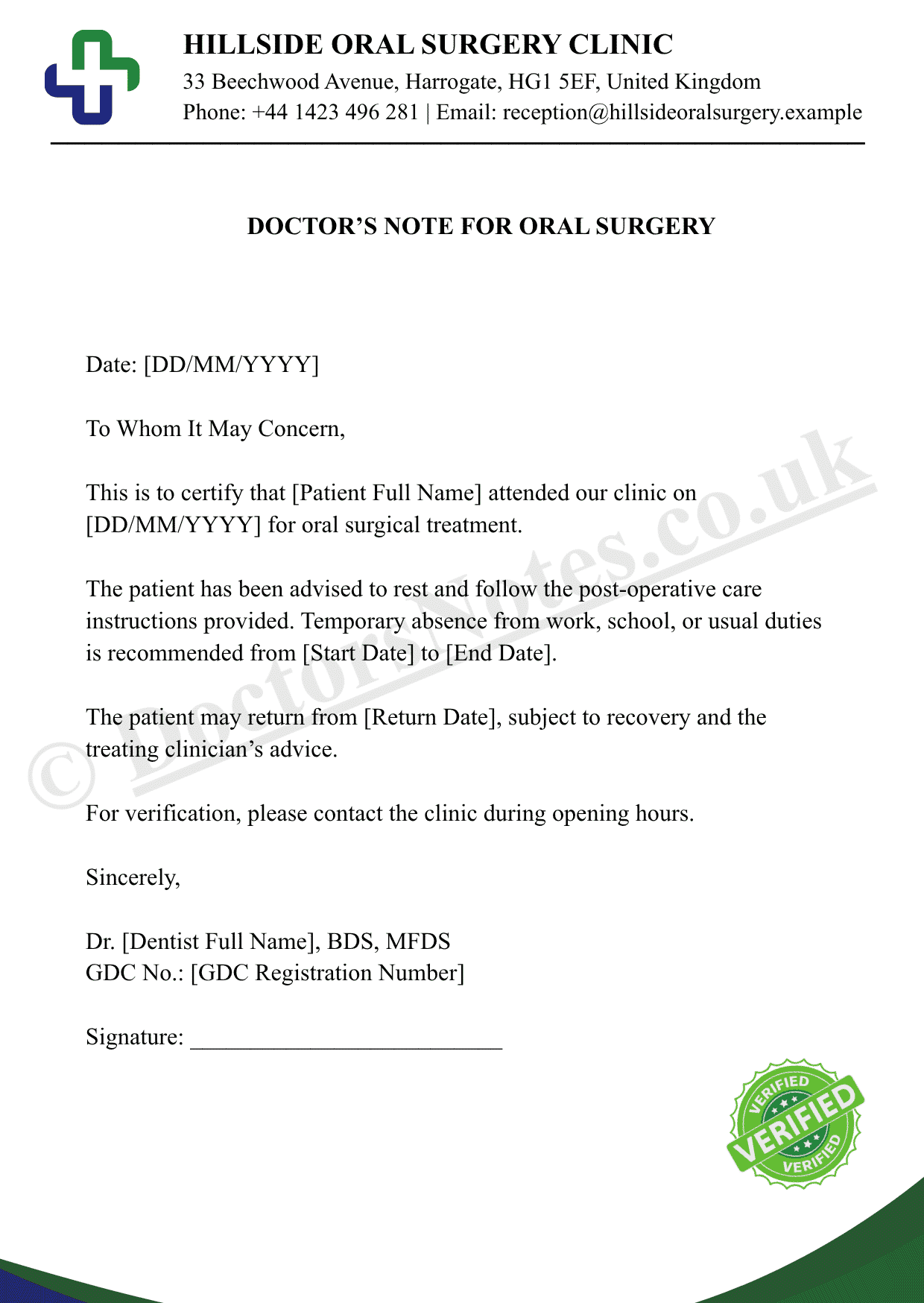
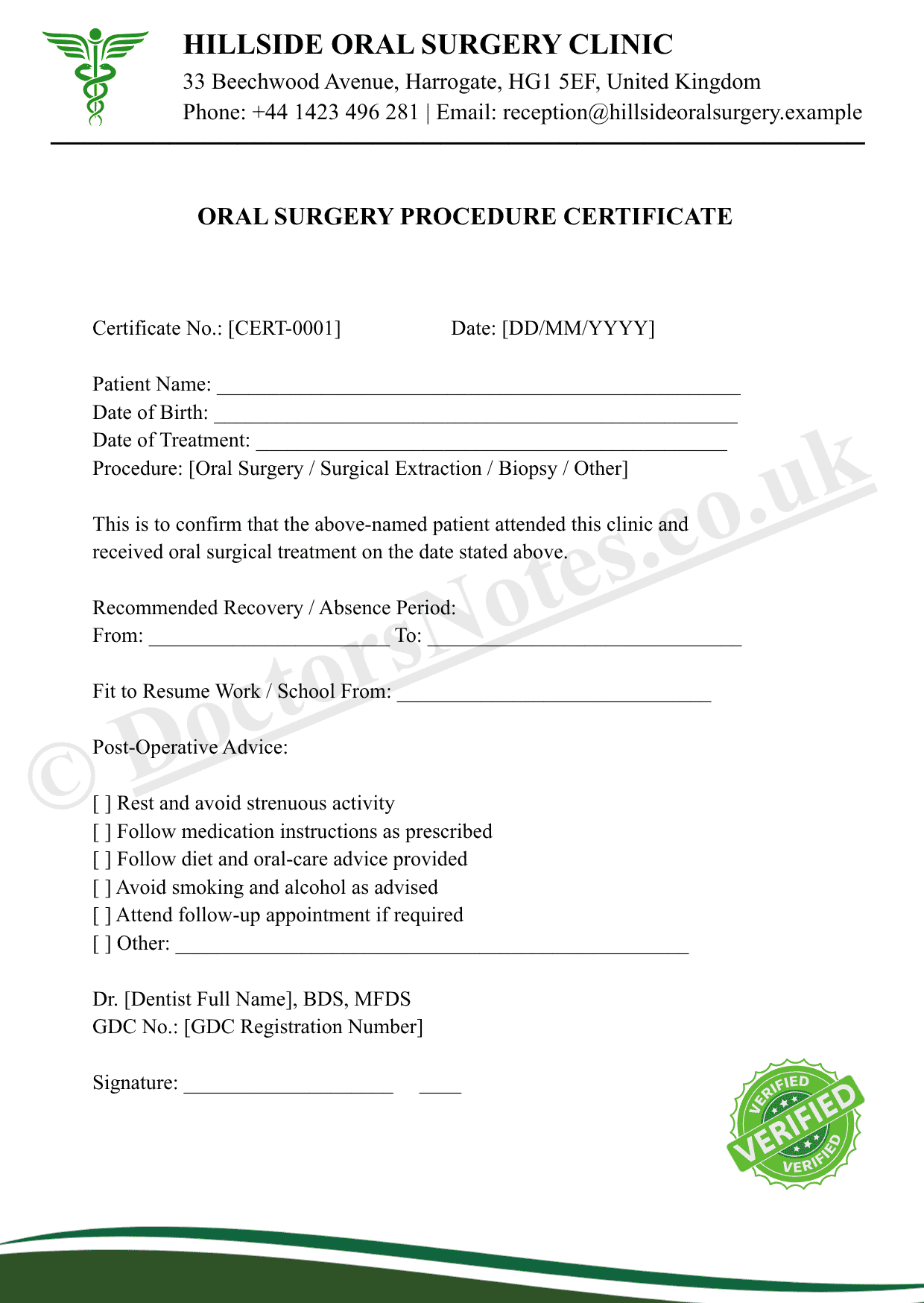
Yes, oral surgery can qualify for sick leave from work if the procedure or recovery symptoms make it difficult to perform your job. Procedures such as wisdom tooth removal, impacted tooth extraction, or jaw surgery may cause pain, swelling, bleeding, and difficulty speaking or eating. The amount of time off needed depends on the complexity of the surgery, your recovery, and whether your job involves physical activity or frequent speaking.
A dentist or oral surgeon can assess your condition and provide a doctor’s note or medical certificate if medically appropriate. The note may include the procedure date, recommended recovery period, and any temporary work restrictions. Simple procedures may require only a short absence, while more complex surgery may need several days or longer. Sick leave approval depends on your employer’s policies and applicable employment rules.
FAQs
Can I get a doctor’s note for oral surgery?
You may be able to receive appropriate medical documentation if your post-operative condition affects your fitness for work and an eligible healthcare professional considers it clinically appropriate.
Can I get a doctor’s note for oral surgery online?
An online medical assessment may be suitable for discussing your recovery, work limitations and documentation needs. The healthcare professional decides whether remote assessment is appropriate.
Can oral surgery make you unfit for work?
It can temporarily affect your ability to work if pain, swelling, restricted jaw movement, medication effects or complications interfere with your normal duties.
How long should I take off work after oral surgery?
There is no standard period for every procedure. Recovery depends on the type of surgery, your symptoms and the demands of your job.
Can I work after oral surgery?
Some people can return to work relatively quickly. Others may need additional recovery time or temporary changes to their duties.
Can I get a fit note after oral surgery?
An eligible healthcare professional can assess whether your health affects your fitness for work and determine whether a fit note is appropriate.
Can an oral surgeon issue a UK fit note?
The current list of professionals authorised to certify formal fit notes includes doctors, nurses, occupational therapists, pharmacists and physiotherapists. Oral surgeons and dentists are not included in that list.
Can I get a doctor’s note for wisdom tooth surgery?
If recovery from wisdom tooth surgery affects your fitness for work, an eligible healthcare professional can assess your circumstances and determine whether medical documentation is appropriate.
Can oral surgery cause facial swelling?
Yes. Swelling and bruising can occur after surgery involving the mouth and jaws and generally begin to settle after a few days.
Can oral surgery make talking difficult?
Yes. Pain, swelling and restricted jaw movement can make prolonged speaking uncomfortable.
Can I get a sick note for oral surgery complications?
If a complication affects your ability to work, seek appropriate dental or medical assessment. An eligible healthcare professional can then determine whether a fit note is appropriate.
Do I need a fit note for the first 7 days after oral surgery?
Generally, employees can self-certify sickness absence for the first 7 calendar days. A fit note may be required if the absence continues beyond that period.
Can a fit note recommend reduced hours after oral surgery?
Yes. Where clinically appropriate, a fit note can support advice about altered hours, amended duties or other workplace adjustments.
Can I get a doctor’s note after oral surgery if my dentist only gave me treatment paperwork?
You can seek a separate health and work assessment. Dental treatment paperwork and a formal fit note serve different purposes, so check what your employer requires.
Can an oral surgery fit note be issued after an online consultation?
A fit note can be based on an appropriate online or telephone assessment where the healthcare professional has enough information to assess fitness for work.
Can an oral surgery doctor’s note be backdated?
Do not assume it can. The healthcare professional must consider the clinical information and determine what documentation is appropriate.
Is a doctor’s note for oral surgery guaranteed?
No. Medical documentation is dependent on clinical assessment. A responsible service cannot guarantee a particular outcome before assessing your circumstances.
Need Medical Documentation After Oral Surgery?
Recovering from oral surgery can affect your ability to speak, eat, concentrate, travel, drive or carry out physical work. The impact depends on both the procedure and your individual recovery.
If your symptoms are interfering with employment, an online medical assessment for a doctor’s note for oral surgery can provide a convenient way to explain your situation and discuss whether appropriate medical documentation is available.
Start your online assessment and tell us about your oral surgery, current symptoms and work requirements. A healthcare professional will assess your circumstances and determine the appropriate next step.


Reviews
There are no reviews yet.