




A doctor’s note for tooth extraction may be relevant when recovery after having a tooth removed affects your ability to work, attend school or carry out your normal responsibilities. Pain, facial swelling, jaw stiffness, bleeding, numbness and difficulty eating or speaking can make a normal working day difficult, particularly during the first few days after an extraction.
If you have recently had a tooth removed and need medical documentation, an online medical assessment can give you a convenient way to discuss your recovery, explain how your symptoms are affecting you and find out whether appropriate documentation can be provided.
A healthcare professional must assess your circumstances before issuing a medical document. A doctor’s note or fit note is not automatically provided simply because you request one.
Need Time Off After Having a Tooth Removed?
A dental extraction can be a relatively straightforward procedure, but recovery is not identical for everyone.
The effect on your routine can depend on:
- Which tooth was removed
- Whether the extraction was simple or surgical
- The number of teeth removed
- Whether stitches were required
- Whether you received local anaesthetic or sedation
- Your level of pain and swelling
- Whether you have bleeding or other complications
- The physical and communication demands of your job
Someone with a desk-based role may be able to return quickly, while someone who works in a physically demanding, customer-facing or safety-sensitive role may need different arrangements.
The important question is not simply “Did I have a tooth extracted?”
It is:
“Are my current symptoms affecting my ability to work safely and normally?”
Doctor’s Note for Tooth Extraction: At a Glance
| Question | Answer |
|---|---|
| Can I get a doctor’s note after tooth extraction? | Medical documentation may be appropriate if your recovery affects your fitness for work and a healthcare professional considers it justified. |
| Can tooth extraction make it difficult to work? | Yes. Pain, swelling, bleeding, jaw stiffness, medication effects or difficulty speaking can interfere with work. |
| Can I get a tooth extraction sick note online? | An online medical assessment may be suitable for discussing your recovery and documentation needs. |
| Can a dentist provide a fit note? | A formal UK fit note can be certified by eligible healthcare professionals. Dentists are not among the five professions currently authorised to certify fit notes. |
| Do I need a fit note for the first 7 days? | Employees can generally self-certify sickness absence for the first 7 calendar days. |
| How long can recovery take? | Recovery varies. Pain and swelling often improve over several days, although more complicated extractions can take longer. |
| Can I work after a tooth extraction? | Some people can return quickly; others may need time away or temporary adjustments depending on their recovery and job. |
| Is a doctor’s note guaranteed? | No. Documentation depends on a clinical assessment. |
| Can I get documentation after wisdom tooth extraction? | A healthcare professional can assess the effects of wisdom tooth removal and determine whether medical documentation is appropriate. |
| Can I get a note if I have complications? | If complications affect your fitness for work, they should be discussed with an appropriate healthcare professional. |
What Is a Tooth Extraction?
A tooth extraction is a dental procedure in which a tooth is removed from its socket.
Extraction may be necessary for different reasons, including:
- Extensive tooth decay
- Severe infection
- Gum disease
- A damaged or broken tooth
- A tooth that cannot be restored
- Overcrowding
- Certain orthodontic treatment plans
- Impacted wisdom teeth
- Other dental or oral-health problems
A simple extraction may be performed under local anaesthetic. More complicated cases can involve surgical removal and may require additional recovery time.
The procedure itself is only one part of the experience. The healing period afterwards can determine whether you feel able to return to your usual routine.
Why Might You Need a Doctor’s Note After Tooth Extraction?
A person may need medical documentation when post-extraction symptoms interfere with their normal responsibilities.
For example, you may find it difficult to work because of:
- Significant dental pain
- Facial swelling
- Jaw stiffness
- Difficulty opening your mouth
- Persistent bleeding
- Difficulty speaking
- Difficulty eating
- Fatigue after the procedure
- Medication-related effects
- Complications during recovery
The situation can be particularly challenging if your work requires continuous talking, physical activity, driving or close interaction with other people.
Tooth Extraction and Work: What Makes the Difference?
There is no universal recovery period that applies to every employee.
Your occupation can change the practical impact of the extraction.
Examples
| Type of work | Potential problem after extraction |
|---|---|
| Office worker | Pain may make concentration difficult |
| Call-centre employee | Jaw discomfort may make prolonged speaking difficult |
| Teacher | Speaking for long periods may be uncomfortable |
| Receptionist | Facial swelling or difficulty speaking may affect customer interaction |
| Retail worker | Standing for long periods may be difficult if pain or medication causes discomfort |
| Hospitality worker | Eating restrictions and prolonged speaking may make a shift uncomfortable |
| Manual worker | Heavy physical activity may not be appropriate immediately after some procedures |
| Healthcare worker | Communication, concentration and physical duties may be affected |
| Driver | Medication, sedation or symptoms may affect safe driving |
| Performer or presenter | Mouth and jaw discomfort may directly affect speech |
These examples do not mean that extraction automatically makes someone unfit for work.
A healthcare professional considers your actual symptoms and circumstances.
Doctor’s Note for Tooth Extraction for Work
If you are searching for a doctor’s note for tooth extraction for work, you may be concerned about what evidence your employer needs.
Start by checking your workplace sickness policy.
Your employer may ask for:
- Self-certification
- A fit note
- Medical evidence
- A treatment or appointment record
- Another form of supporting documentation
The type of document required can vary.
If your absence is longer than the self-certification period, appropriate medical evidence may become necessary.
How Long Should You Take Off Work After a Tooth Extraction?
There is no single number of days that applies to everyone.
A straightforward extraction may cause relatively short-lived discomfort. Surgical extraction can produce more noticeable pain, swelling and jaw stiffness.
NHS hospital guidance commonly notes that pain and swelling can be more noticeable during the first few days before gradually settling. Some people continue to experience soreness for longer, particularly after more complicated procedures.
Your return to work can therefore depend on:
- The complexity of the extraction
- Your symptoms after treatment
- Your occupation
- Whether complications occur
- Any medication you are taking
- Your healthcare professional’s advice
Can You Work the Day After a Tooth Extraction?
Possibly.
Some people feel well enough to resume normal activities relatively quickly. Others experience enough pain, swelling or jaw stiffness to need additional recovery time.
Consider what your job requires.
A quiet desk job may be easier to manage than a role involving:
- Heavy lifting
- Constant speaking
- Physical exertion
- Driving
- Machinery
- Customer interaction
- Long shifts
If you are uncertain whether your symptoms allow you to work safely, seek medical advice rather than relying solely on a generic recovery timeline.
What Happens After a Tooth Is Removed?
Once a tooth is extracted, a blood clot forms inside the empty socket.
That clot is important for healing.
Post-extraction instructions from NHS dental services commonly advise patients not to disturb the socket, particularly during the first 24 hours. Smoking, vigorous rinsing and other activities can interfere with the healing process.
You may experience:
- Numbness while local anaesthetic wears off
- Mild bleeding or blood-stained saliva
- Pain
- Swelling
- Bruising
- Jaw stiffness
- Difficulty opening your mouth
- Temporary difficulty eating
- Discomfort while speaking
The intensity depends on the procedure and the individual.
Tooth Extraction Recovery: What Can Affect Your Working Day?
Recovery is not just about pain.
Several smaller problems can combine and make work difficult.
Speaking
If your extraction has left your mouth sore or swollen, talking for long periods may become uncomfortable.
This can matter for:
- Teachers
- Receptionists
- Sales staff
- Call-centre workers
- Customer service teams
- Healthcare professionals
- Public speakers
Eating
You may need softer foods for a period after the procedure. NHS dental guidance commonly recommends soft food after extraction and avoiding foods or drinks that may disturb the healing site.
Concentration
Persistent pain can make it harder to focus on demanding tasks.
Physical activity
Strenuous exercise may be discouraged immediately after some extractions because it can contribute to renewed bleeding or discomfort.
Sleep
Pain or discomfort at night can affect your energy the following day.
Doctor’s Note for Tooth Extraction Aftercare
A doctor’s note for tooth extraction aftercare may become relevant when your recovery continues to interfere with work after the procedure.
For example, you may still have:
- Significant swelling
- Persistent pain
- Difficulty opening your mouth
- Difficulty speaking
- Ongoing bleeding
- Suspected infection
- Dry socket
- Other post-operative problems
If symptoms are continuing instead of gradually improving, it is important to seek appropriate dental or medical advice.
Can You Get a Sick Note for Tooth Extraction?
In everyday language, people often use “sick note” to mean medical evidence for sickness absence.
The formal UK term is generally fit note, also known as a Statement of Fitness for Work or Med 3.
A fit note is based on a healthcare professional’s assessment of whether a person’s health affects their ability to work.
It can indicate that someone is:
- Not fit for work, or
- May be fit for work subject to advice
The second option can support discussions about temporary workplace adjustments.
Who Can Issue a Fit Note in the UK?
Current GOV.UK guidance states that fit notes can be certified by:
- Doctors
- Nurses
- Occupational therapists
- Pharmacists
- Physiotherapists
Dentists are not included in this list of professionals authorised to certify formal fit notes.
However, dental professionals can provide treatment records or other documentation relating to dental care. Whether an employer accepts alternative evidence depends on the employer’s requirements.
This distinction matters if you have recently undergone tooth extraction and your workplace specifically asks for a formal fit note.
Do I Need a Fit Note for the First 7 Days?
Generally, no.
Employees can normally self-certify sickness absence for the first 7 calendar days.
This includes weekends and bank holidays.
If your absence lasts longer than 7 calendar days, your employer may ask for medical evidence such as a fit note.
Your employer may also have its own sickness-reporting procedure, so follow the process provided by your workplace.
Can a Fit Note Be Issued After an Online Consultation?
Yes, where the consultation method is appropriate and the healthcare professional can properly assess your fitness for work.
GOV.UK guidance allows a fit-note assessment to be undertaken through:
- Face-to-face consultation
- Video consultation
- Telephone consultation
- Consideration of a written report from another healthcare professional
The method does not remove the need for a proper clinical assessment.
For tooth extraction, the healthcare professional will need enough information to understand your current symptoms and their effect on your ability to work.
How to Get a Doctor’s Note for Tooth Extraction Online
The process is centred around your recovery rather than simply ordering a document.
1. Explain the dental procedure
Tell the healthcare professional when the tooth was removed and whether it was a straightforward or surgical extraction.
2. Describe your current symptoms
Mention pain, swelling, bleeding, jaw stiffness, difficulty speaking or any other problems.
3. Explain your work requirements
Describe what you normally do during a working day and which tasks are currently difficult.
4. Share relevant treatment information
Tell the healthcare professional about medication, follow-up appointments and any concerns raised by your dentist.
5. Complete the assessment
Your symptoms and functional limitations will be reviewed.
6. Discuss the appropriate documentation
If your health is affecting your fitness for work, the healthcare professional can determine whether a fit note or another appropriate medical document is justified.
What Should You Have Ready for Your Online Assessment?
A short preparation checklist can make the consultation easier.
Dental procedure
☐ Date of extraction
☐ Tooth removed
☐ Simple or surgical extraction
☐ Number of teeth removed
☐ Stitches used
☐ Local anaesthetic or sedation
Current symptoms
☐ Pain level
☐ Swelling
☐ Bleeding
☐ Jaw stiffness
☐ Difficulty opening your mouth
☐ Difficulty speaking
☐ Difficulty eating
☐ Fever or feeling unwell
☐ Any unusual taste or discharge
Work information
☐ Job role
☐ Normal working hours
☐ Physical demands
☐ Speaking requirements
☐ Driving requirements
☐ Safety-sensitive duties
☐ Date you were unable to work
Existing medical information
☐ Medication
☐ Dental treatment instructions
☐ Follow-up appointment
☐ Previous relevant conditions
☐ Any complications identified by your dentist
Tooth Extraction and Workplace Adjustments
Time away from work is not the only possibility.
If your symptoms are manageable but make certain tasks difficult, a healthcare professional may consider whether you could work with temporary adjustments.
Depending on your situation, these could involve:
- Reduced working hours
- Amended duties
- A phased return
- Temporary reduction in physically demanding tasks
- Fewer prolonged speaking duties
- Additional opportunities for breaks
- Temporary changes to work patterns
A fit note provides medical advice. It does not automatically require an employer to implement every suggestion. The employee and employer should discuss what is practical.
Tooth Extraction and Driving to Work
Be careful about driving immediately after dental treatment.
The key considerations include:
- Whether you received sedation
- Whether you are still numb
- Whether medication affects alertness
- Whether pain is distracting
- Whether you feel dizzy or unwell
- Whether you can safely control the vehicle
For example, NHS guidance for wisdom tooth removal advises against driving for 48 hours after a general anaesthetic or 24 hours after a sedative injection.
Follow the specific instructions provided by your dental team.
Can You Work With Stitches After Tooth Extraction?
Having stitches does not automatically mean that you cannot work.
Many dental stitches are designed to dissolve naturally.
However, your ability to work depends on the overall recovery.
You may need additional time if you have:
- Significant pain
- Swelling
- Difficulty speaking
- Difficulty eating
- Ongoing bleeding
- Infection
- Other complications
Do not judge your fitness for work based solely on whether stitches are present.
Tooth Extraction and Pain: When Is It Normal?
Some pain after extraction is expected.
Pain can be more noticeable after the local anaesthetic wears off and may be worse during the first few days. NHS hospital guidance also notes that swelling and discomfort can persist for days or, after more complex surgery, longer.
What matters is the overall pattern.
Gradual improvement is generally different from pain that suddenly becomes much worse.
If pain becomes severe, unmanageable or suddenly increases after several days, contact your dental service or seek appropriate medical advice.
What Is Dry Socket?
Dry socket is a painful complication that can occur when the blood clot in the tooth socket is lost or does not develop properly.
A typical warning pattern is pain that becomes significantly worse a few days after extraction rather than steadily improving.
Other symptoms can include:
- Severe or throbbing pain
- Bad taste
- Bad breath
- Increased discomfort around the extraction site
NHS dental guidance identifies dry socket as a possible complication of tooth removal and recommends seeking dental advice when severe or worsening symptoms occur.
If you suspect dry socket, obtaining a work document should not be your only priority. The underlying dental problem needs attention.
When Should You Seek Urgent Dental Help?
Contact your dentist, NHS 111 or an appropriate urgent dental service if you experience concerning symptoms.
These can include:
- Bleeding that does not stop
- Severe or worsening pain
- Significant or worsening swelling
- High temperature
- Feeling generally unwell
- Bad taste with increasing pain
- Signs of infection
- Other symptoms that concern you
NHS guidance specifically advises urgent dental assessment for persistent bleeding and severe or worsening pain and swelling after wisdom tooth removal.
If you have a severe emergency affecting breathing, swallowing or your airway, seek emergency medical help immediately.
Can You Get a Doctor’s Note for Wisdom Tooth Extraction?
Yes, the same medical-documentation principles can apply after wisdom tooth removal.
However, wisdom tooth extraction can sometimes involve more extensive oral surgery than a straightforward extraction.
Recovery may therefore involve:
- More swelling
- Jaw stiffness
- Difficulty opening the mouth
- Greater discomfort
- Temporary difficulty eating
- More noticeable facial swelling
NHS guidance notes that complications after wisdom tooth removal can include dry socket, infection and temporary nerve symptoms.
If these symptoms affect your fitness for work, explain them during your assessment.
What If You Had Multiple Teeth Removed?
Multiple extractions can have a greater impact on eating, speaking and general comfort.
Your recovery may also depend on whether the teeth were removed during one procedure or across separate appointments.
When requesting medical documentation, provide the full picture rather than simply saying that you had teeth removed.
Mention:
- Number of teeth
- Date of treatment
- Type of extraction
- Current symptoms
- Medication
- Work demands
- Expected follow-up
Can a Tooth Extraction Doctor’s Note Be Backdated?
Do not assume that medical documentation can automatically be backdated.
The healthcare professional needs to assess the information available and determine what documentation is appropriate.
If you were already absent from work, explain:
- When you stopped working
- When the extraction occurred
- What symptoms you experienced
- Whether you sought dental treatment
- Whether symptoms continued afterwards
- Whether your condition has improved
This helps the healthcare professional make an informed decision.
How Long Can a Tooth Extraction Fit Note Cover?
There is no fixed duration for every tooth extraction.
The appropriate period depends on the person’s recovery and the healthcare professional’s clinical judgement.
GOV.UK guidance states that during the first six months of a health condition, a fit note can cover a maximum of three months at a time. The healthcare professional determines the clinically appropriate period.
A straightforward extraction and a complicated surgical extraction should not automatically be treated as identical.
Can You Return to Work Before You Feel 100%?
Sometimes.
A person may be able to return while still experiencing some minor symptoms.
The more useful question is whether you can perform your normal duties safely and effectively.
For example:
- Mild residual soreness may not prevent office work.
- Significant jaw pain may make prolonged speaking difficult.
- Strong medication effects may make driving inappropriate.
- Heavy physical work may require different considerations.
Your healthcare professional can discuss your fitness for work based on your individual circumstances.
What If Your Employer Does Not Accept a Dental Certificate?
Check what your employer specifically requires.
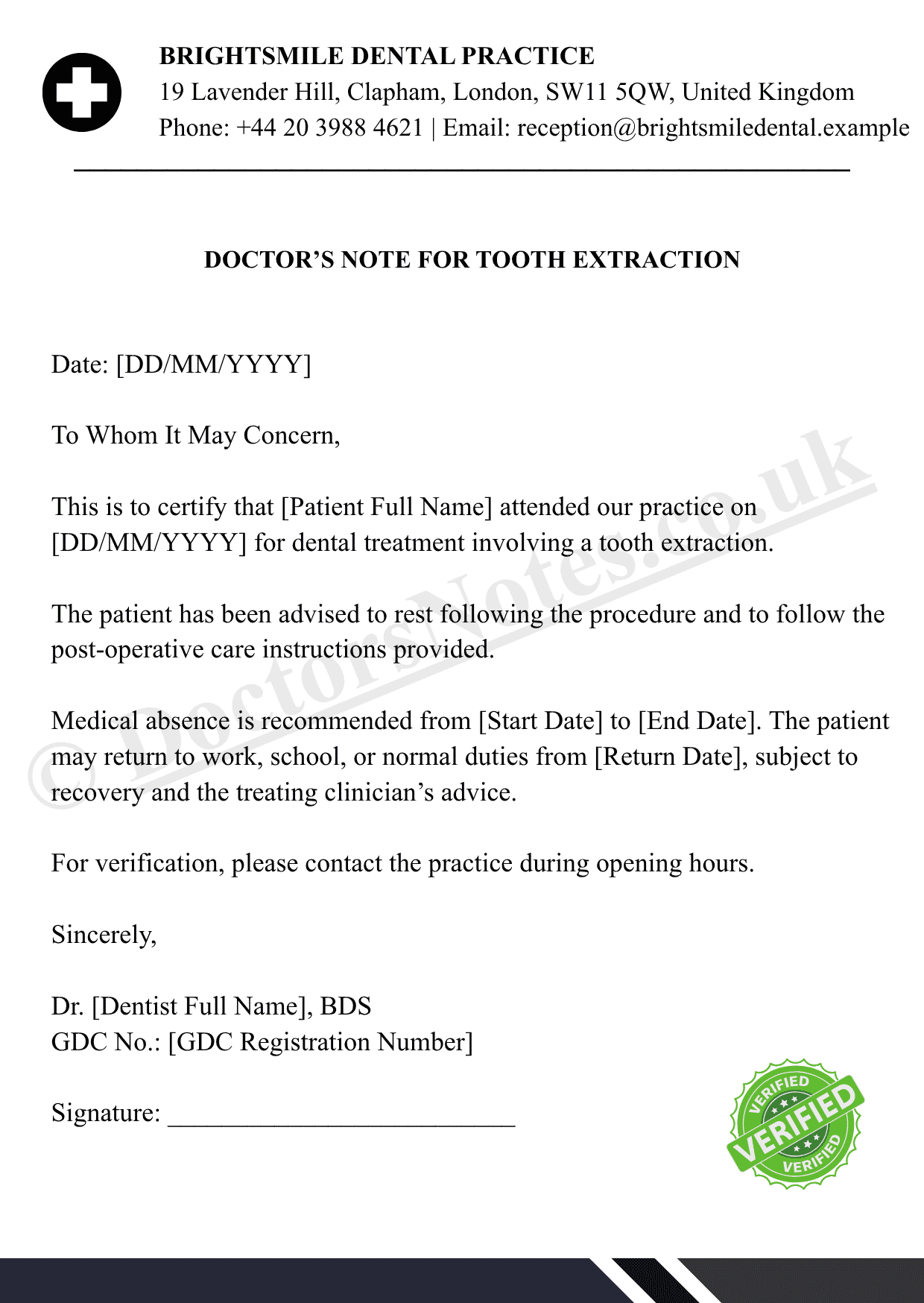
A dental practice may provide evidence that you attended treatment, but this is not necessarily the same as a formal UK fit note.
If your employer asks specifically for a Statement of Fitness for Work, you may need assessment by an eligible healthcare professional.
GOV.UK also notes that private healthcare professionals who are not treating NHS patients may provide a report or form containing equivalent information, which an employer can consider as medical evidence. Whether an employer accepts alternative documentation remains a matter for the employer.
Why Choose an Online Medical Assessment?
Dental treatment can already take time out of your day.
If you then need to arrange additional medical documentation, another appointment may feel inconvenient.
An online assessment can provide a practical route to discuss:
- Your post-extraction symptoms
- Your ability to work
- Your recovery
- Workplace requirements
- Appropriate medical documentation
It is particularly useful when you need to explain your circumstances without making an unnecessary journey.
However, an online assessment cannot replace urgent dental treatment or a physical examination when either is needed.
Before You Request a Doctor’s Note for Tooth Extraction
Ask yourself these five questions:
1. When was the tooth removed?
2. What symptoms are you experiencing now?
3. Are those symptoms preventing you from performing your normal duties?
4. What does your employer actually require?
5. Have you followed the aftercare instructions from your dentist?
Having clear answers makes it easier to explain your situation during an assessment.
How Long Should You Rest After Wisdom Tooth Removal?
Most people need around 1–3 days of rest after wisdom tooth removal, but recovery time depends on the complexity of the procedure, the number of teeth removed, and individual healing. Some people recover quickly after a simple extraction, while impacted wisdom teeth or surgical removal may require several days or longer. Swelling, soreness, and jaw stiffness are common during the first few days.
If your job involves heavy lifting, strenuous activity, or long periods of standing, you may need additional time off or temporary work restrictions. Your dentist or oral surgeon can assess your recovery and provide a doctor’s note or medical certificate if medically appropriate. Follow their instructions about rest, pain relief, oral hygiene, and when to resume normal activities.
FAQs
Can I get a doctor’s note for tooth extraction?
You may be able to receive appropriate medical documentation if your recovery affects your fitness for work and a healthcare professional considers documentation clinically justified.
Can I get a sick note after having a tooth removed?
A healthcare professional can assess whether your post-extraction condition affects your ability to work and whether a fit note or other medical evidence is appropriate.
Can I get a doctor’s note for tooth extraction online?
An online medical assessment may be suitable for discussing your symptoms and work situation. The healthcare professional decides whether remote assessment is appropriate and whether documentation can be issued.
Can a dentist issue a fit note after tooth extraction?
Dentists are not among the healthcare professions currently authorised to certify formal UK fit notes. The current eligible professions are doctors, nurses, occupational therapists, pharmacists and physiotherapists.
How many days should I take off work after tooth extraction?
There is no universal number. Recovery depends on the extraction, your symptoms and your job. Simple extractions may have a shorter recovery than more complicated surgical procedures.
Can I work the day after a tooth extraction?
Some people can return to work the following day, while others need more recovery time. Consider your pain, swelling, medication, job requirements and any advice from your dental or healthcare professional.
Can tooth extraction cause swelling?
Yes. Swelling is a common part of recovery and can be more noticeable during the first few days, particularly after surgical extraction.
Can I get a fit note for wisdom tooth removal?
If your recovery affects your fitness for work, an eligible healthcare professional can assess whether a fit note is appropriate.
Can I get a doctor’s note for multiple tooth extractions?
Yes, the same assessment principle applies. The healthcare professional will consider your symptoms, recovery and ability to perform your normal duties.
Can tooth extraction affect my ability to speak at work?
It can. Pain, swelling and jaw stiffness may make prolonged speaking uncomfortable, particularly during the early recovery period.
Can tooth extraction make it difficult to eat at work?
Yes. Soft foods are commonly recommended during the early recovery period, and you may need to avoid foods that could disturb the extraction site.
Can I get a doctor’s note if I have dry socket?
If dry socket or another post-extraction complication is affecting your fitness for work, discuss the problem with an appropriate healthcare professional. Treatment of the complication should take priority.
Can I get a fit note for dental pain after extraction?
If your post-extraction pain affects your ability to work, an eligible healthcare professional can assess your fitness for work and determine whether a fit note is appropriate.
Do I need a fit note for seven days or less?
Generally, employees can self-certify sickness absence for the first 7 calendar days. A fit note is normally relevant after that period if medical evidence is required.
Can a fit note recommend reduced working hours after tooth extraction?
A fit note can state that someone may be fit for work subject to advice. Where clinically appropriate, adjustments such as altered hours or amended duties may be considered.
Is a doctor’s note for tooth extraction guaranteed?
No. Medical documentation must follow an appropriate assessment. A responsible service should not promise a particular medical outcome before reviewing your circumstances.
Need Medical Documentation After Tooth Extraction?
Recovery after a tooth extraction can affect much more than your mouth. Pain, swelling, difficulty speaking, restricted eating, medication effects or complications may interfere with your normal working day.
If you need medical documentation, an online assessment for a doctor’s note for tooth extraction gives you a convenient way to explain what happened, describe your current symptoms and discuss how they are affecting your ability to work.
Start your online medical assessment and explain your post-extraction symptoms. A healthcare professional will assess your circumstances and determine what medical documentation, if any, is appropriate.



Reviews
There are no reviews yet.