
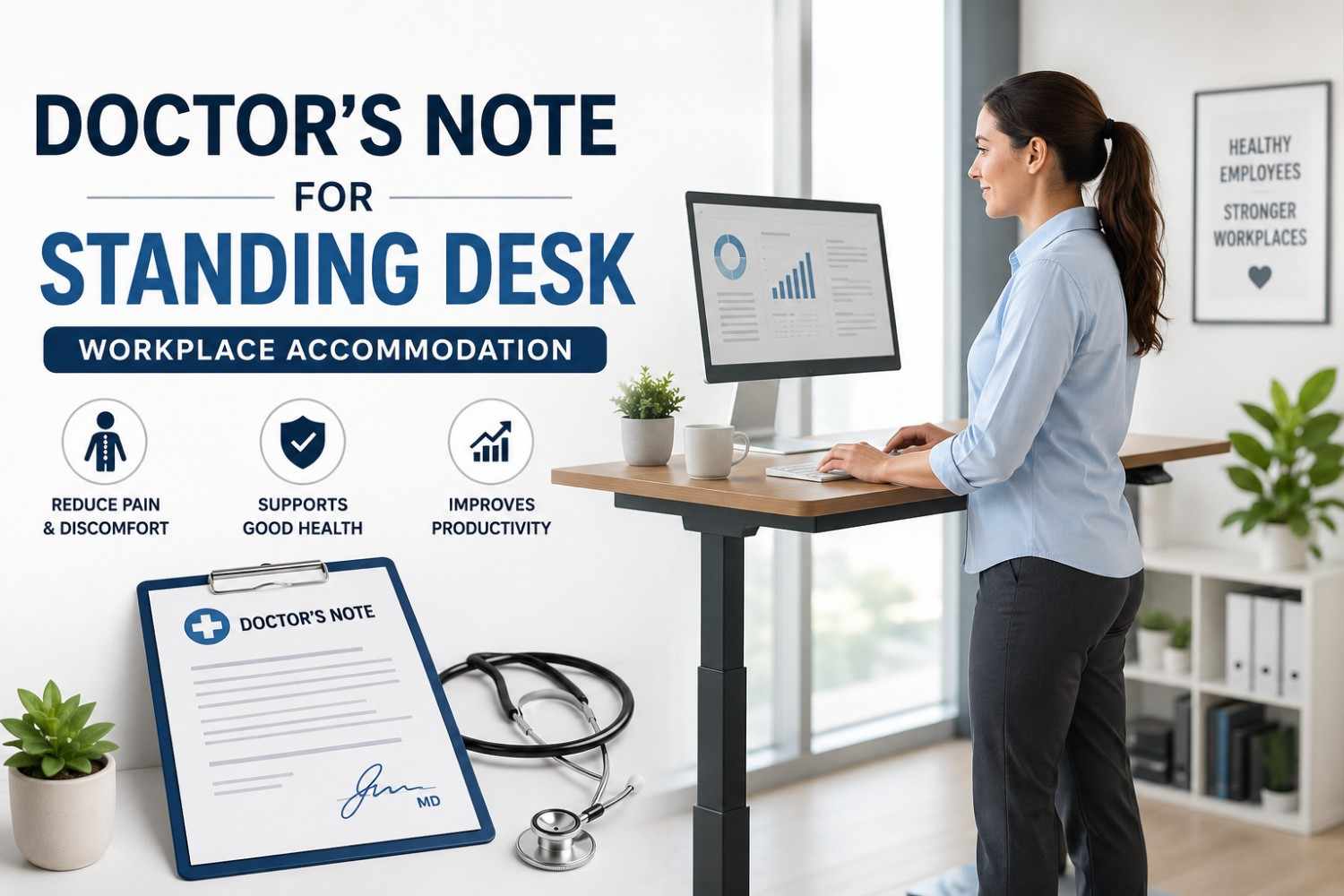


Many employees spend long hours working at a desk, which can contribute to discomfort, poor posture, muscle fatigue, and other musculoskeletal concerns. For some individuals, alternating between sitting and standing throughout the day may help improve comfort and support their ability to perform their job effectively. When an employer requires medical documentation before providing ergonomic equipment, a Doctor’s Note for a Standing Desk may be requested.
This guide explains what a Doctor’s Note for a Standing Desk is, when it may be required, what information it may include, how the consultation works, and important considerations regarding workplace ergonomic accommodations.
Related Post:
What Is a Doctor’s Note for a Standing Desk?
A Doctor’s Note for a Standing Desk is medical documentation issued after a healthcare professional evaluates whether an ergonomic workstation adjustment may benefit your health or improve your ability to work comfortably.
Depending on your clinical assessment, the documentation may include:
- Confirmation that a medical assessment has been completed.
- Recommendations for a height-adjustable or sit-stand desk.
- Advice to alternate between sitting and standing during the workday.
- Suggestions for additional ergonomic adjustments where appropriate.
- Temporary or ongoing workplace recommendations based on your functional needs.
- Advice regarding follow-up assessment if symptoms change.
The document focuses on improving workplace ergonomics rather than providing medical leave.
When Might You Need a Doctor’s Note for a Standing Desk?
Employers may request medical documentation before approving ergonomic equipment or making changes to an employee’s workstation.
Persistent Back or Neck Discomfort During Desk Work
Employees who spend most of the day seated may experience discomfort that becomes worse after prolonged sitting.
Medical assessment may be appropriate when symptoms interfere with workplace comfort or productivity.
Office Ergonomic Accommodation Requests
Many organisations require supporting medical documentation before purchasing ergonomic office equipment.
Examples include:
- Height-adjustable desks.
- Sit-stand workstations.
- Ergonomic office furniture.
- Adjustable monitor setups.
- Keyboard or mouse modifications.
The healthcare professional will assess whether the requested accommodation is clinically appropriate.
Recovery Following Injury or Surgery
Some individuals recovering from musculoskeletal injuries or surgery may temporarily benefit from avoiding prolonged sitting.
Depending on your recovery, recommendations may include:
- Frequent posture changes.
- Reduced sitting time.
- Gradual return to normal workstation use.
- Temporary ergonomic adjustments.
Any recommendation is based on your current recovery rather than the diagnosis alone.
Long-Term Health Conditions Affecting Comfort
Certain medical conditions may make remaining seated for extended periods uncomfortable.
Examples may include conditions affecting:
- The lower back.
- The neck and shoulders.
- The hips.
- The joints.
- Mobility.
A healthcare professional will determine whether workplace modifications may help support your daily work activities.
What Information May Be Included in the Doctor’s Note?
The exact contents depend on your assessment and your employer’s accommodation process.
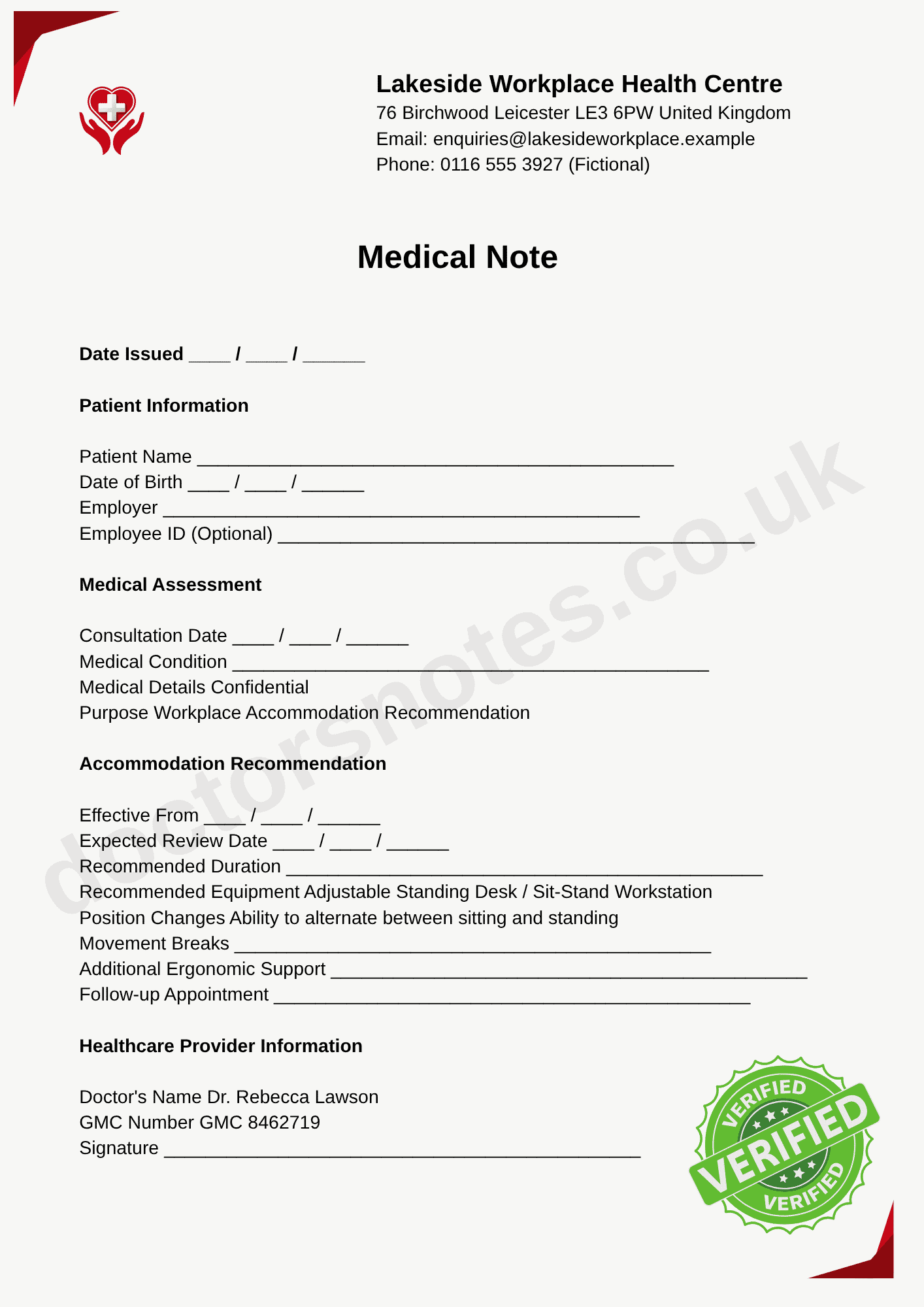
A doctor’s note may include:
- Confirmation of a medical consultation.
- Date of assessment.
- Recommendations for ergonomic workstation adjustments.
- Advice to alternate sitting and standing where appropriate.
- Temporary or ongoing workplace recommendations.
- Follow-up review recommendations if your condition changes.
Healthcare professionals generally provide only the information necessary to support the workplace accommodation while protecting your medical privacy.
Why Workplace Ergonomics Matter
A properly designed workstation helps employees work more comfortably and may reduce unnecessary physical strain during the working day.
Good ergonomic practices may help:
- Encourage healthier posture.
- Reduce prolonged static sitting.
- Improve workstation comfort.
- Support movement throughout the workday.
- Reduce fatigue associated with remaining in one position for long periods.
- Improve overall workplace wellbeing.
A standing desk should normally be used as part of an overall ergonomic strategy rather than standing continuously throughout the day.
What Happens During the Medical Consultation?
During your consultation, the healthcare professional will assess your symptoms, work routine, and functional limitations to determine whether a standing desk recommendation is medically appropriate.
You may be asked about:
- Your occupation and daily job duties.
- How many hours you spend sitting each day.
- The location and duration of your discomfort.
- Activities that worsen or relieve your symptoms.
- Previous injuries or surgeries.
- Current treatments or physiotherapy.
- Existing medical conditions.
- Whether your employer requires specific documentation for ergonomic accommodations.
- Any workplace equipment you currently use.
Following the assessment, the healthcare professional will determine whether a Doctor’s Note for a Standing Desk is clinically appropriate and whether additional ergonomic recommendations or further medical evaluation should be included.
Important: A doctor’s note may recommend a standing desk or other ergonomic accommodation where medically appropriate. However, the decision to provide workplace equipment or modify your workstation remains the responsibility of your employer and is subject to organisational policies, occupational health procedures, and applicable employment laws.
How to Book a Doctor’s Note for a Standing Desk
If you believe an adjustable workstation may help you work more comfortably, you can arrange an online consultation with a licensed healthcare professional. During the appointment, your symptoms, daily work routine, and workstation setup will be reviewed to determine whether a Doctor’s Note for a Standing Desk is clinically appropriate.
Step 1: Book an Ergonomic Assessment Consultation
Schedule an online consultation at a convenient time. If your employer has asked for medical documentation before approving ergonomic equipment, it is helpful to arrange your appointment before submitting your accommodation request.
Step 2: Register or Log In
New patients can create an account by completing a simple registration process. Returning patients can log in using their existing account details.
Step 3: Select the Appropriate Consultation
Choose a consultation relating to workplace ergonomics, occupational health advice, musculoskeletal concerns, or medical documentation for workplace accommodations.
If your employer has a workplace accommodation form or occupational health questionnaire, mention this when making your booking.
Step 4: Complete Your Health and Workplace Questionnaire
Before your consultation, you will be asked questions about your work environment and any symptoms you experience during the day.
The healthcare professional may ask about:
- Your job title and daily responsibilities.
- The number of hours you spend sitting each day.
- Whether you work from home, in an office, or a hybrid environment.
- The location and severity of your discomfort.
- Activities that improve or worsen your symptoms.
- Previous back, neck, hip, or joint injuries.
- Current medications or physiotherapy.
- Existing medical conditions.
- Whether you have already tried ergonomic adjustments.
- The reason your employer requires medical documentation.
Providing detailed information helps the healthcare professional understand how your workstation may be affecting your health.
Step 5: Upload Supporting Documents (If Available)
You may upload relevant documents such as:
- Previous medical reports.
- Physiotherapy assessments.
- Occupational health reports.
- Ergonomic workstation assessments.
- Specialist letters.
- Imaging reports if relevant.
- Employer accommodation request forms.
These documents may support the assessment but are not always required.
Step 6: Attend Your Consultation
During your consultation, the healthcare professional will discuss your symptoms and evaluate whether an adjustable workstation may be beneficial.
The discussion may include:
- Your current workstation setup.
- How often you change positions during the day.
- Whether prolonged sitting affects your symptoms.
- The physical demands of your job.
- Other workplace adjustments that may improve comfort.
- Whether additional treatment or referral is appropriate.
The assessment focuses on identifying practical workplace solutions that may support your ability to perform your job safely and comfortably.
Step 7: Receive Your Doctor’s Note
If the healthcare professional concludes that a workplace accommodation is clinically appropriate, your Doctor’s Note for a Standing Desk will be prepared following the consultation.
Depending on your assessment, the documentation may recommend:
- Access to a height-adjustable desk.
- A sit-stand workstation.
- Regular position changes throughout the workday.
- Temporary ergonomic modifications during recovery.
- Follow-up assessment if symptoms continue.
Important: Booking a consultation does not guarantee that a standing desk recommendation will be issued. Any workplace accommodation included in your documentation must be supported by the healthcare professional’s independent clinical assessment.
Making the Most of a Standing Desk
Receiving a standing desk is only one part of creating a healthier workstation. Using it correctly can help maximise comfort while avoiding unnecessary strain.
Healthcare professionals commonly recommend:
- Alternating between sitting and standing instead of remaining in one position for long periods.
- Adjusting the desk so your elbows remain close to a 90-degree angle while typing.
- Positioning your monitor at eye level to reduce neck strain.
- Wearing supportive footwear if standing for extended periods.
- Taking short walking or stretching breaks throughout the day.
- Keeping frequently used items within comfortable reach.
- Maintaining good posture regardless of whether you are sitting or standing.
Regular movement is generally more beneficial than standing continuously.
Can Other Workplace Adjustments Be Recommended?
Yes. A standing desk may not be the only solution. During your consultation, the healthcare professional may recommend additional ergonomic improvements based on your individual needs.
These may include:
- An ergonomic office chair.
- A footrest.
- An adjustable monitor arm.
- Ergonomic keyboard or mouse equipment.
- Lumbar support.
- Voice-recognition software where appropriate.
- Scheduled movement or stretching breaks.
- Referral for a professional ergonomic workstation assessment.
The recommendations will depend on your symptoms, work duties, and existing workstation setup.
How Long Is a Doctor’s Note for a Standing Desk Valid?
Unlike medical certificates issued for illness, a Doctor’s Note for a Standing Desk is intended to support a workplace accommodation rather than certify an absence from work.
The duration or review period depends on:
- Whether the recommendation is temporary or ongoing.
- Changes in your medical condition.
- Recovery from injury or surgery.
- Your employer’s workplace accommodation policy.
- Whether follow-up assessments are recommended.
Some employers may periodically request updated medical documentation if workplace accommodations are reviewed.
Examples of Workplace Recommendations
| Workplace Situation | Possible Recommendation* |
|---|---|
| Prolonged desk-based work causing discomfort | Sit-stand workstation |
| Recovery after musculoskeletal injury | Temporary ergonomic adjustment |
| Office-based employee with posture-related symptoms | Regular position changes |
| Existing ergonomic workstation requiring review | Updated accommodation recommendations |
| Symptoms not improving | Further medical or ergonomic assessment |
*These examples are provided for general guidance only. Recommendations are based on your individual clinical assessment.
When Should You Arrange Another Review?
A follow-up consultation may be appropriate if:
- Your symptoms continue despite workstation changes.
- You develop new pain or mobility problems.
- Your employer requests updated accommodation documentation.
- Your work duties change significantly.
- You undergo surgery or sustain a new injury.
- Physiotherapy or rehabilitation recommendations change.
- Your healthcare professional advises periodic reassessment.
Reviewing your workstation needs over time helps ensure that any workplace accommodations continue to support your health, comfort, and ability to perform your job effectively.
What Documents May Be Issued?
Following your consultation, the healthcare professional will determine which workplace documentation is appropriate based on your symptoms, functional limitations, and the ergonomic requirements of your job.
Depending on your individual assessment, you may receive:
- Doctor’s Note for a Standing Desk recommending an ergonomic workstation adjustment where clinically appropriate.
- Medical documentation supporting a workplace accommodation request.
- Recommendations for a height-adjustable or sit-stand workstation.
- Advice regarding temporary or ongoing ergonomic modifications.
- Documentation recommending changes to your work routine, such as alternating between sitting and standing.
- Guidance on temporary physical limitations while recovering from an injury or musculoskeletal condition.
- Referral recommendations for occupational health, physiotherapy, ergonomics, or specialist assessment where appropriate.
- Updated workplace accommodation documentation following a follow-up consultation.
All recommendations are based on your individual clinical assessment and your ability to safely perform your work duties.
Important Legal Information About a Doctor’s Note for a Standing Desk
A Doctor’s Note for a Standing Desk is an official medical document prepared by a licensed healthcare professional after evaluating whether an ergonomic workstation adjustment may be beneficial for your health or functional ability at work.
Before requesting this documentation, it is important to understand:
- A doctor’s note is issued only after an appropriate medical consultation and clinical assessment.
- Booking a consultation does not guarantee that a recommendation for a standing desk will be provided.
- Healthcare professionals are required to make recommendations based solely on clinical evidence and your individual functional needs.
- A doctor’s note may recommend ergonomic accommodations but does not require an employer to purchase a standing desk or implement every requested workplace modification.
- Employers determine whether accommodations can be provided based on workplace policies, operational requirements, occupational health advice, and applicable employment and disability laws.
- In some workplaces, employers may request an additional occupational health assessment before approving ergonomic equipment.
- Medical documentation generally focuses on your functional limitations and recommended workplace adjustments rather than disclosing detailed medical diagnoses unless clinically necessary or authorised by you.
- Your consultation, medical records, and personal health information remain confidential and are protected under applicable healthcare privacy and data protection laws.
- If your condition changes or your job responsibilities are significantly altered, another assessment may be required before updated recommendations can be issued.
Important: A Doctor’s Note for a Standing Desk provides professional medical guidance regarding workplace ergonomics. It is intended to support discussions about reasonable workplace accommodations but does not guarantee approval of equipment, reimbursement, or changes to your workstation.
FAQ
Can I get a Doctor’s Note for a Standing Desk online?
Yes. You can book an online consultation with a licensed healthcare professional. If your assessment indicates that an ergonomic workstation adjustment is clinically appropriate, medical documentation may be issued.
Do I need to have back pain to qualify for a standing desk recommendation?
Not necessarily. A healthcare professional considers your overall functional needs, work environment, posture, mobility, and symptoms. Recommendations are based on your individual assessment rather than one specific diagnosis.
Will the doctor’s note require my employer to provide a standing desk?
No. The note contains a medical recommendation. The final decision regarding workplace equipment or accommodations is made by your employer according to workplace policies and applicable legal requirements.
Can the note recommend other ergonomic equipment?
Yes. Depending on your assessment, the healthcare professional may recommend additional ergonomic measures such as an adjustable chair, monitor stand, ergonomic keyboard, footrest, lumbar support, or other workplace modifications.
Can remote employees request this documentation?
Yes. Employees working from home, in hybrid roles, or in traditional office environments may seek ergonomic recommendations if their workstation is contributing to discomfort or functional limitations.
Will my diagnosis be included in the documentation?
In most cases, no. The documentation usually focuses on the recommended workplace adjustment and any functional limitations rather than providing detailed medical information unless disclosure is clinically necessary or authorised by you.
Is my consultation confidential?
Yes. Your consultation and medical records remain confidential and are managed in accordance with healthcare privacy and data protection laws.
What if my symptoms continue after receiving a standing desk?
If your symptoms persist despite ergonomic improvements, arrange another medical review. Additional assessment, treatment, physiotherapy, or specialist referral may be appropriate.
Can this documentation support a workplace accommodation request?
Yes. Many employers ask for medical evidence when reviewing ergonomic accommodation requests. Whether the accommodation is approved depends on the employer’s assessment process and workplace policies.
Does using a standing desk eliminate the need for movement during the day?
No. Standing continuously is generally not recommended. Most healthcare professionals encourage alternating between sitting, standing, stretching, and walking regularly throughout the workday to promote comfort and reduce prolonged static posture.
Why Choose Our Online Workplace Ergonomic Consultation?
- Licensed healthcare professionals experienced in workplace health assessments.
- Convenient online consultations without disrupting your work schedule.
- Individual evaluations based on your symptoms, job role, and workstation setup.
- Medical documentation issued only when clinically appropriate.
- Practical guidance on ergonomic improvements and healthy workplace habits.
- Confidential, secure, and patient-centred consultations.
- Follow-up appointments available if your condition or work environment changes.
Conclusion
A well-designed workstation can play an important role in supporting comfort, productivity, and long-term musculoskeletal health. If prolonged sitting or an unsuitable desk setup is affecting your ability to work comfortably, a professional medical assessment can help determine whether ergonomic adjustments may be beneficial.
A Doctor’s Note for a Standing Desk provides medical documentation based on your individual functional assessment and may support requests for workplace accommodations where clinically appropriate. By consulting with a licensed healthcare professional, you can receive personalised recommendations that focus on improving your work environment while helping you perform your duties safely and comfortably.


Reviews
There are no reviews yet.