



Returning to work after recovering from an illness, injury, surgery, or another medical condition is an important step in the recovery process. Before resuming normal duties, some employers require confirmation from a licensed healthcare professional that an employee is medically fit to return or that any necessary workplace adjustments have been identified.
This guide explains what a Return-to-Work Doctor’s Note is, when it may be required, what information it may include, how the medical assessment works, and what employees can expect before returning to work.
What Is a Return-to-Work Doctor’s Note?
A Return-to-Work Doctor’s Note is medical documentation prepared by a licensed healthcare professional after evaluating whether you are medically capable of returning to your job.
Unlike a sick leave certificate, this document concentrates on your current functional capacity rather than the illness or injury that kept you away from work.
Depending on your assessment, the note may include:
- Confirmation that you have been medically reassessed.
- Whether you are fit to resume work.
- Recommendations for a full or gradual return to duties.
- Temporary work limitations where clinically appropriate.
- Guidance regarding workplace accommodations.
- A suggested review date if additional monitoring is needed.
Every recommendation is based on your recovery progress and the physical or mental demands of your occupation.
When Might a Return-to-Work Doctor’s Note Be Required?
Many employers request medical clearance before allowing an employee to return after an extended absence or following certain medical conditions.
After Surgery
Recovery following surgery often varies depending on the procedure performed.
A healthcare professional may assess whether you are ready to:
- Sit for extended periods.
- Walk safely.
- Lift objects.
- Drive for work.
- Perform repetitive movements.
- Resume physically demanding duties.
Recommendations are tailored to your stage of recovery.
Following a Workplace or Non-Workplace Injury
Whether the injury occurred at work, at home, or elsewhere, employers may request confirmation that you can safely perform your job without placing yourself or others at risk.
The assessment may consider:
- Mobility.
- Strength.
- Balance.
- Range of movement.
- Pain levels.
- Ability to complete essential job tasks.
After Recovery From a Significant Illness
Some medical conditions can leave temporary weakness or reduced endurance even after symptoms improve.
Examples include recovery from:
- Serious infections.
- Hospital admission.
- Respiratory illness.
- Cardiac conditions.
- Neurological illness.
- Other significant medical conditions.
The healthcare professional evaluates whether additional recovery time or temporary restrictions are advisable.
Returning After Mental Health Treatment
Employees returning after treatment for mental health conditions may benefit from an individualised return-to-work plan.
Recommendations may include:
- Gradual increase in working hours.
- Reduced workload.
- Temporary flexibility.
- Scheduled review appointments.
- Supportive workplace adjustments where appropriate.
What May Be Included in a Return-to-Work Doctor’s Note?
The content depends on your clinical assessment, current recovery status, and job responsibilities.
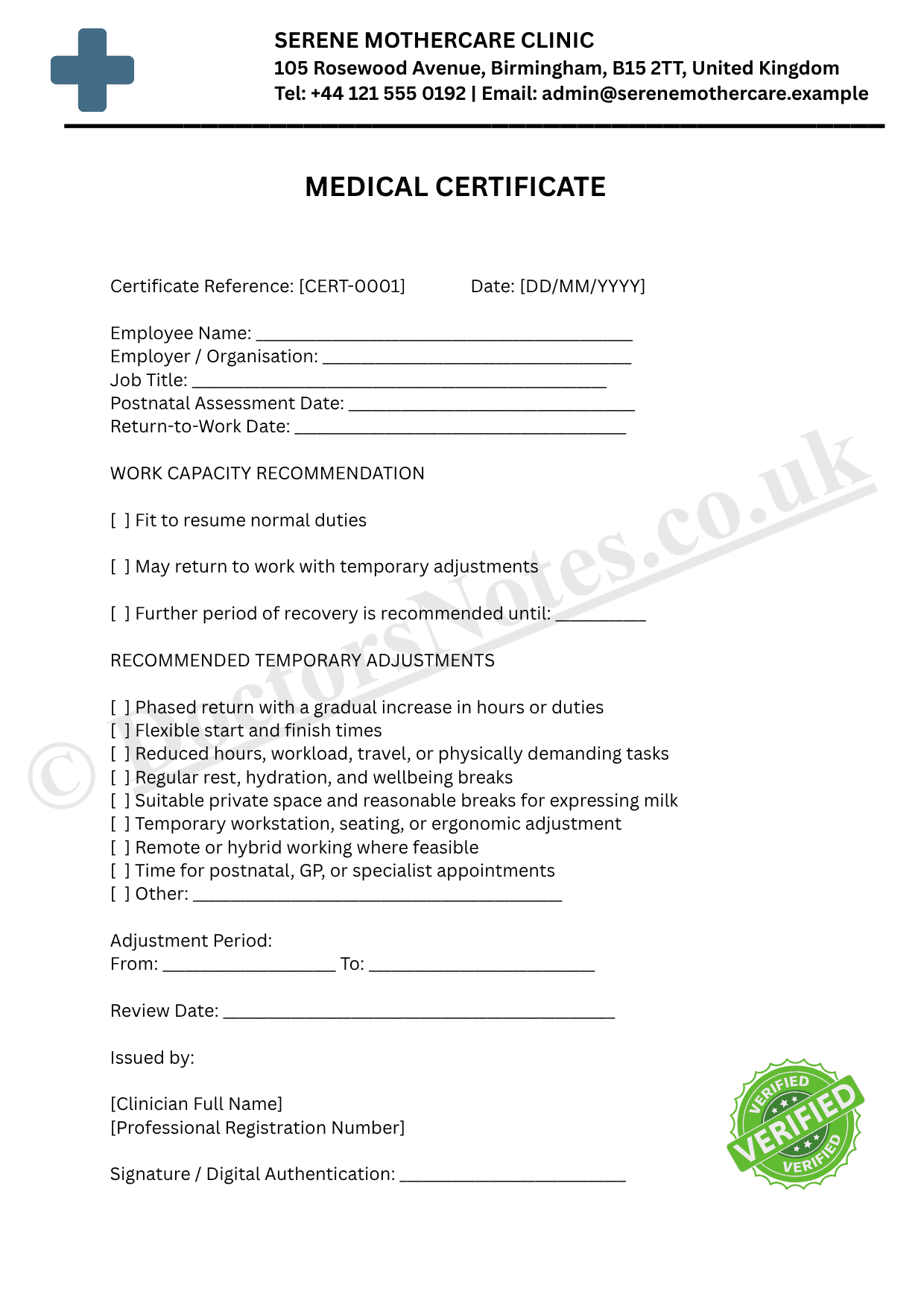
The documentation may include:
- Date of reassessment.
- Confirmation that you have been medically reviewed.
- Fitness for work status.
- Temporary work restrictions.
- Recommended workplace accommodations.
- Guidance regarding phased return to duties.
- Suggested review date if required.
The healthcare professional generally provides only the information necessary to support workplace decision-making while protecting your confidential medical information.
Full Return vs Modified Return to Work
Not everyone returns to work in the same way. Depending on your recovery, the healthcare professional may recommend either a full return or a temporary modified work arrangement.
| Full Return to Work | Modified Return to Work |
|---|---|
| Employee can perform normal duties | Temporary adjustments are recommended |
| No medical restrictions required | Reduced physical or mental workload may be appropriate |
| Regular working hours resume | Hours may be increased gradually |
| Suitable when recovery is complete | Suitable while recovery continues |
A modified return-to-work plan can often help employees rebuild confidence, improve recovery, and reduce the likelihood of setbacks.
What Happens During the Return-to-Work Assessment?
Unlike an assessment for sick leave, this consultation focuses on your recovery and your ability to safely perform your job.
The healthcare professional may discuss:
- How your health has improved since your previous treatment.
- Any remaining symptoms.
- Current medications.
- Your physical or mental limitations.
- Your normal job responsibilities.
- Whether your employer can provide modified duties.
- Any ongoing treatment or rehabilitation.
- Whether further follow-up is recommended.
Following the assessment, the healthcare professional will determine whether a Return-to-Work Doctor’s Note is clinically appropriate and whether any temporary work restrictions should be included.
Important: A Return-to-Work Doctor’s Note provides medical guidance regarding your fitness to resume employment. It does not require an employer to accept specific workplace adjustments or guarantee reinstatement under a particular role. Final employment decisions remain subject to workplace policies, occupational health requirements, and applicable employment laws.
How to Get a Return-to-Work Doctor’s Note
If you are preparing to return to your job after recovering from an illness, injury, surgery, or another medical condition, you can arrange an online consultation with a licensed healthcare professional. The purpose of the consultation is to evaluate your current health, determine whether you are medically fit to resume work, and identify any temporary work restrictions that may support a safe transition back to your workplace.
Step 1: Schedule an Online Medical Assessment
Book a return-to-work consultation through our website at a time that is convenient for you. Choose a private setting where you can discuss your recovery openly with the healthcare professional.
Step 2: Access Your Patient Account
New patients can create an account by completing a simple registration process, while existing patients can sign in using their previously registered details.
Step 3: Select a Return-to-Work Consultation
Choose the consultation specifically for fitness-to-work assessments or medical clearance after recovery.
If your employer has provided an occupational health form or specific documentation requirements, you can mention this during the booking process.
Step 4: Provide Details About Your Recovery
Before the consultation, you will be asked questions about your health and progress since your illness or treatment.
The healthcare professional may ask about:
- The medical condition or treatment you are recovering from.
- When your recovery began.
- Any surgery or hospital care you received.
- Current symptoms or ongoing discomfort.
- Your prescribed medications.
- Rehabilitation or physiotherapy, if applicable.
- Your normal job duties.
- Tasks you currently find difficult.
- Whether your employer can offer modified duties.
Providing complete and accurate information helps ensure that your return-to-work assessment reflects your current abilities.
Step 5: Upload Relevant Medical Information
If available, you may provide supporting documents such as:
- Hospital discharge summaries.
- Surgical reports.
- Physiotherapy or rehabilitation notes.
- Specialist consultation letters.
- Previous fitness-for-work certificates.
- Occupational health forms.
- Diagnostic test results.
These documents can help the healthcare professional better understand your recovery but may not always be required.
Step 6: Complete Your Medical Consultation
During your consultation, the healthcare professional will evaluate whether you are ready to return to work safely.
The discussion may include:
- Your recovery progress.
- Any remaining physical or mental limitations.
- Your ability to perform essential job duties.
- Whether workplace adjustments may support your return.
- Whether additional recovery time is advisable.
- Whether further follow-up care is recommended.
The assessment focuses on your current functional abilities rather than your original illness or injury.
Step 7: Receive Your Return-to-Work Doctor’s Note
If the healthcare professional determines that you are medically fit to return, your Return-to-Work Doctor’s Note will be prepared after the consultation.
Depending on your assessment, the document may confirm:
- Fitness to resume work.
- Temporary work restrictions.
- Recommended workplace adjustments.
- A phased return-to-work plan where appropriate.
- A future review date if continued monitoring is recommended.
Important: Booking a consultation does not automatically guarantee medical clearance. A return-to-work note is issued only when the healthcare professional concludes that it is clinically appropriate based on your current condition.
How to Prepare for Returning to Work
Returning after a medical absence is often easier when you plan ahead. Preparing in advance can help you resume your responsibilities more comfortably while supporting your continued recovery.
Before returning, consider:
- Discussing your planned return date with your employer.
- Understanding whether temporary workplace adjustments are available.
- Following your prescribed treatment or rehabilitation programme.
- Gradually rebuilding your physical stamina if advised.
- Taking medications exactly as prescribed.
- Attending all scheduled follow-up appointments.
- Reporting any recurring symptoms to your healthcare professional.
If your role involves physically demanding or safety-sensitive tasks, additional precautions may be recommended before you resume full duties.
Can Temporary Work Restrictions Be Recommended?
Yes. If you are medically fit to return but still recovering, the healthcare professional may recommend temporary work restrictions to help protect your health during the transition.
Examples may include:
- Limiting heavy lifting.
- Avoiding prolonged standing.
- Restricting repetitive movements.
- Working reduced hours for a temporary period.
- Taking additional rest breaks.
- Avoiding night shifts where appropriate.
- Temporarily avoiding safety-critical tasks.
These recommendations are based on your individual recovery and the demands of your occupation.
How Long Does a Return-to-Work Doctor’s Note Apply?
A Return-to-Work Doctor’s Note is based on your health at the time of the assessment. If temporary restrictions are included, they are usually intended for a specific period until your recovery progresses further.
Examples of Return-to-Work Recommendations
| Recovery Stage | Possible Recommendation* |
|---|---|
| Full recovery | Resume normal duties |
| Recovering with mild limitations | Modified duties |
| Ongoing rehabilitation | Gradual increase in workload |
| Physically demanding occupation | Temporary lifting or activity restrictions |
| Continued medical monitoring | Follow-up assessment before full clearance |
*These examples are for general guidance only. Recommendations are determined individually following clinical assessment.
When Should You Arrange Another Return-to-Work Assessment?
A further medical review may be appropriate if:
- Your symptoms return after resuming work.
- You experience increased pain or fatigue.
- Your job responsibilities change significantly.
- Your employer requests updated medical clearance.
- Temporary work restrictions need to be reviewed.
- Your rehabilitation programme changes.
- Your healthcare professional recommends ongoing monitoring.
Follow-up assessments help ensure that your work responsibilities continue to match your recovery and current functional abilities while supporting a safe and sustainable return to employment.
What Documents May Be Issued?
Following your return-to-work assessment, the healthcare professional will determine which type of medical documentation is appropriate based on your recovery, current functional abilities, and the physical or mental demands of your occupation.
Depending on your individual circumstances, you may receive:
- Return-to-Work Doctor’s Note confirming that you have been medically assessed for fitness to resume employment.
- A fitness-for-work certificate indicating that you are able to return to your normal duties where clinically appropriate.
- Documentation recommending a phased return-to-work programme.
- Medical recommendations for temporary workplace modifications or activity restrictions.
- A review certificate requesting reassessment before returning to unrestricted duties.
- Referral recommendations for occupational health, physiotherapy, rehabilitation, or specialist care if additional recovery is required.
- Updated medical documentation following a follow-up assessment if your recovery status changes.
All documentation reflects the healthcare professional’s clinical judgement and is prepared according to your individual recovery rather than a standard template.
Important Legal Information About a Return-to-Work Doctor’s Note
A Return-to-Work Doctor’s Note is an official medical document completed by a licensed healthcare professional after assessing whether you are medically fit to resume employment. Its purpose is to provide professional guidance regarding your current work capacity and any temporary medical recommendations that may support a safe return.
Before requesting this documentation, it is important to understand:
- A return-to-work note is issued only after an appropriate medical assessment.
- Scheduling a consultation does not guarantee medical clearance or the issue of a return-to-work document.
- Healthcare professionals must provide recommendations that are accurate, impartial, and supported by their clinical findings.
- The note may confirm fitness for full duties, recommend temporary work restrictions, or advise a gradual return depending on your recovery.
- Employers are responsible for deciding whether recommended workplace adjustments can be implemented in accordance with operational requirements, employment contracts, and applicable employment legislation.
- Some employers may require additional occupational health assessments before an employee resumes certain safety-sensitive roles.
- The document generally contains only information necessary to explain your current work capacity and does not normally disclose detailed medical diagnoses unless required or authorised by you.
- Your consultation and medical records remain confidential and are managed in accordance with applicable healthcare privacy and data protection laws.
- If your health changes after returning to work, another clinical assessment may be necessary before revised documentation can be issued.
Important: A Return-to-Work Doctor’s Note provides medical guidance regarding your present ability to work. It does not guarantee reinstatement, remove an employer’s health and safety obligations, or replace workplace occupational health policies where these apply.
What Should a Return-to-Work Doctor’s Note Include?
A return-to-work doctor’s note should confirm that an employee has been medically assessed and explain whether they can resume their job duties. Depending on the situation, it may include:
-
Employee details: Name and relevant identification information.
-
Return date: The date the employee can resume work.
-
Work restrictions: Any temporary limits on lifting, standing, or other activities.
-
Recommended adjustments: Reduced hours, light duties, or additional breaks, if needed.
-
Duration of restrictions: How long adjustments should continue and whether a follow-up is required.
-
Healthcare provider details: Provider’s name, credentials, signature, and contact information.
The exact requirements vary by employer, location, and medical circumstances. Employees should check their workplace policy and follow their healthcare provider’s advice before returning to work.
FAQ
Can I get a Return-to-Work Doctor’s Note online?
Yes. You can arrange an online consultation with a licensed healthcare professional. If the assessment confirms that medical clearance is appropriate, a return-to-work note may be issued based on your current condition.
Does a return-to-work note mean I am fully recovered?
Not always. Some employees are medically fit to return with temporary restrictions or modified duties while they continue recovering. The recommendations depend on your individual assessment.
Can my doctor recommend lighter duties?
Yes. If full duties are not yet appropriate, the healthcare professional may recommend temporary limitations such as reduced lifting, shorter working hours, or avoidance of specific tasks.
What if my employer cannot accommodate the recommended restrictions?
Employers will consider the recommendations alongside workplace policies, operational requirements, and applicable employment laws. In some situations, additional discussions or occupational health assessments may be necessary.
Will my medical diagnosis appear on the return-to-work note?
In most cases, only the information necessary to explain your work capacity is included. Detailed medical information is generally not disclosed unless clinically necessary or authorised by you.
Can I request another assessment if my condition improves?
Yes. If your recovery progresses and temporary restrictions are no longer required, you can arrange a follow-up consultation for reassessment and updated medical documentation.
Is the consultation confidential?
Yes. Your consultation, medical records, and any documentation issued are handled confidentially in accordance with healthcare privacy and data protection laws.
When should I delay returning to work?
If you continue to experience significant pain, severe fatigue, reduced mobility, uncontrolled symptoms, or your healthcare professional advises that additional recovery is necessary, you should follow the recommended treatment plan before resuming work.
Can this document be used for occupational health reviews?
Many employers and occupational health providers accept return-to-work documentation as part of their review process. Acceptance depends on the individual organisation’s policies and requirements.
Does this note replace workplace safety assessments?
No. A Return-to-Work Doctor’s Note provides medical guidance about your fitness for work. Employers may still carry out their own workplace risk assessments or occupational health evaluations where required.
Why Choose Our Online Return-to-Work Assessment Service?
- Online consultations with licensed healthcare professionals.
- Individual assessments focused on your current work capacity rather than your previous illness.
- Practical recommendations to support a safe and sustainable return to employment.
- Medical documentation issued only when clinically appropriate.
- Guidance on phased returns, workplace restrictions, and functional recovery.
- Secure, confidential, and patient-centred consultations.
- Follow-up assessments available if your recovery or work capacity changes.
Conclusion
Returning to work after illness, injury, surgery, or ongoing treatment is an important milestone, but it should take place at a pace that supports your health and long-term recovery. A professional medical assessment helps determine whether you are ready to resume your duties safely and whether temporary workplace adjustments may reduce the risk of further injury or setbacks.
A Return-to-Work Doctor’s Note provides evidence-based medical guidance following an individual assessment and can assist employers in planning a safe return to work while considering your current functional abilities.
By arranging an online consultation, you can discuss your recovery with a licensed healthcare professional, receive personalised advice, and obtain appropriate documentation based on your present fitness for work and ongoing recovery needs.



Reviews
There are no reviews yet.