

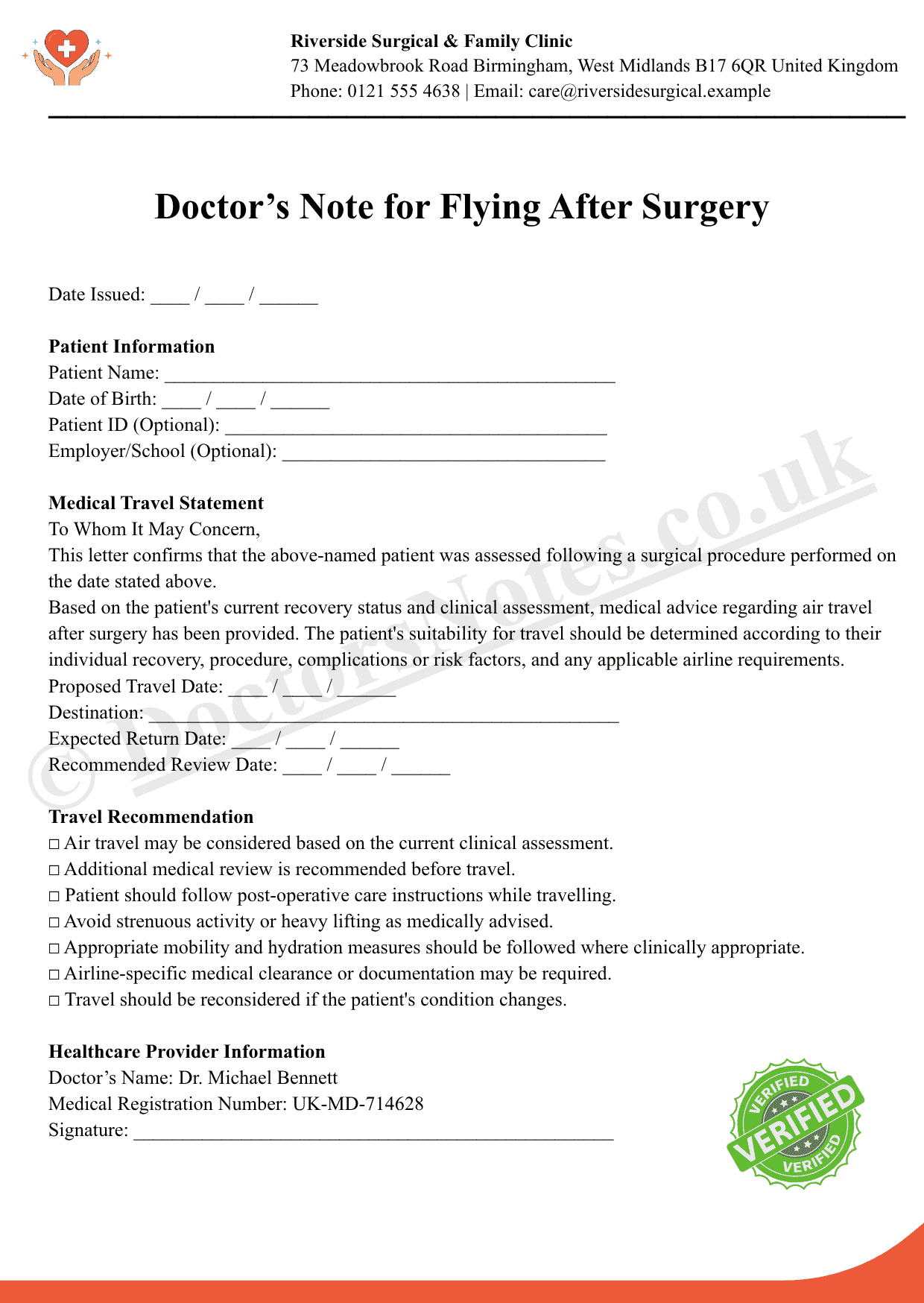
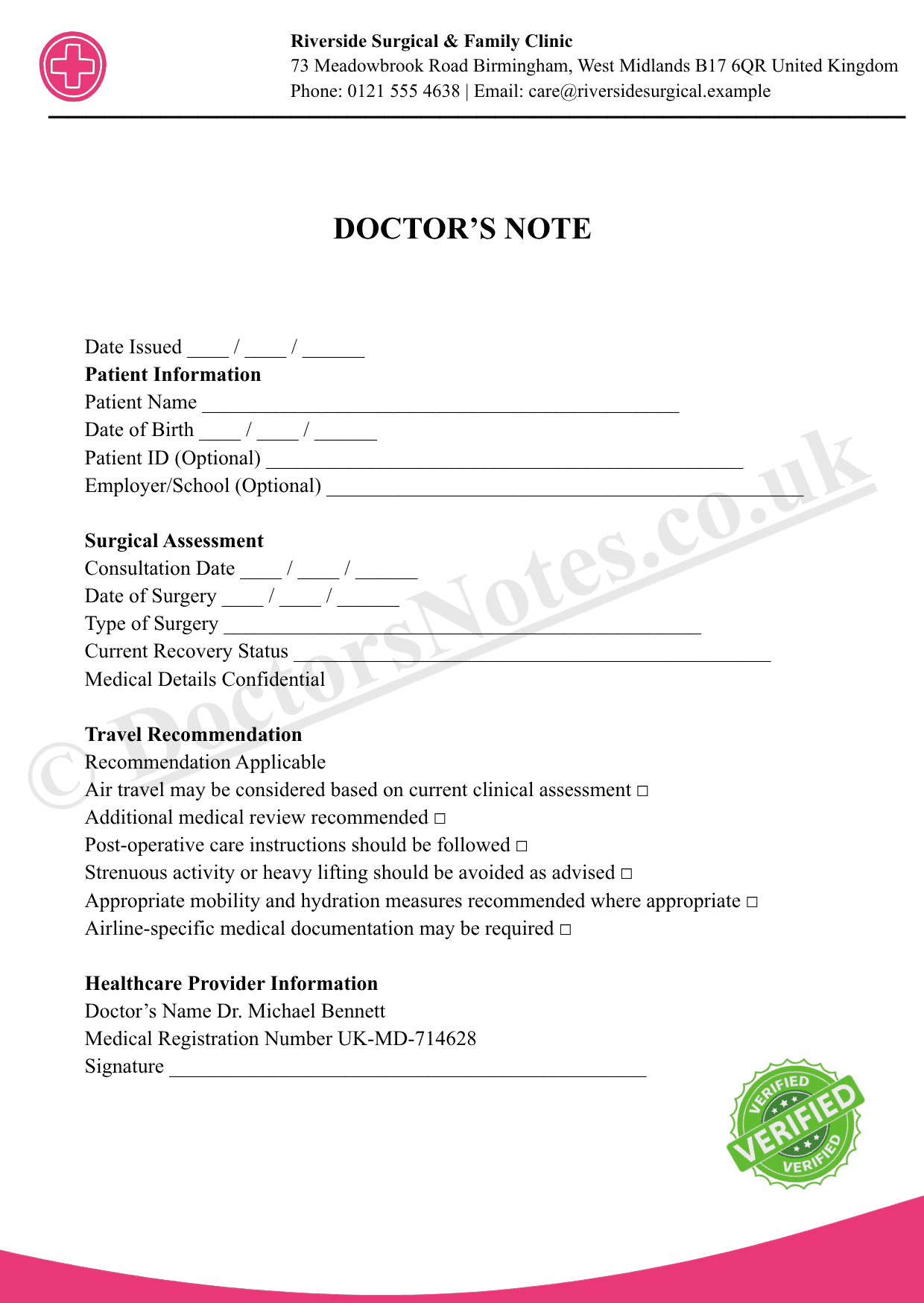
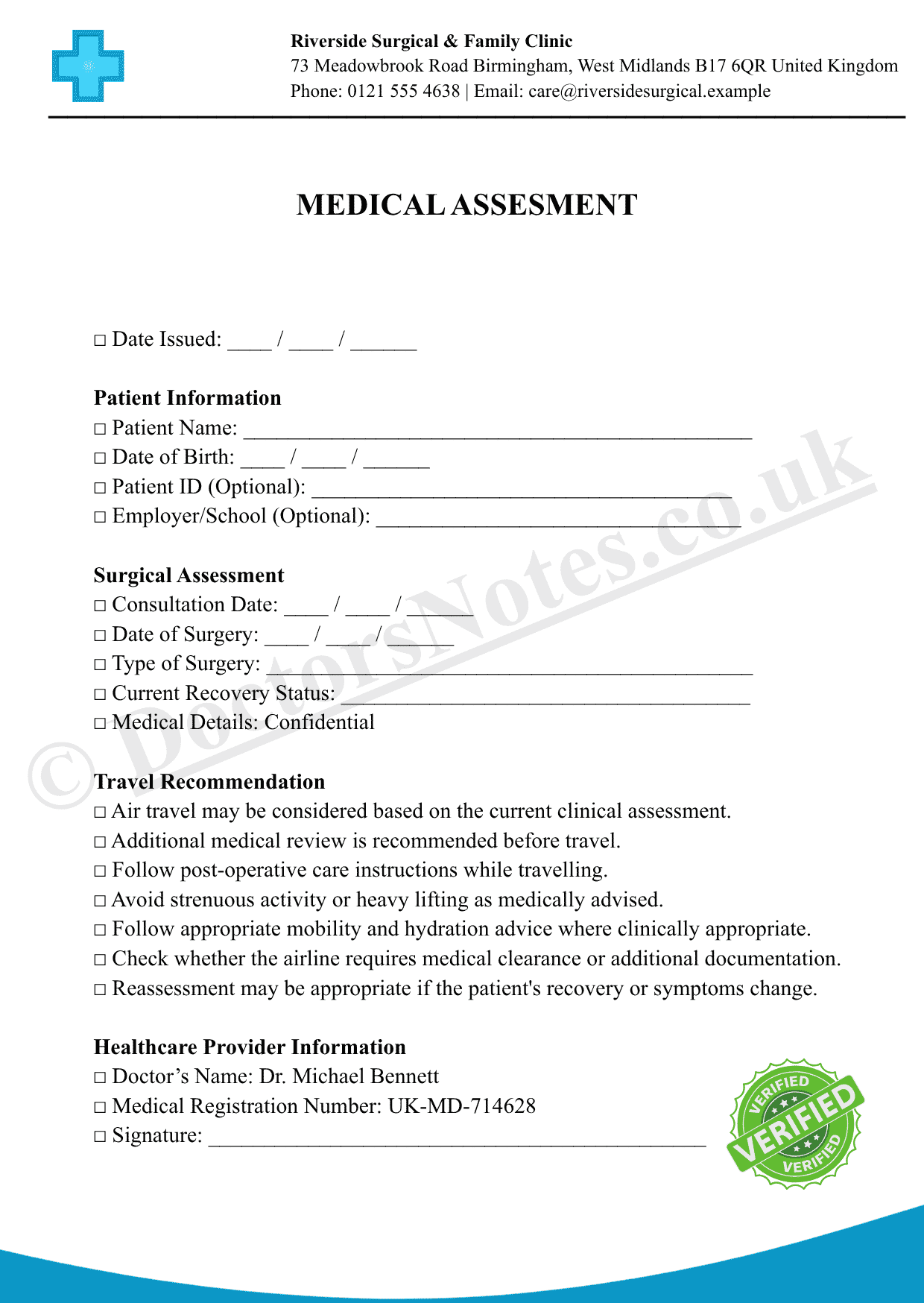


Flying after an operation can require extra planning. Your recovery, type of surgery, symptoms, and flight length can all affect whether travel is suitable.
A doctor’s note for flying after surgery may help document your recovery and provide medical information requested by an airline. Some airlines may also ask for a medical clearance form before allowing a passenger to fly after recent surgery.
There is no single waiting period for every operation. The right time to fly depends on your procedure and recovery. Your airline may also have its own rules.
Flying After Surgery
| Question | Answer |
|---|---|
| Can you fly after surgery? | Sometimes. The timing depends on the operation and your recovery. |
| Do airlines require a doctor’s letter? | Some may request medical clearance after recent surgery. |
| Is there one waiting period for all surgeries? | No. Different procedures have different considerations. |
| Can you get a doctor’s note online? | An online assessment may be suitable in some situations. |
| Can surgery affect your fitness to fly? | Yes. Pain, reduced mobility, wounds, and other factors may matter. |
| Does flight length matter? | Yes. Longer journeys involve more time sitting and may increase some travel-related risks. |
| Can you fly after minor surgery? | It may be possible, but your individual recovery still matters. |
| Does an airline’s policy still apply if your doctor approves travel? | Yes. The airline makes its own decision under its travel rules. |
What Is a Doctor’s Note for Flying After Surgery?
A post-surgery travel letter is medical documentation about your ability to travel after an operation.
Depending on the airline, it may confirm information such as:
- The type of procedure
- Date of surgery
- Current recovery status
- Relevant medical restrictions
- Whether further treatment is planned
- Whether there are concerns about air travel
The exact information required varies between airlines.
Some carriers may use a specific medical clearance form instead of accepting a general doctor’s letter.
Check your airline’s requirements before arranging your assessment.
Why Might You Need Medical Clearance After Surgery?
Recent surgery can affect several parts of a journey.
You may still have:
- Pain
- Swelling
- Reduced mobility
- A healing wound
- Surgical dressings
- Fatigue
- Medication requirements
- Restrictions on lifting
- Difficulty sitting for long periods
The airport itself can also involve walking, standing, security checks, boarding, and carrying luggage.
A healthcare professional can consider these factors when assessing your situation.
How Soon Can You Fly After Surgery?
There is no universal answer.
The appropriate timing depends on:
- Type of surgery
- Location of the operation
- Whether complications occurred
- Current symptoms
- Wound healing
- Mobility
- Anaesthesia and recovery
- Need for follow-up care
- Flight duration
- Destination
Some operations require a longer recovery period than others.
Your surgeon or treating healthcare professional is best placed to advise you about your individual recovery.
Surgery Type Can Change the Travel Advice
Different procedures create different travel considerations.
| Surgery type | Possible travel considerations |
|---|---|
| Abdominal surgery | Pain, movement, wound healing, and prolonged sitting |
| Orthopaedic surgery | Mobility, swelling, walking, and blood-clot risk |
| Chest surgery | Breathing and pain during travel |
| Eye surgery | Follow-up needs and procedure-specific restrictions |
| Dental surgery | Swelling, pain, bleeding, and medication |
| Laparoscopic surgery | Recovery and, depending on the procedure, residual gas-related discomfort |
| Caesarean section | Postpartum recovery, wound healing, and mobility |
| Cosmetic surgery | Incisions, swelling, compression garments, and movement restrictions |
This table is only a general guide. Your surgeon’s advice should take priority for your specific procedure.
Can You Fly After Minor Surgery?
Some people can travel relatively soon after a minor procedure.
However, “minor surgery” does not automatically mean that flying is safe immediately.
Consider:
- How you feel
- Whether the wound is healing normally
- Whether you can walk comfortably
- Whether you need strong pain medication
- Whether you have follow-up appointments
- Whether your surgeon has given travel restrictions
- What the airline requires
If you are unsure, ask your treating healthcare professional before travelling.
Can You Fly After Major Surgery?
Major surgery often requires more recovery time.
You may have restrictions involving:
- Walking
- Lifting
- Bending
- Sitting
- Driving
- Exercise
- Medication
- Wound care
Long-distance travel can add further demands.
Your healthcare professional can assess whether your recovery is compatible with the planned journey.
What Does an Airline Medical Clearance Letter Do?
A medical clearance letter can provide information about your health for the airline.
It does not automatically give permission to fly.
The airline may still:
- Review the documentation
- Ask for additional information
- Require its own medical form
- Apply its own travel restrictions
- Request clearance through its medical department
Therefore, check the carrier’s policy before travelling.
What Information May Be Included in a Post-Surgery Travel Letter?
The required information depends on the airline.
A healthcare professional may be asked to provide:
Passenger details
Your name and relevant identification information.
Procedure details
The type and date of your surgery.
Recovery information
Your current condition and relevant restrictions.
Travel information
Your flight dates or planned journey.
Medical considerations
Any issue that could affect air travel.
Follow-up requirements
Whether you need ongoing treatment or review.
Only information supported by the medical assessment should be included.
What If the Airline Gives You a Medical Form?
Follow the airline’s instructions carefully.
Step 1: Find the airline’s policy
Check the carrier’s current rules for passengers who recently had surgery.
Step 2: Check the required document
Find out whether they accept a doctor’s letter or require a specific form.
Step 3: Check the deadline
Some airlines may require medical clearance before the flight.
Step 4: Arrange an assessment
Discuss your surgery and planned journey with a healthcare professional.
Step 5: Complete the required documentation
Provide the airline’s form if one is required.
Step 6: Submit it correctly
Follow the airline’s instructions for sending or presenting the documentation.
Do not wait until airport check-in if advance clearance is required.
What Should You Tell the Healthcare Professional?
Give details about both your surgery and your journey.
You should be ready to explain:
- What surgery you had
- When the operation took place
- Why the surgery was performed
- How recovery has progressed
- Any current symptoms
- Whether your wound is healing
- Your mobility
- Current medication
- Any complications
- Flight date
- Flight duration
- Destination
- Airline requirements
This information helps the healthcare professional understand the full situation.
Post-Surgery Flying Assessment Checklist
Before your assessment, prepare:
- Surgery date
- Type of surgery
- Hospital or clinic details
- Discharge information if available
- Current symptoms
- Medication list
- Wound or dressing information
- Current mobility
- Planned departure date
- Return date
- Flight duration
- Airline name
- Airline medical form
- Airline clearance requirements
Does Flight Length Matter After Surgery?
It can.
A long flight means more time sitting in one position. This may be particularly relevant after operations that affect mobility or increase your risk of blood clots.
Your individual risk depends on factors such as:
- Type of surgery
- How recently you had surgery
- Your mobility
- Previous blood-clot history
- Other medical conditions
- Flight duration
Ask your healthcare professional about your personal risk before a long journey.
Can Surgery Increase the Risk of Blood Clots During Travel?
Some surgical procedures can increase the risk of venous thromboembolism (VTE), including deep vein thrombosis and pulmonary embolism.
Long periods of immobility during travel can also contribute to clot risk.
This is especially important after certain operations and when mobility is reduced.
Do not assume that walking around during a flight is enough to make travel safe. Ask your healthcare professional about your individual risk and any prevention measures you may need.
What If You Still Have Pain After Surgery?
Some pain can occur during normal recovery.
However, significant or worsening pain should not be ignored simply because you have travel plans.
Tell your healthcare professional:
- Where the pain occurs
- How severe it is
- Whether it is improving
- Whether movement makes it worse
- What medication you are taking
- Whether the pain affects walking or sitting
Your assessment should focus on your current recovery rather than only the date of surgery.
Can You Fly With a Surgical Wound?
A healing wound does not automatically mean that air travel is unsuitable.
However, the condition of the wound matters.
Tell your healthcare professional if you have:
- Increasing redness
- Significant swelling
- New bleeding
- Pus or unusual discharge
- Worsening pain
- Fever
- Wound separation
These symptoms may require medical review rather than a travel letter.
Can You Fly With Stitches or Staples?
The presence of stitches or staples does not by itself determine whether you can fly.
The underlying surgery and your recovery are more important.
Your healthcare professional can assess the wound and consider whether travelling is appropriate.
If your airline has a specific requirement about recent surgery or wound care, provide that information during the assessment.
Can You Fly After General Anaesthesia?
The timing after general anaesthesia can depend on the procedure, your recovery, and the airline’s rules.
You may need to consider:
- Drowsiness
- Medication effects
- Pain
- Mobility
- Ability to manage the journey
- Need for post-operative monitoring
Do not rely on a general waiting period. Ask the healthcare professional who is responsible for your post-operative care.
Can You Get a Doctor’s Note for Flying After Surgery Online?
An online medical assessment may be suitable in some cases.
The healthcare professional may review:
- Your procedure
- Recovery progress
- Current symptoms
- Medication
- Mobility
- Planned flight
- Airline documentation requirements
However, an online consultation cannot replace a physical examination when one is medically necessary.
If the assessment raises concerns about your wound, breathing, mobility, or another post-operative problem, you may need in-person care.
What If You Need the Letter Quickly?
Start by checking the airline’s requirements.
Find out:
- What document is required.
- Whether a specific form must be used.
- Whether the airline has a submission deadline.
- Whether the document must be issued within a certain period.
- Whether the airline requires direct medical clearance.
Then arrange the appropriate medical assessment.
Avoid relying on a generic travel letter if the airline has requested a specific form.
Can a Doctor’s Note Guarantee That You Can Fly?
No.
A healthcare professional’s assessment and an airline’s decision are separate matters.
A medical letter can provide relevant clinical information, but it does not override the airline’s policies.
The airline may require additional clearance or documentation.
What If Your Surgery Was Recent?
Recent surgery deserves extra attention before air travel.
Consider:
- Your recovery stage
- Whether you have had your post-operative review
- Whether your wound is healing
- Whether you can walk comfortably
- Whether you still need significant pain relief
- Whether you have developed new symptoms
- Whether your surgeon has given travel advice
If you have not yet discussed travel with your surgical team, consider doing so before arranging your trip.
Can a Post-Surgery Travel Letter Be Backdated?
Do not assume that travel clearance can be issued retrospectively.
A healthcare professional can only provide information supported by their assessment.
If you need documentation relating to an earlier journey, explain the circumstances clearly and ask what documentation can appropriately be provided.
Doctor’s Note for Flying vs Fit Note
These documents have different purposes.
| Document | Purpose |
|---|---|
| Post-surgery travel letter | Provides medical information relevant to air travel |
| Airline medical clearance | Meets an airline’s specific medical requirements |
| Fit note | Provides advice about fitness for work |
| Sick note | Common term for a fit note in the UK |
A UK fit note is based on an assessment of how a health condition affects your ability to work. It can also recommend adjustments such as altered hours, amended duties, or a phased return. (gov.uk)
A travel letter is not a substitute for a workplace fit note.
Can Surgery Affect Your Ability to Work Too?
Yes.
Recovery can affect:
- Standing
- Walking
- Lifting
- Driving
- Concentration
- Stamina
- Manual tasks
- Working hours
If your recovery affects your fitness for work, a healthcare professional can assess whether a fit note is appropriate.
UK guidance allows fit notes to include advice about phased returns, altered hours, amended duties, and workplace adaptations where appropriate. (gov.uk)
Who Can Issue a UK Fit Note After Surgery?
In the UK, fit notes can be certified by:
- Doctors
- Registered nurses
- Occupational therapists
- Pharmacists
- Physiotherapists
The professional must carry out an appropriate health and work assessment. (gov.uk)
For post-operative care, GOV.UK guidance also notes that fit notes may be issued when someone is receiving post-operative care, such as at a fracture clinic or outpatient department. (gov.uk)
When Should You Get Medical Help Instead of Travel Documentation?
Do not focus on obtaining a travel letter if you have signs of a post-operative complication.
Seek appropriate medical care if you develop:
- Severe or worsening pain
- Heavy bleeding
- Wound separation
- Increasing redness or swelling
- Fever
- Pus or unusual wound discharge
- New or worsening breathing problems
- Chest pain
- Fainting
- Severe weakness
- Sudden leg swelling or pain
Some of these symptoms can require urgent assessment.
If you have severe breathing difficulty, chest pain, or other emergency symptoms, seek emergency medical care.
Is a Doctor’s Note for Flying After Surgery Guaranteed?
No.
Medical documentation depends on an individual healthcare assessment.
The healthcare professional may decide that you need an examination, further information, or follow-up with your surgical team before they can advise on travel.
The airline may also have separate requirements.
FAQs
Can you get a doctor’s note for flying after surgery?
A healthcare professional may provide medical documentation after assessing your recovery and planned travel.
How soon can I fly after surgery?
There is no universal waiting period. It depends on the type of surgery, your recovery, and the airline’s requirements.
Do airlines require a medical letter after surgery?
Some airlines may request medical clearance after recent surgery. Check your carrier’s current policy.
Can I fly after minor surgery?
It may be possible, but your recovery and the type of procedure still need to be considered.
Can I fly after major surgery?
Major surgery may require a longer recovery period. Discuss your travel plans with your treating healthcare professional.
Can I get a fit-to-fly letter online after surgery?
An online assessment may be suitable in some cases. A physical examination may be needed if your condition requires one.
What should a post-surgery flight letter include?
The airline may request information about your surgery, recovery, medical restrictions, and ability to travel. Requirements vary between carriers.
Is a doctor’s note the same as airline medical clearance?
Not necessarily. An airline may require its own medical clearance process or form.
Can I fly with stitches after surgery?
Stitches alone do not determine whether flying is suitable. Your surgery, wound condition, recovery, and airline rules all matter.
Can I fly after abdominal surgery?
Travel may be possible after recovery, but abdominal surgery can affect mobility, pain, wound healing, and comfort during prolonged sitting.
Can I fly after orthopaedic surgery?
Orthopaedic surgery can affect mobility and may require additional consideration because of reduced movement and blood-clot risk.
Can I fly after laparoscopic surgery?
The timing depends on the procedure and recovery. Ask your treating healthcare professional before travelling.
Does a long flight matter after surgery?
Yes. Long periods of sitting can be relevant to mobility and blood-clot risk, particularly after some operations.
Can surgery increase the risk of blood clots when flying?
Some surgeries increase clot risk, and prolonged immobility can add to that risk. Discuss your individual risk with your healthcare professional.
Can a doctor guarantee that I can fly?
No. A healthcare professional provides medical advice based on an assessment. The airline still applies its own rules.
Can a post-surgery travel letter be backdated?
Do not assume this is possible. The healthcare professional decides what information can be supported by the assessment.
Is a fit note needed after surgery?
If your recovery affects your fitness for work and you need formal evidence, a fit note may be appropriate. For the first 7 calendar days of sickness, employees can normally self-certify. (gov.uk)
Planning to Fly After Surgery?
Your recovery and your airline’s requirements both matter.
Before travelling, check the carrier’s medical policy and discuss your planned journey with a healthcare professional. If medical documentation is required, have the airline’s form or requirements available during your assessment.
Arrange an online medical assessment to discuss your post-surgery recovery and travel documentation needs.




Reviews
There are no reviews yet.